
Health/Environment
Keep Our Air Clean – Adhere to Open Burn Ban


As precaution, Fire Department follows guidelines from regional air quality district
Smoke from open fires doesn’t just smell badly and makes eyes water. It contains harmful gases and toxic byproducts that can lead to respiratory problems, asthma, and heart problems. At this time of year, the Marin County Fire Department reminds residents that it has placed a ban starting May 1 on open burning for the purposes of range management, crop replacement, forest management and orchard pruning.
Although the California State Department of Forestry and Fire Protection (CALFIRE) allows permitted burns in many areas of the state, Marin County Fire follows the Bay Area Air Quality Management District’s recommendation and puts the ban in place each spring as a precaution.
“There are areas just outside the district boundaries where such burns are allowed, but we place our own ban because we want to try and have a consistent message,” said Marin County Fire Deputy Chief Mark Brown.
Marin’s restriction is in force from May through September according to guidelines set forth by the Bay Area Air Quality Management District. The district allows some permitted burns year-round within its nine Bay Area counties such as for fire agency trainings, removal of fire hazard materials and flood debris. However, Marin County Fire’s ban supercedes the district’s policy.
Small recreational fires are still allowed in Marin. Outdoor wood stoves and fire pits that are 3 feet in diameter or less are legal to use for cooking or warming as long as it’s not a Spare the Air Day as set by the district.
As it prepares for another wildfire season, Marin County Fire also reminds residents to create 100 feet of defensible space around homes as required by the California Public Resources Code. Study after study has shown that the solution to disastrous home loss during wildfires is to prevent buildings from igniting while the wildfire burns the surrounding vegetation. Firefighters who battle urban wildfires are often forced to choose which homes can be safely and effectively defended from fire. By reducing fire fuels on the property, the homeowner increases the likelihood that a fire engine could be safely parked in a driveway and that firefighters have a chance to save the home.
Disaster preparedness was among the top concerns in a recent resident survey conducted by the County of Marin. Accordingly, the Marin County Board of Supervisors has listed emergency preparedness among its top priorities and is preparing to declare the week of May 5-11 as Wildfire Awareness Week.
Marin County Fire works year-around in conjunction with the nonprofit FireSafe Marin to promote fire safety. A countywide wildfire forum is scheduled for May 4 in San Rafael, and there is much more information on the FireSafe Marin website.


Activism
Families Across the U.S. Are Facing an ‘Affordability Crisis,’ Says United Way Bay Area
United Way’s Real Cost Measure data reveals that 27% of Bay Area households – more than 1 in 4 families – cannot afford essentials such as food, housing, childcare, transportation, and healthcare. A family of four needs $136,872 annually to cover these basic necessities, while two adults working full time at minimum wage earn only $69,326.

By Post Staff
A national poll released this week by Marist shows that 61% of Americans say the economy is not working well for them, while 70% report that their local area is not affordable. This marks the highest share of respondents expressing concern since the question was first asked in 2011.
According to United Way Bay Area (UWBA), the data underscores a growing reality in the region: more than 600,000 Bay Area households are working hard yet still cannot afford their basic needs.
Nationally, the Marist Poll found that rising prices are the top economic concern for 45% of Americans, followed by housing costs at 18%. In the Bay Area, however, that equation is reversed. Housing costs are the dominant driver of the affordability crisis.
United Way’s Real Cost Measure data reveals that 27% of Bay Area households – more than 1 in 4 families – cannot afford essentials such as food, housing, childcare, transportation, and healthcare. A family of four needs $136,872 annually to cover these basic necessities, while two adults working full time at minimum wage earn only $69,326.
“The national numbers confirm what we’re seeing every day through our 211 helpline and in communities across the region,” said Keisha Browder, CEO of United Way Bay Area. “People are working hard, but their paychecks simply aren’t keeping pace with the cost of living. This isn’t about individual failure; it’s about policy choices that leave too many of our neighbors one missed paycheck away from crisis.”

The Bay Area’s affordability crisis is particularly defined by extreme housing costs:
- Housing remains the No. 1 reason residents call UWBA’s 211 helpline, accounting for 49% of calls this year.
- Nearly 4 in 10 Bay Area households (35%) spend at least 30% of their income on housing, a level widely considered financially dangerous.
- Forty percent of households with children under age 6 fall below the Real Cost Measure.
- The impact is disproportionate: 49% of Latino households and 41% of Black households struggle to meet basic needs, compared to 15% of white households.
At the national level, the issue of affordability has also become a political flashpoint. In late 2025, President Donald Trump has increasingly referred to “affordability” as a “Democrat hoax” or “con job.” While he previously described himself as the “affordability president,” his recent messaging frames the term as a political tactic used by Democrats to assign blame for high prices.
The president has defended his administration by pointing to predecessors and asserting that prices are declining. However, many Americans remain unconvinced. The Marist Poll shows that 57% of respondents disapprove of Trump’s handling of the economy, while just 36% approve – his lowest approval rating on the issue across both terms in office.
Activism
A West Coast CDC? California Partners With Oregon, Washington and Hawaii to Form Regional Health Alliance
“President Trump’s mass firing of CDC doctors and scientists — and his blatant politicization of the agency — is a direct assault on the health and safety of the American people. California, Oregon, and Washington will not allow the people of our states to be put at risk,” said Governors Gavin Newsom, Tina Kotek, and Bob Ferguson in a joint statement.

By Bo Tefu, California Black Media
California, Oregon, and Washington have launched the West Coast Health Alliance, a regional initiative to provide unified, science-based guidance on immunizations and other public health policies. The alliance was created in response to federal actions that have undermined the independence of the Centers for Disease Control (CDC) and raised concerns about the politicization of science.
The alliance aims to ensure residents receive credible, evidence-based recommendations, free from political interference.
“President Trump’s mass firing of CDC doctors and scientists — and his blatant politicization of the agency — is a direct assault on the health and safety of the American people. California, Oregon, and Washington will not allow the people of our states to be put at risk,” said Governors Gavin Newsom, Tina Kotek, and Bob Ferguson in a joint statement.
State health leaders emphasized the importance of transparency and evidence-based communication.
California Department of Public Health Director Erica Pan said, “The dismantling of public health and dismissal of experienced and respected health leaders and advisors, along with the lack of using science, data, and evidence to improve our nation’s health are placing lives at risk.”
Oregon Health Authority Director Sejal Hathi backed the coalition saying, “Our communities deserve clear and transparent communication about vaccines — communication grounded in science, not ideology.” Washington State Secretary of Health Dennis Worsham noted, “Public health at its core is about prevention — preventing illness, preventing the spread of disease, and preventing early, avoidable deaths.”
Hawaii has joined the alliance, expanding the partnership to four states. “Hawaii is proud to stand with our West Coast partners to ensure public health decisions are grounded in science, not politics,” said Gov. Josh Green.
The alliance states will coordinate health guidelines using trusted national medical organizations, aligning immunization recommendations and public health strategies while respecting tribal sovereignty. Shared principles to strengthen public confidence in vaccines and other health measures will be finalized in the coming weeks.
Activism
On Lok Celebrates PACE Program and Innovative Elder Care
On Lok serves adults age 55 and older who are nursing-home eligible but wish to remain in their communities. What sets PACE apart is its integration of primary and long-term care, two systems often separated in traditional healthcare systems. Instead of focusing solely on medications or chronic disease management, PACE takes a whole-person approach, addressing medical, social, and emotional needs.
By Carla Thomas
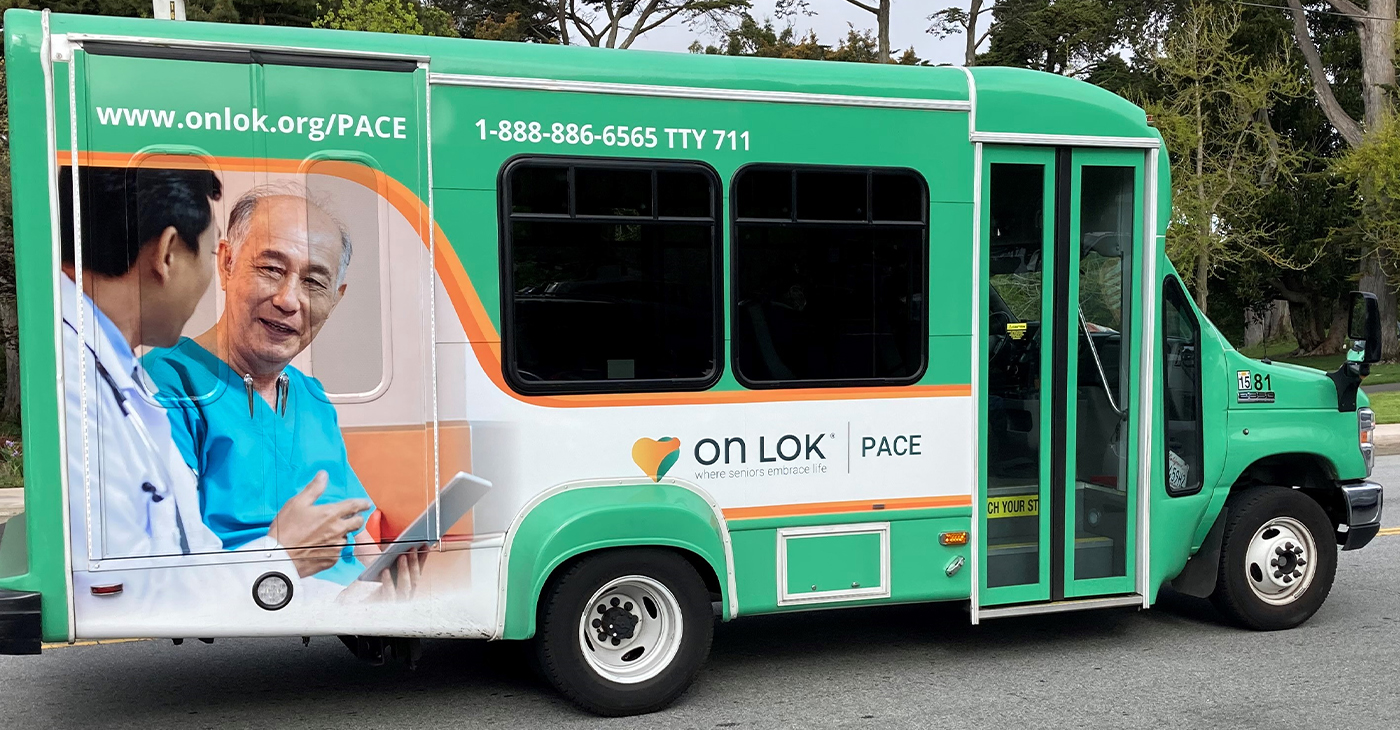
Cruising along Bay Area highways or parked on neighborhood streets, the brightly decorated vans of On Lok are mobile works of art.
Boasting a larger than life photograph bubble wrapped over the entire vehicle, the illustration depicts the warmth and glow of a dedicated care giver and smiling gray-haired elder, symbolizing the nonprofit’s signature service, PACE (Program of All-Inclusive Care for the Elderly).
This September, On Lok celebrates PACE not only as a transportation program for seniors but as a real pathway to independence.
“Through PACE we provide a healthcare delivery system, offering both primary and long-term care so that seniors can live the way they want to live,” said On Lok Chief Medical Officer Dr. Ben Lui.
Unlike fragmented healthcare models, On Lok’s interdisciplinary teams bring together physicians, nurses, therapists, and social workers to provide wraparound support. The nonprofit operates as a one-stop resource for aging adults, relieving families of the overwhelming responsibility of navigating complex healthcare needs on their own.
“A senior’s health is more than their medical needs,” said Dr. Lui, who has served the leadership team for five years.
“Everyday support, social engagement, and community all play a role. It truly takes a village, and the continuity of care we provide helps promote long-term well-being.”
On Lok serves adults age 55 and older who are nursing-home eligible but wish to remain in their communities. What sets PACE apart is its integration of primary and long-term care, two systems often separated in traditional healthcare systems. Instead of focusing solely on medications or chronic disease management, PACE takes a whole-person approach, addressing medical, social, and emotional needs.
Funded mostly through Medicare and Medicaid, the program ensures that cost is not a barrier to care, with 95% of participants fully covered by the public insurance programs.
For more than 50 years, On Lok has been a lifeline for Bay Area seniors. By integrating healthcare, home support, transportation, meals, and social activities, the organization helps participants remain independent, active, and safe at home. More than 2,200 clients currently take part in a wide range of services at On Lok’s neighborhood centers, where they receive not just medical care but also meals, exercise classes, and meaningful activities from arts and crafts to live music.
“It’s a joy to work with dedicated staff members who are really making a difference in the lives of our seniors every day,” said Dr. Lui. “Our team is compassionate, committed, and truly believes in this mission.”
Dr. Lui is a Yale Medical School graduate with 20 years of healthcare leadership experience, including eight years with the San Francisco Department of Public Health (SFDPH).
In March, On Lok PACE was honored by the Institute for Healthcare Improvement (IHI) as an Age-Friendly Health System — Committed to Care Excellence. The award recognizes healthcare organizations that have demonstrated a strong commitment to providing evidence-based and person-centered care for older adults.
The recognition is based on the IHI’s Age-Friendly Health Systems movement, which promotes the “4Ms” framework for high-quality care:
- What Matters: Focusing on each individual’s health goals and care preferences.
- Medication: Reviewing medications to ensure they do not interfere with what matters to the patient.
- Mentation: Preventing, identifying, and managing dementia, depression, and delirium.
- Mobility: Ensuring older adults can move safely every day.
Founded in 1971 by social worker Marie-Louise Ansak and physician Dr. William Gee, On Lok began as a day health center in San Francisco and expanded PACE nationwide, now serving over 86,000 clients.
For more information, visit www.onlok.org

WORK FROM HOME
Home-based business with potential monthly income of $10K+ per month. A proven training system and website provided to maximize business effectiveness. Perfect job to earn side and primary income. Contact Lynne for more details: Lynne4npusa@gmail.com 800-334-0540


Lu Lu’s House is Not Just Toying Around with the Community

Desmond Gumbs — Visionary Founder, Mentor, and Builder of Opportunity

Families Across the U.S. Are Facing an ‘Affordability Crisis,’ Says United Way Bay Area

Black Arts Movement Business District Named New Cultural District in California

Support Your Child’s Mental Health: Medi-Cal Covers Therapy, Medication, and More

Ann Lowe: The Quiet Genius of American Couture

2025 in Review: Seven Questions for Black Women’s Think Tank Founder Kellie Todd Griffin

BRIDGE Housing President and CEO Ken Lombard Scores Top Honors for Affordable Housing Leadership

Oakland School Board Grapples with Potential $100 Million Shortfall Next Year

COMMENTARY: If You Don’t Want Your ‘Black Card’ Revoked, Watch What You Bring to Holiday Dinners

Mayor Lee, City Leaders Announce $334 Million Bond Sale for Affordable Housing, Roads, Park Renovations, Libraries and Senior Centers

Fayeth Gardens Holds 3rd Annual Kwanzaa Celebration at Hayward City Hall on Dec. 28

Post Salon to Discuss Proposal to Bring Costco to Oakland Community meeting to be held at City Hall, Thursday, Dec. 18

Oakland Post: Week of December 10 – 16, 2025

Seth Curry Makes Impressive Debut with the Golden State Warriors

Oakland Post: Week of November 5 – 11, 2025

Oakland Post: Week of November 12 – 18, 2025

IN MEMORIAM: William ‘Bill’ Patterson, 94

How Charles R. Drew University Navigated More Than $20 Million in Fed Cuts – Still Prioritizing Students and Community Health

No Justice in the Justice System

Oakland Post: Week of November 19 – 25, 2025

LIHEAP Funds Released After Weeks of Delay as States and the District Rush to Protect Households from the Cold
Seth Curry Makes Impressive Debut with the Golden State Warriors

Oakland Post: Week of November 26 – December 2, 2025

Beyoncé and Jay-Z make rare public appearance with Lewis Hamilton at Las Vegas Grand Prix

Seven Steps to Help Your Child Build Meaningful Connections

Seven Steps to Help Your Child Build Meaningful Connections

Lewis Hamilton set to start LAST in Saturday Night’s Las Vegas Grand Prix

Protecting Pedophiles: The GOP’s Warped Crusade Against Its Own Lies

The Perfumed Hand of Hypocrisy: Trump Hosted Former Terror Suspect While America Condemns a Muslim Mayor

Hyundai Ioniq 5 Parking, Safety, and 360 View #shorts

2025 Ioniq 5 New Wiper & Powerful Performance! #shorts

Electric SUV Range: Is 259 Miles Enough? #shorts

EV Charging: How Fast Can You Charge an Electric Vehicle? #shorts

Biometric Cooling… Messaging Seats…Come on! 2025 Infiniti QX80 Autograph 4WD

Charged Up: Witness the Magic of a Fully Electric Car! #shorts

Range Rover Sport PHEV Included…: See What’s Inside This Luxury SUV! #shorts

Invisible Hood View: Perfect Parking with X-Ray Vision! #shorts

AI Is Reshaping Black Healthcare: Promise, Peril, and the Push for Improved Results in California

ESSAY: Technology and Medicine, a Primary Care Point of View

Sanctuary Cities

The RESISTANCE – FREEDOM NOW

STATE OF THE PEOPLE: Freddie

ECONOMIC BOYCOTT DAY!!!!!

I told You So
-
 Activism4 weeks ago
Oakland Post: Week of November 19 – 25, 2025
-
 #NNPA BlackPress3 weeks ago
LIHEAP Funds Released After Weeks of Delay as States and the District Rush to Protect Households from the Cold
-
 Alameda County2 weeks ago
Seth Curry Makes Impressive Debut with the Golden State Warriors
-
 Activism3 weeks ago
Oakland Post: Week of November 26 – December 2, 2025
-
 #NNPA BlackPress4 weeks ago
Beyoncé and Jay-Z make rare public appearance with Lewis Hamilton at Las Vegas Grand Prix
-
 #NNPA BlackPress3 weeks ago
Seven Steps to Help Your Child Build Meaningful Connections
-
 #NNPA BlackPress3 weeks ago
Seven Steps to Help Your Child Build Meaningful Connections
-
 #NNPA BlackPress4 weeks ago
Lewis Hamilton set to start LAST in Saturday Night’s Las Vegas Grand Prix
