
Bay Area
To Boot Out Prop 209: Black Lawmakers Make Case for Affirmative Action in California


Does California have a “legacy of unequal treatment” of minorities and women? That’s language from Assembly Constitutional Amendment 5 (ACA-5) introduced by Assemblymember Dr. Shirley Weber (D-San Diego) and Assemblymember Mike Gipson (D-Carson). Members of the California Legislative Black Caucus (CLBC) want their colleagues in the legislature to consider that question and examine whether affirmative action is the right response for redressing that history of inequality.
The Opportunity for All Coalition is a group that has formed in support of ACA-5, which would repeal Proposition 209.
In 1996 voters passed the controversial amendment to the state constitution. It banned discrimination or preferential treatment based on race or gender in public education, employment, and contracting.
“It’s been 24 years — 24 long years — since Prop. 209 was promoted as a civil rights initiative,” said Weber.
On May 1, the Opportunity for All Coalition held a virtual seminar. More than 100 people logged on to take part in a discussion about the ethnic disparities of the COVID-19 crisis. Coalition member and the Chair of the California State Board of Equalization, Malia Cohen, said data revealing that communities of color are disproportionately impacted by the coronavirus crisis highlights inequities in society and the need for affirmative action. A recent Centers for Disease Control and Prevention (CDC) report confirmed that death rates for African Americans and Latinos, “were substantially higher than that of white” people.
Coalition member Vincent Pan is the Co-Executive Director of Chinese for Affirmative Action (CAA). During the discussion he referenced recently-released California Department of Public Health (CDPH) data that showed Pacific Islanders and Native Hawaiians are also dying at a higher rate than their representation in the population. CDPH numbers show, as of April 30, 2,073 people have died in California from COVID-19.
Coalition members said Proposition 209 exacerbated disparities. While people from communities of color are more likely to be hospitalized for the virus, they’re less likely to have healthcare coverage and more likely to work essential service jobs. ACA-5 supporters also said this population is less likely to have access to public job opportunities, and women and small business owners who are Black or from other minority groups are less likely to earn government contracts. “Proposition 209 cost women- and minority-owned businesses $1.1 billion each year,” Weber said in a written statement.
Prop. 209’s impact on admission at California’s most competitive public universities has remained a flashpoint in public debate about the policy. Ethnic minority groups have mobilized on both sides “… with the intent to divide the various ethnic communities to fight over the scraps at the University of California,” said Weber at the March 10 press conference announcing ACA-5.
The movement against reestablishing affirmative action in the state is also virtual. “No On ACA-5″ is the name of a Change.org petition being circulated by a Silicon Valley-based Asian American group that campaigned to block past repeal efforts in 2014. As of May 2, more than 22,000 people have signed the petition. One supporter wrote that “race-based” policies are “unconstitutional” and are not fair to Asians.
The Asian American Coalition for Education (AACE) used similar language in a press release encouraging Californians to join the fight. The national organization known for accusing Harvard University of discriminating against Asians wrote: “ACA-5 will surely result in racial discrimination against Asian Americans in California.”
Groups opposed to ACA-5 argue that race-conscious policies favoring other groups take opportunities away from qualified Asian American students. In a written statement, the Opportunity for All Coalition said the state’s ban on affirmative action hurts everyone, citing a decrease in college-educated workers and lost wages.
“We can’t have shared success without shared opportunities to get ahead,” The Opportunity for All statement read. “We refuse to let the rich and powerful use race and lies to divide us when so much is at stake. We’re not going to rebuild a stronger California unless we come together to end discrimination and ensure real equal opportunity for all.”
The number of Asian students enrolled in the University of California (UC) system increased in the absence of affirmative action. While post Prop 209, Black, Latino, and Native American enrollment at UCLA and UC Berkeley dropped by 60 percent. The same UC Institutional Research and Academic Planning report found an overall decline in diversity.
Race-neutral programs targeting students from disadvantaged communities have helped to increase enrollment for some minority groups. The number of Latino students also increased as the population grew statewide. Still, African American enrollment at the UCs hasn’t rebounded. In the fall of 2019, Black students made up 3.8% of the student body system wide. Asian students made up 36% while accounting for about 15% of the state population.
UC research also finds a denial letter can derail a student’s life trajectory. Applicants shut out of UCs are less likely to earn a degree or high wages. This might help to explain some of the emotion driving the dispute that has gone before the nation’s highest court. The U.S. Supreme Court has upheld the use of affirmative action in college admissions only to achieve diversity. The Court also ruled that race cannot be the deciding factor in admission. California is one of eight states that has barred affirmative action altogether.
Opponents of the ban argue affirmative action is not preferential treatment. Instead, they say, it removes barriers. Supporters of ACA-5 say, in the absence of affirmative action, historically excluded groups are denied opportunities for upward mobility. They argue public organizations should reflect the communities they serve — and point to data that shows that diverse environments foster understanding and respect for others.
Though less often discussed, Prop. 209 has impacted public contracts and hiring for nearly a quarter of a century. “This law served as an impediment to state contracting, hiring and legislative policies addressing economic and social disparities experienced by women and people of color,” said Weber. One example is the state’s efforts to increase the number of Black and Latino teachers to address the achievement gap between Black and Latino students and their white and Asian peers.
In a statement appealing to Asian American business owners, CAA wrote, “repealing Proposition 209 would unlock billions of dollars in economic opportunities for Asian Americans and Pacific Islanders (AAPI) small business owners. In cities where affirmative action is legal, like Chicago or Atlanta, AAPI-owned businesses earn much more in public contracts than in San Francisco or Los Angeles.”
In addition to virtual meetings, the Opportunity for All Coalition is encouraging supporters to tweet Assemblymembers Ken Cooley (D-Rancho Cordova), Freddie Rodriguez (D-Pomona) and Patrick O’Donnell (D-Long Beach) to encourage the Democratic lawmakers to vote for ACA-5. It would take a two-thirds majority vote to repeal Proposition 209.
Opponents are working to stop the bill in its tracks. The campaign against affirmative action includes drumming up support mostly online and encouraging people to contact their state representatives.
Organizers on both sides say they’re fighting for equality. ACA-5 is set to be discussed Tuesday May 5 in committee when the state Assembly reopens for sessions this week. If the constitution amendment passes and meets all requirements by June 25, voters could once again have a chance to weigh in on a ballot measure in November that decides whether affirmative action is the right answer for California.
Due to the statewide stay-at-home order and guidance on physical distancing, seating for this hearing will be very limited for press and for the public. All are encouraged to watch the hearing from its live stream on the Assembly’s website at 10:00 a.m. https://www.assembly.ca.gov/todaysevents.




Activism
Chase Oakland Community Center Hosts Alley-Oop Accelerator Building Community and Opportunity for Bay Area Entrepreneurs
Over the past three years, the Alley-Oop Accelerator has helped more than 20 Bay Area businesses grow, connect, and gain meaningful exposure. The program combines hands-on training, mentorship, and community-building to help participants navigate the legal, financial, and marketing challenges of small business ownership.

By Carla Thomas

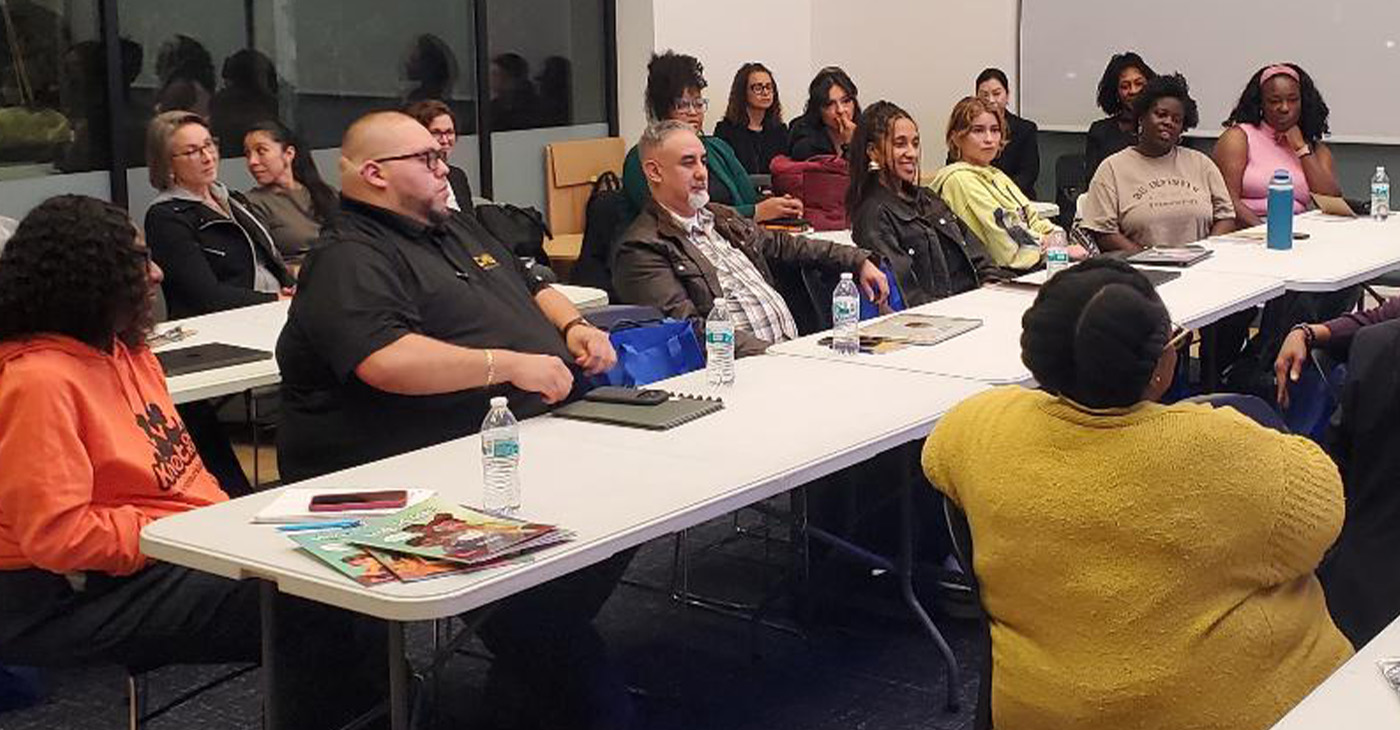
The Golden State Warriors and Chase bank hosted the third annual Alley-Oop Accelerator this month, an empowering eight-week program designed to help Bay Area entrepreneurs bring their visions for business to life.
The initiative kicked off on Feb. 12 at Chase’s Oakland Community Center on Broadway Street, welcoming 15 small business owners who joined a growing network of local innovators working to strengthen the region’s entrepreneurial ecosystem.
Over the past three years, the Alley-Oop Accelerator has helped more than 20 Bay Area businesses grow, connect, and gain meaningful exposure. The program combines hands-on training, mentorship, and community-building to help participants navigate the legal, financial, and marketing challenges of small business ownership.
At its core, the accelerator is designed to create an ecosystem of collaboration, where local entrepreneurs can learn from one another while accessing the resources of a global financial institution.
“This is our third year in a row working with the Golden State Warriors on the Alley-Oop Accelerator,” said Jaime Garcia, executive director of Chase’s Coaching for Impact team for the West Division. “We’ve already had 20-plus businesses graduate from the program, and we have 15 enrolled this year. The biggest thing about the program is really the community that’s built amongst the business owners — plus the exposure they’re able to get through Chase and the Golden State Warriors.”

According to Garcia, several graduates have gone on to receive vendor contracts with the Warriors and have gained broader recognition through collaborations with JPMorgan Chase.
“A lot of what Chase is trying to do,” Garcia added, “is bring businesses together because what they’ve asked for is an ecosystem, a network where they can connect, grow, and thrive organically.”
This year’s Alley-Oop Accelerator reflects that vision through its comprehensive curriculum and emphasis on practical learning. Participants explore the full spectrum of business essentials including financial management, marketing strategy, and legal compliance, while also preparing for real-world experiences such as pop-up market events.
Each entrepreneur benefits from one-on-one mentoring sessions through Chase’s Coaching for Impact program, which provides complimentary, personalized business consulting.
Garcia described the impact this hands-on approach has had on local small business owners. He recalled one candlemaker, who, after participating in the program, was invited to provide candles as gifts at Chase events.
“We were able to help give that business exposure,” he explained. “But then our team also worked with them on how to access capital to buy inventory and manage operations once those orders started coming in. It’s about preparation. When a hiccup happens, are you ready to handle it?”
The Coaching for Impact initiative, which launched in 2020 in just four cities, has since expanded to 46 nationwide.
“Every business is different,” Garcia said. “That’s why personal coaching matters so much. It’s life-changing.”
Participants in the 2026 program will each receive a $2,500 stipend, funding that Garcia said can make an outsized difference. “It’s amazing what some people can do with just $2,500,” he noted. “It sounds small, but it goes a long way when you have a plan for how to use it.”
For Chase and the Warriors, the Alley-Oop Accelerator represents more than an educational initiative, it’s a pathway to empowerment and economic inclusion. The program continues to foster lasting relationships among the entrepreneurs who, as Garcia put it, “build each other up” through shared growth and opportunity.
“Starting a business is never easy, but with the right support, it becomes possible, and even exhilarating,” said Oscar Lopez, the senior business consultant for Chase in Oakland.

Activism
Oakland Post: Week of February 18 – 24, 2026
The printed Weekly Edition of the Oakland Post: Week of – February 18 – 24, 2026
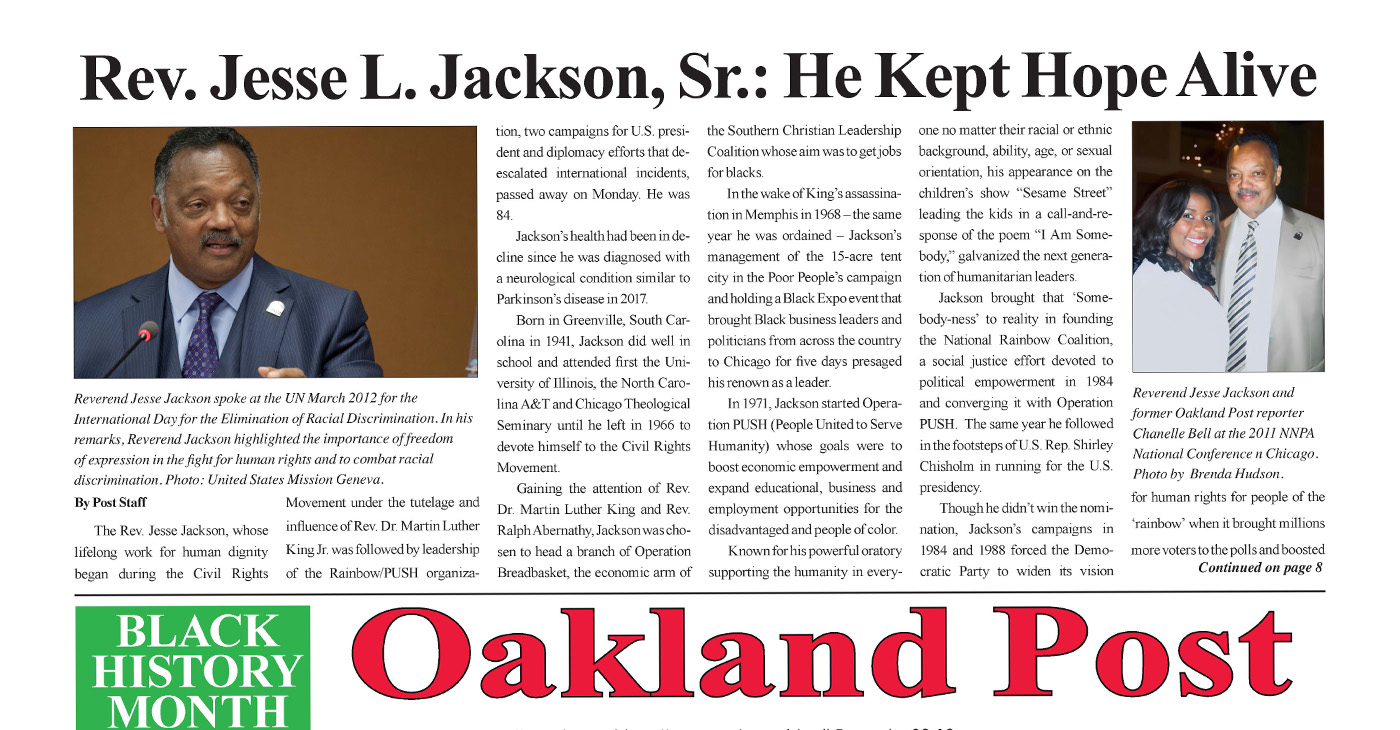
To enlarge your view of this issue, use the slider, magnifying glass icon or full page icon in the lower right corner of the browser window.
Bay Area
CITY OF SAN LEANDRO STATE OF CALIFORNIA PUBLIC WORKS DEPARTMENT ENGINEERING DIVISION NOTICE TO BIDDERS FOR ANNUAL STREET OVERLAY/REHABILITATION 2019-21 – PHASE III
WORK DESCRIPTION: The work to be done consists of roadway paving, base cement stabilization, concrete curb ramps, driveways, sidewalks, curbs and gutters, traffic detection loops and pavement striping, and doing all appurtenant work in place and ready for use, all as shown on the plans and described in the specifications with the title indicated in Paragraph 1 above, and on file in the office of the City Engineer. Reference to said plans and specifications is hereby made for further particulars.

PROJECT NO. 2020.0050
BID NO. 25-26.011
- BID OPENING: The bidder shall complete the “Proposal to the City of San Leandro” form contained in the Contract Book. The proposal shall be submitted in its entirety. Incomplete proposals will be considered non-responsive. Sealed bids containing the completed Proposal Section subject to the conditions named herein and in the specifications for ANNUAL STREET OVERLAY/REHABILITATION 2019-21 – PHASE III/PROJECT NO. 2020.0050 addressed to the City of San Leandro will be received at City Hall, 835 East 14th Street, 2nd Floor San Leandro at the office of the City Clerk up to 3:00 p.m. on Thursday, March 19, 2026, at which time they will be publicly opened and read.
- WORK DESCRIPTION: The work to be done consists of roadway paving, base cement stabilization, concrete curb ramps, driveways, sidewalks, curbs and gutters, traffic detection loops and pavement striping, and doing all appurtenant work in place and ready for use, all as shown on the plans and described in the specifications with the title indicated in Paragraph 1 above, and on file in the office of the City Engineer. Reference to said plans and specifications is hereby made for further particulars.
- OBTAINING THE PROJECT PLANS AND CONTRACT BOOK: The project plans and Contract Book may be obtained free of charge from the City’s website at:https://www.sanleandro.org/Bids.aspx Bidders who download the plans are encouraged to contact the City of San Leandro Public Works Department Engineering division at 510-577-3428 to be placed on the project planholder’s list to receive courtesy notifications of addenda and other project information. Project addenda, if any, will be posted on the website. A bidder who fails to address all project addenda in its proposal may be deemed non-responsive.Bidders may also purchase the Project Plans and Contract Book from East Bay Blueprint & Supply Co., at 1745 14th Street, Oakland, CA 94606; Phone Number: (510) 261-2990 or email: ebbp@eastbayblueprint.com.
- PRE-BID CONFERENCE: A mandatory pre-bid conference will be held on Tuesday, February 24, 2026, at 2:00 PM and on Wednesday, February 25, 2026, at 10:00 AM as follows:
Tuesday, February 24, 2026, at 2:00 PM
Zoom Meeting ID: 883 8752 6074
Passcode: 502955
Zoom Link: https://sanleandro-org.zoom.us/j/88387526074?pwd=hZ5rjB8AWdLAUem3CtByFiZxqKarHj.1
And - Wednesday, February 25, 2026, at 10:00 AM
Zoom Meeting ID: 898 2672 0472
Passcode: 091848
Zoom Link: https://sanleandro-org.zoom.us/j/89826720472?pwd=JgZX2nXMpLSRM5xDPr7EJUxl7QIznr.1The information presented at the conferences will be identical, all bidders must attend one of the pre-bid conference and sign the attendance sheet. A firm that didn’t attend the pre-bid conference isn’t qualified to bid on the project.Questions regarding the plans and specifications may be submitted in writing to the project engineer until 5:00 p.m. five (5) days before, excluding Saturdays, Sundays and Holidays, bids must be received by the City. The City will not respond to oral questions outside of the pre-bid conference. The response, if any, will be by written addendum only. Oral responses do not constitute a revision to these plans or specifications. - VALUE OF WORK: The Engineer has estimated that the value of work is between $1,000,000 and $5,000,000.
- SAN LEANDRO BUSINESS PREFERENCE AND PARTICIPATION GOALS: The work performed under this contract is subject to Section 1-6-225 of the San Leandro Municipal Code regarding local business preference and participation. A list of companies that hold a San Leandro business license is located on the City webpage under the finance department, here: https://www.sanleandro.org/340/Business-License
- SAN LEANDRO COMMUNITY WORKFORCE AGREEMENT: The work performed under this contract is subject to the Community Workforce Agreement adopted by City Council Resolution 2015-104. Contractors attention is directed to Section 10.
Dated: February 13, 2026 Sarah Bunting, City Clerk


WORK FROM HOME
Home-based business with potential monthly income of $10K+ per month. A proven training system and website provided to maximize business effectiveness. Perfect job to earn side and primary income. Contact Lynne for more details: Lynne4npusa@gmail.com 800-334-0540


PRESS ROOM: NBA Hall of Fame Nominee Terry Cummings Joins 100 Black Men of DeKalb County to Launch Victory & Values Initiative

Reflecting on Black History Milestones in Birmingham AL

OP-ED: One Hundred Years of Black Workers Telling the Truth

PRESS ROOM: Civil Rights TV Launches in Selma as the World’s First 24/7 Civil Rights Television Network

Advancements in solar technology that are changing the way we power the world

U.S. manufacturing rebounds – how foundry services are adapting to rising demand

Why has blood testing become so popular in today’s world?

Ghana Mourns a Son of the African World

OP-ED: Trump’s Policies Hurt Black America—and Everyone Else

OP-ED: Meta Deleted Me. I Still Don’t Know Why. And neither will you.

More than a Mission: Paying It Forward for the Future of Education

Avoid Eviction This Season: Landlord Checklist for Stable Tenancies

How chronic back problems affect Black communities differently

How cancer care is evolving with modern medicine

Diabetes disparity: Understanding Type 2 risks for Black Americans

Life Expectancy in Marin City, a Black Community, Is 15-17 Years Less than the Rest of Marin County

Oakland Post: Week of January 28, 2025 – February 3, 2026

Community Celebrates Turner Group Construction Company as Collins Drive Becomes Turner Group Drive

California Launches Study on Mileage Tax to Potentially Replace Gas Tax as Republicans Push Back

Discrimination in City Contracts

Oakland Post: Week of January 21 – 27, 2026

Book Review: Books on Black History and Black Life for Kids

Medi-Cal Cares for You and Your Baby Every Step of the Way

COMMENTARY: The Biases We Don’t See — Preventing AI-Driven Inequality in Health Care

After Don Lemon’s Arrest, Black Officials Raise Concerns About Independent Black Media

Post Newspaper Invites NNPA to Join Nationwide Probate Reform Initiative

OP-ED: The Dream Cannot be Realized Without Financial Freedom

COMMENTARY: The National Protest Must Be Accompanied with Our Votes

Four Stolen Futures: Will H-E-B Do The Right Thing?

Black History Events in the East Bay

Hyundai Ioniq 5 Parking, Safety, and 360 View #shorts

2025 Ioniq 5 New Wiper & Powerful Performance! #shorts

Electric SUV Range: Is 259 Miles Enough? #shorts

EV Charging: How Fast Can You Charge an Electric Vehicle? #shorts

Biometric Cooling… Messaging Seats…Come on! 2025 Infiniti QX80 Autograph 4WD

Charged Up: Witness the Magic of a Fully Electric Car! #shorts

Range Rover Sport PHEV Included…: See What’s Inside This Luxury SUV! #shorts

Invisible Hood View: Perfect Parking with X-Ray Vision! #shorts

AI Is Reshaping Black Healthcare: Promise, Peril, and the Push for Improved Results in California

ESSAY: Technology and Medicine, a Primary Care Point of View

Sanctuary Cities

The RESISTANCE – FREEDOM NOW

STATE OF THE PEOPLE: Freddie

ECONOMIC BOYCOTT DAY!!!!!

I told You So

-
 Activism4 weeks ago
Life Expectancy in Marin City, a Black Community, Is 15-17 Years Less than the Rest of Marin County
-
 Activism4 weeks ago
Oakland Post: Week of January 28, 2025 – February 3, 2026
-
 Activism3 weeks ago
Community Celebrates Turner Group Construction Company as Collins Drive Becomes Turner Group Drive
-
 Business3 weeks ago
California Launches Study on Mileage Tax to Potentially Replace Gas Tax as Republicans Push Back
-
 Activism3 weeks ago
Discrimination in City Contracts
-
 Arts and Culture3 weeks ago
Book Review: Books on Black History and Black Life for Kids
-
 Activism4 weeks ago
Medi-Cal Cares for You and Your Baby Every Step of the Way
-
 Activism3 weeks ago
COMMENTARY: The Biases We Don’t See — Preventing AI-Driven Inequality in Health Care
