
Black History
Before Chocolate Cities: The New Promised Land
During the late 19th and 20th centuries, at least 88 and as many as 200 Black towns were established throughout the United States. Mostly or completely Black incorporated communities with autonomous Black city governments and commercially oriented economies, these cities were created with purposeful economic and political motives.

By Tamara Shiloh
During the late 19th and 20th centuries, at least 88 and as many as 200 Black towns were established throughout the United States. Mostly or completely Black incorporated communities with autonomous Black city governments and commercially oriented economies, these cities were created with purposeful economic and political motives.
The greatest draw to these cities was the ability to escape racial oppression, control one’s economic destiny, and prove Black capacity for self-government. They were thought to be the New Promised Land. Texas would lead the effort with the founding of Shankleville Community (1867) and Kendleton (1870), both populated by ex-slaves from the surrounding countryside.
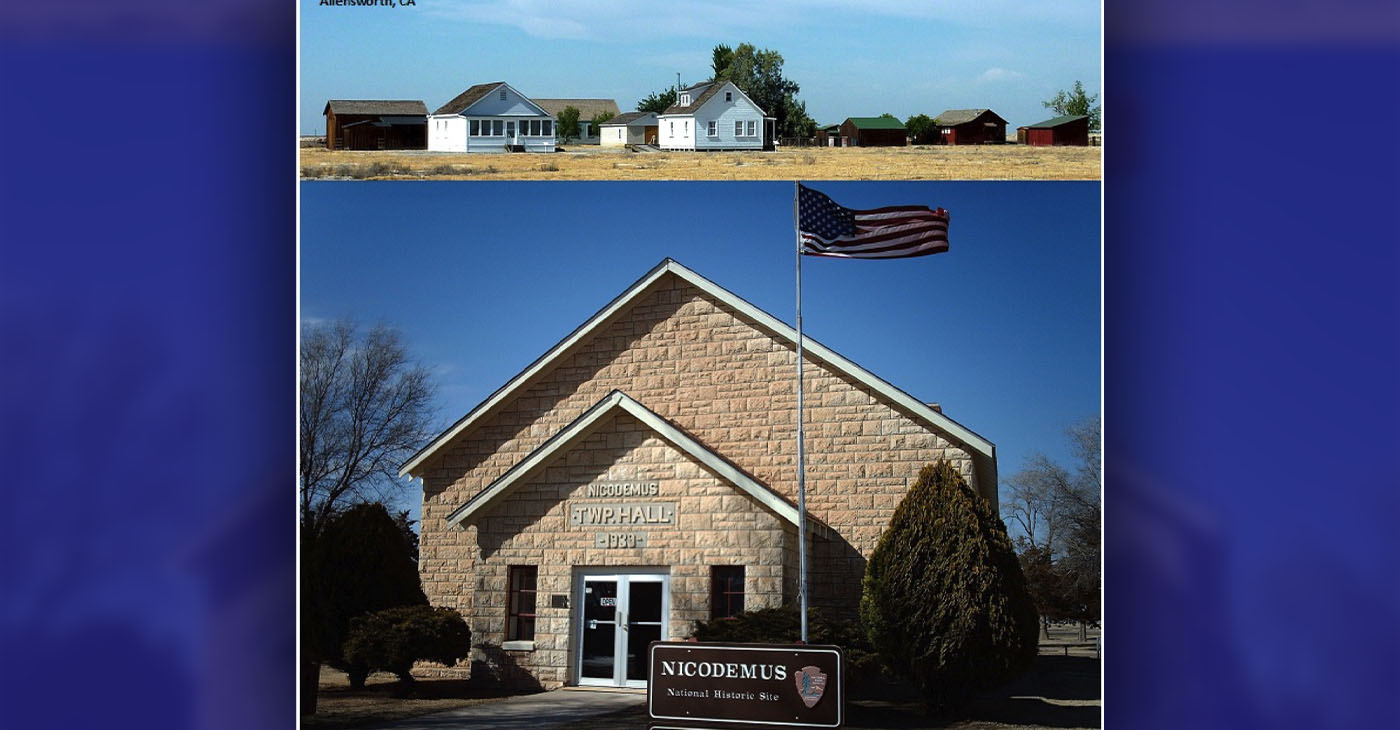
At the end of the Reconstruction-era South, Nicodemus, Kansas, (1877) was founded by newly freed slaves.
The land on which Nicodemus and other Black communities in Kansas stood turned out to be unproductive for agriculture. Natural drought cycles diminished efforts to raise crops. Despite this setback, the lifestyle remained better than that of the South. Instead, residents built houses, businesses, clubs, churches, and schools. They also “participated in political and commercial life in ways previously denied to them,” according to the National Park Service website.
Nicodemus, populated with some descendants of the original settlers, still stands. The 2020 census reported its population to be 14.
On June 30, 1908, Allen Allensworth, a former soldier, and William Payne, a teacher, created the California Colony and Home Promoting Association. It was soon dubbed Allensworth. It had a depot station on the main Santa Fe Railroad line from Los Angeles to San Francisco, the soil was fertile, the water seemingly abundant, and the acreage was plentiful and reasonably priced, according to the News One website.
The town became a member of the county school district and the regional library system. There, the first Black Justice of the Peace in post-Mexican California was elected. By 1914, it boasted 100 residents. Most of the adults worked 10-acre farms nearby, which they purchased for $110 per acre on an installment plan.
Allen Allensworth, in 1914, lobbied for an educational institute. That’s when a series of methodical racist acts began to trigger the community’s decline. The Santa Fe Railroad built a spur line to neighboring Alpaugh, depriving Allensworth of its lucrative carrying trade. Santa Fe also refused to hire Blacks as managers or ticket agents of the station located in the colony despite repeated letters and recriminations.
Powerful white farmers diverted the White River to irrigate their own crops and cut off Allensworth’s supply. The Pacific Farming Company then failed to honor its commitment to supply sufficient water for irrigation. But the largest factor in the community’s decline was Allen Allensworth’s death. By 1920, people began to leave the area.
On Oct. 6, 1976, what was once a thriving Black community was dedicated as a park.
Read more about the dynamic network of cities and towns built, maintained, and defended by African Americans in “Chocolate Cities: The Black Map of American Life,” by Marcus Anthony Hunter and Zandria F. Robinson









Activism
Oakland Post: Week of March 4 – 10, 2026
The printed Weekly Edition of the Oakland Post: Week of March 4 – 10, 2026

To enlarge your view of this issue, use the slider, magnifying glass icon or full page icon in the lower right corner of the browser window.
Activism
Oakland Post: Week of February 25 – March 3, 2026
The printed Weekly Edition of the Oakland Post: Week of – February 25 – March 3, 2026
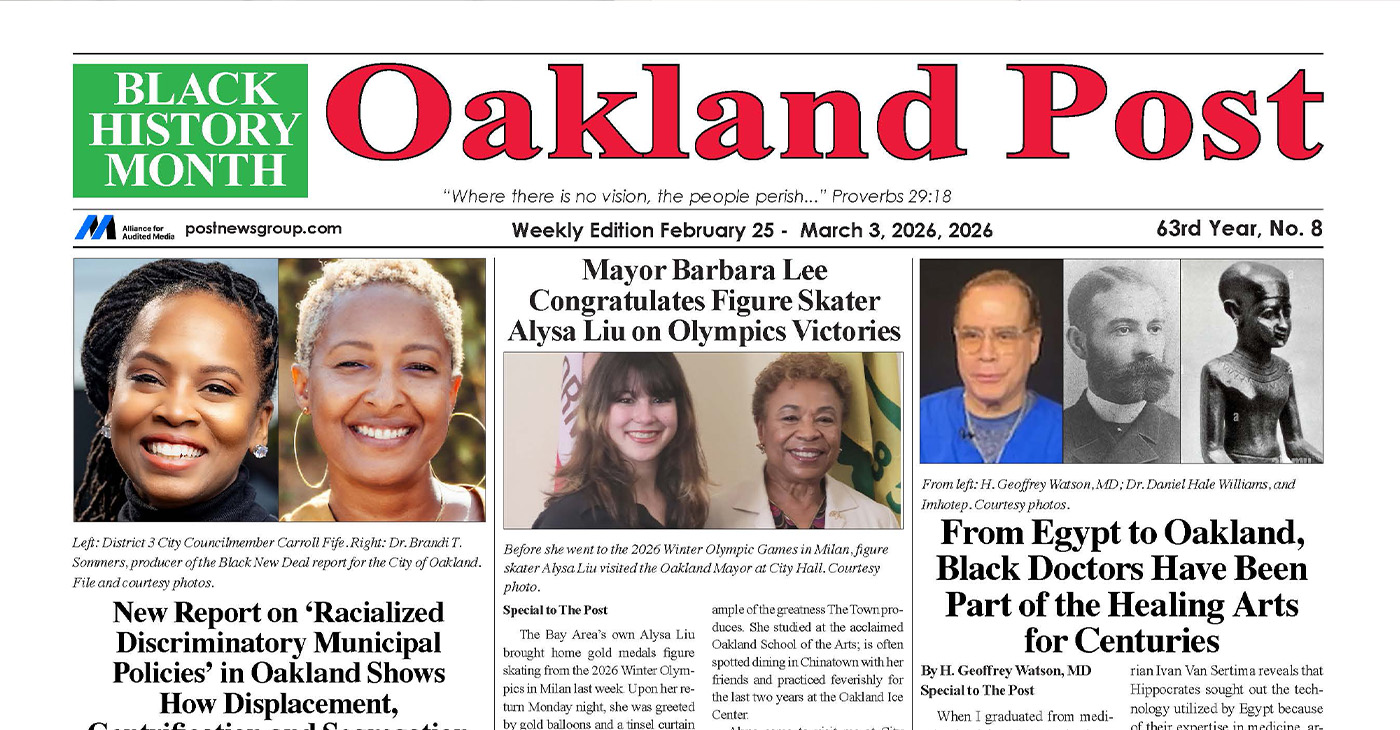
To enlarge your view of this issue, use the slider, magnifying glass icon or full page icon in the lower right corner of the browser window.
Activism
Oakland Post: Week of February 18 – 24, 2026
The printed Weekly Edition of the Oakland Post: Week of – February 18 – 24, 2026
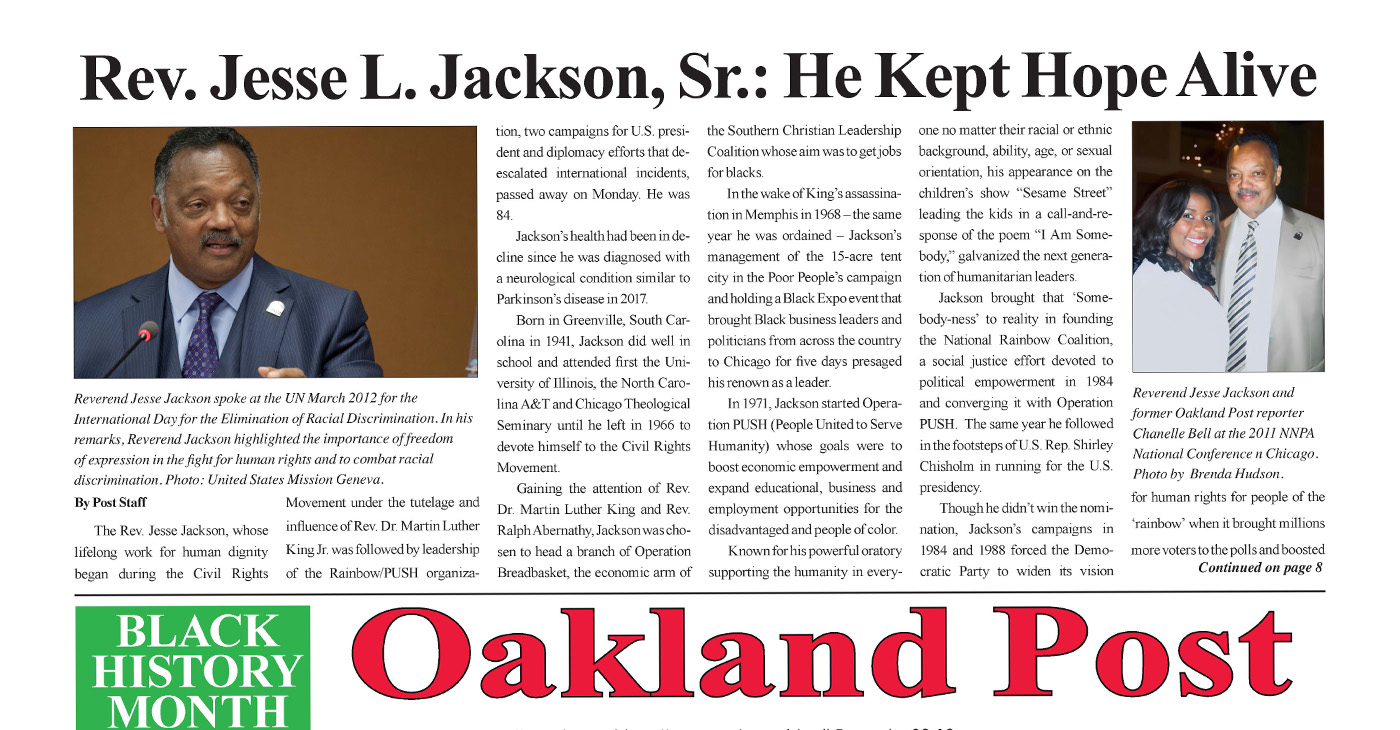
To enlarge your view of this issue, use the slider, magnifying glass icon or full page icon in the lower right corner of the browser window.

WORK FROM HOME
Home-based business with potential monthly income of $10K+ per month. A proven training system and website provided to maximize business effectiveness. Perfect job to earn side and primary income. Contact Lynne for more details: Lynne4npusa@gmail.com 800-334-0540


COMMENTARY: Women of Color Shape Our Past and Future

Woman’s Search for Family’s Roots Leads to Ancestor John T. Ward – A Successful Entrepreneur and Conductor on the Underground Railroad

Advocates Raise Alarm Over ICE Operation, MOU and Detention Risks in Baltimore County

Pete Buttigieg to Join Mayor Randall Woodfin for Community Town Hall in Birmingham

WATCH: Week One – NNPA’s “Leadership Matters” Video Series

Oakland Post: Week of March 4 – 10, 2026

OP-ED: NNPA Launches 2026 “Leadership Matters” Video Series

PRESS ROOM: PMG and Cranbrook Horizons-Upward Bound Launch Journey Fellowship Cohort 2

Los Angeles Summit Brings Together Leaders to Tackle Poverty and Affordability

Civil Rights TV Launches 24/7 Network Focused on Black History, Education and Equity

REVIEW: The Ultimate Hot Girl Summer Getaway: Sunseeker Resort Florida

COMMENTARY: How You Stop a Prescription Medicine is as Important as How You Start

PRESS ROOM: From Congress to Corporate America: NNPA Spotlights Visionaries in New Video Series

Poll Shows Support for Policies That Help Families Afford Child Care

Oakland Post: Week of February 25 – March 3, 2026

Oakland Post: Week of January 28, 2025 – February 3, 2026

Life Expectancy in Marin City, a Black Community, Is 15-17 Years Less than the Rest of Marin County

Community Celebrates Turner Group Construction Company as Collins Drive Becomes Turner Group Drive

California Launches Study on Mileage Tax to Potentially Replace Gas Tax as Republicans Push Back

Discrimination in City Contracts

Book Review: Books on Black History and Black Life for Kids

Oakland Post: Week of January 21 – 27, 2026

COMMENTARY: The Biases We Don’t See — Preventing AI-Driven Inequality in Health Care

Post Newspaper Invites NNPA to Join Nationwide Probate Reform Initiative

Black History Events in the East Bay

Medi-Cal Cares for You and Your Baby Every Step of the Way

Art of the African Diaspora Celebrates Legacy and Community at Richmond Art Center

COMMENTARY: The National Protest Must Be Accompanied with Our Votes

New Bill, the RIDER Safety Act, Would Support Transit Ambassadors and Safety on Public Transit

After Don Lemon’s Arrest, Black Officials Raise Concerns About Independent Black Media

Hyundai Ioniq 5 Parking, Safety, and 360 View #shorts

2025 Ioniq 5 New Wiper & Powerful Performance! #shorts

Electric SUV Range: Is 259 Miles Enough? #shorts

EV Charging: How Fast Can You Charge an Electric Vehicle? #shorts

Biometric Cooling… Messaging Seats…Come on! 2025 Infiniti QX80 Autograph 4WD

Charged Up: Witness the Magic of a Fully Electric Car! #shorts

Range Rover Sport PHEV Included…: See What’s Inside This Luxury SUV! #shorts

Invisible Hood View: Perfect Parking with X-Ray Vision! #shorts

AI Is Reshaping Black Healthcare: Promise, Peril, and the Push for Improved Results in California

ESSAY: Technology and Medicine, a Primary Care Point of View

Sanctuary Cities

The RESISTANCE – FREEDOM NOW

STATE OF THE PEOPLE: Freddie

ECONOMIC BOYCOTT DAY!!!!!

I told You So

-
 Activism4 weeks ago
Community Celebrates Turner Group Construction Company as Collins Drive Becomes Turner Group Drive
-
 Business4 weeks ago
California Launches Study on Mileage Tax to Potentially Replace Gas Tax as Republicans Push Back
-
 Activism4 weeks ago
Discrimination in City Contracts
-
 Arts and Culture4 weeks ago
Book Review: Books on Black History and Black Life for Kids
-
 Activism4 weeks ago
COMMENTARY: The Biases We Don’t See — Preventing AI-Driven Inequality in Health Care
-
 Activism4 weeks ago
Post Newspaper Invites NNPA to Join Nationwide Probate Reform Initiative
-
 Alameda County4 weeks ago
Black History Events in the East Bay
-
 Activism4 weeks ago
Art of the African Diaspora Celebrates Legacy and Community at Richmond Art Center
