
Community
Bay Area Mayors, Advocates Urge Congressional Delegation to Make Historic Investments in Housing
Leaders Rally Around Long-term Solutions to Region’s Affordability Crisis


A coalition of elected leaders, private, and philanthropic partners sent a letter (http://ow.ly/DBuJ50FNGsX) to the region’s federal legislators on August 10 calling on them to include historic investments in affordable housing in the upcoming budget reconciliation legislation before Congress.

San Francisco Mayor London Breed, San Jose Mayor Sam Liccardo, and Oakland Mayor Libby Schaaf were joined by many of the region’s leading housing providers, advocates, and experts to urge California members of Congress to:
- Ensure anyone eligible for a housing voucher can get one by making vouchers a federal entitlement.
- Enact House Financial Services Chairman Maxine Waters’ Housing is Infrastructure Act of 2021, which would provide over $600 billion in affordable, equitable housing infrastructure; and focus resources in the region using flexible models such as the Bay Area Housing Finance Authority.
- Strengthen the Low-Income Housing Tax Credit program by increasing the number of credits, which would create over 330,000 new housing units in California.
This coalition stemmed from a regional effort to build on local economic recovery task forces and to align behind key priorities to rebuild and regrow a Bay Area where everyone can thrive. It recognizes that affordable housing is a critical priority to ensure an equitable recovery. The coalition noted:
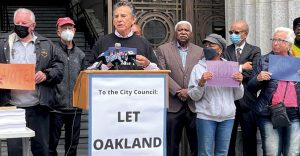
“In the Bay Area and around California, our communities face an acute shortage of affordable housing, worsened by a pandemic that has further revealed the vast inequities, especially facing Black, Brown, Asian Pacific Islander, and Indigenous communities…”
“…Advancing these priorities will spur desperately needed affordable housing production and ensure all residents have access to a safe, affordable place to call home.”
A copy of the letter can be found at http://ow.ly/DBuJ50FNGsX, and the full text is included below:
The Honorable Dianne Feinstein, U.S. Senate,
The Honorable Alex Padilla, U.S. Senate,
The Honorable Nancy Pelosi, U.S. House of Representatives,
The Honorable Mark DeSaulnier, U.S. House of Representatives ,
The Honorable Anna Eshoo, U.S. House of Representatives,
The Honorable John Garamendi, U.S. House of Representatives,
The Honorable Jared Huffman, U.S. House of Representatives,
The Honorable Ro Khanna, U.S. House of Representatives,
The Honorable Barbara Lee, U.S. House of Representatives,
The Honorable Zoe Lofgren, U.S. House of Representatives,
The Honorable Jerry McNerney, U.S. House of Representatives,
The Honorable Jackie Speier, U.S. House of Representatives,
The Honorable Eric Swalwell, U.S. House of Representatives,
The Honorable Mike Thompson, U.S. House of Representatives
Re: Housing Priorities for the Bay Area Region
Dear Bay Area Congressional Delegation Members:
Thank you for your historic, ongoing leadership in providing critical resources to the nation – and the Bay Area – to recover from the health, economic, and housing consequences of the COVID-19 pandemic. We have come together across the private, public, and nonprofit sectors to work in collaboration toward a more equitable housing recovery in our region, home to over 7.7 million people, and look to your leadership in helping us secure key housing investments, which only the federal government can meet.
Cities and counties across the region convened local economic recovery task forces early in the pandemic, identifying local priorities and actions to provide immediate relief and advance local recovery strategies. To build on the work of the regional economic recovery task forces, a coalition of public, private, and philanthropic partners came together to identify our region’s most pressing state and federal priorities to ensure an equitable recovery. Common across the Bay Area was the recognition of affordable housing as a critical priority to ensure an equitable recovery.
In the Bay Area and around California, our communities face an acute shortage of affordable housing, worsened by a pandemic that has further revealed the vast inequities, especially facing Black, Brown, Asian Pacific Islander, and Indigenous communities. While there are numerous causes, millions of California families are housing insecure:
- Tens of thousands are homeless. In 2019, 35,028 individuals were experiencing homelessness in Bay Area counties.
- Overall, 137,500 households, including 86,600 low-income Bay Area households, are at risk of eviction and collectively owe $256 million in rent debt. If 10% of currently at-risk households became homeless, that would lead to a 44% increase in homelessness.
- The vast majority of renters who are behind on their rent have experienced job and income losses during the pandemic: 78% have lost employment income, while 81% earn less than $75,000.
- As of 2017, 71% of necessary permits were issued for above moderate-income units, compared with only 9% to 13% for either very low, low, or moderate-income units in the current 2015 to 2023 housing cycle.
- Due to generations of disinvestment, Black, Latinx, Native American, Mixed/other renters are more likely to be rent-burdened, particularly among female-headed renter households. Eighty-eight percent of renters who are behind on rent are people of color. Moreover, Black residents represent 29% of people experiencing homelessness in the region but only 6% of Bay Area residents.
As a coalition of leading housing providers, advocates, and experts working in the region, we are requesting that you fight on behalf of the following federal priorities that will directly improve millions of lives in the Bay Area:
- Transform the Housing Choice Voucher program into a federal entitlement so that every household that qualifies for assistance can receive it. We urge you to support House Financial Services Chairwoman Maxine Waters’ visionary effort to advance this goal through the inclusion of the Ending Homelessness Act of 2021 in reconciliation legislation this year. In addition to making vouchers an entitlement, the comprehensive Ending Homelessness Act of 2021 provides protections against discrimination based on source of income and funding for supportive services, creation of permanent affordable housing for people experiencing homelessness, and technical assistance for relevant state and local authorities. Together, these actions could end widespread homelessness as we know it.
- Invest in affordable housing in reconciliation legislation this year by including Chairwoman Waters’ Housing is Infrastructure Act of 2021, which would provide over $600 billion in housing infrastructure; and include in this flexible funding for innovative regional approaches for more equitable housing solutions. This transformational legislation would address the acute shortage of affordable housing and advance equity in the Bay Area and other parts of the country by investing in the creation and preservation of affordable and accessible housing, public housing, and community development, with set-asides for high and persistent poverty communities and measures that improve equitable planning and development processes to affirmatively advance fair housing. In addition, fully funding cross-jurisdictional solutions, such as the Bay Area Housing Finance Authority (BAHFA), within these programs will allow regions and metro areas across the country to elevate a commitment to racial equity, foster innovation to integrate housing solutions with regional transportation and climate strategies, and make each dollar invested in housing goes further than other piecemeal approaches would otherwise accomplish.
- Strengthen the Low Income Housing Tax Credit – a crucial tool in the production of affordable housing – by enacting the bipartisan, bicameral Affordable Housing Credit Improvement Act (AHCIA). Since its inception in 1986, the Low Income Housing Tax Credit (LIHTC) has built or rehabilitated more than 3.5 million affordable housing units, making it the most successful federal policy to produce affordable rental housing. We thank you for your support of this meaningful tax credit. Today, AHCIA is needed to expand its impact in order to meet the scope of the current affordable housing crisis. AHCIA would help build more than two million new affordable housing units across the country, including 330,000 in California alone, in the next decade by increasing the amount of credits allocated to each state by 50 percent, increasing the number of affordable housing projects that can be built using private activity bonds, and making improvements to the LIHTC to better serve victims of domestic violence, formerly homeless students, Native American communities, veterans, and rural Americans.
Advancing these priorities will spur desperately needed affordable housing production and ensure all residents have access to a safe, affordable place to call home. Thank you for contacting Christa Brown with the San Francisco Foundation so we can further discuss these priorities in the near future.
Sincerely,
| London Breed Mayor, City of San Francisco |
Sam Liccardo Mayor, City of San Jose |
Libby Schaaf Mayor, City of Oakland |
| Tomiquia Moss Founder & Chief Executive, All Home |
Margaret Peterson CEO, Catholic Charities East Bay |
Monique Berlanga Interim Executive Director, Centro Legal de La Raza |
| Malcolm Yeung Executive Director, Chinatown Community Development Center |
Don Gilmore Executive Director, Community Housing Development Corporation |
James W. Head President & CEO, East Bay Community Foundation |
| Michael McAfee President and CEO, PolicyLink |
Priscilla Almodovar President and CEO, Enterprise Community Partners |
Cindy Wu Executive Director, LISC Bay Area |
| Leslye Corsiglia Executive Director, Silicon Valley @ Home |
Guillermo Mayer President & CEO, Public Advocates |
Fred Blackwell CEO, San Francisco Foundation |
| Nicole Taylor President and CEO, Silicon Valley Community Foundation |
Amie Fishman Executive Director, Nonprofit Housing Association of Northern California |
Gloria Bruce Executive Director, East Bay Housing Organization |
| Ellen Wu Executive Director, Urban Habitat |
Alicia John-Baptiste President and CEO, SPUR |
Omar Carrera CEO, Canal Alliance |
| Debra Gore-Mann President and CEO, The Greenlining Institute |
Derecka Mehrens Executive Director, Working Partnerships USA |







#NNPA BlackPress
Poll Shows Support for Policies That Help Families Afford Child Care
BLACKPRESSUSA NEWSWIRE — New national polling shows persistent voter concern about the affordability and availability of child care for working parents, alongside broad support across key demographic groups for federal child care policies that help families afford care.


By First Five Years Fund
New national polling shows persistent voter concern about the affordability and availability of child care for working parents, alongside broad support across key demographic groups for federal child care policies that help families afford care.
The national survey was conducted by UpOne Insight on behalf of the First Five Years Fund from January 13–18, 2026.
Key findings include:
• Parents need help: 80% of voters say the ability of working parents to find and afford child care is either in a state of crisis or a major problem.
• This is an affordability issue: 82% believe federal child care funding will help lower costs for working families — including 69% of Republicans, 84% of Independents, and 94% of Democrats.
• And there continues to be strong support (62%) for the Child Care and Development Block Grant (CCDBG), a federal program that makes it possible for hundreds of thousands of families to afford safe, quality care for their children while parents work or go to school, including a majority of Republicans, 63% of Independents and 72% of Democrats.
• Support for funding child care programs remains strong: 75% believe child care funding should be increased or kept at current levels — including 75% of Republicans, 85% of Independents, and 97% of Democrats.
• 74% say funding for child care is an important and good use of tax dollars, including a majority of Republicans, three-quarters of Independents, and nine in ten Democrats.
FFYF Executive Director Sarah Rittling said, “Voters across the country are sending a clear message: federal child care and early learning programs work. These investments help parents stay in the workforce, strengthen families, and support healthy child development. They have also long had strong bipartisan support in Congress. At a time when affordability is top of mind for families, continued federal funding is essential to ensure child care remains accessible and within reach.”
First Five Years Fund works to protect, prioritize, and build bipartisan support for quality child care and early learning programs at the federal level. Reliable, affordable, and high-quality early learning and child care can be transformative, not only enhancing a child’s prospects for a brighter future but also bolstering working parents and fostering economic stability nationwide.
We work with Congress and the Administration to identify federal solutions that work for families with young children, as well as states and communities. We work with policymakers to identify ways to increase access to affordable, high-quality child care and early learning programs for children. And we collaborate with advocacy groups to help align best practices with the best possible policies. http://www.ffyf.org

Activism
Oakland Post: Week of February 25 – March 3, 2026
The printed Weekly Edition of the Oakland Post: Week of – February 25 – March 3, 2026

To enlarge your view of this issue, use the slider, magnifying glass icon or full page icon in the lower right corner of the browser window.
#NNPA BlackPress
Trump’s MAGA Allies are Creating Executive Order Plan to Steal the 2026 Midterms
NNPA NEWSWIRE — The document that could lead to an executive order proposes using the claim that China interfered with the 2020 elections as grounds to “declare a national emergency.” The move would be an unprecedented step that would grant Trump new authority over the voting systems in the U.S.

By Lauren Victoria Burke, NNPA Newswire Correspondent
A group of MAGA pro-Trump activists, who say they are working in coordination with the White House, are circulating a 17-page draft executive order that would claim without evidence that China interfered with the 2020 presidential election. Donald Trump lost the 2020 presidential to President Joe Biden by over 7 million votes. Since Trump lost to Biden in 2020, he has repeatedly claimed that the election was “stolen” without evidence. The report of a group of “Trump allies” preparing an executive order to give Trump power over elections was first reported by The Washington Post.
The lies around the right-wing campaign that pushed falsehoods that the 2020 election was stolen was trafficked through right-wing media, particularly Fox News. Fox News was then sued for defamation for the claims by Dominion Voting Systems. Fox lost the case and had to settle for the largest defamation amount on record of $787.5 million in April 2023.
The document that could lead to an executive order proposes using the claim that China interfered with the 2020 elections as grounds to “declare a national emergency.” The move would be an unprecedented step that would grant Trump new authority over the voting systems in the U.S.

The story in The Washington Post arrives as Trump increasingly signals that he may take actions that would alter the result of the 2026 midterms. The Republicans are widely expected to lose as their approval ratings plummet as a result of a failing economy under Trump. Over 50 members of Congress have announced they will retire this year and not return in 2027.
The Trump Department of Justice, which now has a large image of Trump on the side of it, “sued five new states Thursday [Feb. 26, 2026] demanding access to their unredacted voter rolls — escalating a campaign that has been rejected by multiple federal courts and faces resistance from Republican-led states as well,” according to Democracy Docket, a group that works to protect voting rights.
Trump claimed back in late 2020, the last year of his first term, that he had the authority to issue an executive order related to mail-in voting for the 2020 elections — which he would then lose. But the Constitution states that control of elections lies with the states. As the GOP works to place hurdles in front of voting, Democrats worked to make voting easier.
In March 2021, President Biden signed an executive order calling on federal agencies to expand voting access as part of the Biden Administration’s effort “to promote and defend the right to vote for all Americans who are legally entitled to participate in elections.”
Trump’s focus is clearly on altering the November 2026 midterm elections. Trump’s polling numbers and the elections and special elections that have taken place around the U.S. over the last year clearly indicate that Republicans are about to be hit by a blue wave of Democratic victories.
Lauren Victoria Burke is an independent investigative journalist and the founder of Black Virginia News. She is a political analyst who appears on #RolandMartinUnfiltered and hosts the show LAUREN LIVE on YouTube @LaurenVictoriaBurke. She can be contacted at LBurke007@gmail.com and on twitter at @LVBurke


WORK FROM HOME
Home-based business with potential monthly income of $10K+ per month. A proven training system and website provided to maximize business effectiveness. Perfect job to earn side and primary income. Contact Lynne for more details: Lynne4npusa@gmail.com 800-334-0540


Poll Shows Support for Policies That Help Families Afford Child Care

Oakland Post: Week of February 25 – March 3, 2026

Trump’s MAGA Allies are Creating Executive Order Plan to Steal the 2026 Midterms

PRESS ROOM: NBA Hall of Fame Nominee Terry Cummings Joins 100 Black Men of DeKalb County to Launch Victory & Values Initiative

Reflecting on Black History Milestones in Birmingham AL

OP-ED: One Hundred Years of Black Workers Telling the Truth

PRESS ROOM: Civil Rights TV Launches in Selma as the World’s First 24/7 Civil Rights Television Network

Advancements in solar technology that are changing the way we power the world

U.S. manufacturing rebounds – how foundry services are adapting to rising demand

Why has blood testing become so popular in today’s world?

Ghana Mourns a Son of the African World

OP-ED: Trump’s Policies Hurt Black America—and Everyone Else

OP-ED: Meta Deleted Me. I Still Don’t Know Why. And neither will you.

More than a Mission: Paying It Forward for the Future of Education

Avoid Eviction This Season: Landlord Checklist for Stable Tenancies

Life Expectancy in Marin City, a Black Community, Is 15-17 Years Less than the Rest of Marin County

Oakland Post: Week of January 28, 2025 – February 3, 2026

Community Celebrates Turner Group Construction Company as Collins Drive Becomes Turner Group Drive

California Launches Study on Mileage Tax to Potentially Replace Gas Tax as Republicans Push Back

Discrimination in City Contracts

Oakland Post: Week of January 21 – 27, 2026

Book Review: Books on Black History and Black Life for Kids

Medi-Cal Cares for You and Your Baby Every Step of the Way

COMMENTARY: The Biases We Don’t See — Preventing AI-Driven Inequality in Health Care

Post Newspaper Invites NNPA to Join Nationwide Probate Reform Initiative

After Don Lemon’s Arrest, Black Officials Raise Concerns About Independent Black Media

OP-ED: The Dream Cannot be Realized Without Financial Freedom

COMMENTARY: The National Protest Must Be Accompanied with Our Votes

Black History Events in the East Bay

Art of the African Diaspora Celebrates Legacy and Community at Richmond Art Center

Hyundai Ioniq 5 Parking, Safety, and 360 View #shorts

2025 Ioniq 5 New Wiper & Powerful Performance! #shorts

Electric SUV Range: Is 259 Miles Enough? #shorts

EV Charging: How Fast Can You Charge an Electric Vehicle? #shorts

Biometric Cooling… Messaging Seats…Come on! 2025 Infiniti QX80 Autograph 4WD

Charged Up: Witness the Magic of a Fully Electric Car! #shorts

Range Rover Sport PHEV Included…: See What’s Inside This Luxury SUV! #shorts

Invisible Hood View: Perfect Parking with X-Ray Vision! #shorts

AI Is Reshaping Black Healthcare: Promise, Peril, and the Push for Improved Results in California

ESSAY: Technology and Medicine, a Primary Care Point of View

Sanctuary Cities

The RESISTANCE – FREEDOM NOW

STATE OF THE PEOPLE: Freddie

ECONOMIC BOYCOTT DAY!!!!!

I told You So

-
 Activism4 weeks ago
Life Expectancy in Marin City, a Black Community, Is 15-17 Years Less than the Rest of Marin County
-
 Activism4 weeks ago
Oakland Post: Week of January 28, 2025 – February 3, 2026
-
 Activism3 weeks ago
Community Celebrates Turner Group Construction Company as Collins Drive Becomes Turner Group Drive
-
 Business3 weeks ago
California Launches Study on Mileage Tax to Potentially Replace Gas Tax as Republicans Push Back
-
 Activism3 weeks ago
Discrimination in City Contracts
-
 Arts and Culture3 weeks ago
Book Review: Books on Black History and Black Life for Kids
-
 Activism4 weeks ago
Medi-Cal Cares for You and Your Baby Every Step of the Way
-
 Activism3 weeks ago
COMMENTARY: The Biases We Don’t See — Preventing AI-Driven Inequality in Health Care
