
Politics
Black Cops Back Officers Charged in Freddie Gray’s Death


Clockwise from top left: Baltimore police officers William G. Porter, Garrett E. Miller, Caesar R. Goodson Jr., Edward M. Nero, Alicia D. White, Brian W. Rice. (Baltimore Police Department)
By Kamau High
Special to the NNPA News Service from The AFRO
BALTIMORE (NNPA) – The Vanguard Justice Society has voiced its support for Sgt. Alicia D. White and the other five officers implicated in the death of Freddie Gray while in police custody.
“The purpose of this press conference is to express our full support in reference to the officers that have recently been charged and one officer in particular, a Vanguard member, Sgt. Alicia White,” Ken Butler president of the non-profit group that advocates for minority police officers in Baltimore.
White was charged earlier this month with manslaughter, second-degree assault and misconduct in office. If convicted, she faces up to 20 years in prison. At a May 13 press conference at Baltimore Community College, Butler said Sgt. White was recruited into Vanguard out of the police academy and was mentored by the organization.
In addition to Vanguard members, Barbara Jackson, a community organizer, spoke of Sgt. White’s Christian faith and volunteer work. Two of her lawyers, Ivan Bates and Tony Garcia, of Bates & Garcia, also addressed the media.
Bates began by pointing out that according to State’s Attorney General Marilyn Mosby, Sgt. White had about 15 seconds of interaction with Freddie Gray and that Sgt. White never actually touched him.
Garcia also noted that Sgt. White was born and reared in Baltimore city as well as attended high school in Baltimore. “Alicia White is your sister, she’s your cousin, she’s your friend, she’s your neighbor,” Garcia said. “She is Baltimore city.”
The law firm of Bates & Garcia is known for suing the Baltimore Police Department for police brutality, including the Kollin Truss case, that involved a Baltimore police officer captured on video tape repeatedly punching Truss in the face.
Of the six officers charged in the Gray case, three of them – including Sgt. White – are Black.
Lisa Robinson, vice president of Vanguard, said the group is looking forward to speaking to the Department of Justice during their investigation of the Freddie Gray case and wants to bring up several issues themselves.
“Those include policies and procedures in terms of hiring, firing, disciplinary actions as well as promotions and transfers, policing strategies,” she said. “Our goal is also to look at the stop snitching culture. The stop snitching culture is prevalent on the streets of Baltimore as well as within the Baltimore Police Department.”
She added, “It is our hope that at the end of this process that Baltimore will have a better, safer police department and city for all the citizens of Baltimore.”
During a question-and-answer period, Garcia, one of Sgt. White’s lawyers criticized Marilyn Mosby, the State’s Attorney for Baltimore City. He said, “You’re going to see accuracy was sacrificed for speed. You’re going to see a ‘chuck and duck’ style of prosecution that is not fair or unbiased to anyone.” He added,” You’re going to see that Ms. White was steamrolled into this. She was at the wrong place at the wrong time and had nothing to do with this.”
Mosby’s press office did not return calls by AFRO press time. However she released a statement, May 5 that said, in part, “While the evidence we have obtained through our independent investigation does substantiate the elements of the charges filed, I refuse to litigate this case through the media.”
Bates, another White’s other attorney, said, “We’ve asked the state’s attorney numerous times to allow us to see the evidence and they haven’t. I guess for some reason the state feels that they have evidence that Ms. White didn’t do anything but before Ms. White got to the point to not do anything Ms. White would have to know that something needed to be done.”
Asked what Sgt. White had told them about her actions on the day of Freddie Gray’s arrest, Bates replied, “I can’t necessarily go into what the client has told us but let’s just say we feel very confident about our defense.”
###






Activism
Oakland Post: Week of March 4 – 10, 2026
The printed Weekly Edition of the Oakland Post: Week of March 4 – 10, 2026

To enlarge your view of this issue, use the slider, magnifying glass icon or full page icon in the lower right corner of the browser window.
Activism
Oakland Post: Week of February 25 – March 3, 2026
The printed Weekly Edition of the Oakland Post: Week of – February 25 – March 3, 2026

To enlarge your view of this issue, use the slider, magnifying glass icon or full page icon in the lower right corner of the browser window.
Activism
Oakland Post: Week of February 18 – 24, 2026
The printed Weekly Edition of the Oakland Post: Week of – February 18 – 24, 2026
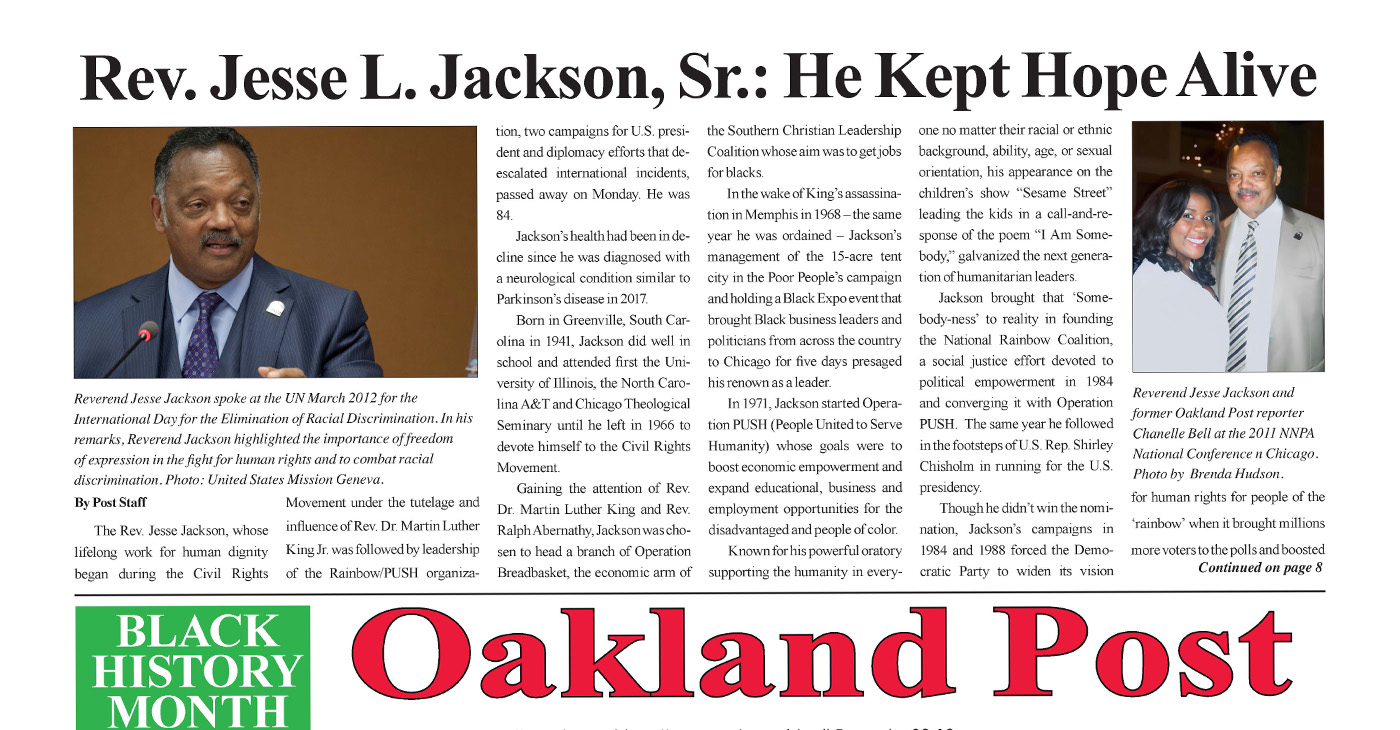
To enlarge your view of this issue, use the slider, magnifying glass icon or full page icon in the lower right corner of the browser window.


WORK FROM HOME
Home-based business with potential monthly income of $10K+ per month. A proven training system and website provided to maximize business effectiveness. Perfect job to earn side and primary income. Contact Lynne for more details: Lynne4npusa@gmail.com 800-334-0540


COMMENTARY: Women of Color Shape Our Past and Future

Woman’s Search for Family’s Roots Leads to Ancestor John T. Ward – A Successful Entrepreneur and Conductor on the Underground Railroad

Advocates Raise Alarm Over ICE Operation, MOU and Detention Risks in Baltimore County

Pete Buttigieg to Join Mayor Randall Woodfin for Community Town Hall in Birmingham

WATCH: Week One – NNPA’s “Leadership Matters” Video Series

Oakland Post: Week of March 4 – 10, 2026

OP-ED: NNPA Launches 2026 “Leadership Matters” Video Series

PRESS ROOM: PMG and Cranbrook Horizons-Upward Bound Launch Journey Fellowship Cohort 2

Los Angeles Summit Brings Together Leaders to Tackle Poverty and Affordability

Civil Rights TV Launches 24/7 Network Focused on Black History, Education and Equity

REVIEW: The Ultimate Hot Girl Summer Getaway: Sunseeker Resort Florida

COMMENTARY: How You Stop a Prescription Medicine is as Important as How You Start

PRESS ROOM: From Congress to Corporate America: NNPA Spotlights Visionaries in New Video Series

Poll Shows Support for Policies That Help Families Afford Child Care

Oakland Post: Week of February 25 – March 3, 2026

Oakland Post: Week of January 28, 2025 – February 3, 2026

Life Expectancy in Marin City, a Black Community, Is 15-17 Years Less than the Rest of Marin County

Community Celebrates Turner Group Construction Company as Collins Drive Becomes Turner Group Drive

California Launches Study on Mileage Tax to Potentially Replace Gas Tax as Republicans Push Back

Discrimination in City Contracts

Book Review: Books on Black History and Black Life for Kids

COMMENTARY: The Biases We Don’t See — Preventing AI-Driven Inequality in Health Care

Black History Events in the East Bay

Post Newspaper Invites NNPA to Join Nationwide Probate Reform Initiative

Art of the African Diaspora Celebrates Legacy and Community at Richmond Art Center

Medi-Cal Cares for You and Your Baby Every Step of the Way

COMMENTARY: The National Protest Must Be Accompanied with Our Votes

New Bill, the RIDER Safety Act, Would Support Transit Ambassadors and Safety on Public Transit

Oakland Post: Week of February 4 – 10, 2026

After Don Lemon’s Arrest, Black Officials Raise Concerns About Independent Black Media

Hyundai Ioniq 5 Parking, Safety, and 360 View #shorts

2025 Ioniq 5 New Wiper & Powerful Performance! #shorts

Electric SUV Range: Is 259 Miles Enough? #shorts

EV Charging: How Fast Can You Charge an Electric Vehicle? #shorts

Biometric Cooling… Messaging Seats…Come on! 2025 Infiniti QX80 Autograph 4WD

Charged Up: Witness the Magic of a Fully Electric Car! #shorts

Range Rover Sport PHEV Included…: See What’s Inside This Luxury SUV! #shorts

Invisible Hood View: Perfect Parking with X-Ray Vision! #shorts

AI Is Reshaping Black Healthcare: Promise, Peril, and the Push for Improved Results in California

ESSAY: Technology and Medicine, a Primary Care Point of View

Sanctuary Cities

The RESISTANCE – FREEDOM NOW

STATE OF THE PEOPLE: Freddie

ECONOMIC BOYCOTT DAY!!!!!

I told You So
-

 Activism4 weeks ago
Oakland Post: Week of February 11 – 17, 2026
-

 #NNPA BlackPress2 weeks ago
Reflecting on Black History Milestones in Birmingham AL
-

 Advice4 weeks ago
Rising Optimism Among Small And Middle Market Business Leaders Suggests Growth for California
-

 Bay Area3 weeks ago
CITY OF SAN LEANDRO STATE OF CALIFORNIA PUBLIC WORKS DEPARTMENT ENGINEERING DIVISION NOTICE TO BIDDERS FOR ANNUAL STREET OVERLAY/REHABILITATION 2019-21 – PHASE III
-

 #NNPA BlackPress3 weeks ago
U.S. manufacturing rebounds – how foundry services are adapting to rising demand
-
 #NNPA BlackPress2 weeks ago
PRESS ROOM: NBA Hall of Fame Nominee Terry Cummings Joins 100 Black Men of DeKalb County to Launch Victory & Values Initiative
-
 Activism3 weeks ago
Oakland Post: Week of February 18 – 24, 2026
-

 #NNPA BlackPress3 weeks ago
Advancements in solar technology that are changing the way we power the world
