
Politics
Black Lives Matter Vote Could Swing Some Key Elections


(AP Photo/Jim Mone)
By Charles D. Ellison
Special to the NNPA from The Philadelphia Tribune
(NNPA)—There are now five presidential battleground states in 2016 that could be heavily impacted by the #BlackLivesMatter movement.
Of course, it depends on a variety of factors and where the political winds blow. And many observers are in wait-and-see mode over the exact status of a scattered, yet burgeoning “Second Civil Rights Movement” some experts perceive as lacking needed political teeth.
That status, also put on slight hiatus by a much more frigid than normal winter, just got complicated with last week’s shootings of two Ferguson, Mo., police officers during an otherwise peaceful protest marking the resignation of police chief Thomas Jackson.
Yet, despite the challenges, there are signs the movement could dramatically shake up the political landscape in several key states. Location, it seems, is everything. The five battleground states identified are also the same spots where tragic shootings of unarmed Black men have taken place in recent years: Florida, Missouri, Ohio, Pennsylvania and Wisconsin.
Three of these states are already launching pads for three prospective Republican presidential candidates.
All five states are also places where Democratic presidential primaries, statewide gubernatorial and senatorial races and general elections find campaigns occasionally declaring all-out electoral war when wooing Black voters.
With the tragedies in each of these states sparking massive social justice protests — from the genesis of #BlackLivesMatter in Ferguson to the spawning of Young, Black and Gifted in Madison, Wis. — there is evidence the movements could mobilize Black voters into action for 2016. That comes at a time when many activists and voter advocates are concerned African-American turnout will be substantially depressed in the next presidential election without President Barack Obama’s name on the ballot. Many Democratic strategists worry Black turnout will be a major challenge without the kind of candidate that will excite them into action in the next election cycle.
However, issues such as police brutality and violence could.
“Given the intensity of the issue and that it’s not likely to be resolved any time soon, I think the momentum will last until the next election,” DePaul University political scientist Christina Rivers told the Tribune. “In particular, I think the #BlackLivesMatter movement will galvanize young Black voters, especially students.”
Rivers also points to students and young voters in North Carolina fighting against that state’s voter suppression laws. And last week, students from HBCUs Fisk and Tennessee State University filed a federal lawsuit challenging Tennessee’s voter ID law.
In Florida, the African-American community is still uneasy and upset over the needless so-called “Stand Your Ground” defense slayings of Black teens Trayvon Martin and Jordan Davis, in which the former’s killer, a troubled George Zimmerman, was acquitted. But, the Sunshine State is also a well-known political bellwether greatly influencing presidential primaries and the general election cycle. It just recovered from a caustic gubernatorial election in which the state’s controversial Republican Gov. Rick Scott won a second term and one of its U.S. senators, Republican Marco Rubio, is openly mulling a 2016 presidential bid. The state is also 20 percent African American.
In Missouri, Black protesters are still smarting over the killing of Black teen Michael Brown and the non-indictment of Ferguson police officer Darren Wilson. Upcoming city council protests in April could be a preview of what the Black electorate, 13 percent of Missouri’s population, could do in 2016.
While protests simmered to a near stop over the winter, advocates have kick-started activities in the wake of federal Department of Justice probe findings of racist policing patterns by the department, the announcement of no civil rights charges against Wilson and the exit of the police chief and city manager.
Ohio is also home to two extremely tragic cases: the case of 12-year old Tamir Rice in Cleveland and John Crawford in Beavercreek. In both instances, white police officers wrongly assumed Black males were armed and dangerous when they were not, killing both within seconds of seeing them and without stopping to assess either situation.
Out of all five states identified, Wisconsin could be the ugliest. A perfect firestorm of political factors are converging on that state, still shaking off the hangover of a nasty recall election triggered by labor unions against Badger State Gov. Scott Walker (R-Wis.). Walker won, but the wounds are visible as Walker continues pressing forward with state right-to-work laws perceived as an existential threat to the state’s public sector workforce.
Making the situation even more politically caustic is the recent fatal shooting of unarmed Black teen Tony Robinson in the state capitol, Madison, Wis., by a white city police officer.
While Madison is considered an oasis of Badger State liberal politics, and the state’s second-largest city with a Black population near 10 percent, it’s now become the flashpoint of brewing protests over Robinson’s death.
But, Walker is also currently viewed as a growing favorite and front-runner in the 2016 presidential race. While the governor, predictably, has not made any comment on what’s happened in Madison, an emerging alliance between Black protesters and state labor unions desperately seeking an ally in their fight against right-to-work could become a thorn in Walker’s national ambitions.
It may not be as impactful in the GOP primary (since the Black vote is less than 10 percent of the Republican electorate). But any sudden spike in Black political activity in Wisconsin could prove challenging for Republicans, especially if Walker wins the primary as a presidential nominee or, at the very least, becomes the nominee’s running mate.
Still, some are doubtful the growing youth movement will gain the traction it needs by 2016 or be politically savvy enough to know what it must do.
“We’ll see how much actual policy comes out of state legislatures and city councils in those states,” said former Colorado Senate President Peter Groff, now a prominent national advisor to Black state legislators. “Recommendations are sitting there, but I haven’t seen much policy movement.”
“From a media standpoint, the ‘movement’ is losing steam,” added Groff.
Washington, D.C.-based attorney and former District of Columbia Democratic Party Committee Chair A. Scott Bolden is also skeptical.
“I would be leery of the notion that these incidents will resonate beyond the protesters,” Bolden argued, suggesting movement platforms could inadvertently alienate white voters. “People who don’t look like you and me have a much different and much more positive view of police.”
“Historically, these types of [police brutality] movements or protests haven’t translated into political impact,” added Bolden. “This angst against police has always been present. The difference, obviously, is social media since we now have immediate access to the events.”
###




Activism
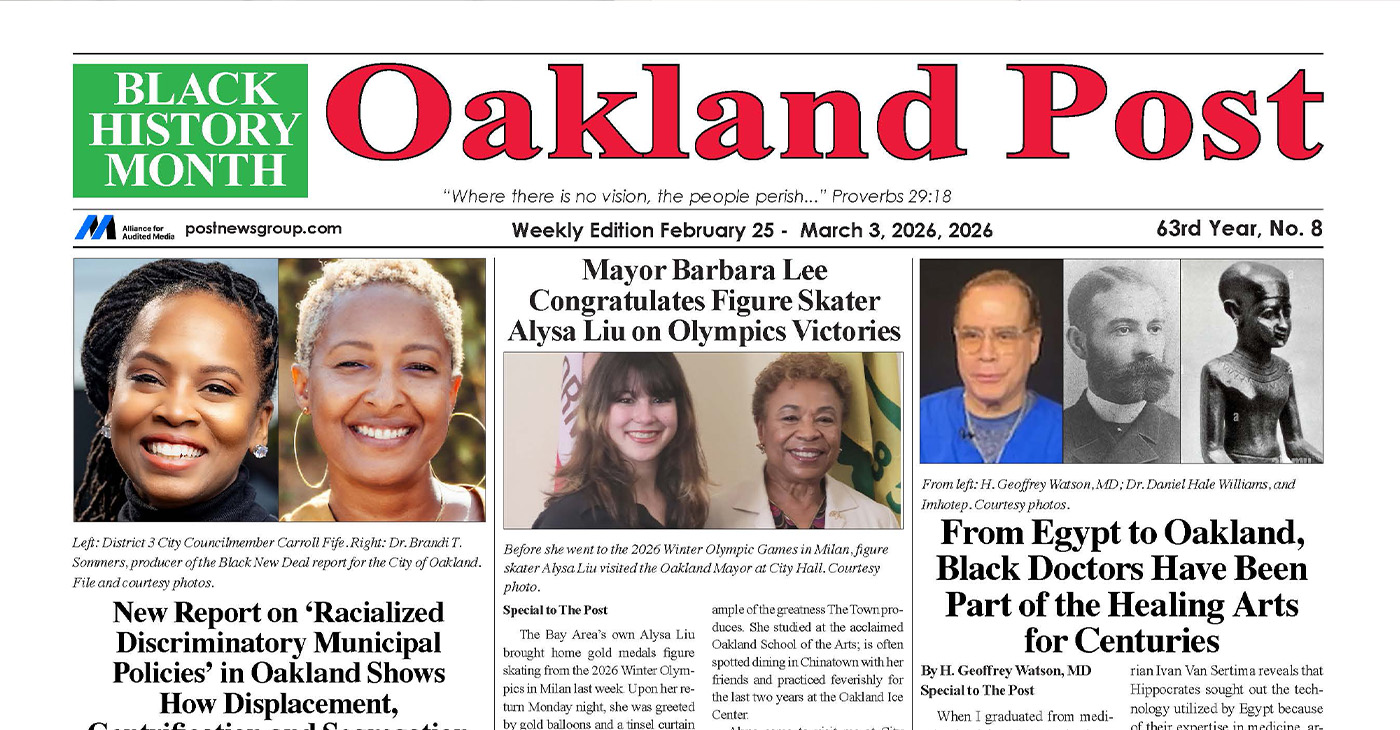
Oakland Post: Week of February 25 – March 3, 2026
The printed Weekly Edition of the Oakland Post: Week of – February 25 – March 3, 2026
To enlarge your view of this issue, use the slider, magnifying glass icon or full page icon in the lower right corner of the browser window.

Activism
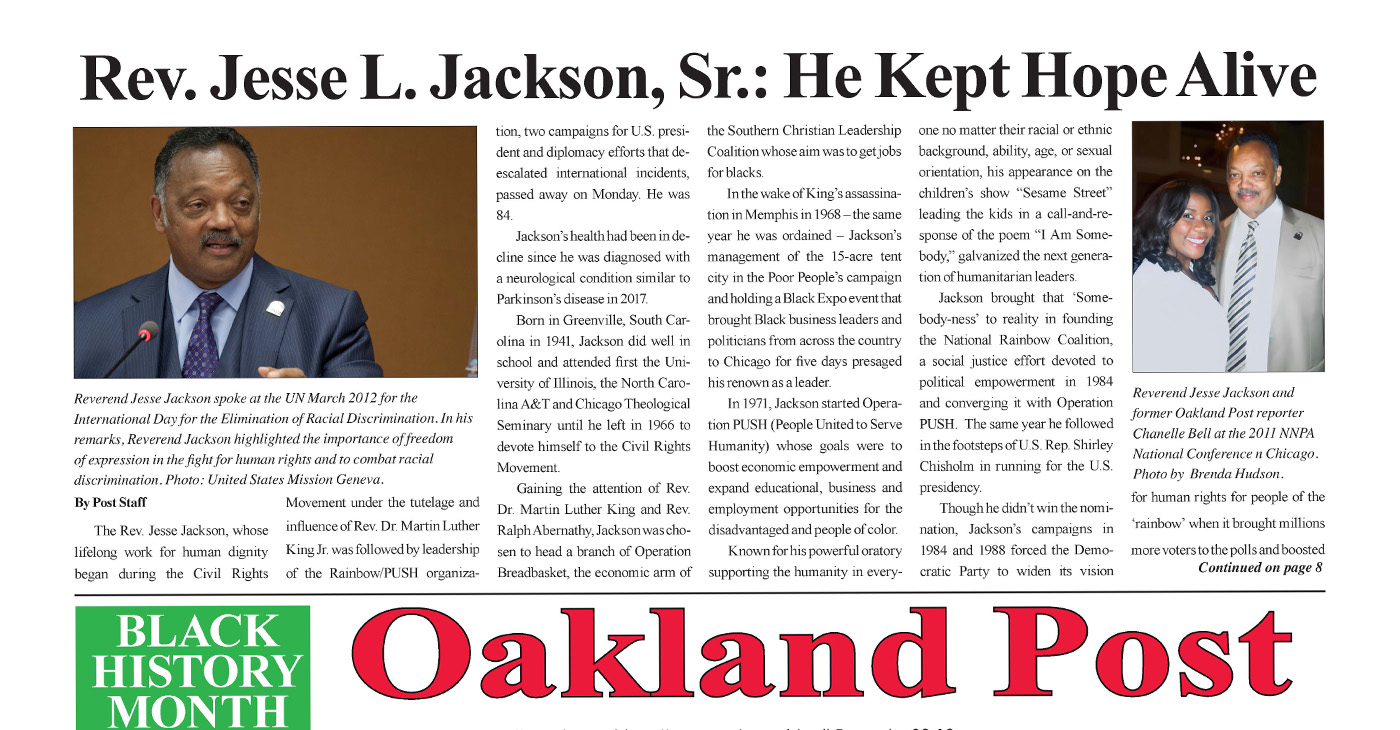
Oakland Post: Week of February 18 – 24, 2026
The printed Weekly Edition of the Oakland Post: Week of – February 18 – 24, 2026
To enlarge your view of this issue, use the slider, magnifying glass icon or full page icon in the lower right corner of the browser window.
Activism
Oakland Post: Week of February 11 – 17, 2026
The printed Weekly Edition of the Oakland Post: Week of – February 11 – 17, 2026

To enlarge your view of this issue, use the slider, magnifying glass icon or full page icon in the lower right corner of the browser window.

WORK FROM HOME
Home-based business with potential monthly income of $10K+ per month. A proven training system and website provided to maximize business effectiveness. Perfect job to earn side and primary income. Contact Lynne for more details: Lynne4npusa@gmail.com 800-334-0540


Poll Shows Support for Policies That Help Families Afford Child Care

Oakland Post: Week of February 25 – March 3, 2026

Trump’s MAGA Allies are Creating Executive Order Plan to Steal the 2026 Midterms

PRESS ROOM: NBA Hall of Fame Nominee Terry Cummings Joins 100 Black Men of DeKalb County to Launch Victory & Values Initiative

Reflecting on Black History Milestones in Birmingham AL

OP-ED: One Hundred Years of Black Workers Telling the Truth

PRESS ROOM: Civil Rights TV Launches in Selma as the World’s First 24/7 Civil Rights Television Network

Advancements in solar technology that are changing the way we power the world

U.S. manufacturing rebounds – how foundry services are adapting to rising demand

Why has blood testing become so popular in today’s world?

Ghana Mourns a Son of the African World

OP-ED: Trump’s Policies Hurt Black America—and Everyone Else

OP-ED: Meta Deleted Me. I Still Don’t Know Why. And neither will you.

More than a Mission: Paying It Forward for the Future of Education

Avoid Eviction This Season: Landlord Checklist for Stable Tenancies

Oakland Post: Week of January 28, 2025 – February 3, 2026

Life Expectancy in Marin City, a Black Community, Is 15-17 Years Less than the Rest of Marin County

Community Celebrates Turner Group Construction Company as Collins Drive Becomes Turner Group Drive

California Launches Study on Mileage Tax to Potentially Replace Gas Tax as Republicans Push Back

Discrimination in City Contracts

Oakland Post: Week of January 21 – 27, 2026

Book Review: Books on Black History and Black Life for Kids

COMMENTARY: The Biases We Don’t See — Preventing AI-Driven Inequality in Health Care

Post Newspaper Invites NNPA to Join Nationwide Probate Reform Initiative

Medi-Cal Cares for You and Your Baby Every Step of the Way

Black History Events in the East Bay

Art of the African Diaspora Celebrates Legacy and Community at Richmond Art Center

COMMENTARY: The National Protest Must Be Accompanied with Our Votes

After Don Lemon’s Arrest, Black Officials Raise Concerns About Independent Black Media

New Bill, the RIDER Safety Act, Would Support Transit Ambassadors and Safety on Public Transit

Hyundai Ioniq 5 Parking, Safety, and 360 View #shorts

2025 Ioniq 5 New Wiper & Powerful Performance! #shorts

Electric SUV Range: Is 259 Miles Enough? #shorts

EV Charging: How Fast Can You Charge an Electric Vehicle? #shorts

Biometric Cooling… Messaging Seats…Come on! 2025 Infiniti QX80 Autograph 4WD

Charged Up: Witness the Magic of a Fully Electric Car! #shorts

Range Rover Sport PHEV Included…: See What’s Inside This Luxury SUV! #shorts

Invisible Hood View: Perfect Parking with X-Ray Vision! #shorts

AI Is Reshaping Black Healthcare: Promise, Peril, and the Push for Improved Results in California

ESSAY: Technology and Medicine, a Primary Care Point of View

Sanctuary Cities

The RESISTANCE – FREEDOM NOW

STATE OF THE PEOPLE: Freddie

ECONOMIC BOYCOTT DAY!!!!!

I told You So

-
 Activism3 weeks ago
Community Celebrates Turner Group Construction Company as Collins Drive Becomes Turner Group Drive
-
 Business3 weeks ago
California Launches Study on Mileage Tax to Potentially Replace Gas Tax as Republicans Push Back
-
 Activism3 weeks ago
Discrimination in City Contracts
-
 Arts and Culture3 weeks ago
Book Review: Books on Black History and Black Life for Kids
-
 Activism3 weeks ago
COMMENTARY: The Biases We Don’t See — Preventing AI-Driven Inequality in Health Care
-
 Activism3 weeks ago
Post Newspaper Invites NNPA to Join Nationwide Probate Reform Initiative
-
 Alameda County4 weeks ago
Black History Events in the East Bay
-
 #NNPA BlackPress3 weeks ago
COMMENTARY: The National Protest Must Be Accompanied with Our Votes
