
Book Reviews
Book Review: “Sandy Feet! Whose Feet?

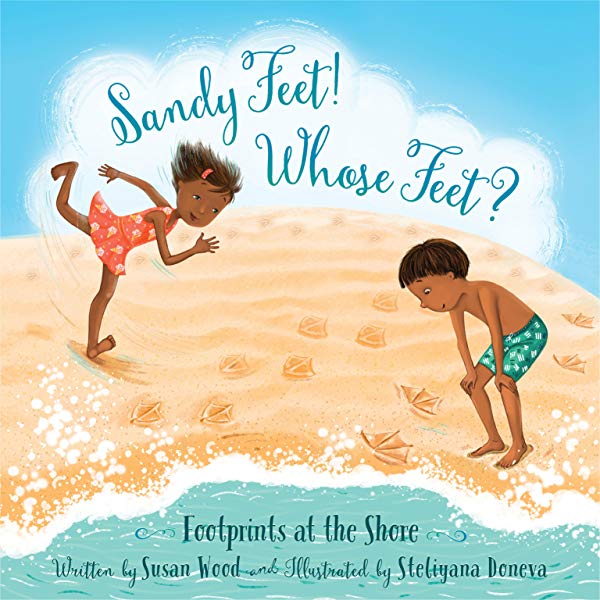
The sand feels funny, squishing between your toes.
It sticks to the bottom of your feet, the bottom of your hands, and the bottom of your swimsuit, and it’s fun to leave footprints in it, so you can see where you’ve been. It’s always a good day when you’re at the beach, but in “Sandy Feet! Whose Feet?” by Susan Wood, illustrated by Steliyana Doneva, who else is there with you?
It’s sunny, the water’s warm, and yay! You’re at the beach. The waves are perfect for splashing and the sand is wet in some places and dry in others. Who could resist making all kinds of footprints?
Not the dog, whose fat, furry paws make footprints in the sand. You can see his toe-marks and his clawprints as he runs around and splashes.
A sandpiper is a bird that lives at the beach and he runs back and forth on his quick little legs. He jumps and skips and you can see his toes in the sand, too, but they’re very small. The sandpiper’s footprints are from little bird feet.
The seagull, another bird, also leaves footprints on the sand.
If you watch over the water, you might see a pelican, as he dives for dinner. He’s a hungry guy, ready for a few fishy snacks.
Over there, right at the edge of shore, you can see a footprint that looks like someone dragged their feet. That’s the print of the crab, who “scuttles on its way” back to the water. Watch out for his claws! The footprints that look a little like a star are from a starfish who doesn’t want to be caught – and that other shuffle-mark is a turtle who might be ready to make her nest. Baby turtles are the cutest!
Pretty soon, it’s the end of the day and almost time to go home – but wait. Look at those long prints with five little round toes. Who do you think made those footprints in the sand?
The towels, toys, swimsuits and sunscreen are all piled up and ready to go. So are the kids; they’re so excited, they can barely sleep and “Sandy Feet! Whose Feet” is the perfect pre-vacation, before-bedtime treat.
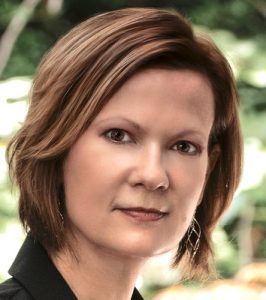
Author Susan Wood
Inside this book, author Susan Wood offers a simple rhyme that’s short on words and light on action, and illustrator Steliyana Doneva matches the tone with muted colors in her drawings. That means a quieter, more relaxing story for your little beachcomber, but it’s one they’ll remember as soon as they hit the sand.
Wood’s tale gives kids something to do while it imparts a different sort of lesson: they’re subtly challenged here to look for marks in the sand made by the beach’s wildlife. More importantly, the children inside this book are respectful of the water and are shown having fun and being safe.
For 4-to-8-year-olds, that’s just-right, and “Sandy Feet! Whose Feet?” may help parents make memories. If you’re heading to the beach for what’s left of summer, step out and get it.
“Sandy Feet! Whose Feet? Footprints at the Shore” by Susan Wood, illustrated by Steliyana Doneva, c.2019, Sleeping Bear Press, $16.99 / $21.99 Canada, 32 pages.

Arts and Culture
Book Review: Books on Black History and Black Life for Kids
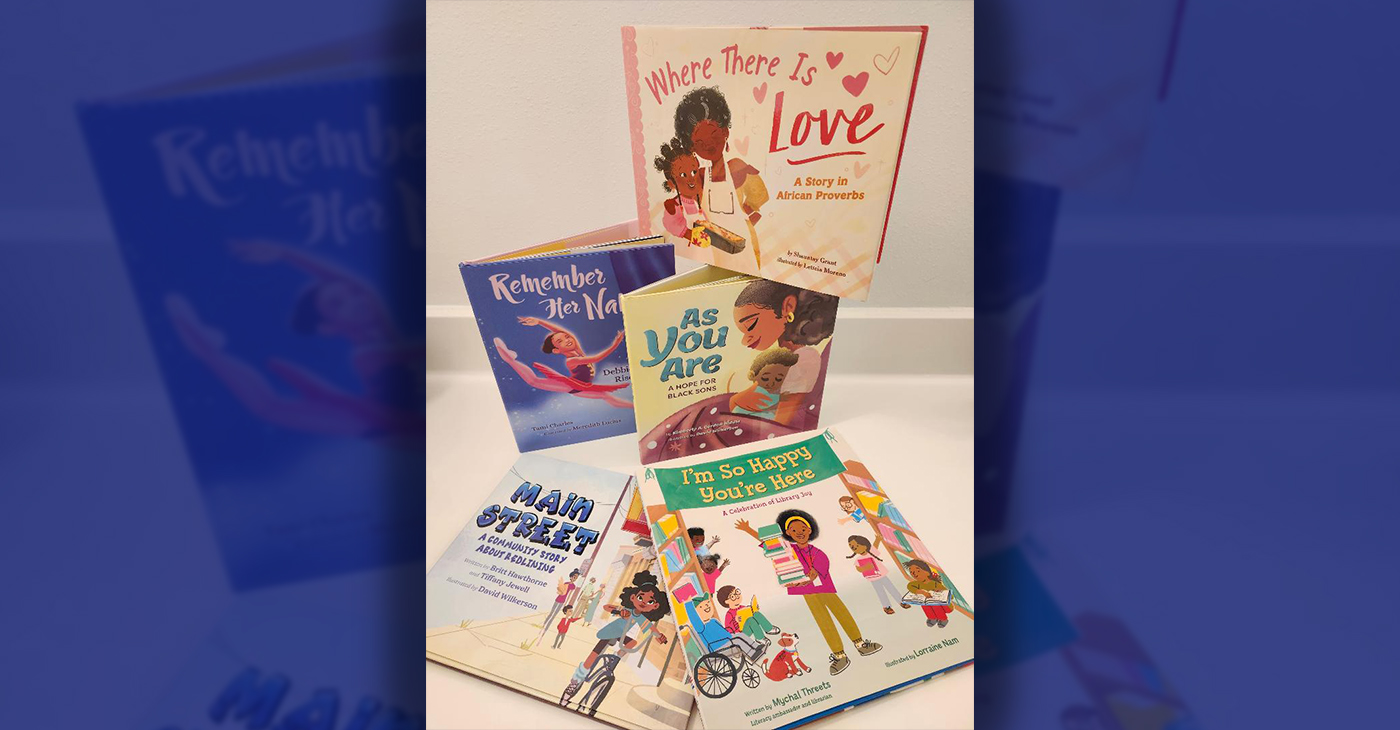
For the youngest reader, “As You Are: A Hope for Black Sons” by Kimberly A. Gordon Biddle, illustrated by David Wilkerson (Magination Press, $18.99) is a book for young Black boys and for their mothers. It’s a hope inside a prayer that the world treats a child gently, and it could make a great baby shower gift.

By Terri Schlichenmeyer
Authors: Various, Copyright: c. 2025, 2026, Publishers: Various, SRPs: $17.99-$18.99, Page Counts: Various,
Everybody in your family has stories to share.
Your parents have told you some, no doubt. Your grandparents have offered a few, too, and aunties and uncles have spun some good tales. But there’s so much more to know, so grab one of these great books and learn about Black History and Black life.
For the youngest reader, “As You Are: A Hope for Black Sons” by Kimberly A. Gordon Biddle, illustrated by David Wilkerson (Magination Press, $18.99) is a book for young Black boys and for their mothers. It’s a hope inside a prayer that the world treats a child gently, and it could make a great baby shower gift.
If someone said you couldn’t do something that you were clearly able to do, would you fight to do it anyhow? In the new book, “Remember Her Name! Debbie Allen’s Rise to Fame” by Tami Charles, illustrated by Meredith Lucius (Charlesbridge, $17.99), a young girl in the Jim Crow South is told that she can’t dance because of the color of her skin.
She didn’t listen, though, and neither did her mother, who took her daughter to Mexico, where the girl soared! This is an inspiration for any 5-to-7-year-old; be sure to check out the back-of-the-book information, if you’re an adult fan.

Do you often hear your elders say things that sound like lessons? They might be, so “Where There is Love: A Story of African Proverbs” by Shauntay Grant, illustrated by Leticia Moreno (Penguin Workshop, $18.99) is a book you’ll like. It’s a quick-to-read collection of short proverbs that you can say every day. Kids ages 4-to-6 will easily remember what they find in this book; again, look in the back for more information.
Surely, you love your neighborhood, which is why the tale inside “Main Street: A Community Story about Redlining” by Britt Hawthorne and Tiffany Jewell, illustrated by David Wilkerson (Penguin Kokila, $18.99) is a book for you.
Olivia’s neighborhood is having a block party, but she’s sad when no one shows up. That’s when she learns that “the government” is discriminating against the people and businesses near where she lives. So, what can she and her neighbors do? The answer might inspire 6-to-8-year-old kids to stand up to wrongs they see, and to help make their neighborhoods stronger and safer.
And finally, if a kid wants a book, where can they go to find it? In “I’m So Happy You’re Here: A Celebration of Library Joy” by Mychal Threets, illustrated by Lorraine Nam (Random House, $18.99) is a good introduction to the best of what a library has to offer. The freedom to walk into a library and borrow a book is the theme here, as is the sheer happiness of being welcomed, no matter who you are. This is an easy book for kids as young as two and as old as five to enjoy.
On that note, if you want more, head to that library, or a nearby bookstore. They’ll be glad to see you. They’ve got stories to share.

Advice
BOOK REVIEW: Let Me Be Real With You
At first look, this book might seem like just any other self-help offering. It’s inspirational for casual reader and business reader, both, just like most books in this genre. Dig a little deeper, though, and you’ll spot what makes “Let Me Be Real With You” stand out.

By Terri Schlichenmeyer
Author: Arshay Cooper, Copyright: c.2025, Publisher: HarperOne, SRP: $26.00, Page Count: 40 Pages
The hole you’re in is a deep one.
You can see the clouds above, and they look like a storm; you sense the wind, and it’s cold. It’s dark down there, and lonesome, too. You feel like you were born there — but how do you get out of the deep hole you’re in? You read the new book “Let Me Be Real With You” by Arshay Cooper. You find a hand-up and bring someone with you.
In the months after his first book was published, Cooper received a lot of requests to speak to youth about his life growing up on the West Side of Chicago, his struggles, and his many accomplishments. He was poor, bullied, and belittled, but he knew that if he could escape those things, he would succeed. He focused on doing what was best, and right. He looked for mentors and strove to understand when opportunities presented themselves.
Still, his early life left him with trauma. Here, he shows how it’s overcome-able.
We must always have hope, Cooper says, but hope is “merely the catalyst for action. The hope we receive must transform into the hope we give.”
Learn to tell your own story, as honestly as you know it. Be open to suggestions, and don’t dismiss them without great thought. Know that masculinity doesn’t equal stoicism; we are hard-wired to need other people, and sharing “pain and relatability can dissipate shame and foster empathy in powerful ways.”
Remember that trauma is intergenerational, and it can be passed down from parent to child. Let your mentors see your potential. Get therapy, if you need it; there’s no shame in it, and it will help, if you learn to trust it. Enjoy the outdoors when you can. Learn self-control. Give back to your community. Respect your financial wellness. Embrace your intelligence. Pick your friends and relationships wisely. “Do it afraid.”
And finally, remember that “You were born to soar to great heights and rule the sky.”
You just needed someone to tell you that.
At first look, this book might seem like just any other self-help offering. It’s inspirational for casual reader and business reader, both, just like most books in this genre. Dig a little deeper, though, and you’ll spot what makes “Let Me Be Real With You” stand out.
With a willingness to discuss the struggles he tackled in the past, Cooper writes with a solidly honest voice that’s exceptionally believable, and not one bit dramatic. You won’t find unnecessarily embellished stories or tall tales here, either; Cooper instead uses his real experiences to help readers understand that there are few things that are truly insurmountable. He then explains how one’s past can shape one’s future, and how today’s actions can change the future of the world.
“Let Me Be Real With You” is full of motivation, and instruction that’s do-able for adults and teens. If you need that, or if you’ve vowed to do better this coming year, it might help make you whole.
Arts and Culture
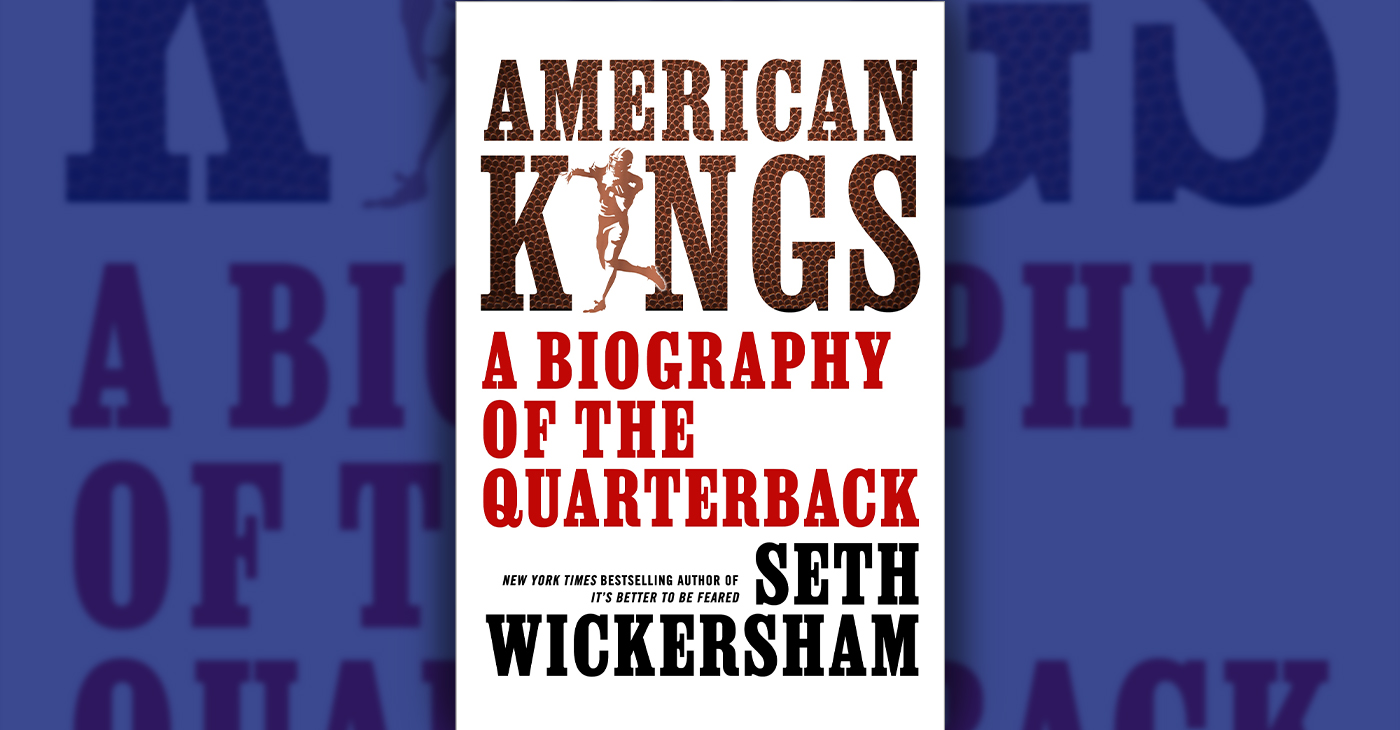
Book Review: American Kings – A Biography of the Quarterback
Wickersham calls his book “a biography,” but it’s just as much a history, since he refers often to the earliest days of the game, as well as the etymology of the word “quarterback.” That helps to lay a solid background, and it adds color to a reader’s knowledge about football itself, while explaining what it takes for men and women to stand out and to achieve gridiron greatness.
By Terri Schlichenmeyer
Author: Seth Wickersham, Copyright: c.2025, Publisher: Hyperion Avenue, Price: $29.99, Page Count: 407 pages
Snap.
And with that, and a catch that’s picture-perfect, your team is on its way to another win. The guy that threw the football sure knows his stuff. He’s worth every penny he’s paid, and in the new book “American Kings” by Seth Wickersham, you’ll see what it took to get there.
Like so many little boys, Wickersham wanted to play pro football when he was growing up; specifically, he wanted to be a quarterback. Unlike most other boys, though, he took it to an extreme, becoming “obsessed” with throwing a football with the best accuracy, hoping to match the skills of the players he admired.
Alas, despite an entire childhood of near-constant practice and a few wins on the field in high school, he didn’t make varsity and ended up playing as a receiver.
He knows now that to be a quarterback is to be a star, but it’s also “a way of life.”
Here, he writes about Arch Manning, “a legend, a folk hero, a song title… and the beginning of a family franchise…” Wickersham shares the story of Warren Moon, how he stepped up to help his mother when his father died, how domestic violence almost derailed his legacy, and the racism he quarterbacked under for years.
He spent time with Caleb Williams, “the first true professional amateur quarterback” to get money for playing at the college level. He interviewed James Harris, who was prepared to become a teacher “If the league didn’t want a Black quarterback…” Wickersham “spent much of 2022 with” Andrew Luck, who “learned quickly that greatness requires an… unlimited selfishness.” He writes about how Jack Elway influenced his son’s choice of career, what Hollywood had to do with one pro footballer’s life, and the post-career of the first player “to throw a consistently beautiful spiral.”
Says Wickersham about his subjects, “Anyone could throw a football. Only a quarterback could make people cheer.”
Your favorite chair is oiled for smooth reclining and fast slam-downs. The snacks are laid in for at least a week, and beverages are on ice. You know exactly what you’re wearing for the game this weekend. All you need is “American Kings” and you’re set.
Wickersham calls his book “a biography,” but it’s just as much a history, since he refers often to the earliest days of the game, as well as the etymology of the word “quarterback.” That helps to lay a solid background, and it adds color to a reader’s knowledge about football itself, while explaining what it takes for men and women to stand out and to achieve gridiron greatness. On that. Wickersham is honest, sometimes calling out his subjects for their attitudes toward teammates and others. Blunt words are used that are unprintable in family newspapers, so beware if you’re sharing.
Is your team’s QB in this book? Maybe. But, more than likely, a past favorite is, So, check out “American Kings” and see what you find. Football fans and pigskin prognosticators both will love this book in a snap.


WORK FROM HOME
Home-based business with potential monthly income of $10K+ per month. A proven training system and website provided to maximize business effectiveness. Perfect job to earn side and primary income. Contact Lynne for more details: Lynne4npusa@gmail.com 800-334-0540


COMMENTARY: Women of Color Shape Our Past and Future

Woman’s Search for Family’s Roots Leads to Ancestor John T. Ward – A Successful Entrepreneur and Conductor on the Underground Railroad

Advocates Raise Alarm Over ICE Operation, MOU and Detention Risks in Baltimore County

Pete Buttigieg to Join Mayor Randall Woodfin for Community Town Hall in Birmingham

WATCH: Week One – NNPA’s “Leadership Matters” Video Series

Oakland Post: Week of March 4 – 10, 2026

OP-ED: NNPA Launches 2026 “Leadership Matters” Video Series

PRESS ROOM: PMG and Cranbrook Horizons-Upward Bound Launch Journey Fellowship Cohort 2

Los Angeles Summit Brings Together Leaders to Tackle Poverty and Affordability

Civil Rights TV Launches 24/7 Network Focused on Black History, Education and Equity

REVIEW: The Ultimate Hot Girl Summer Getaway: Sunseeker Resort Florida

COMMENTARY: How You Stop a Prescription Medicine is as Important as How You Start

PRESS ROOM: From Congress to Corporate America: NNPA Spotlights Visionaries in New Video Series

Poll Shows Support for Policies That Help Families Afford Child Care

Oakland Post: Week of February 25 – March 3, 2026

Oakland Post: Week of January 28, 2025 – February 3, 2026

Life Expectancy in Marin City, a Black Community, Is 15-17 Years Less than the Rest of Marin County

Community Celebrates Turner Group Construction Company as Collins Drive Becomes Turner Group Drive

California Launches Study on Mileage Tax to Potentially Replace Gas Tax as Republicans Push Back

Discrimination in City Contracts

Book Review: Books on Black History and Black Life for Kids

COMMENTARY: The Biases We Don’t See — Preventing AI-Driven Inequality in Health Care

Black History Events in the East Bay

Post Newspaper Invites NNPA to Join Nationwide Probate Reform Initiative

Medi-Cal Cares for You and Your Baby Every Step of the Way

Art of the African Diaspora Celebrates Legacy and Community at Richmond Art Center

COMMENTARY: The National Protest Must Be Accompanied with Our Votes

New Bill, the RIDER Safety Act, Would Support Transit Ambassadors and Safety on Public Transit

Oakland Post: Week of February 4 – 10, 2026

After Don Lemon’s Arrest, Black Officials Raise Concerns About Independent Black Media

Hyundai Ioniq 5 Parking, Safety, and 360 View #shorts

2025 Ioniq 5 New Wiper & Powerful Performance! #shorts

Electric SUV Range: Is 259 Miles Enough? #shorts

EV Charging: How Fast Can You Charge an Electric Vehicle? #shorts

Biometric Cooling… Messaging Seats…Come on! 2025 Infiniti QX80 Autograph 4WD

Charged Up: Witness the Magic of a Fully Electric Car! #shorts

Range Rover Sport PHEV Included…: See What’s Inside This Luxury SUV! #shorts

Invisible Hood View: Perfect Parking with X-Ray Vision! #shorts

AI Is Reshaping Black Healthcare: Promise, Peril, and the Push for Improved Results in California

ESSAY: Technology and Medicine, a Primary Care Point of View

Sanctuary Cities

The RESISTANCE – FREEDOM NOW

STATE OF THE PEOPLE: Freddie

ECONOMIC BOYCOTT DAY!!!!!

I told You So
-
 Activism4 weeks ago
Discrimination in City Contracts
-

 Activism4 weeks ago
Oakland Post: Week of February 11 – 17, 2026
-

 #NNPA BlackPress2 weeks ago
Reflecting on Black History Milestones in Birmingham AL
-

 Advice4 weeks ago
Rising Optimism Among Small And Middle Market Business Leaders Suggests Growth for California
-
 Bay Area3 weeks ago
CITY OF SAN LEANDRO STATE OF CALIFORNIA PUBLIC WORKS DEPARTMENT ENGINEERING DIVISION NOTICE TO BIDDERS FOR ANNUAL STREET OVERLAY/REHABILITATION 2019-21 – PHASE III
-

 #NNPA BlackPress2 weeks ago
U.S. manufacturing rebounds – how foundry services are adapting to rising demand
-

 #NNPA BlackPress2 weeks ago
PRESS ROOM: NBA Hall of Fame Nominee Terry Cummings Joins 100 Black Men of DeKalb County to Launch Victory & Values Initiative
-
 Activism3 weeks ago
Oakland Post: Week of February 18 – 24, 2026
