
Commentary
COMMENTARY: Something to sing about
FLORIDA COURIER — Robert F. Smith’s gift of paying off the student loans of Morehouse College’s 2019 graduating class stunned the school’s students and faculty, but it was just the latest act of philanthropy by the quiet billionaire tech investment executive who is concerned that economic opportunities for African-Americans have narrowed.

By Wire Reports
WHO IS THIS MAN? A HUMBLE BUT ‘WOKE’ BLACK BILLIONAIRE
ATLANTA – Robert F. Smith’s gift of paying off the student loans of Morehouse College’s 2019 graduating class stunned the school’s students and faculty, but it was just the latest act of philanthropy by the quiet billionaire tech investment executive who is concerned that economic opportunities for African-Americans have narrowed.
“My family is going to create a grant to eliminate your student loans!” Smith told the graduates during his commencement address. “You great Morehouse men are bound only by the limits of your own conviction and creativity.”
MILLIONS IN DEBT ELIMINATED
Smith made the surprise announcement Sunday while giving the college’s commencement address. His gift is estimated at $40 million-plus.
Smith, 56, is the nation’s richest African-American – ahead of Oprah Winfrey–with a net worth of $5 billion, according to Forbes. He amassed his wealth as chief executive of Vista Equity Partners, a private equity firm in Austin, Texas, that he founded in 2000.
Vista Equity buys, grows and sells companies in the software and other technology fields. It manages $46 billion in investments with a portfolio of more than 50 companies that employ more than 60,000 people, according to the firm’s website.
TOP BLACK COMPANY
His company is No. 1 on the BE100s (Black Enterprise magazine’s annual list of the most successful Black-owned companies) Private Equity list with $14 billion in capital under management. His company has been named to the BE 100s list for about a decade. Vista Equity Partners was BE’s 2013 Financial Services Company of the Year.
Smith seldom gives interviews and operated in relative obscurity until a few years ago. His profile began growing in step with his philanthropy, much of which is aimed at supporting the African-American community, and with more public appearances.
Speaking at the Milken Institute Global Conference in Beverly Hills, Calif., this month, Smith warned that educational and economic opportunities for African-Americans had narrowed since the time he and other Denver children were bused to recently desegregated schools in the area.
‘Great public schools’
“There is only one of those folks that were on that bus that actually got incarcerated,” he said. “We have doctors. We have lawyers. We have politicians. We have investors – all because we had the opportunity to get into a great public school.
“That dynamic lived in my neighborhood. It doesn’t live in that neighborhood today as much as it did then. The economic opportunity that was afforded me, I think, has changed. It has shrunk.”
Smith said African-American communities are as segregated today as in the 1950s, subjecting them to “economic underdevelopment” that doesn’t allow them to fully participate in the economy.
He called for companies to invest in the problem, including by offering internships to underprivileged students who may not even be aware of the job opportunities created by the tech revolution.
Constantly giving
Months before saying he’d wipe out the student loans of this year’s graduating class, Smith announced a $1.5 million gift to Morehouse. He also has donated $20 million to the Smithsonian’s National Museum of African-American History and Culture in Washington, and he and his foundation have given $50 million to Cornell University, his alma mater.
In 2016, Smith became the first African-American to be named chairman of Carnegie Hall. He had served on the celebrated New York concert venue’s board and was a donor, and hall officials cited his passion for music and his desire to help undeserved communities connect with the arts.
At a gala last fall for the City of Hope – the cancer hospital and research center in Duarte, Calif. – Smith was the largest individual donor, with a gift of $500,000 that was earmarked for prostate cancer treatment for Black men and breast cancer research for Black women.
Smith also signed on to the Giving Pledge, a commitment by the world’s wealthiest individuals and families to dedicate a majority of their wealth to philanthropy. The concept was formed by Bill and Melinda Gates and Warren Buffett.
Living large
The Colorado native also enjoys the fruits of his success. He owns a $59 million penthouse in Manhattan and a $19.5 million mansion in Malibu, Calif., among other properties, according to media reports.
Smith has five children, three from his first marriage and two with wife Hope Dworaczyk, a former Playboy model he married in 2015.
The son of two high school principals with doctorate degrees, Smith grew up in a mostly Black middle-class neighborhood. In a Washington Post interview, he recalled that his father made sure music filled the house and that as they went to bed, the recordings of African-American opera star Leontyne Price played on the stereo.
STEM, then business
According to Black Enterprise, “Smith started his early life out as a computer geek and even interned at Bell Labs. Although he worked in the STEM (science, technology, engineering and math) field for some time after earning a degree in chemical engineering from Cornell, the financial world beckoned.”
Smith earned a bachelor’s degree in chemical engineering from Cornell, followed by an MBA from Columbia Business School and a stint at Kraft General Foods. He switched to tech investment banking in 1994 when he joined Goldman Sachs, where he worked on mergers and acquisitions in Silicon Valley and elsewhere, then stepped out on his own and started Vista Equity.
‘I can do that’
As his success and wealth grew, Smith maintained a low profile and shied away from being photographed. But now he’s more comfortable with his public profile in part because he wants young African-Americans to see what he’s accomplishing, Smith told the Post.
“Now I want people to say, ‘If Robert Smith can do it, I can do that and more,’” he said. “I could just live off my money. It might be a good life, though it wouldn’t be a fulfilled life.”
‘Love your community’
According to Black Enterprise, at an event last year at the Oakland, Calif., home of business strategist Carl Hackney, Smith spoke with a gathering of mostly Black politicians, venture capitalists, tech entrepreneurs, and philanthropists. He weighed in on the importance of investing in communities and his advice for future generations.
“Love your community by voting,” he said. “Love your community by taking care of your community. Love your community by actually doing something wherever you can.
“Think about what is it that you uniquely bring to a community that changes that community. Sometimes, it is words of inspiration. Most of the time it’s acts of inspiration. It is doing something, it is leading, it is taking advantage of what it is you have to provide.
“Sometimes what you have to provide is walking a child home every night so they feel safe. Sometimes it’s making sure a child is read to at night because their parent is at work. Sometimes it’s a scholarship. Sometimes it’s the encouragement to go dream big, go take the test, go try something different, go get an internship.
“Or it’s creating an internship, like the internship I got at Bell Labs when I was 17 years old, that allows them to stretch their imaginations,” he said.
Information from James F. Peltz and Laurence Darmiento of the Los Angeles Times/TNS and Samara Lynn, Caroline Clarke and Selena Hill of Black Enterprise was used to prepare this report.
This article originally appeared in the Florida Courier.









Activism
Oakland Post: Week of February 25 – March 3, 2026
The printed Weekly Edition of the Oakland Post: Week of – February 25 – March 3, 2026
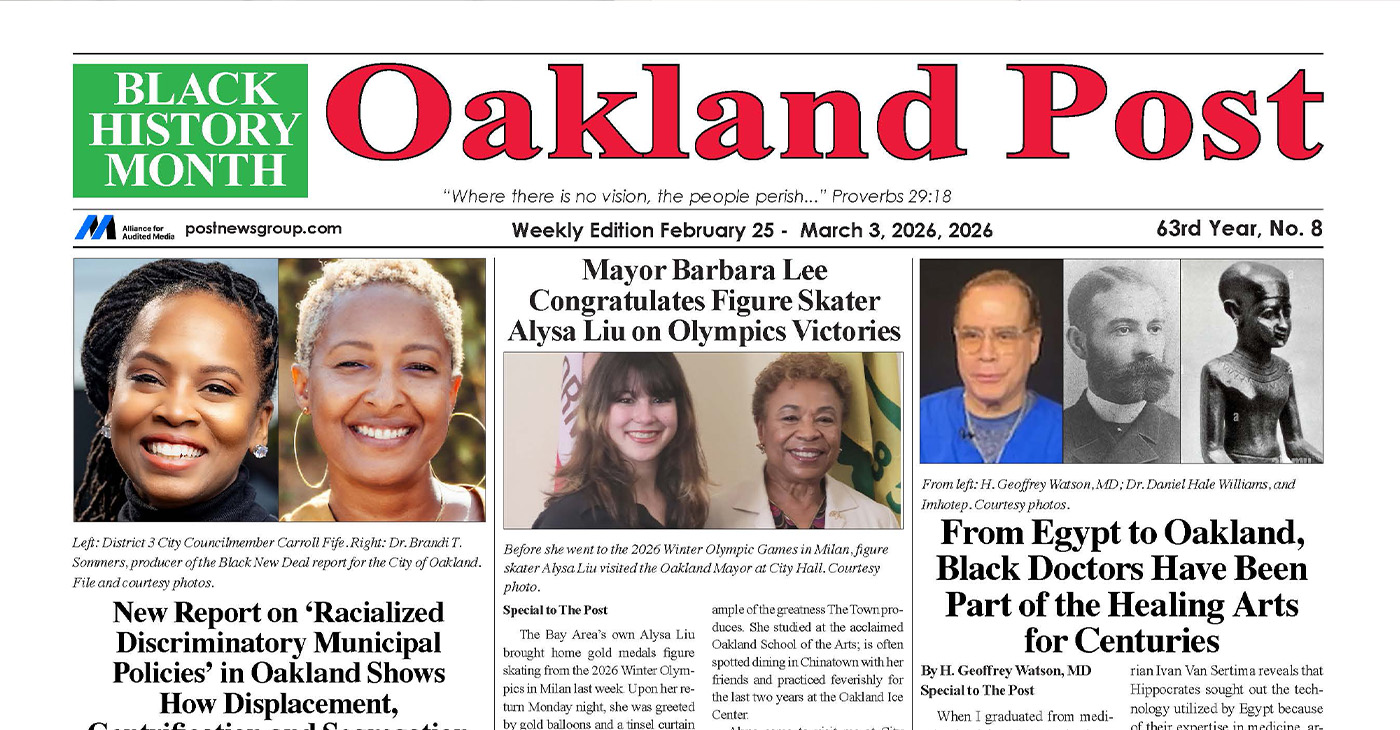
To enlarge your view of this issue, use the slider, magnifying glass icon or full page icon in the lower right corner of the browser window.
Activism
Oakland Post: Week of February 18 – 24, 2026
The printed Weekly Edition of the Oakland Post: Week of – February 18 – 24, 2026
To enlarge your view of this issue, use the slider, magnifying glass icon or full page icon in the lower right corner of the browser window.
Activism
Oakland Post: Week of February 11 – 17, 2026
The printed Weekly Edition of the Oakland Post: Week of – February 11 – 17, 2026

To enlarge your view of this issue, use the slider, magnifying glass icon or full page icon in the lower right corner of the browser window.
WORK FROM HOME
Home-based business with potential monthly income of $10K+ per month. A proven training system and website provided to maximize business effectiveness. Perfect job to earn side and primary income. Contact Lynne for more details: Lynne4npusa@gmail.com 800-334-0540


Poll Shows Support for Policies That Help Families Afford Child Care

Oakland Post: Week of February 25 – March 3, 2026

Trump’s MAGA Allies are Creating Executive Order Plan to Steal the 2026 Midterms

PRESS ROOM: NBA Hall of Fame Nominee Terry Cummings Joins 100 Black Men of DeKalb County to Launch Victory & Values Initiative

Reflecting on Black History Milestones in Birmingham AL

OP-ED: One Hundred Years of Black Workers Telling the Truth

PRESS ROOM: Civil Rights TV Launches in Selma as the World’s First 24/7 Civil Rights Television Network

Advancements in solar technology that are changing the way we power the world

U.S. manufacturing rebounds – how foundry services are adapting to rising demand

Why has blood testing become so popular in today’s world?

Ghana Mourns a Son of the African World

OP-ED: Trump’s Policies Hurt Black America—and Everyone Else

OP-ED: Meta Deleted Me. I Still Don’t Know Why. And neither will you.

More than a Mission: Paying It Forward for the Future of Education

Avoid Eviction This Season: Landlord Checklist for Stable Tenancies

Oakland Post: Week of January 28, 2025 – February 3, 2026

Life Expectancy in Marin City, a Black Community, Is 15-17 Years Less than the Rest of Marin County

Community Celebrates Turner Group Construction Company as Collins Drive Becomes Turner Group Drive

California Launches Study on Mileage Tax to Potentially Replace Gas Tax as Republicans Push Back

Discrimination in City Contracts

Book Review: Books on Black History and Black Life for Kids

Oakland Post: Week of January 21 – 27, 2026

COMMENTARY: The Biases We Don’t See — Preventing AI-Driven Inequality in Health Care

Post Newspaper Invites NNPA to Join Nationwide Probate Reform Initiative

Black History Events in the East Bay

Medi-Cal Cares for You and Your Baby Every Step of the Way

Art of the African Diaspora Celebrates Legacy and Community at Richmond Art Center

COMMENTARY: The National Protest Must Be Accompanied with Our Votes

New Bill, the RIDER Safety Act, Would Support Transit Ambassadors and Safety on Public Transit

After Don Lemon’s Arrest, Black Officials Raise Concerns About Independent Black Media

Hyundai Ioniq 5 Parking, Safety, and 360 View #shorts

2025 Ioniq 5 New Wiper & Powerful Performance! #shorts

Electric SUV Range: Is 259 Miles Enough? #shorts

EV Charging: How Fast Can You Charge an Electric Vehicle? #shorts

Biometric Cooling… Messaging Seats…Come on! 2025 Infiniti QX80 Autograph 4WD

Charged Up: Witness the Magic of a Fully Electric Car! #shorts

Range Rover Sport PHEV Included…: See What’s Inside This Luxury SUV! #shorts

Invisible Hood View: Perfect Parking with X-Ray Vision! #shorts

AI Is Reshaping Black Healthcare: Promise, Peril, and the Push for Improved Results in California

ESSAY: Technology and Medicine, a Primary Care Point of View

Sanctuary Cities

The RESISTANCE – FREEDOM NOW

STATE OF THE PEOPLE: Freddie

ECONOMIC BOYCOTT DAY!!!!!

I told You So
-
 Activism4 weeks ago
Community Celebrates Turner Group Construction Company as Collins Drive Becomes Turner Group Drive
-
 Business4 weeks ago
California Launches Study on Mileage Tax to Potentially Replace Gas Tax as Republicans Push Back
-
 Activism4 weeks ago
Discrimination in City Contracts
-
 Arts and Culture4 weeks ago
Book Review: Books on Black History and Black Life for Kids
-
 Activism4 weeks ago
COMMENTARY: The Biases We Don’t See — Preventing AI-Driven Inequality in Health Care
-
 Activism4 weeks ago
Post Newspaper Invites NNPA to Join Nationwide Probate Reform Initiative
-
 Alameda County4 weeks ago
Black History Events in the East Bay
-
 Activism4 weeks ago
Art of the African Diaspora Celebrates Legacy and Community at Richmond Art Center
