
City Government
Council Members, Community Angry at Mayor Schaaf’s Plan to Divert Soda Tax Money


Caption: Authors of the Soda Tax Measure HH were Oakland City Councilmembers Rebecca Kaplan, Desley Brooks and Annie Campbell Washington.
In a presentation at this week’s City Council meeting, Mayor Libby Schaaf’ attempted to put a positive slant on her proposals to close a $32.5 million deficit in the new two-year budget that will be adopted in June. But the mayor faced a backlash from council members and community speakers who were furious that she wanted to divert Measure HH soda tax revenues to help close the city’s deficit.
In face of the pressure, she backed away from the plan after a number of speakers, who said they had supported her in the last election, threated to campaign against her reelection.
Mayor Schaaf faced harsh criticism from Annie Campbell Washington, Rebecca Kaplan and Desley Brooks, the co-authors of Measure HH, which was on the November ballot and passed with 61 percent of the vote.
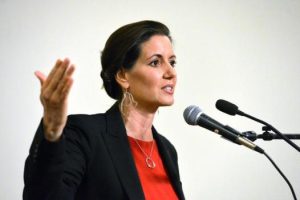
Mayor Libby Schaaf
The authors of the measure, along with community members, including, health professionals and advocates, urged the mayor to keep the faith with the voters and spend soda tax revenue according to community input to improve health and nutrition.
“This sets a bad precedent. We should honor our word (to the community),” said Councilmember Brooks.
“This sets a bad precedent on the national level (and could impact) soda tax measures across this country” she said. “We are talking about a serious health issue, and that´s what we went out to the community in good faith and said.”
“The issue is not whether the diversion of Measure HH money to the general fund is legal, said Campbell Washington. “What is completely unacceptable is to destroy the public trust that we built when we went door to door talking about the (measure), when we talked about health impacts in Black and Brown communities, caused by sodas.”
Kaplan said, “I will continue to fight to ensure that soda tax dollars are used properly, with community input, for programs and education to improve health and nutrition, particularly for our most vulnerable communities that have been disproportionately affected by diseases resulting from sugary drink consumption.”
Thirty-six speakers signed up to talk to the council about the issue.
A doctor who works for La Clinica in the Fruitvale said, “This money grab may be legal. But it´s not right. You know it´s not right. We all know it’s not right. I will work next time to unseat you.”
A public health professional said she worked alongside Mayor Schaaf to support Measure HH, serving as a precinct captain. “I put my credibility on the line. I´m not sure we were exactly campaigning for the same thing,” she said.
“It may well be political suicide. (People) will not forget what happens with this budget.”








Activism
Oakland Post: Week of March 4 – 10, 2026
The printed Weekly Edition of the Oakland Post: Week of March 4 – 10, 2026

To enlarge your view of this issue, use the slider, magnifying glass icon or full page icon in the lower right corner of the browser window.
Activism
Oakland Post: Week of February 25 – March 3, 2026
The printed Weekly Edition of the Oakland Post: Week of – February 25 – March 3, 2026

To enlarge your view of this issue, use the slider, magnifying glass icon or full page icon in the lower right corner of the browser window.
Activism
Oakland Post: Week of February 18 – 24, 2026
The printed Weekly Edition of the Oakland Post: Week of – February 18 – 24, 2026
To enlarge your view of this issue, use the slider, magnifying glass icon or full page icon in the lower right corner of the browser window.


WORK FROM HOME
Home-based business with potential monthly income of $10K+ per month. A proven training system and website provided to maximize business effectiveness. Perfect job to earn side and primary income. Contact Lynne for more details: Lynne4npusa@gmail.com 800-334-0540


COMMENTARY: Women of Color Shape Our Past and Future

Woman’s Search for Family’s Roots Leads to Ancestor John T. Ward – A Successful Entrepreneur and Conductor on the Underground Railroad

Advocates Raise Alarm Over ICE Operation, MOU and Detention Risks in Baltimore County

Pete Buttigieg to Join Mayor Randall Woodfin for Community Town Hall in Birmingham

WATCH: Week One – NNPA’s “Leadership Matters” Video Series

Oakland Post: Week of March 4 – 10, 2026

OP-ED: NNPA Launches 2026 “Leadership Matters” Video Series

PRESS ROOM: PMG and Cranbrook Horizons-Upward Bound Launch Journey Fellowship Cohort 2

Los Angeles Summit Brings Together Leaders to Tackle Poverty and Affordability

Civil Rights TV Launches 24/7 Network Focused on Black History, Education and Equity

REVIEW: The Ultimate Hot Girl Summer Getaway: Sunseeker Resort Florida

COMMENTARY: How You Stop a Prescription Medicine is as Important as How You Start

PRESS ROOM: From Congress to Corporate America: NNPA Spotlights Visionaries in New Video Series

Poll Shows Support for Policies That Help Families Afford Child Care

Oakland Post: Week of February 25 – March 3, 2026

Oakland Post: Week of January 28, 2025 – February 3, 2026

Life Expectancy in Marin City, a Black Community, Is 15-17 Years Less than the Rest of Marin County

Community Celebrates Turner Group Construction Company as Collins Drive Becomes Turner Group Drive

California Launches Study on Mileage Tax to Potentially Replace Gas Tax as Republicans Push Back

Discrimination in City Contracts

Book Review: Books on Black History and Black Life for Kids

COMMENTARY: The Biases We Don’t See — Preventing AI-Driven Inequality in Health Care

Black History Events in the East Bay

Post Newspaper Invites NNPA to Join Nationwide Probate Reform Initiative

Medi-Cal Cares for You and Your Baby Every Step of the Way

Art of the African Diaspora Celebrates Legacy and Community at Richmond Art Center

COMMENTARY: The National Protest Must Be Accompanied with Our Votes

New Bill, the RIDER Safety Act, Would Support Transit Ambassadors and Safety on Public Transit

Oakland Post: Week of February 4 – 10, 2026

After Don Lemon’s Arrest, Black Officials Raise Concerns About Independent Black Media

Hyundai Ioniq 5 Parking, Safety, and 360 View #shorts

2025 Ioniq 5 New Wiper & Powerful Performance! #shorts

Electric SUV Range: Is 259 Miles Enough? #shorts

EV Charging: How Fast Can You Charge an Electric Vehicle? #shorts

Biometric Cooling… Messaging Seats…Come on! 2025 Infiniti QX80 Autograph 4WD

Charged Up: Witness the Magic of a Fully Electric Car! #shorts

Range Rover Sport PHEV Included…: See What’s Inside This Luxury SUV! #shorts

Invisible Hood View: Perfect Parking with X-Ray Vision! #shorts

AI Is Reshaping Black Healthcare: Promise, Peril, and the Push for Improved Results in California

ESSAY: Technology and Medicine, a Primary Care Point of View

Sanctuary Cities

The RESISTANCE – FREEDOM NOW

STATE OF THE PEOPLE: Freddie

ECONOMIC BOYCOTT DAY!!!!!

I told You So
-
 Activism4 weeks ago
Discrimination in City Contracts
-

 Activism4 weeks ago
Oakland Post: Week of February 11 – 17, 2026
-

 #NNPA BlackPress2 weeks ago
Reflecting on Black History Milestones in Birmingham AL
-

 Advice4 weeks ago
Rising Optimism Among Small And Middle Market Business Leaders Suggests Growth for California
-

 Bay Area3 weeks ago
CITY OF SAN LEANDRO STATE OF CALIFORNIA PUBLIC WORKS DEPARTMENT ENGINEERING DIVISION NOTICE TO BIDDERS FOR ANNUAL STREET OVERLAY/REHABILITATION 2019-21 – PHASE III
-

 #NNPA BlackPress2 weeks ago
U.S. manufacturing rebounds – how foundry services are adapting to rising demand
-

 #NNPA BlackPress2 weeks ago
PRESS ROOM: NBA Hall of Fame Nominee Terry Cummings Joins 100 Black Men of DeKalb County to Launch Victory & Values Initiative
-
 Activism3 weeks ago
Oakland Post: Week of February 18 – 24, 2026
