
City Government
Gallo Backs Community Call for Police Accountability

Councilmember Noel Gallo is pushing the City Council to consider placing a charter amendment on the November ballot. The measure would create a public safety oversight commission to assume most of the authority over the police department, including discipline of officers, currently in the hands of the City Administrator’s office.
“There are some legitimate concerns here. – (Many people) in Oakland are talking about how they lack the trust in the City Council to even listen to and talk about their concerns,” said Gallo, speaking Thursday to the members of the council’s Rules Committee, which puts items on council agendas.
Gallois chair of the council’s Public Safety Committee.
The Rules Committee agreed Thursday to put the item on the June 24 Public Safety Committee meeting agenda only as informational item, which means it could not be passed at Public Safety and sent to the full council.
Councilmember Dan Kalb asked for the matter to be discussed again at next Thursday, Rules Committee meeting, indicating he would support Gallo’s motion, which would allow for possible action on the motion.

Supporters of placing a measure to create a Public Safety Oversight Commission on the November ballot include from left: Claudine Tong; child Dahlia Wong; Maria Dominguez from Ella Baker Center; Gwen Hardy of PUEBLO; Susan Schawl, a former CPRB member; PUEBLO Executive Director Rashidah Grinage; and Kyle Hudson, member of Oakland Youth Policy Builders. Photo by Ken Epstein
Councilmember Larry Reid says he opposes allowing the issue to go to the full council, and Councilmember Libby Schaaf appears to be reluctant.
Oakland Police Officers Association President Barry Donelan attended the meeting but declined to comment.
If it makes the ballot and passes, the oversight commission will combine the staff and responsibilities of the currently existing Citizens’ Police Review Board and the Community Policing Advisory Board. By combining the staff of existing boards, the new commission would not require additional funds.
To be on the November ballot, the City Council must vote in favor of putting the measure on the ballot before the council breaks in August for its regular summer recess.
The proposal is supported by the Coalition of Police Accountability, which includes the Oakland-Berkeley chapter of Black Women Organized for Political Action (BWOPA), the Ella Baker Center, the Mentoring Center, Oakland NAACP, People United for a Better Life in Oakland (PUEBLO), Chair of the Measure Y Oversight Committee Jose Dorado, as well an mayoral candidates Dan Siegel and Jason “Shake” Anderson.
Rashidah Grinage, PUEBLO’s executive director, spoke on behalf of the Coalition for Police Accountability. “If it’s just an information item, it dies right there,” she said. “If it doesn’t go to the council now, it will not make it to the ballot” until 2016.









Activism
Oakland Post: Week of March 4 – 10, 2026
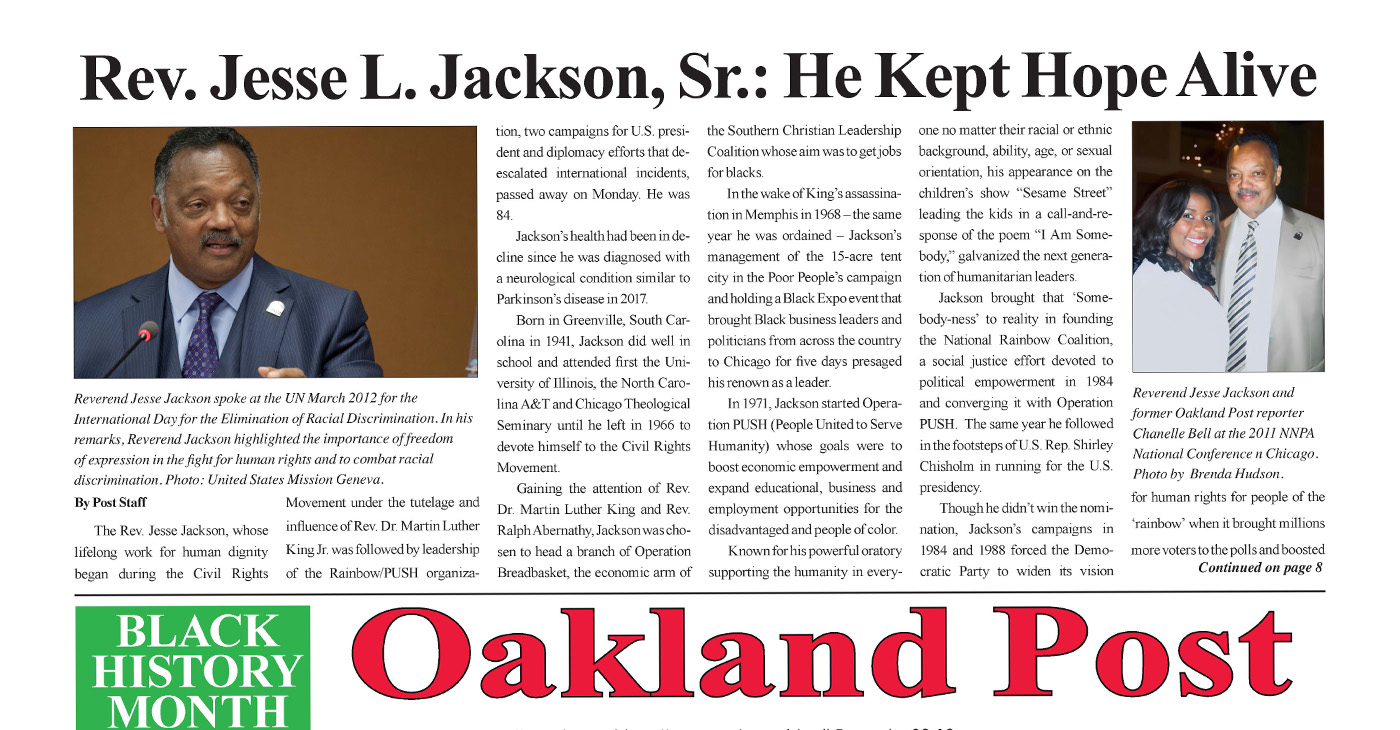
The printed Weekly Edition of the Oakland Post: Week of March 4 – 10, 2026
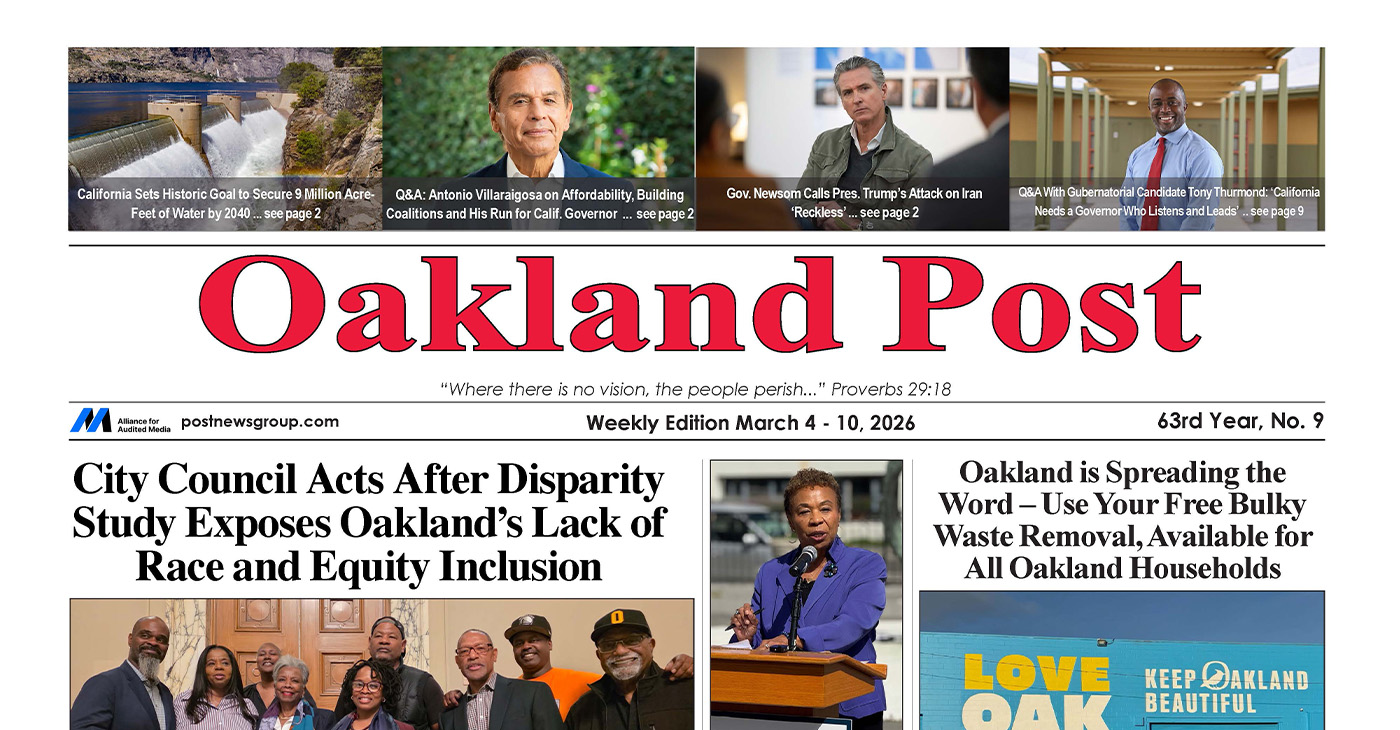
To enlarge your view of this issue, use the slider, magnifying glass icon or full page icon in the lower right corner of the browser window.
Activism
Oakland Post: Week of February 25 – March 3, 2026
The printed Weekly Edition of the Oakland Post: Week of – February 25 – March 3, 2026

To enlarge your view of this issue, use the slider, magnifying glass icon or full page icon in the lower right corner of the browser window.
Activism
Oakland Post: Week of February 18 – 24, 2026
The printed Weekly Edition of the Oakland Post: Week of – February 18 – 24, 2026
To enlarge your view of this issue, use the slider, magnifying glass icon or full page icon in the lower right corner of the browser window.


WORK FROM HOME
Home-based business with potential monthly income of $10K+ per month. A proven training system and website provided to maximize business effectiveness. Perfect job to earn side and primary income. Contact Lynne for more details: Lynne4npusa@gmail.com 800-334-0540


COMMENTARY: Women of Color Shape Our Past and Future

Woman’s Search for Family’s Roots Leads to Ancestor John T. Ward – A Successful Entrepreneur and Conductor on the Underground Railroad

Advocates Raise Alarm Over ICE Operation, MOU and Detention Risks in Baltimore County

Pete Buttigieg to Join Mayor Randall Woodfin for Community Town Hall in Birmingham

WATCH: Week One – NNPA’s “Leadership Matters” Video Series

Oakland Post: Week of March 4 – 10, 2026

OP-ED: NNPA Launches 2026 “Leadership Matters” Video Series

PRESS ROOM: PMG and Cranbrook Horizons-Upward Bound Launch Journey Fellowship Cohort 2

Los Angeles Summit Brings Together Leaders to Tackle Poverty and Affordability

Civil Rights TV Launches 24/7 Network Focused on Black History, Education and Equity

REVIEW: The Ultimate Hot Girl Summer Getaway: Sunseeker Resort Florida

COMMENTARY: How You Stop a Prescription Medicine is as Important as How You Start

PRESS ROOM: From Congress to Corporate America: NNPA Spotlights Visionaries in New Video Series

Poll Shows Support for Policies That Help Families Afford Child Care

Oakland Post: Week of February 25 – March 3, 2026

Oakland Post: Week of January 28, 2025 – February 3, 2026

Life Expectancy in Marin City, a Black Community, Is 15-17 Years Less than the Rest of Marin County

California Launches Study on Mileage Tax to Potentially Replace Gas Tax as Republicans Push Back

Community Celebrates Turner Group Construction Company as Collins Drive Becomes Turner Group Drive

Discrimination in City Contracts

Book Review: Books on Black History and Black Life for Kids

Oakland Post: Week of January 21 – 27, 2026

COMMENTARY: The Biases We Don’t See — Preventing AI-Driven Inequality in Health Care

Post Newspaper Invites NNPA to Join Nationwide Probate Reform Initiative

Black History Events in the East Bay

Medi-Cal Cares for You and Your Baby Every Step of the Way

Art of the African Diaspora Celebrates Legacy and Community at Richmond Art Center

COMMENTARY: The National Protest Must Be Accompanied with Our Votes

New Bill, the RIDER Safety Act, Would Support Transit Ambassadors and Safety on Public Transit

After Don Lemon’s Arrest, Black Officials Raise Concerns About Independent Black Media

Hyundai Ioniq 5 Parking, Safety, and 360 View #shorts

2025 Ioniq 5 New Wiper & Powerful Performance! #shorts

Electric SUV Range: Is 259 Miles Enough? #shorts

EV Charging: How Fast Can You Charge an Electric Vehicle? #shorts

Biometric Cooling… Messaging Seats…Come on! 2025 Infiniti QX80 Autograph 4WD

Charged Up: Witness the Magic of a Fully Electric Car! #shorts

Range Rover Sport PHEV Included…: See What’s Inside This Luxury SUV! #shorts

Invisible Hood View: Perfect Parking with X-Ray Vision! #shorts

AI Is Reshaping Black Healthcare: Promise, Peril, and the Push for Improved Results in California

ESSAY: Technology and Medicine, a Primary Care Point of View

Sanctuary Cities

The RESISTANCE – FREEDOM NOW

STATE OF THE PEOPLE: Freddie

ECONOMIC BOYCOTT DAY!!!!!

I told You So
-
 Business4 weeks ago
California Launches Study on Mileage Tax to Potentially Replace Gas Tax as Republicans Push Back
-
 Activism4 weeks ago
Community Celebrates Turner Group Construction Company as Collins Drive Becomes Turner Group Drive
-
 Activism4 weeks ago
Discrimination in City Contracts
-
 Arts and Culture4 weeks ago
Book Review: Books on Black History and Black Life for Kids
-
 Activism4 weeks ago
COMMENTARY: The Biases We Don’t See — Preventing AI-Driven Inequality in Health Care
-
 Activism4 weeks ago
Post Newspaper Invites NNPA to Join Nationwide Probate Reform Initiative
-
 #NNPA BlackPress4 weeks ago
COMMENTARY: The National Protest Must Be Accompanied with Our Votes
-
 Activism4 weeks ago
New Bill, the RIDER Safety Act, Would Support Transit Ambassadors and Safety on Public Transit
