
Black History
Hamline’s Black Student Collective 50 years strong
MINNESOTA SPOKESMAN-RECORDER — As the first student of color organization in the state’s oldest college, Hamline’s Black Student Collective has served to empower some of the state’s most prolific Black leaders and activists

As the first student of color organization in the state’s oldest college, Hamline’s Black Student Collective (BSC) has served to empower some of the state’s most prolific Black leaders and activists — including Juanita C. Freeman, Washington County’s first Black judge, and Anika Bowie, vice president of NAACP Minneapolis and current candidate for St. Paul City Council.
Now, the BSC is set to celebrate 50 years of service this weekend.
Black student unions across the country have proven to be effective support systems for Black students entering higher education. Whether first-generation or part of a familial legacy, Blacks entering college face significant challenges and disparities in course-readiness and access to resources.
Only 47 percent of Black students earn traditional “four-year” degrees within six years, while Whites graduate at a rate of 67 percent, according to the National Student Clearing Research Center. That’s in addition to other intangible social, mental and emotional issues that may arise while competing for grades within a population that does not always feel welcoming to them.
The Hamline student of color population has doubled over the past 20 years, now boasting 30 percent students of color, nine percent of whom are Black. While the look and landscape of the BSC have evolved over the years — changing its official name from P.R.I.D.E. (Promoting Racial Identity Dignity & Equality) to the Black Student Collective — the need for support is still there.
“We’re still in the middle of a civil rights situation,” said Carlos Sneed, associate dean of students at Hamline. “Although our numbers are large for a private school in Minnesota, our students are still interacting in an environment that wasn’t necessarily designed with them in mind,” he admitted. “We’ve gotten better, as have most colleges and universities, but White supremacy is still real. White Ethnocentric European thinking is still real. Students of color — and White students — still come from high schools that didn’t teach about the accomplishments or the experiences of people of color or women or LGBT people.”
Hamline’s students and alumni are quick to speak on the BSC’s impact. Bowie, a Hamline 2014 alum, said the BSC was her lifeline. Coming from a very diverse high school, she said, “Going to Hamline and being the only Black person in my classroom was a cultural shock.”
Having access to PRIDE, she said, “helped build community, promote African American scholars, and relating to other students… It had a real diverse hub — there were students from Duluth, Chicago, or from out of the country, like Liberia.”
She also noted the importance in creating safe spaces for Black people. “If you don’t have intentionality, then you’d find us marginalized in the corners of these primarily White universities,” said Bowie. “Just like the NAACP is a place that people to know to go if they have experienced any discrimination, Black student unions serve as a trusted organization for Black faces.”
Current BSC president Shania Smith agreed. “[BSC] is a home away from home…[where] we can just celebrate our Blackness and be around other Black students” said Smith, who is now a junior. She added being able to talk about issues in the Black communityis key. “I can talk to them about things that I struggle with that only Blacks or other POCs would understand.”
Sneed said that the BSC also supports retention rates in “subtle unquantifiable ways” by putting members in key leadership roles, having people who look like prospective students of color, as well as providing resources and cultural opportunities to celebrate their identity.
Freeman, a 2005 alum, will serve as keynote speaker for this Saturday’s planned PRIDE recognition. “She came in with a lot of academic and cultural capacity,” Sneed recalled of Freeman.
“I remember those conversations we had about her not only wanting to be a lawyer, but being a judge. She became involved, intricate and important to the campus community. What she gained in PRIDE and what she gave to PRIDE still continue to serve the organization well.”
Watching the BSC’s growth over the past 20 years, Sneed conjured images of the Ghana’s House of Slaves.
“There are doors that say ‘Door of No Return,’” he said. “I hope that this 50th anniversary will be a door of return for Black alumni. I want them to come back and tell their stories of being at Hamline and being in school, in high schools teaching, in the courtroom being lawyers. I want them to talk about working at 3M and Medtronic, and I want them to talk about being parents and partners. The time is right.”
Smith said that door is always open, whether alum or current students. “We just want people to feel supported.”
Hamline’s Black Student Collective 50th Anniversary Gala takes place Saturday, March 2 at Hamline University Anderson Student Center and Forum. For more information, visit hamline.edu.
This article originally appeared in the Minnesota Spokesman-Recorder.





Activism
Oakland Post: Week of February 25 – March 3, 2026
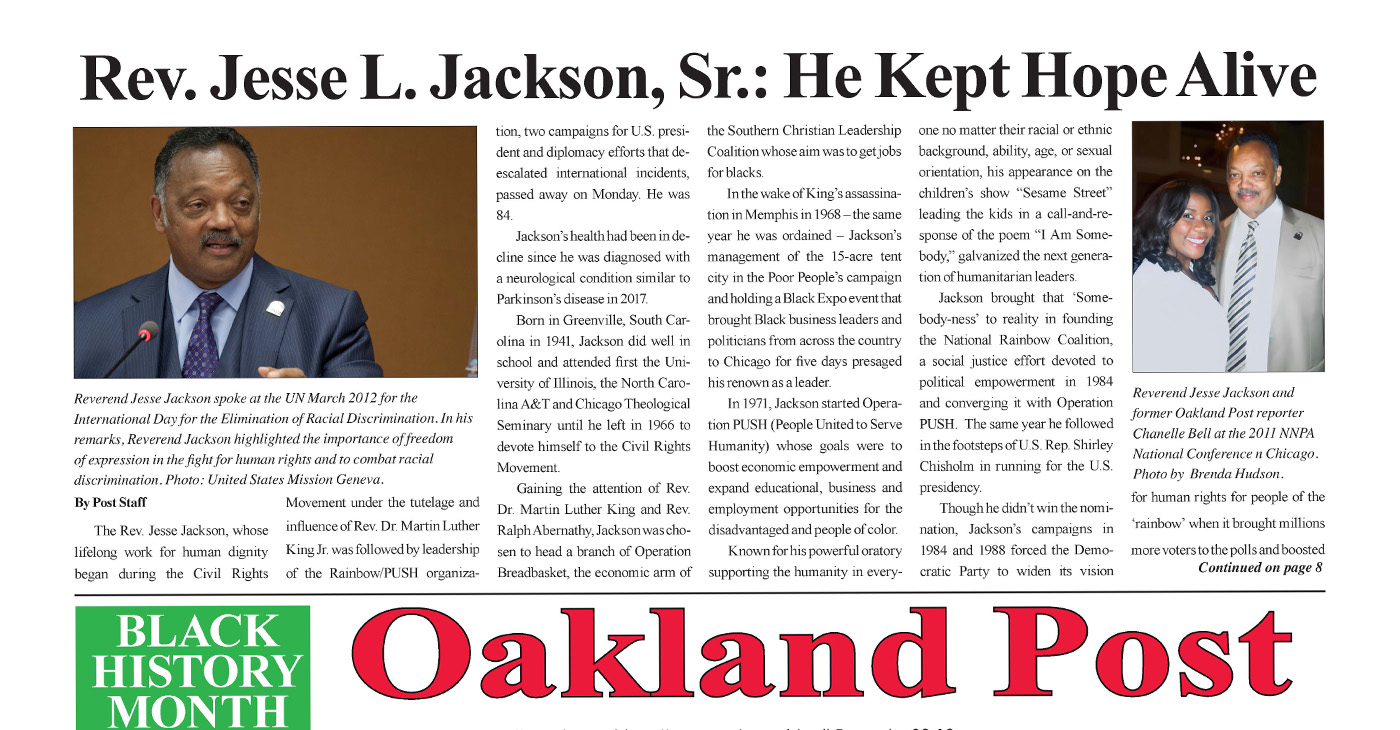
The printed Weekly Edition of the Oakland Post: Week of – February 25 – March 3, 2026

To enlarge your view of this issue, use the slider, magnifying glass icon or full page icon in the lower right corner of the browser window.
Activism
Oakland Post: Week of February 18 – 24, 2026
The printed Weekly Edition of the Oakland Post: Week of – February 18 – 24, 2026
To enlarge your view of this issue, use the slider, magnifying glass icon or full page icon in the lower right corner of the browser window.
Activism
Oakland Post: Week of February 11 – 17, 2026
The printed Weekly Edition of the Oakland Post: Week of – February 11 – 17, 2026

To enlarge your view of this issue, use the slider, magnifying glass icon or full page icon in the lower right corner of the browser window.

WORK FROM HOME
Home-based business with potential monthly income of $10K+ per month. A proven training system and website provided to maximize business effectiveness. Perfect job to earn side and primary income. Contact Lynne for more details: Lynne4npusa@gmail.com 800-334-0540


Poll Shows Support for Policies That Help Families Afford Child Care

Oakland Post: Week of February 25 – March 3, 2026

Trump’s MAGA Allies are Creating Executive Order Plan to Steal the 2026 Midterms

PRESS ROOM: NBA Hall of Fame Nominee Terry Cummings Joins 100 Black Men of DeKalb County to Launch Victory & Values Initiative

Reflecting on Black History Milestones in Birmingham AL

OP-ED: One Hundred Years of Black Workers Telling the Truth

PRESS ROOM: Civil Rights TV Launches in Selma as the World’s First 24/7 Civil Rights Television Network

Advancements in solar technology that are changing the way we power the world

U.S. manufacturing rebounds – how foundry services are adapting to rising demand

Why has blood testing become so popular in today’s world?

Ghana Mourns a Son of the African World

OP-ED: Trump’s Policies Hurt Black America—and Everyone Else

OP-ED: Meta Deleted Me. I Still Don’t Know Why. And neither will you.

More than a Mission: Paying It Forward for the Future of Education

Avoid Eviction This Season: Landlord Checklist for Stable Tenancies

Oakland Post: Week of January 28, 2025 – February 3, 2026

Life Expectancy in Marin City, a Black Community, Is 15-17 Years Less than the Rest of Marin County

Community Celebrates Turner Group Construction Company as Collins Drive Becomes Turner Group Drive

California Launches Study on Mileage Tax to Potentially Replace Gas Tax as Republicans Push Back

Discrimination in City Contracts

Book Review: Books on Black History and Black Life for Kids

Oakland Post: Week of January 21 – 27, 2026

COMMENTARY: The Biases We Don’t See — Preventing AI-Driven Inequality in Health Care

Post Newspaper Invites NNPA to Join Nationwide Probate Reform Initiative

Medi-Cal Cares for You and Your Baby Every Step of the Way

Black History Events in the East Bay

Art of the African Diaspora Celebrates Legacy and Community at Richmond Art Center

COMMENTARY: The National Protest Must Be Accompanied with Our Votes

New Bill, the RIDER Safety Act, Would Support Transit Ambassadors and Safety on Public Transit

After Don Lemon’s Arrest, Black Officials Raise Concerns About Independent Black Media

Hyundai Ioniq 5 Parking, Safety, and 360 View #shorts

2025 Ioniq 5 New Wiper & Powerful Performance! #shorts

Electric SUV Range: Is 259 Miles Enough? #shorts

EV Charging: How Fast Can You Charge an Electric Vehicle? #shorts

Biometric Cooling… Messaging Seats…Come on! 2025 Infiniti QX80 Autograph 4WD

Charged Up: Witness the Magic of a Fully Electric Car! #shorts

Range Rover Sport PHEV Included…: See What’s Inside This Luxury SUV! #shorts

Invisible Hood View: Perfect Parking with X-Ray Vision! #shorts

AI Is Reshaping Black Healthcare: Promise, Peril, and the Push for Improved Results in California

ESSAY: Technology and Medicine, a Primary Care Point of View

Sanctuary Cities

The RESISTANCE – FREEDOM NOW

STATE OF THE PEOPLE: Freddie

ECONOMIC BOYCOTT DAY!!!!!

I told You So
-
 Activism4 weeks ago
Community Celebrates Turner Group Construction Company as Collins Drive Becomes Turner Group Drive
-
 Business4 weeks ago
California Launches Study on Mileage Tax to Potentially Replace Gas Tax as Republicans Push Back
-
 Activism4 weeks ago
Discrimination in City Contracts
-
 Arts and Culture4 weeks ago
Book Review: Books on Black History and Black Life for Kids
-
 Activism4 weeks ago
COMMENTARY: The Biases We Don’t See — Preventing AI-Driven Inequality in Health Care
-
 Activism4 weeks ago
Post Newspaper Invites NNPA to Join Nationwide Probate Reform Initiative
-
 Alameda County4 weeks ago
Black History Events in the East Bay
-
 Activism4 weeks ago
Art of the African Diaspora Celebrates Legacy and Community at Richmond Art Center
