
Entertainment
Ledisi ‘Disappointed’ Not Upset Over Beyonce Grammys Switch


Beyonce performs at the 57th annual Grammy Awards on Sunday, Feb. 8, 2015, in Los Angeles. (Photo by John Shearer/Invision/AP)
Nekesa Mumbi Moody, ASSOCIATED PRESS
LOS ANGELES (AP) — Beyonce gave a resplendent rendition of “Precious Lord, Take My Hand” at the Grammys but it was Ledisi who gave the song revived attention with her performance of it for “Selma.”
Ledisi plays Mahalia Jackson in the Oscar-nominated film and sings the song on the movie’s soundtrack, so some of her fans expressed anger on social media that she was not asked to perform on the Grammys. (John Legend and Common performed their song from the movie, “Glory,” which has been nominated for an Academy Award.)
The Grammy-nominated Ledisi said she understands why Beyonce was chosen, but admitted to being “a little disappointed.”
“But I got over that and I had to look at the positive and empower women,” she told The Associated Press on the Grammy red carpet on Sunday before the show started. “We have to empower each other. It’s a great thing. And one day I’ll be on that Grammy stage. Every artist wants to be on the Grammys stage. That’s part of our career is to be there. So my time will come when it’s time.”
And Ledisi said she is glad more focus is coming to “Selma.”
“I was able to portray an iconic gospel singer, the queen of gospel Mahalia Jackson. I sang the version she sang, take my hand as well with Thomas Dorsey writing it and now we get to see Beyoncé sing a song that’s been living forever and to her generation,” she said. “It’s great. I’m part of a legacy of great women and the Queen of Soul (Aretha Franklin) sang it as well. So I’m a part of that.”
___
Xixi Yang contributed to this report.
Copyright 2015 The Associated Press. All rights reserved. This material may not be published, broadcast, rewritten or redistributed.
###




Activism
Oakland Post: Week of February 18 – 24, 2026
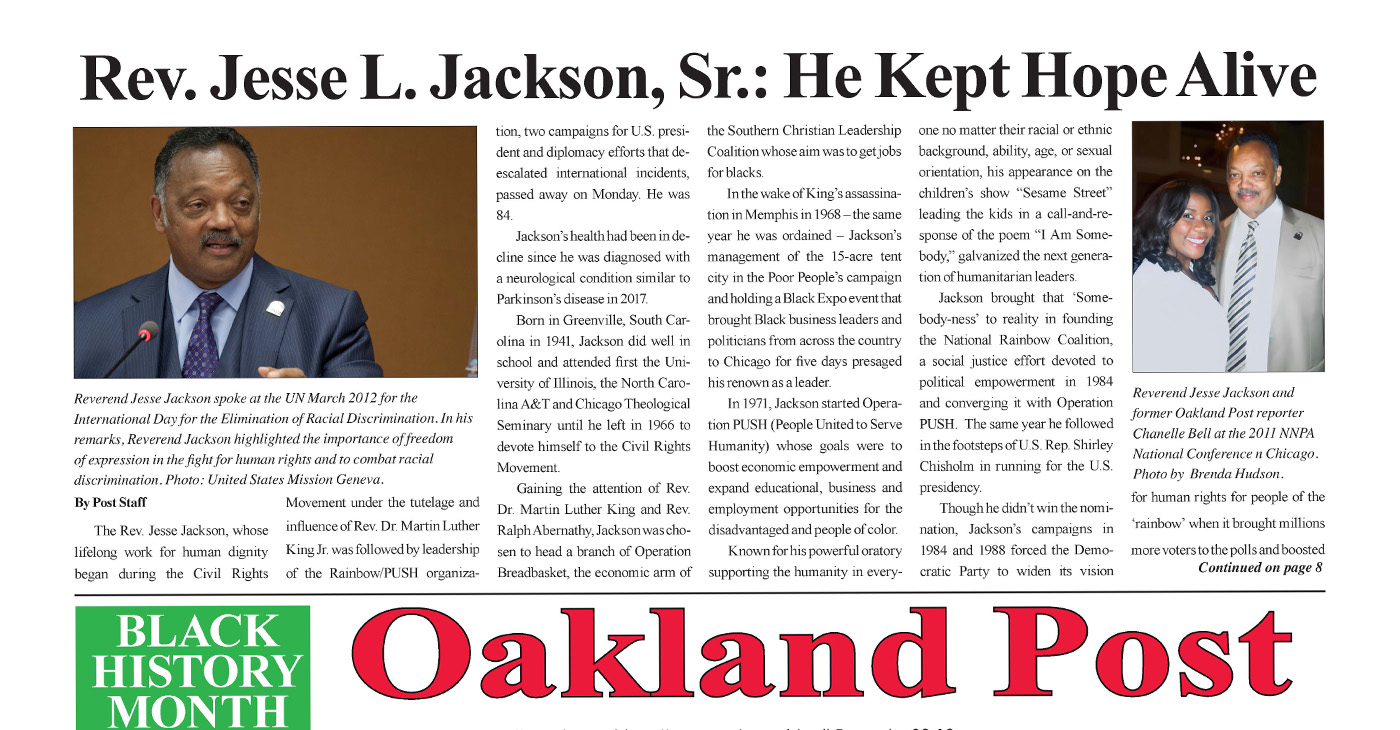
The printed Weekly Edition of the Oakland Post: Week of – February 18 – 24, 2026

To enlarge your view of this issue, use the slider, magnifying glass icon or full page icon in the lower right corner of the browser window.

Activism
Oakland Post: Week of February 11 – 17, 2026
The printed Weekly Edition of the Oakland Post: Week of – February 11 – 17, 2026

To enlarge your view of this issue, use the slider, magnifying glass icon or full page icon in the lower right corner of the browser window.

Arts and Culture
Book Review: Books on Black History and Black Life for Kids
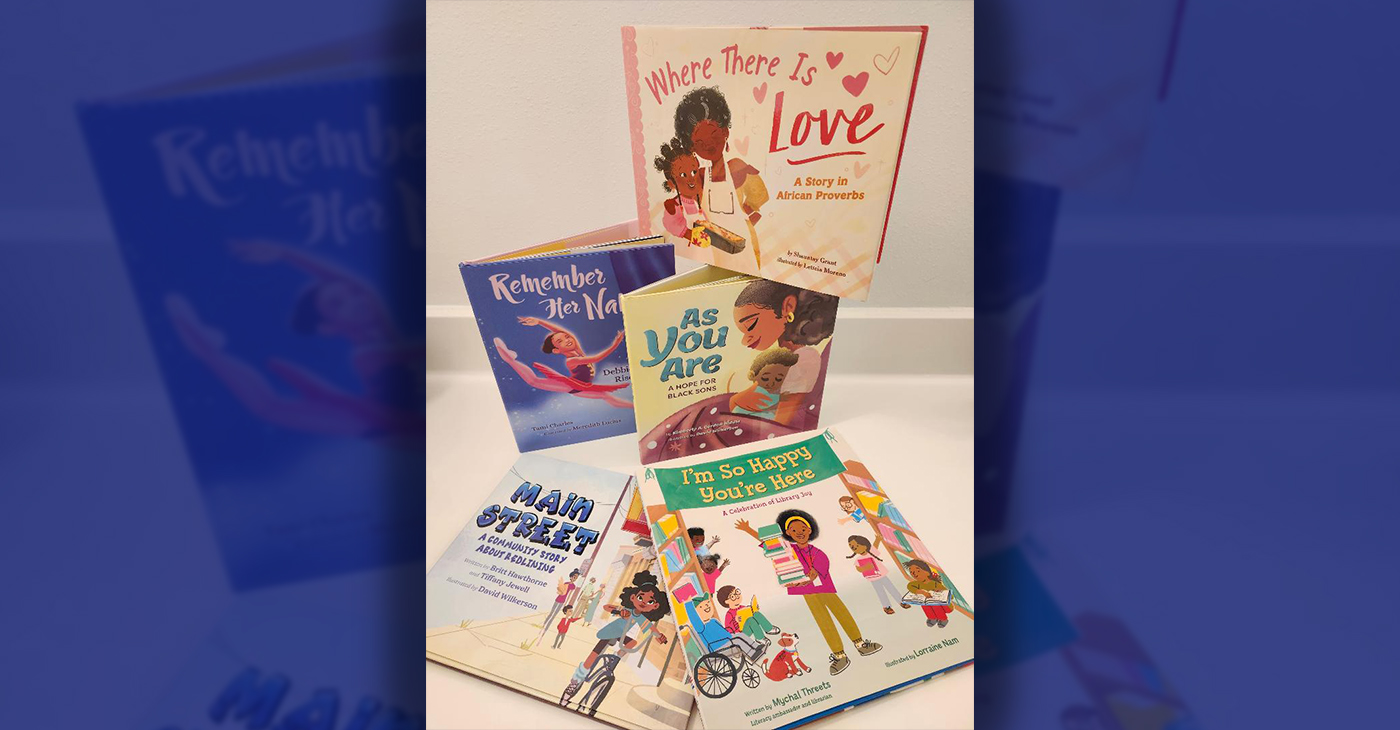
For the youngest reader, “As You Are: A Hope for Black Sons” by Kimberly A. Gordon Biddle, illustrated by David Wilkerson (Magination Press, $18.99) is a book for young Black boys and for their mothers. It’s a hope inside a prayer that the world treats a child gently, and it could make a great baby shower gift.
By Terri Schlichenmeyer
Authors: Various, Copyright: c. 2025, 2026, Publishers: Various, SRPs: $17.99-$18.99, Page Counts: Various,
Everybody in your family has stories to share.
Your parents have told you some, no doubt. Your grandparents have offered a few, too, and aunties and uncles have spun some good tales. But there’s so much more to know, so grab one of these great books and learn about Black History and Black life.
For the youngest reader, “As You Are: A Hope for Black Sons” by Kimberly A. Gordon Biddle, illustrated by David Wilkerson (Magination Press, $18.99) is a book for young Black boys and for their mothers. It’s a hope inside a prayer that the world treats a child gently, and it could make a great baby shower gift.
If someone said you couldn’t do something that you were clearly able to do, would you fight to do it anyhow? In the new book, “Remember Her Name! Debbie Allen’s Rise to Fame” by Tami Charles, illustrated by Meredith Lucius (Charlesbridge, $17.99), a young girl in the Jim Crow South is told that she can’t dance because of the color of her skin.
She didn’t listen, though, and neither did her mother, who took her daughter to Mexico, where the girl soared! This is an inspiration for any 5-to-7-year-old; be sure to check out the back-of-the-book information, if you’re an adult fan.

Do you often hear your elders say things that sound like lessons? They might be, so “Where There is Love: A Story of African Proverbs” by Shauntay Grant, illustrated by Leticia Moreno (Penguin Workshop, $18.99) is a book you’ll like. It’s a quick-to-read collection of short proverbs that you can say every day. Kids ages 4-to-6 will easily remember what they find in this book; again, look in the back for more information.
Surely, you love your neighborhood, which is why the tale inside “Main Street: A Community Story about Redlining” by Britt Hawthorne and Tiffany Jewell, illustrated by David Wilkerson (Penguin Kokila, $18.99) is a book for you.
Olivia’s neighborhood is having a block party, but she’s sad when no one shows up. That’s when she learns that “the government” is discriminating against the people and businesses near where she lives. So, what can she and her neighbors do? The answer might inspire 6-to-8-year-old kids to stand up to wrongs they see, and to help make their neighborhoods stronger and safer.
And finally, if a kid wants a book, where can they go to find it? In “I’m So Happy You’re Here: A Celebration of Library Joy” by Mychal Threets, illustrated by Lorraine Nam (Random House, $18.99) is a good introduction to the best of what a library has to offer. The freedom to walk into a library and borrow a book is the theme here, as is the sheer happiness of being welcomed, no matter who you are. This is an easy book for kids as young as two and as old as five to enjoy.
On that note, if you want more, head to that library, or a nearby bookstore. They’ll be glad to see you. They’ve got stories to share.
WORK FROM HOME
Home-based business with potential monthly income of $10K+ per month. A proven training system and website provided to maximize business effectiveness. Perfect job to earn side and primary income. Contact Lynne for more details: Lynne4npusa@gmail.com 800-334-0540


PRESS ROOM: NBA Hall of Fame Nominee Terry Cummings Joins 100 Black Men of DeKalb County to Launch Victory & Values Initiative

Reflecting on Black History Milestones in Birmingham AL

OP-ED: One Hundred Years of Black Workers Telling the Truth

PRESS ROOM: Civil Rights TV Launches in Selma as the World’s First 24/7 Civil Rights Television Network

Advancements in solar technology that are changing the way we power the world

U.S. manufacturing rebounds – how foundry services are adapting to rising demand

Why has blood testing become so popular in today’s world?

Ghana Mourns a Son of the African World

OP-ED: Trump’s Policies Hurt Black America—and Everyone Else

OP-ED: Meta Deleted Me. I Still Don’t Know Why. And neither will you.

More than a Mission: Paying It Forward for the Future of Education

Avoid Eviction This Season: Landlord Checklist for Stable Tenancies

How chronic back problems affect Black communities differently

How cancer care is evolving with modern medicine

Diabetes disparity: Understanding Type 2 risks for Black Americans

Life Expectancy in Marin City, a Black Community, Is 15-17 Years Less than the Rest of Marin County

Oakland Post: Week of January 28, 2025 – February 3, 2026

Community Celebrates Turner Group Construction Company as Collins Drive Becomes Turner Group Drive

California Launches Study on Mileage Tax to Potentially Replace Gas Tax as Republicans Push Back

Discrimination in City Contracts

Oakland Post: Week of January 21 – 27, 2026

Book Review: Books on Black History and Black Life for Kids

Medi-Cal Cares for You and Your Baby Every Step of the Way

COMMENTARY: The Biases We Don’t See — Preventing AI-Driven Inequality in Health Care

Post Newspaper Invites NNPA to Join Nationwide Probate Reform Initiative

After Don Lemon’s Arrest, Black Officials Raise Concerns About Independent Black Media

OP-ED: The Dream Cannot be Realized Without Financial Freedom

COMMENTARY: The National Protest Must Be Accompanied with Our Votes

Black History Events in the East Bay

Art of the African Diaspora Celebrates Legacy and Community at Richmond Art Center

Hyundai Ioniq 5 Parking, Safety, and 360 View #shorts

2025 Ioniq 5 New Wiper & Powerful Performance! #shorts

Electric SUV Range: Is 259 Miles Enough? #shorts

EV Charging: How Fast Can You Charge an Electric Vehicle? #shorts

Biometric Cooling… Messaging Seats…Come on! 2025 Infiniti QX80 Autograph 4WD

Charged Up: Witness the Magic of a Fully Electric Car! #shorts

Range Rover Sport PHEV Included…: See What’s Inside This Luxury SUV! #shorts

Invisible Hood View: Perfect Parking with X-Ray Vision! #shorts

AI Is Reshaping Black Healthcare: Promise, Peril, and the Push for Improved Results in California

ESSAY: Technology and Medicine, a Primary Care Point of View

Sanctuary Cities

The RESISTANCE – FREEDOM NOW

STATE OF THE PEOPLE: Freddie

ECONOMIC BOYCOTT DAY!!!!!

I told You So

-
 Activism4 weeks ago
Life Expectancy in Marin City, a Black Community, Is 15-17 Years Less than the Rest of Marin County
-
 Activism4 weeks ago
Oakland Post: Week of January 28, 2025 – February 3, 2026
-
 Activism3 weeks ago
Community Celebrates Turner Group Construction Company as Collins Drive Becomes Turner Group Drive
-
 Business3 weeks ago
California Launches Study on Mileage Tax to Potentially Replace Gas Tax as Republicans Push Back
-
 Activism3 weeks ago
Discrimination in City Contracts
-
 Arts and Culture3 weeks ago
Book Review: Books on Black History and Black Life for Kids
-
 Activism4 weeks ago
Medi-Cal Cares for You and Your Baby Every Step of the Way
-
 Activism3 weeks ago
COMMENTARY: The Biases We Don’t See — Preventing AI-Driven Inequality in Health Care
