
Politics
Lynch to Bring Prosecutor’s Perspective to Justice Dept.


Attorney General nominee Loretta Lynch is sworn in on Capitol Hill in Washington, Wednesday, Jan. 28, 2015, prior to testifying before the Senate Judiciary Committee hearing on her nomination. (AP Photo/Susan Walsh)
ERIC TUCKER, Associated Press
WASHINGTON (AP) — As attorney general Loretta Lynch assumes a portfolio that includes fighting terrorism, preventing cyberattacks and dealing with police and race — issues strikingly similar to what she’s dealt with as top federal prosecutor for much of New York City and its eastern suburbs.
She inherits a Justice Department consumed by efforts to stop the flow of Islamic State recruits to Syria and prevent destructive computer crimes against American corporations. And she arrives with the department at the center of an ongoing national dialogue on relations between police and minority communities, something she pledged at her confirmation hearing to address.
The Senate’s long-delayed confirmation Thursday of Lynch, 55, makes her the first African-American woman to hold the position. She’s expected to be sworn in next week to replace Eric Holder following his six-year tenure, which made civil rights protections a cornerstone priority.
Lynch will have limited time in the twilight of the Obama administration to craft ambitious new policy proposals and is seen as unlikely to depart in radical ways from Holder’s priorities. But supporters expect her to bring her own understated and low-key management style, and she sought to assure anxious Republicans in recent months that she would arrive in Washington with her own law-and-order perspective.
“She’s a professional prosecutor, a career law-enforcement person, and she’s also someone who is apolitical,” said Robert Giuffra, a New York lawyer who has known Lynch for years.
The workload itself won’t be unfamiliar for Lynch, who since 2010 has been the U.S. Attorney for the Eastern District of New York, one of the busiest Justice Department offices in the country. The job has given her the opportunity to oversee cases against terrorists, cybercriminals and elected officials — all common Justice Department targets. Her office also is involved in the civil rights investigation arising from the death of a black Staten Island man who was placed in a chokehold by a white police officer.
In addition, she’ll need to build relationships on Capitol Hill, where Republicans who criticized Holder as overly political repeatedly clashed with him and once held him in contempt.
“I think DoJ badly needs a new attorney general to start to reset relationships, first and foremost with members of Congress, the overseers,” said Ron Hosko, former head of the FBI’s criminal division and president of the Law Enforcement Legal Defense Fund. “I think that the negativity, the friction, between Holder and the oversight committees ultimately hurt” the department.
Never known as a publicity seeker, the Harvard-educated Lynch has kept an even lower profile in recent months while her nomination was in limbo, caught up in a partisan dispute over a human trafficking bill. Her office has recently brought several noteworthy cases against suspected Islamic State group recruits, but without the typical fanfare of a news conference. Her chief media spokesman retired last year and was never replaced.
As a Brooklyn prosecutor, she attracted attention for her leading role in one of the most sensational police brutality cases in city history, the 1997 broomstick torture of Haitian immigrant Abner Louima in a precinct bathroom. Even in that case, she encouraged a far more junior member of the trial team, Kenneth Thompson, to deliver opening statements rather than taking the opportunity herself.
“It shows that Loretta is more interested in doing justice than getting the limelight,” said Thompson, now the Brooklyn district attorney.
She served from 1999 to 2001 as U.S. attorney for the Eastern District — which encompasses Brooklyn, Queens, Staten Island and Long Island — before entering private practice. She returned to the position in 2010 and was appointed to the Attorney General’s Advisory Committee, a position that required her to spend more time in Washington and drew her closer to Holder.
During her second tenure, Lynch’s office has won convictions in a thwarted al Qaida-sanctioned plot to attack New York City subways, and against a Canadian drug kingpin who was one of New York’s biggest marijuana suppliers. More recently, her office brought a tax evasion case against former Republican Congressman Michael Grimm that resulted in his guilty plea and resignation.
Lynch is not expected to radically reshape the Justice Department in the remaining year and a half of the Obama administration, and at her confirmation hearing in January, she carefully endorsed some of the staples of Holder’s legacy and spoke of the need to continue repairing bonds between law enforcement and minorities.
But in nuanced ways, she also created space between herself and the outgoing attorney general. She said the death penalty, which Holder personally opposes, was an effective punishment and voiced unequivocal opposition to the prospect of marijuana legalization.
It also remains to be seen how aggressively she will support Holder’s efforts to transform the criminal justice system’s treatment of nonviolent defendants.
Supporters expect her to bring not only her own perspective but also a unique biography that she says instilled in her the value of public service. She grew up in North Carolina at the height of the Civil Rights movement, the daughter of a librarian and a fourth-generation Baptist preacher who carried her on his shoulders as he opened his Greensboro church to protesters planning sit-ins and marches.
“If confirmed as attorney general,” she told lawmakers in January, “I will be myself. I will be Loretta Lynch.”
___
Associated Press writer Tom Hays in New York contributed to this report.
___
Follow Eric Tucker on Twitter at http://www.twitter.com/etuckerAP
Copyright 2015 The Associated Press. All rights reserved. This material may not be published, broadcast, rewritten or redistributed.




Activism
Oakland Post: Week of February 25 – March 3, 2026
The printed Weekly Edition of the Oakland Post: Week of – February 25 – March 3, 2026

To enlarge your view of this issue, use the slider, magnifying glass icon or full page icon in the lower right corner of the browser window.

Activism
Oakland Post: Week of February 18 – 24, 2026
The printed Weekly Edition of the Oakland Post: Week of – February 18 – 24, 2026
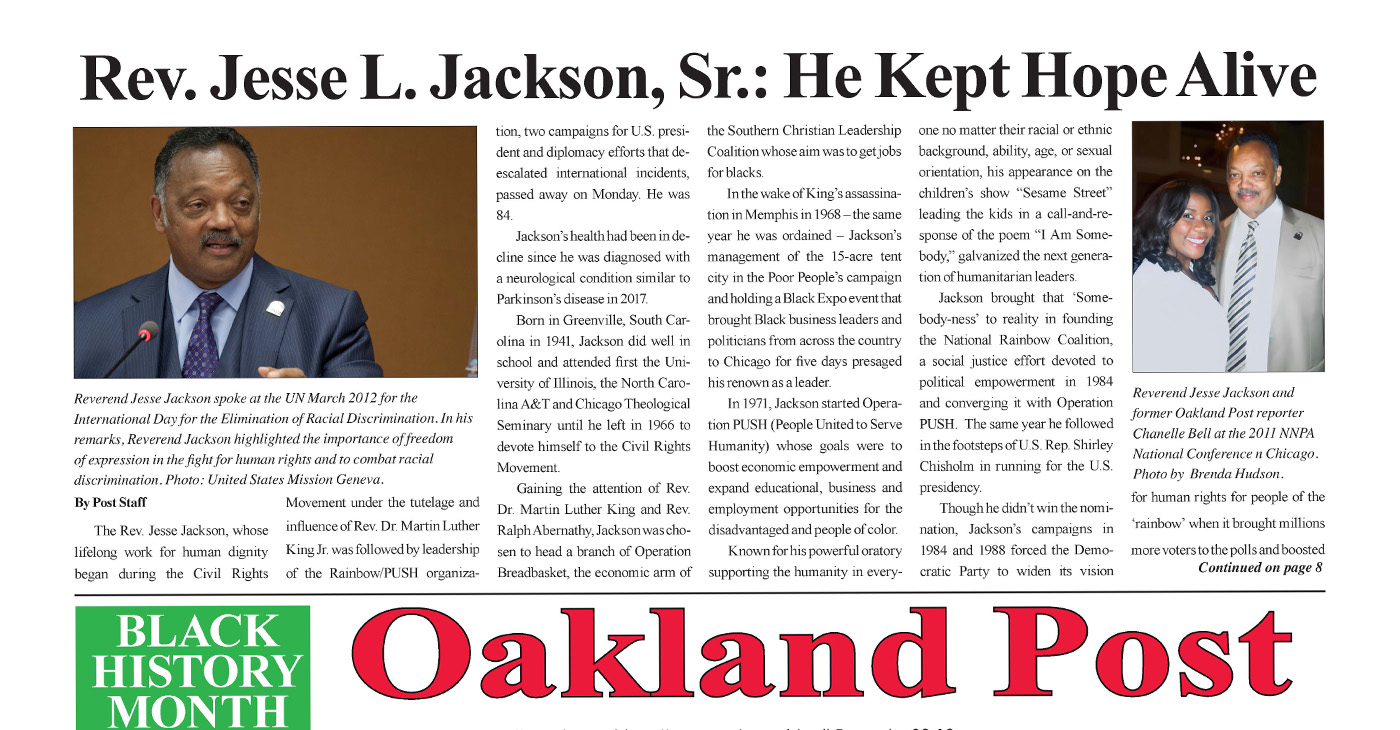
To enlarge your view of this issue, use the slider, magnifying glass icon or full page icon in the lower right corner of the browser window.
Activism
Oakland Post: Week of February 11 – 17, 2026
The printed Weekly Edition of the Oakland Post: Week of – February 11 – 17, 2026

To enlarge your view of this issue, use the slider, magnifying glass icon or full page icon in the lower right corner of the browser window.

WORK FROM HOME
Home-based business with potential monthly income of $10K+ per month. A proven training system and website provided to maximize business effectiveness. Perfect job to earn side and primary income. Contact Lynne for more details: Lynne4npusa@gmail.com 800-334-0540


Poll Shows Support for Policies That Help Families Afford Child Care

Oakland Post: Week of February 25 – March 3, 2026

Trump’s MAGA Allies are Creating Executive Order Plan to Steal the 2026 Midterms

PRESS ROOM: NBA Hall of Fame Nominee Terry Cummings Joins 100 Black Men of DeKalb County to Launch Victory & Values Initiative

Reflecting on Black History Milestones in Birmingham AL

OP-ED: One Hundred Years of Black Workers Telling the Truth

PRESS ROOM: Civil Rights TV Launches in Selma as the World’s First 24/7 Civil Rights Television Network

Advancements in solar technology that are changing the way we power the world

U.S. manufacturing rebounds – how foundry services are adapting to rising demand

Why has blood testing become so popular in today’s world?

Ghana Mourns a Son of the African World

OP-ED: Trump’s Policies Hurt Black America—and Everyone Else

OP-ED: Meta Deleted Me. I Still Don’t Know Why. And neither will you.

More than a Mission: Paying It Forward for the Future of Education

Avoid Eviction This Season: Landlord Checklist for Stable Tenancies

Life Expectancy in Marin City, a Black Community, Is 15-17 Years Less than the Rest of Marin County

Oakland Post: Week of January 28, 2025 – February 3, 2026

Community Celebrates Turner Group Construction Company as Collins Drive Becomes Turner Group Drive

California Launches Study on Mileage Tax to Potentially Replace Gas Tax as Republicans Push Back

Discrimination in City Contracts

Oakland Post: Week of January 21 – 27, 2026

Book Review: Books on Black History and Black Life for Kids

COMMENTARY: The Biases We Don’t See — Preventing AI-Driven Inequality in Health Care

Medi-Cal Cares for You and Your Baby Every Step of the Way

Post Newspaper Invites NNPA to Join Nationwide Probate Reform Initiative

COMMENTARY: The National Protest Must Be Accompanied with Our Votes

After Don Lemon’s Arrest, Black Officials Raise Concerns About Independent Black Media

Art of the African Diaspora Celebrates Legacy and Community at Richmond Art Center

Black History Events in the East Bay

OP-ED: The Dream Cannot be Realized Without Financial Freedom

Hyundai Ioniq 5 Parking, Safety, and 360 View #shorts

2025 Ioniq 5 New Wiper & Powerful Performance! #shorts

Electric SUV Range: Is 259 Miles Enough? #shorts

EV Charging: How Fast Can You Charge an Electric Vehicle? #shorts

Biometric Cooling… Messaging Seats…Come on! 2025 Infiniti QX80 Autograph 4WD

Charged Up: Witness the Magic of a Fully Electric Car! #shorts

Range Rover Sport PHEV Included…: See What’s Inside This Luxury SUV! #shorts

Invisible Hood View: Perfect Parking with X-Ray Vision! #shorts

AI Is Reshaping Black Healthcare: Promise, Peril, and the Push for Improved Results in California

ESSAY: Technology and Medicine, a Primary Care Point of View

Sanctuary Cities

The RESISTANCE – FREEDOM NOW

STATE OF THE PEOPLE: Freddie

ECONOMIC BOYCOTT DAY!!!!!

I told You So

-
 Activism4 weeks ago
Life Expectancy in Marin City, a Black Community, Is 15-17 Years Less than the Rest of Marin County
-
 Activism4 weeks ago
Oakland Post: Week of January 28, 2025 – February 3, 2026
-
 Activism3 weeks ago
Community Celebrates Turner Group Construction Company as Collins Drive Becomes Turner Group Drive
-
 Business3 weeks ago
California Launches Study on Mileage Tax to Potentially Replace Gas Tax as Republicans Push Back
-
 Activism3 weeks ago
Discrimination in City Contracts
-
 Arts and Culture3 weeks ago
Book Review: Books on Black History and Black Life for Kids
-
 Activism3 weeks ago
COMMENTARY: The Biases We Don’t See — Preventing AI-Driven Inequality in Health Care
-
 Activism4 weeks ago
Medi-Cal Cares for You and Your Baby Every Step of the Way
