
City Government
Mayoral Candidates Back Measure Z for Public Safety

Five candidates for Oakland mayor held a press conference to express their unanimous support this week to support a “Yes” vote on Measure Z, Oakland’s public safety tax measure.
Measure Z is designed to replace Measure Y, which is expiring.
Speaking in favor of the measure at Measure Z campaign headquarters in Old Oakland were mayoral candidates Bryan Parker, Jean Quan, Joe Tuman, Libby Schaaf and Rebecca Kaplan. Dan Siegel also has endorsed Measure Z, though he could not attend Monday’s press conference.
Measure Z will increase public safety without increasing taxes, according to supporters.
If passed on November 4, Measure Z will continue an existing measure to fund 50 police officers along with critical anti-violence programs that have been successful in reducing violent crime in Oakland.
“We all need to look long and hard at what Measure Z will do – provide vital dollars and services to keep our city safe,” said candidate Bryan Parker, an Oakland businessman.
The measure will also continue funding for community programs that protect at-risk youth and the re-entry population.
Mayoral candidate and Oakland City Councilmember Libby Schaaf addressed critics of the measure who associate it with the challenges of Measure Y. She said Measure Z has much stronger accountability.
“Measure Z is better in two ways,” Schaaf said. “Measure Z will have tighter accountability with an independent citizen’s commission and it has wording to guarantee actual (police) boots on the ground, not just called for in the budget.”
Added Joe Tuman, mayoral candidate and professor at San Francisco State, “If we don’t pass Measure Z, that’s 50 police officers we lose and we can’t afford that. For those who say this isn’t perfect and let’s start over, that’s too risky and it will take too long. Let’s start moving forward and, whoever is elected mayor, hold their feet to the fire to make Oakland safer.”
“Measure Z is funding the most effective programs to keep our city safe,” said Oakland Mayor Jean Quan. “More than 80 percent of young people in the Ceasefire program do not go back to jail. It’s recognized nationally as a successful anti-violence program and it will continue to be funded with Measure Z.”
For those who say they are voting reluctantly for Measure Z, mayoral candidate Rebecca Kaplan said thank you.
“That’s fine; let’s just vote for Measure Z,” said Kaplan, an Oakland City Councilmember. “We need more than what Measure Z calls for, but let’s be clear: If we don’t pass Measure Z we will be cutting officers and vital services. It’s vital – and we need more.”
Measure Z is supported by The League of Women Voters Oakland, the Democratic Party, The Central Labor Council (including Oakland Police Officers Association, IFPTE, SEIU, International Association of Fire Fighters Local 55), The Oakland Metropolitan Chamber of Commerce, The Pastors of Oakland, and The Oakland Board of Education.



Activism
Oakland Post: Week of March 4 – 10, 2026
The printed Weekly Edition of the Oakland Post: Week of March 4 – 10, 2026

To enlarge your view of this issue, use the slider, magnifying glass icon or full page icon in the lower right corner of the browser window.
Activism
Oakland Post: Week of February 25 – March 3, 2026
The printed Weekly Edition of the Oakland Post: Week of – February 25 – March 3, 2026

To enlarge your view of this issue, use the slider, magnifying glass icon or full page icon in the lower right corner of the browser window.
Activism
Oakland Post: Week of February 18 – 24, 2026
The printed Weekly Edition of the Oakland Post: Week of – February 18 – 24, 2026
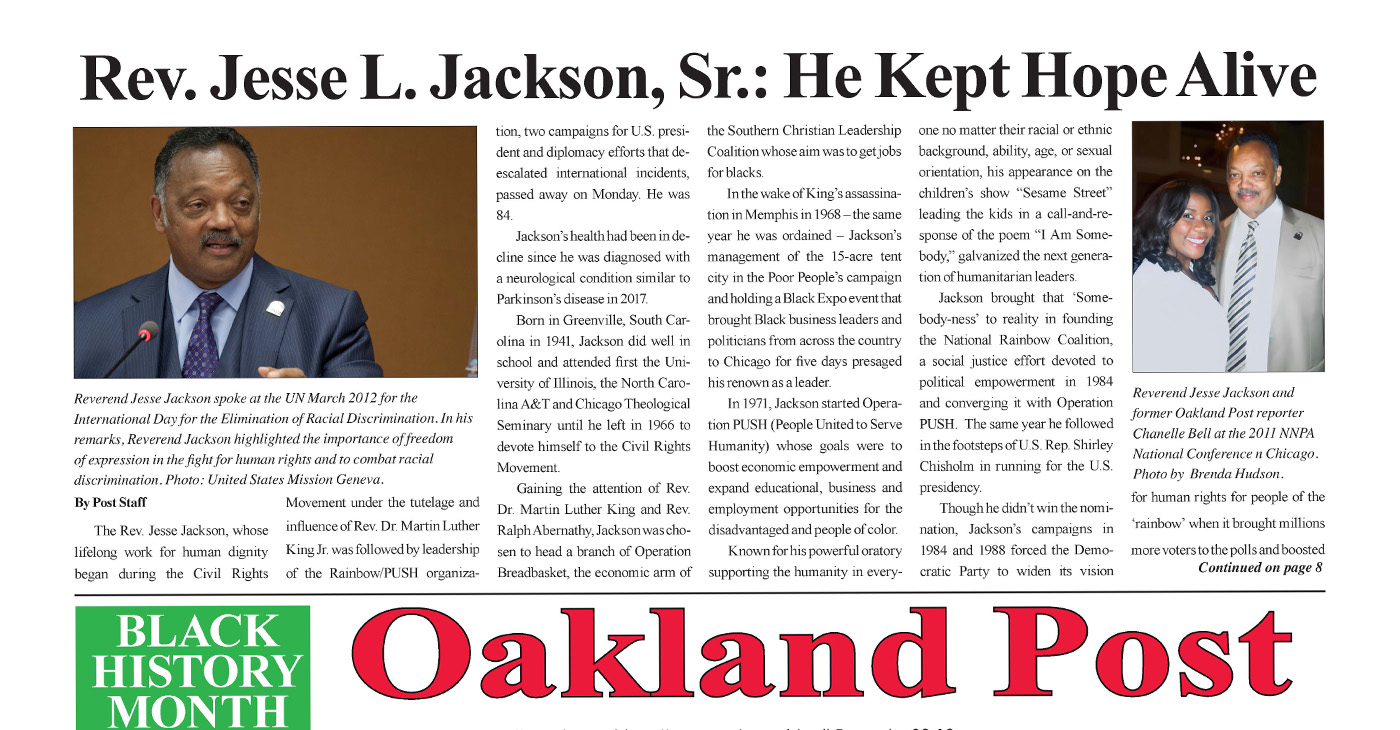
To enlarge your view of this issue, use the slider, magnifying glass icon or full page icon in the lower right corner of the browser window.


WORK FROM HOME
Home-based business with potential monthly income of $10K+ per month. A proven training system and website provided to maximize business effectiveness. Perfect job to earn side and primary income. Contact Lynne for more details: Lynne4npusa@gmail.com 800-334-0540


COMMENTARY: Women of Color Shape Our Past and Future

Woman’s Search for Family’s Roots Leads to Ancestor John T. Ward – A Successful Entrepreneur and Conductor on the Underground Railroad

Advocates Raise Alarm Over ICE Operation, MOU and Detention Risks in Baltimore County

Pete Buttigieg to Join Mayor Randall Woodfin for Community Town Hall in Birmingham

WATCH: Week One – NNPA’s “Leadership Matters” Video Series

Oakland Post: Week of March 4 – 10, 2026

OP-ED: NNPA Launches 2026 “Leadership Matters” Video Series

PRESS ROOM: PMG and Cranbrook Horizons-Upward Bound Launch Journey Fellowship Cohort 2

Los Angeles Summit Brings Together Leaders to Tackle Poverty and Affordability

Civil Rights TV Launches 24/7 Network Focused on Black History, Education and Equity

REVIEW: The Ultimate Hot Girl Summer Getaway: Sunseeker Resort Florida

COMMENTARY: How You Stop a Prescription Medicine is as Important as How You Start

PRESS ROOM: From Congress to Corporate America: NNPA Spotlights Visionaries in New Video Series

Poll Shows Support for Policies That Help Families Afford Child Care

Oakland Post: Week of February 25 – March 3, 2026

Oakland Post: Week of January 28, 2025 – February 3, 2026

Life Expectancy in Marin City, a Black Community, Is 15-17 Years Less than the Rest of Marin County

Community Celebrates Turner Group Construction Company as Collins Drive Becomes Turner Group Drive

California Launches Study on Mileage Tax to Potentially Replace Gas Tax as Republicans Push Back

Discrimination in City Contracts

Book Review: Books on Black History and Black Life for Kids

Oakland Post: Week of January 21 – 27, 2026

COMMENTARY: The Biases We Don’t See — Preventing AI-Driven Inequality in Health Care

Post Newspaper Invites NNPA to Join Nationwide Probate Reform Initiative

Black History Events in the East Bay

Medi-Cal Cares for You and Your Baby Every Step of the Way

Art of the African Diaspora Celebrates Legacy and Community at Richmond Art Center

COMMENTARY: The National Protest Must Be Accompanied with Our Votes

New Bill, the RIDER Safety Act, Would Support Transit Ambassadors and Safety on Public Transit

After Don Lemon’s Arrest, Black Officials Raise Concerns About Independent Black Media

Hyundai Ioniq 5 Parking, Safety, and 360 View #shorts

2025 Ioniq 5 New Wiper & Powerful Performance! #shorts

Electric SUV Range: Is 259 Miles Enough? #shorts

EV Charging: How Fast Can You Charge an Electric Vehicle? #shorts

Biometric Cooling… Messaging Seats…Come on! 2025 Infiniti QX80 Autograph 4WD

Charged Up: Witness the Magic of a Fully Electric Car! #shorts

Range Rover Sport PHEV Included…: See What’s Inside This Luxury SUV! #shorts

Invisible Hood View: Perfect Parking with X-Ray Vision! #shorts

AI Is Reshaping Black Healthcare: Promise, Peril, and the Push for Improved Results in California

ESSAY: Technology and Medicine, a Primary Care Point of View

Sanctuary Cities

The RESISTANCE – FREEDOM NOW

STATE OF THE PEOPLE: Freddie

ECONOMIC BOYCOTT DAY!!!!!

I told You So
-
 Activism4 weeks ago
Community Celebrates Turner Group Construction Company as Collins Drive Becomes Turner Group Drive
-
 Business4 weeks ago
California Launches Study on Mileage Tax to Potentially Replace Gas Tax as Republicans Push Back
-
 Activism4 weeks ago
Discrimination in City Contracts
-
 Arts and Culture4 weeks ago
Book Review: Books on Black History and Black Life for Kids
-
 Activism4 weeks ago
COMMENTARY: The Biases We Don’t See — Preventing AI-Driven Inequality in Health Care
-
 Activism4 weeks ago
Post Newspaper Invites NNPA to Join Nationwide Probate Reform Initiative
-
 #NNPA BlackPress4 weeks ago
COMMENTARY: The National Protest Must Be Accompanied with Our Votes
-
 Activism4 weeks ago
New Bill, the RIDER Safety Act, Would Support Transit Ambassadors and Safety on Public Transit
