
Activism
‘Ngingubani:’ Who Am I? How DNA and Oral History Helps Black Youth Connect to Tribal Roots
‘I didn’t know who I was.’ This was not an uncommon belief for teenage boys plucked from the streets of Johannesburg, South Africa. Often disconnected from their families and living on the streets, they had little evidence of strong family ties. Maybe their story sounds familiar to you. Maybe you find yourself asking similar questions: Who am I? Where do I actually belong?

By Chelsea Trautman
‘I didn’t know who I was.’
This was not an uncommon belief for teenage boys plucked from the streets of Johannesburg, South Africa. Often disconnected from their families and living on the streets, they had little evidence of strong family ties. Maybe their story sounds familiar to you. Maybe you find yourself asking similar questions: Who am I? Where do I actually belong?
These questions were the initial inspiration for the Johannesburg Applied Ancestry Program launched in 2006 by researcher and program coordinator Clive Haydon, and Dr. Brian Hill, a university professor at Brigham Young University.
The program’s name: “Ngingubani,” or “Who am I?” in the African Zulu language, has a goal to help teenage boys between the ages of 12-16 better understand their identities by learning and sharing their own family stories.
Connect
One story included a young boy who was separated from his biological mother when he was only 5 years old. Having no written history or knowledge of his family, his story was like many at the Twilight Children’s Center in Johannesburg where the program took place.
Through outreach to extended family, program social workers were able to find this young boy’s mother and facilitate their reuniting nearly 14 years after their separation.
After being connected with unknown relatives, participants sat down for an interview to learn the stories of those who had gone before them: the boys developed a stronger sense of self after hearing their rich oral history from people who shared their blood, culture, and heritage.
Robyn Fivush, PhD and professor of Psychology at Emory University stated: “These kinds of family stories create meaning beyond the individual. To include a sense of self through historical time and in relation to family members” (Jorgenson & Bochner, 2004: Norris, Kuiack, & Pratt, 2004).
Belong
The interviews and DNA samplings gave insight about these young boy’s native ancestral tribes. While not all participants were reunited with parents, they were all still able to connect with a living relative.
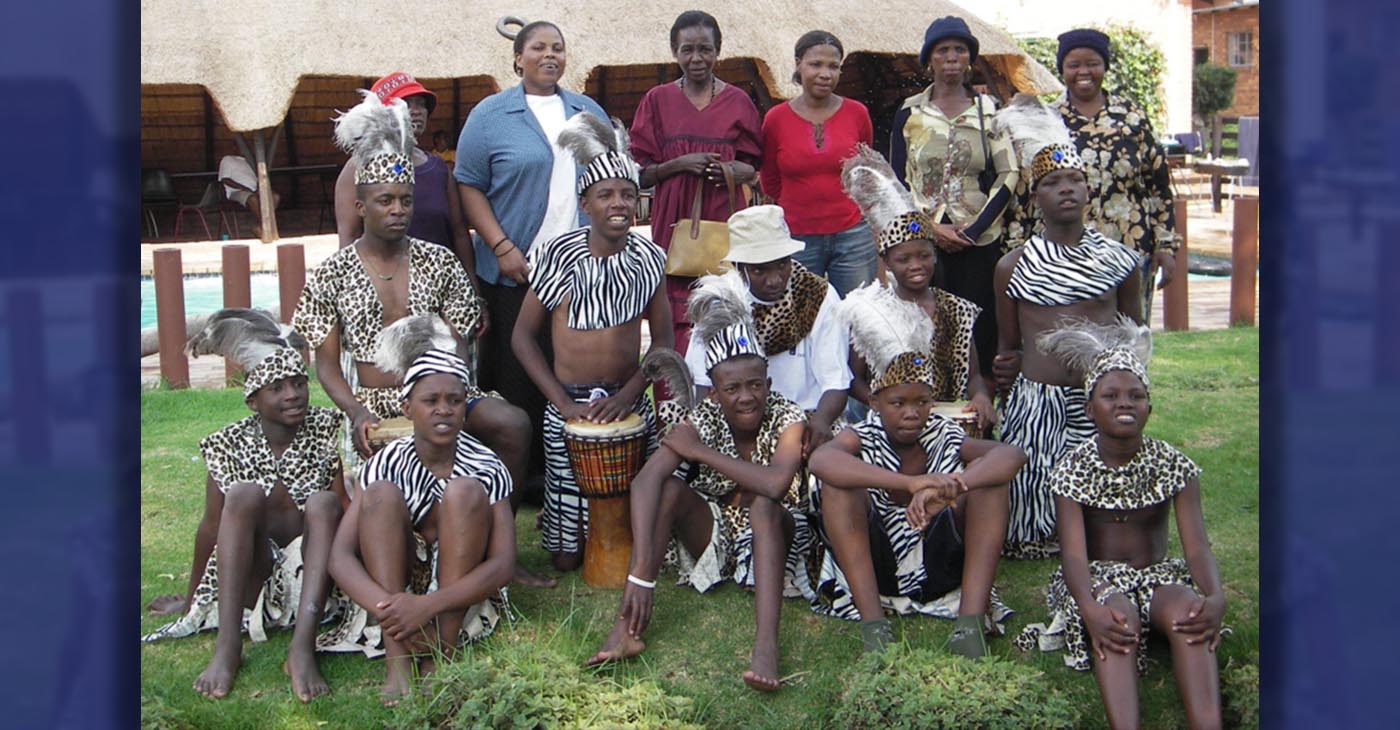
Through a culminating cultural celebration, participants at the Twilight Children’s Center dressed in traditional tribal clothing, and shared dances, artwork, and personal stories from the knowledge they gained during the program. This emotional tearful event made the boys feel valued by their parents and motivated their belief in who they could become.
Become
Thanks to DNA testing and family history stories, many can now discover their heritage and find a similar connection and belonging with deceased and distant family members.
A great way to begin is by telling family stories. Tell them as they are, setting aside opinions and personal bias to allow one’s family to interpret the meaning themselves.
For information on how to start, visit: familysearch.org, or through visiting a cemetery or by celebrating an ancestor’s birthday.
The ripple effect of family storytelling has the capacity to answer “Ngingubani.”
Chelsea Trautman is a research assistant at Brigham Young University.






Activism
Oakland Post: Week of November 26 – December 2, 2025
The printed Weekly Edition of the Oakland Post: Week of November 26 – December 2, 2025
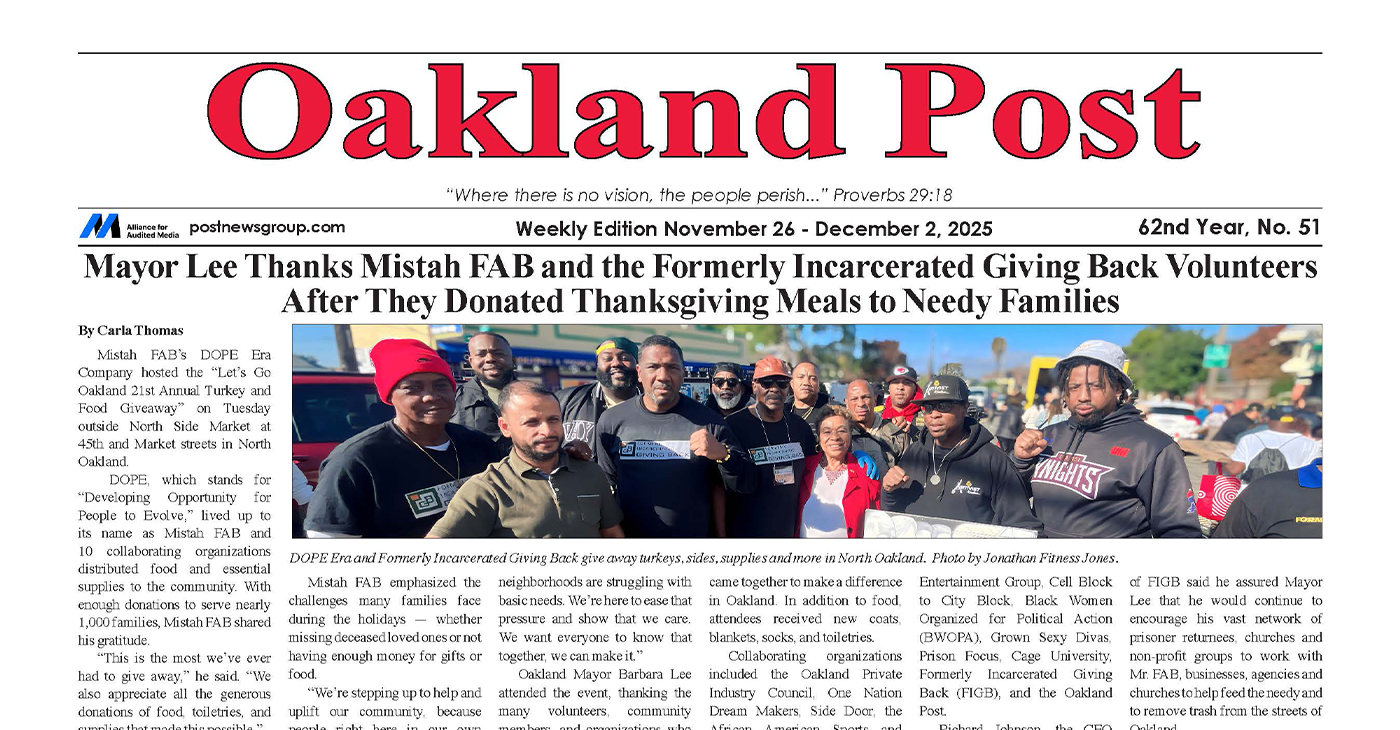
To enlarge your view of this issue, use the slider, magnifying glass icon or full page icon in the lower right corner of the browser window.
Activism
Oakland Post: Week of November 19 – 25, 2025
The printed Weekly Edition of the Oakland Post: Week of November 19 – 25, 2025
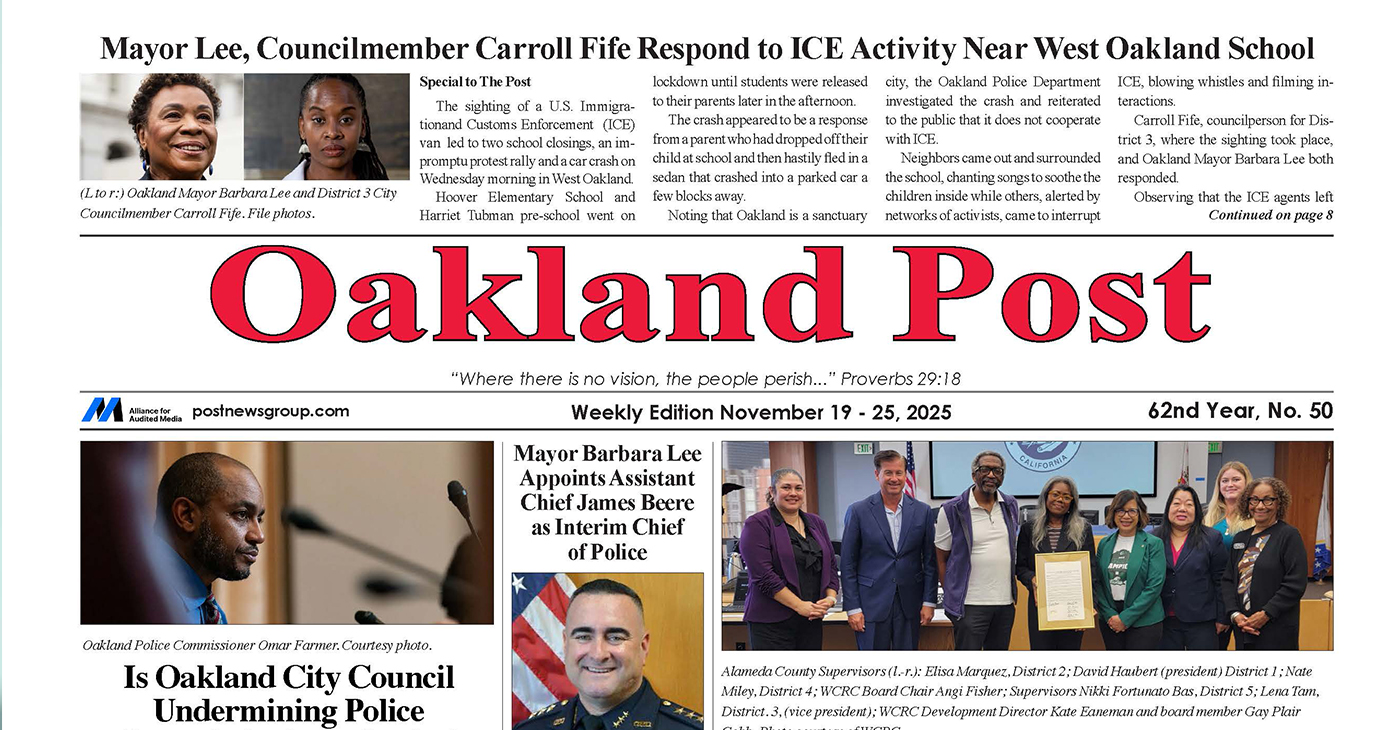
To enlarge your view of this issue, use the slider, magnifying glass icon or full page icon in the lower right corner of the browser window.
Activism
IN MEMORIAM: William ‘Bill’ Patterson, 94
Bill devoted his life to public service and education. In 1971, he became the founding director for the Peralta Community College Foundation, he also became an administrator for Oakland Parks and Recreation overseeing 23 recreation centers, the Oakland Zoo, Children’s Fairyland, Lake Merritt, and the Henry J. Kaiser Convention Center.
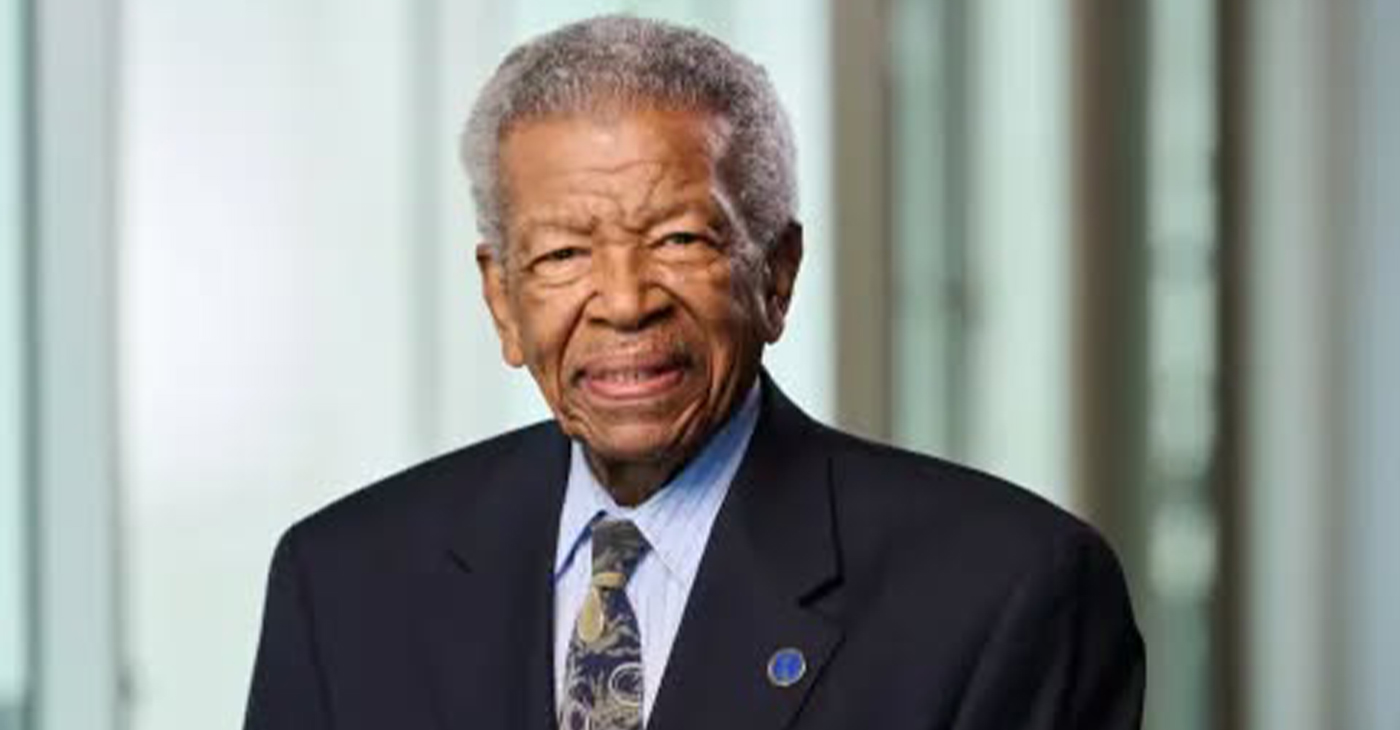
William “Bill” Patterson, 94, of Little Rock, Arkansas, passed away peacefully on October 21, 2025, at his home in Oakland, CA. He was born on May 19, 1931, to Marie Childress Patterson and William Benjamin Patterson in Little Rock, Arkansas. He graduated from Dunbar High School and traveled to Oakland, California, in 1948. William Patterson graduated from San Francisco State University, earning both graduate and undergraduate degrees. He married Euradell “Dell” Patterson in 1961. Bill lovingly took care of his wife, Dell, until she died in 2020.
Bill devoted his life to public service and education. In 1971, he became the founding director for the Peralta Community College Foundation, he also became an administrator for Oakland Parks and Recreation overseeing 23 recreation centers, the Oakland Zoo, Children’s Fairyland, Lake Merritt, and the Henry J. Kaiser Convention Center.
He served on the boards of Oakland’s Urban Strategies Council, the Oakland Public Ethics Commission, and the Oakland Workforce Development Board.
He was a three-term president of the Oakland branch of the NAACP.
Bill was initiated in the Gamma Alpha chapter of Kappa Alpha Psi Fraternity.
In 1997 Bill was appointed to the East Bay Utility District Board of Directors. William Patterson was the first African American Board President and served the board for 27 years.
Bill’s impact reached far beyond his various important and impactful positions.
Bill mentored politicians, athletes and young people. Among those he mentored and advised are legends Joe Morgan, Bill Russell, Frank Robinson, Curt Flood, and Lionel Wilson to name a few.
He is survived by his son, William David Patterson, and one sister, Sarah Ann Strickland, and a host of other family members and friends.
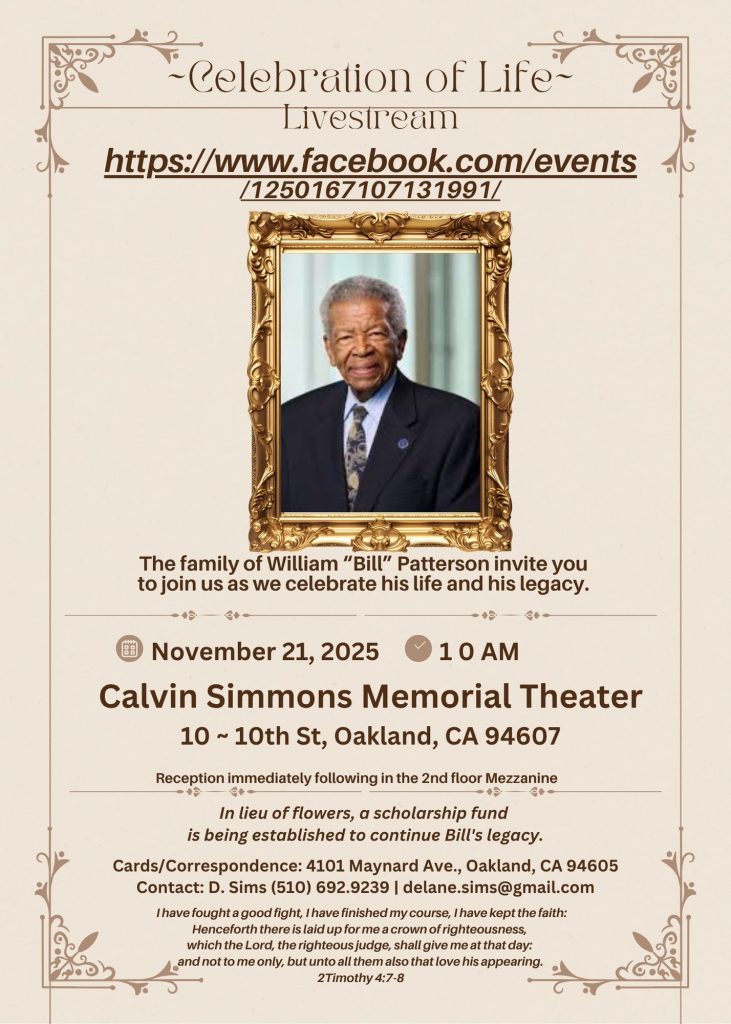
A celebration of life service will take place at Henry J. Kaiser Convention Center (Calvin Simmons Theater) on November 21, 2025, at 10 AM.
His services are being livestreamed at: https://www.facebook.com/events/1250167107131991/
In lieu of flowers, donations can be made to the Euradell and William Patterson scholarship fund TBA.

WORK FROM HOME
Home-based business with potential monthly income of $10K+ per month. A proven training system and website provided to maximize business effectiveness. Perfect job to earn side and primary income. Contact Lynne for more details: Lynne4npusa@gmail.com 800-334-0540


Seth Curry Makes Impressive Debut with the Golden State Warriors

LIHEAP Funds Released After Weeks of Delay as States and the District Rush to Protect Households from the Cold

Seven Steps to Help Your Child Build Meaningful Connections

Seven Steps to Help Your Child Build Meaningful Connections

Teens Reject Today’s News as Trump Intensifies His Assault on the Press

Thanksgiving Celebrated Across the Tri-State

Breaking the Silence: Black Veterans Speak Out on PTSD and the Path to Recovery

Trinidad and Tobago – Prime Minister Confirms U.S. Marines Working on Tobago Radar System

‘Tis the Season: Festive Holiday Pop-ups Happening Around Atlanta

IN MEMORIAM: Mardelle Walker, 101

Oakland Post: Week of November 26 – December 2, 2025

‘Targeted’ Shooting of Two National Guardsmen Blocks From the White House

Meet Roxanne Brown, The First African American And The First Woman President Of The United Steelworkers

Tax Refunds Expected to Rise by About $1,000 Next Year

CFP Rankings: Top Five Remains Unchanged; Major Decision Looms for Lane Kiffin

Oakland School Board Proposes Budget Solutions to Avoid State or County Takeover

A Call to Save Liberty Hall: Oakland’s Beacon of Black Heritage Faces an Uncertain Future

Port of Oakland September Cargo Volumes Dip Amid Shifting Trade Patterns

Oakland Post: Week of October 22 – 28, 2025

Prescribing Prevention: Doctors Turn to Lifestyle, Herbs and Veggies to Protect Against Chronic Illness in Black Californians

Mayor Lee Responds to OPD Chief Floyd Mitchell’s Decision to Resign

Past, Present, Possible! Oakland Residents Invited to Reimagine the 980 Freeway

Oakland Post: Week of October 29 – November 4, 2025

California Teachers Association Rallies Behind Prop. 50: A Stand for Education and Democracy

Man Arrested for Making Death Threats Against Mayor Barbara Lee

Essay: Intentional Self Care and Community Connections Can Improve Our Wellbeing

Oakland Post: Week of November 12 – 18, 2025

Oakland Post: Week of November 5 – 11, 2025

MLK Way at 57th Street in Oakland Renamed Bobby Seale Way for Black Panther Co-Founder

IN MEMORIAM: William ‘Bill’ Patterson, 94

Hyundai Ioniq 5 Parking, Safety, and 360 View #shorts

2025 Ioniq 5 New Wiper & Powerful Performance! #shorts

Electric SUV Range: Is 259 Miles Enough? #shorts

EV Charging: How Fast Can You Charge an Electric Vehicle? #shorts

Biometric Cooling… Messaging Seats…Come on! 2025 Infiniti QX80 Autograph 4WD

Charged Up: Witness the Magic of a Fully Electric Car! #shorts

Range Rover Sport PHEV Included…: See What’s Inside This Luxury SUV! #shorts

Invisible Hood View: Perfect Parking with X-Ray Vision! #shorts

AI Is Reshaping Black Healthcare: Promise, Peril, and the Push for Improved Results in California

ESSAY: Technology and Medicine, a Primary Care Point of View

Sanctuary Cities

The RESISTANCE – FREEDOM NOW

STATE OF THE PEOPLE: Freddie

ECONOMIC BOYCOTT DAY!!!!!

I told You So

-
 Activism3 weeks ago
Oakland Post: Week of November 12 – 18, 2025
-
 Activism4 weeks ago
Oakland Post: Week of November 5 – 11, 2025
-
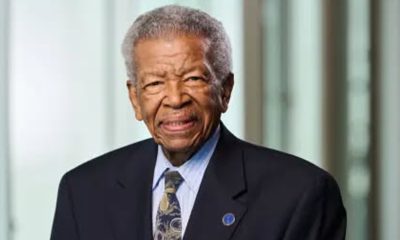 Activism2 weeks ago
IN MEMORIAM: William ‘Bill’ Patterson, 94
-

 Activism3 weeks ago
How Charles R. Drew University Navigated More Than $20 Million in Fed Cuts – Still Prioritizing Students and Community Health
-

 Bay Area3 weeks ago
No Justice in the Justice System
-

 #NNPA BlackPress3 weeks ago
The Perfumed Hand of Hypocrisy: Trump Hosted Former Terror Suspect While America Condemns a Muslim Mayor
-
 #NNPA BlackPress2 weeks ago
Trump’s Death Threat Rhetoric Sends Nation into Crisis
-
 #NNPA BlackPress4 weeks ago
Protecting Pedophiles: The GOP’s Warped Crusade Against Its Own Lies
