
Activism
Oakland School Board Proposes Budget Solutions to Avoid State or County Takeover
After 22 years, OUSD was finally released from state receivership in July. Facing a new deficit, the district is now urgently dealing with the threat of a new state or county takeover.


Teachers’ union calls for spending plan that prioritizes classrooms and student services
By Post Staff
Seeking to avoid the threat of a state or county takeover of the Oakland Unified School District, the Board of Education has adopted recommendations designed to provide guidelines to the superintendent and administration to resolve an ongoing budget deficit for this year and the next two years.
A resolution on budget guidance was approved at the Oct. 8 board meeting by board members Rachel Latta, Jennifer Brouhard, VanCedric Williams, and Valarie Bachelor. Voting ‘no’ were board members Mike Hutchinson, Patrice Berry, and Clifford Thompson.
After 22 years, OUSD was finally released from state receivership in July. Facing a new deficit, the district is now urgently dealing with the threat of a new state or county takeover.
The board resolution passed at the Oct. 8 board meeting directs Supt. Denise Saddler and her administration to implement a hiring freeze and review openings for new positions. Other possible savings include freezing or canceling consulting contracts, reducing travel expenses, and consolidating other purchases.
Whatever the district decides, none of the possibilities will include school closures or mergers, according to the board resolution.
District staff is expected to come back in November with budget proposals for the 2026-27 school year, including restructuring the central office, reducing administrative positions, and cutting spending on consulting contracts, as well as ways to increase enrollment.

Speaking at the board meeting, Saddler said, “What I need from all of you is to hear what the parameters are of what you would like staff to look at so we can do our best work to bring you options.”
“I want to respect that every single one of you has been doing some thinking about this and writing about it and have amendments and proposals,” she continued. “I urge you to give us the outside of the puzzle so we can go forth and do our best work.”
In an interview with the Oakland Post, Williams explained that a new board was elected last November and started in January. The board approved cuts in March of over $100 million to exit state receivership. And additional cuts of $60-$80 million are requested for 2026-2027, “which means up to $180 million within a year cycle, about 20% of the annual budget, raising the risk of returning to state receivership,” he said.
According to Williams the district carried high deficits with layoffs in 2020-21, 2021-22, and 2022-23, and prior boards “kicked the can down the road” rather than dealing with the deficits.
Past board presidents Sam Davis, Mike Hutchinson, Gary Yee, and Shanthi Gonzales “did not address the problems, leaving the current board to solve them,” he said.
Further, Willliams said, Alameda County Supt. of Schools Alysse Castro and the state agency, Fiscal Crisis Management and Assistance Team (FCMAT) “gave qualified budget approvals for four years. They could have (halted) raises or spending but did not, expecting eventual cuts without mandating immediate reductions.”
As a result, he said the “board needs to make major budget decisions this year within the next few weeks due to a looming fiscal cliff and threat of state receivership.”
“Reductions cannot come solely from central office or consultants,” Williams said. “Everything is on the table, including afterschool (programs), special education, and school restructuring.”
In a statement to the community, OUSD Chief Budget Officer Lisa Grant-Dawson wrote, “The district must develop a plan to restore its reserves as we navigate through the 2025-26 budget and prepare for the 2026-27 Budget Development process. The district will present its first Interim Report in December, reflecting its revised projections for the budget and reserves, which will then be reviewed by the County.
“As we have been saying since early in the 2024-25 school year, the District is currently deficit-spending about $4 million per month, that is, spending $4 million more every month than it’s receiving in revenues. The more we do that moving forward, the more we diminish our reserves, until, eventually, we run out of money.”
“As a school district where the mission is educating children, we cannot run out of money, and the State and County won’t let that happen,” she said. “But we need to prevent it from getting to that point in the first place. The district will need to make some very difficult choices in the near future to remain financially solvent.”
According to the Oakland Education Association (OEA), the teachers’ union, which is currently negotiating with the district for a new contract, the district traditionally distorts its budget, minimizing its revenue and maximizing its expenses to avoid increasing employee wages.
In a presentation to teachers and families, OEA President Kampala Taiz-Rancifer said, “The City of Oakland has a long history of standing up for the most marginalized in our community. And we need OUSD to stand up and be a part of protecting Oakland students by really investing in our school sites.”
Continuing, she said, “Our main job in this district is to teach children, and we need OUSD to change its priorities from (spending its money) outsourcing, contracting out, and investing in top-level management to really providing a student-centered budget.”
“The district has spent too much on the wrong things, too much on outside contracting and on central office administration while also simultaneously having this history of under-projecting revenue,” she said.
“We have a vision for a student-centered budget that invests in our school,” Rancifer said. “We need to restructure the budget to prioritize students and staff, making a student-centered budget that invests in classrooms and student services.”
According to OEA, “OUSD receives nearly $1 billion yearly to fund our schools — yet only 56% of that goes to student-facing staff. Our students feel the daily impact through high teacher- and support staff- turnover. Districts like San Diego Unified prove it’s possible to do better, investing 80% of funds directly into the people who serve students.”


Activism
Chase Oakland Community Center Hosts Alley-Oop Accelerator Building Community and Opportunity for Bay Area Entrepreneurs
Over the past three years, the Alley-Oop Accelerator has helped more than 20 Bay Area businesses grow, connect, and gain meaningful exposure. The program combines hands-on training, mentorship, and community-building to help participants navigate the legal, financial, and marketing challenges of small business ownership.
By Carla Thomas
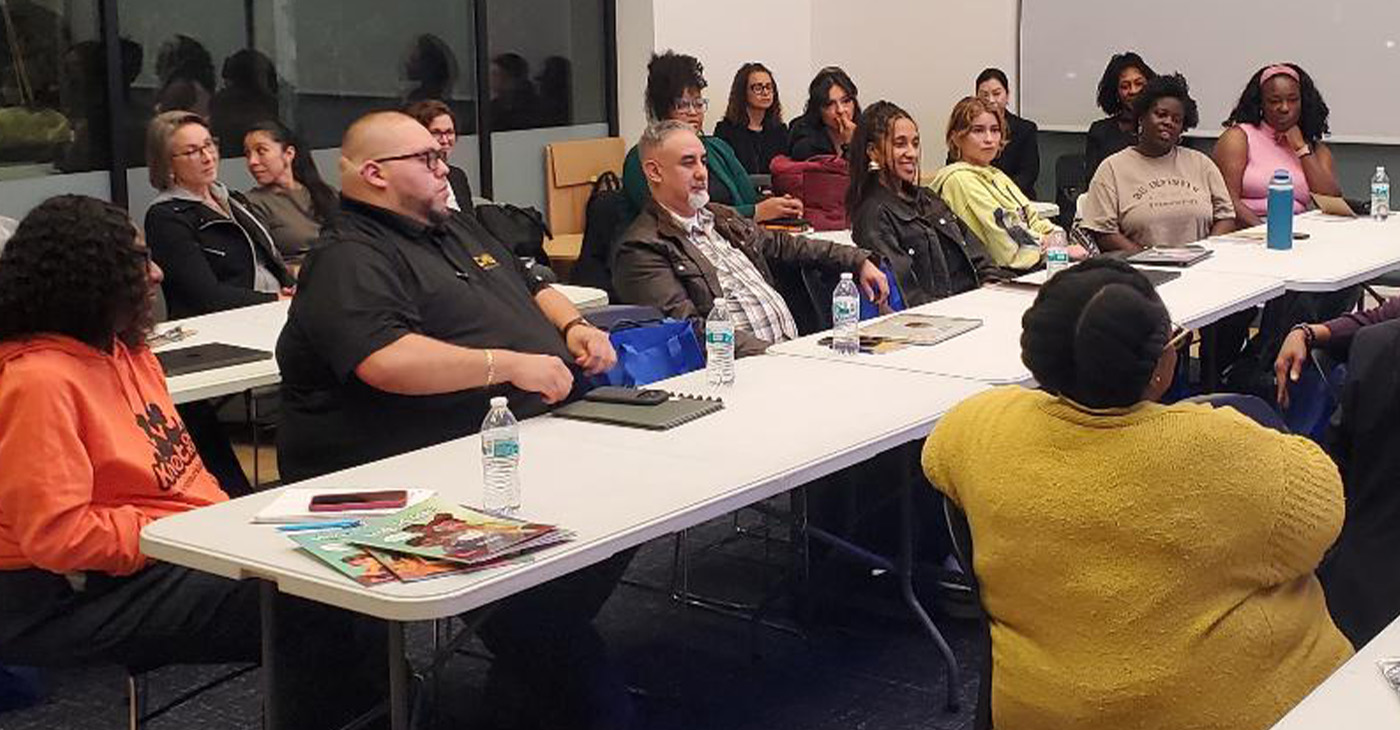
The Golden State Warriors and Chase bank hosted the third annual Alley-Oop Accelerator this month, an empowering eight-week program designed to help Bay Area entrepreneurs bring their visions for business to life.
The initiative kicked off on Feb. 12 at Chase’s Oakland Community Center on Broadway Street, welcoming 15 small business owners who joined a growing network of local innovators working to strengthen the region’s entrepreneurial ecosystem.
Over the past three years, the Alley-Oop Accelerator has helped more than 20 Bay Area businesses grow, connect, and gain meaningful exposure. The program combines hands-on training, mentorship, and community-building to help participants navigate the legal, financial, and marketing challenges of small business ownership.
At its core, the accelerator is designed to create an ecosystem of collaboration, where local entrepreneurs can learn from one another while accessing the resources of a global financial institution.
“This is our third year in a row working with the Golden State Warriors on the Alley-Oop Accelerator,” said Jaime Garcia, executive director of Chase’s Coaching for Impact team for the West Division. “We’ve already had 20-plus businesses graduate from the program, and we have 15 enrolled this year. The biggest thing about the program is really the community that’s built amongst the business owners — plus the exposure they’re able to get through Chase and the Golden State Warriors.”
According to Garcia, several graduates have gone on to receive vendor contracts with the Warriors and have gained broader recognition through collaborations with JPMorgan Chase.
“A lot of what Chase is trying to do,” Garcia added, “is bring businesses together because what they’ve asked for is an ecosystem, a network where they can connect, grow, and thrive organically.”
This year’s Alley-Oop Accelerator reflects that vision through its comprehensive curriculum and emphasis on practical learning. Participants explore the full spectrum of business essentials including financial management, marketing strategy, and legal compliance, while also preparing for real-world experiences such as pop-up market events.
Each entrepreneur benefits from one-on-one mentoring sessions through Chase’s Coaching for Impact program, which provides complimentary, personalized business consulting.
Garcia described the impact this hands-on approach has had on local small business owners. He recalled one candlemaker, who, after participating in the program, was invited to provide candles as gifts at Chase events.
“We were able to help give that business exposure,” he explained. “But then our team also worked with them on how to access capital to buy inventory and manage operations once those orders started coming in. It’s about preparation. When a hiccup happens, are you ready to handle it?”
The Coaching for Impact initiative, which launched in 2020 in just four cities, has since expanded to 46 nationwide.
“Every business is different,” Garcia said. “That’s why personal coaching matters so much. It’s life-changing.”
Participants in the 2026 program will each receive a $2,500 stipend, funding that Garcia said can make an outsized difference. “It’s amazing what some people can do with just $2,500,” he noted. “It sounds small, but it goes a long way when you have a plan for how to use it.”
For Chase and the Warriors, the Alley-Oop Accelerator represents more than an educational initiative, it’s a pathway to empowerment and economic inclusion. The program continues to foster lasting relationships among the entrepreneurs who, as Garcia put it, “build each other up” through shared growth and opportunity.
“Starting a business is never easy, but with the right support, it becomes possible, and even exhilarating,” said Oscar Lopez, the senior business consultant for Chase in Oakland.
Activism
Oakland Post: Week of February 18 – 24, 2026
The printed Weekly Edition of the Oakland Post: Week of – February 18 – 24, 2026
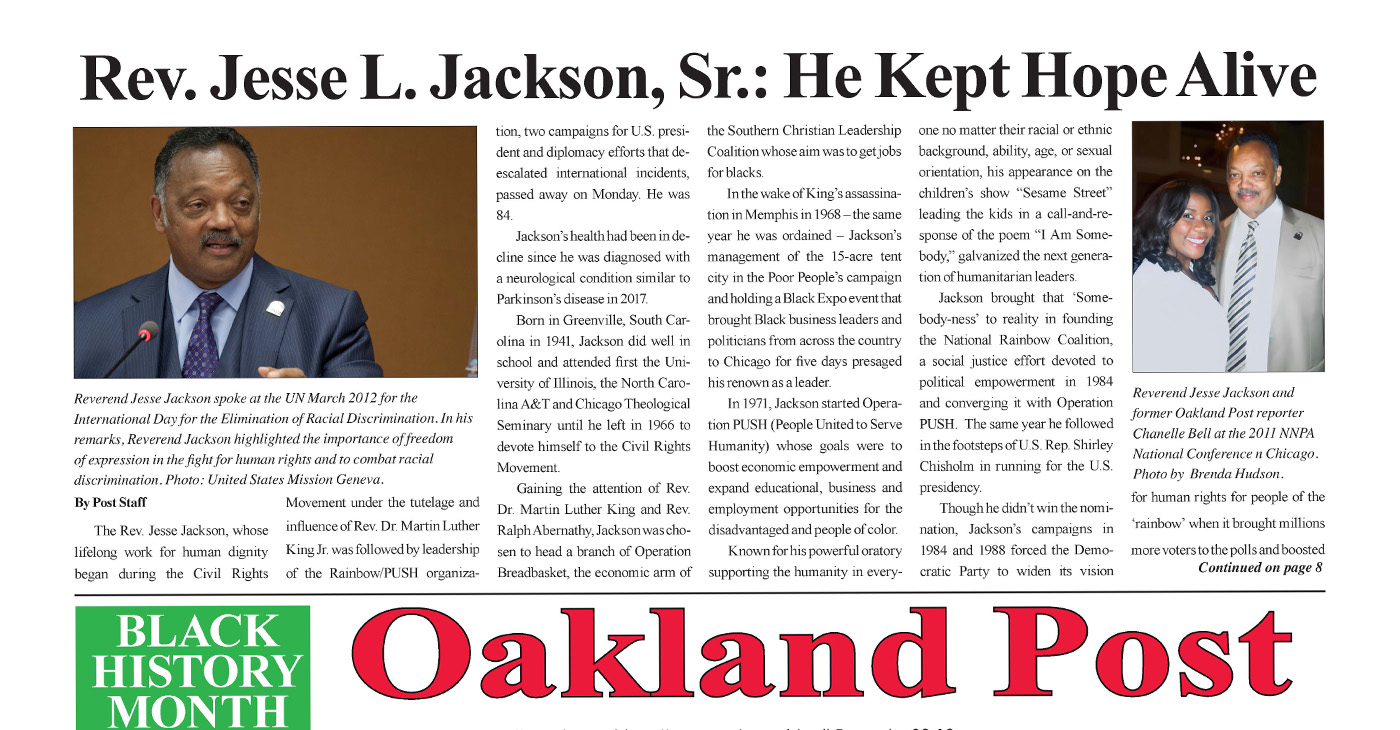
To enlarge your view of this issue, use the slider, magnifying glass icon or full page icon in the lower right corner of the browser window.
Activism
Oakland Post: Week of February 11 – 17, 2026
The printed Weekly Edition of the Oakland Post: Week of – February 11 – 17, 2026

To enlarge your view of this issue, use the slider, magnifying glass icon or full page icon in the lower right corner of the browser window.


WORK FROM HOME
Home-based business with potential monthly income of $10K+ per month. A proven training system and website provided to maximize business effectiveness. Perfect job to earn side and primary income. Contact Lynne for more details: Lynne4npusa@gmail.com 800-334-0540


PRESS ROOM: NBA Hall of Fame Nominee Terry Cummings Joins 100 Black Men of DeKalb County to Launch Victory & Values Initiative

Reflecting on Black History Milestones in Birmingham AL

OP-ED: One Hundred Years of Black Workers Telling the Truth

PRESS ROOM: Civil Rights TV Launches in Selma as the World’s First 24/7 Civil Rights Television Network

Advancements in solar technology that are changing the way we power the world

U.S. manufacturing rebounds – how foundry services are adapting to rising demand

Why has blood testing become so popular in today’s world?

Ghana Mourns a Son of the African World

OP-ED: Trump’s Policies Hurt Black America—and Everyone Else

OP-ED: Meta Deleted Me. I Still Don’t Know Why. And neither will you.

More than a Mission: Paying It Forward for the Future of Education

Avoid Eviction This Season: Landlord Checklist for Stable Tenancies

How chronic back problems affect Black communities differently

How cancer care is evolving with modern medicine

Diabetes disparity: Understanding Type 2 risks for Black Americans

Life Expectancy in Marin City, a Black Community, Is 15-17 Years Less than the Rest of Marin County

Oakland Post: Week of January 28, 2025 – February 3, 2026

Community Celebrates Turner Group Construction Company as Collins Drive Becomes Turner Group Drive

California Launches Study on Mileage Tax to Potentially Replace Gas Tax as Republicans Push Back

Discrimination in City Contracts

Oakland Post: Week of January 21 – 27, 2026

Book Review: Books on Black History and Black Life for Kids

Medi-Cal Cares for You and Your Baby Every Step of the Way

COMMENTARY: The Biases We Don’t See — Preventing AI-Driven Inequality in Health Care

After Don Lemon’s Arrest, Black Officials Raise Concerns About Independent Black Media

Post Newspaper Invites NNPA to Join Nationwide Probate Reform Initiative

OP-ED: The Dream Cannot be Realized Without Financial Freedom

Travis Scott Teaches Us How to Give Forward

COMMENTARY: The National Protest Must Be Accompanied with Our Votes

Four Stolen Futures: Will H-E-B Do The Right Thing?

Hyundai Ioniq 5 Parking, Safety, and 360 View #shorts

2025 Ioniq 5 New Wiper & Powerful Performance! #shorts

Electric SUV Range: Is 259 Miles Enough? #shorts

EV Charging: How Fast Can You Charge an Electric Vehicle? #shorts

Biometric Cooling… Messaging Seats…Come on! 2025 Infiniti QX80 Autograph 4WD

Charged Up: Witness the Magic of a Fully Electric Car! #shorts

Range Rover Sport PHEV Included…: See What’s Inside This Luxury SUV! #shorts

Invisible Hood View: Perfect Parking with X-Ray Vision! #shorts

AI Is Reshaping Black Healthcare: Promise, Peril, and the Push for Improved Results in California

ESSAY: Technology and Medicine, a Primary Care Point of View

Sanctuary Cities

The RESISTANCE – FREEDOM NOW

STATE OF THE PEOPLE: Freddie

ECONOMIC BOYCOTT DAY!!!!!

I told You So
-
 Activism4 weeks ago
Life Expectancy in Marin City, a Black Community, Is 15-17 Years Less than the Rest of Marin County
-
 Activism4 weeks ago
Oakland Post: Week of January 28, 2025 – February 3, 2026
-
 Activism3 weeks ago
Community Celebrates Turner Group Construction Company as Collins Drive Becomes Turner Group Drive
-
 Business3 weeks ago
California Launches Study on Mileage Tax to Potentially Replace Gas Tax as Republicans Push Back
-
 Activism3 weeks ago
Discrimination in City Contracts
-
 Arts and Culture3 weeks ago
Book Review: Books on Black History and Black Life for Kids
-
 Activism4 weeks ago
Medi-Cal Cares for You and Your Baby Every Step of the Way
-
 Activism3 weeks ago
COMMENTARY: The Biases We Don’t See — Preventing AI-Driven Inequality in Health Care
