
Politics
Obama Aims to Influence 2016 Debate with State of the Union


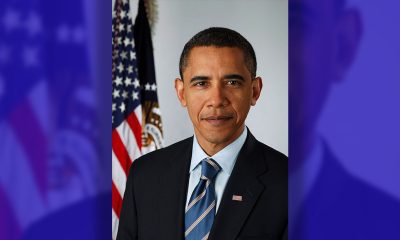
In this Jan. 28, 2014, file photo, President Barack Obama delivers the State of Union address before a joint session of Congress in the House chamber in Washington. Obama will outline in his State of the Union address Tuesday, Jan. 20, 2015, appear to be aimed at driving the debate in the 2016 election on income inequality and middle-class economic issues, rather than setting a realistic agenda for Congress. (AP Photo/Larry Downing, Pool, File)
JULIE PACE, AP White House Correspondent
WASHINGTON (AP) — Key elements of the economic proposals President Barack Obama will outline in his State of the Union address Tuesday appear to be aimed at driving the debate in the 2016 election on income inequality and middle-class economic issues, rather than setting a realistic agenda for Congress.
Obama’s calls for increasing taxes on the wealthy, making community college free for many students and expanding paid leave for workers stand little chance of winning approval from the new Republican majority on Capitol Hill. But the debate over middle-class economics is looking critical for the coming campaign.
“Inequality — and especially the growing opportunity gap — have become the top litmus test of seriousness for 2016,” said Robert Putnam, a Harvard political scientist who has discussed inequality issues with the president and his advisers. “The entry ticket for the presidential sweepstakes is that you have a policy — some policy — for dealing with this issue.”
Indeed, potential Republican candidates Jeb Bush and Mitt Romney have been talking openly about income inequality and the need to give lower-earning Americans more opportunities. On the Democratic side, Massachusetts Sen. Elizabeth Warren appears intent on keeping the party focused on a populist economic agenda, even if she doesn’t plan to run for president herself.
As the nation’s attention increasingly turns to the 2016 election, the Obama White House is making clear that it still wants to set the terms of the economic conversation.
White House chief of staff Denis McDonough, appearing in a nationally broadcast interview Tuesday, said Obama is determined to improve the lives of middle-class Americans. “His mindset is to keep doing everything he can for the middle class,” McDonough said on “CBS This Morning.”
McDonough said Obama will not hesitate to veto legislation that doesn’t improve the lot of the middle class.
The president’s advisers argue that the debate over income equality is one that Democrats have won previously, including in Obama’s victory over Romney in 2012 and the fiscal cliff fight with Congress that led to the raising of George W. Bush-era tax rates for the wealthiest Americans.
However, Obama no longer has the political advantage on Capitol Hill that he would need to enact more tax increases. When Obama addresses Congress Tuesday night, he will be standing before a Republican majority in both chambers for the first time in his presidency.
The president and GOP leaders have spoken about their desire to compromise, but the opening weeks of the new Congress have offered few glimpses of where both sides plan to find common ground. Obama’s economic proposals will do little to move the White House and Republicans closer together, given the GOP leadership’s aversion to raising taxes on wealthy Americans.
The president’s proposal would increase the capital gains rate on couples making more than $500,000 annually to 28 percent, require estates to pay capital gains taxes on securities at the time they’re inherited and slap a fee on the roughly 100 U.S. financial firms with assets of more than $50 billion.
Administration officials said much of the $320 billion in new taxes and fees would be used for measures aimed at helping the middle class, including a $500 tax credit for some families with two spouses working and a $60 billion program to make community college free.
Obama is also asking lawmakers to increase paid leave for workers. And he’s moved unilaterally to lower a mortgage insurance rate that could help attract first-time homebuyers.
The White House cast the president’s measures as steps that can help keep up economic momentum amid a recent spurt of growth that has also seen the unemployment rate fall below 6 percent.
There has been little Republican support for much of what the White House has rolled out ahead of Obama’s address.
A spokesman for House Speaker John Boehner, R-Ohio, called the White House’s tax proposal “the same old top-down approach we’ve come to expect from President Obama that hasn’t worked.” And Florida Sen. Marco Rubio, who is weighing a GOP presidential bid, said the president’s approach was outdated.
“Raising taxes on people that are successful is not going to make people that are struggling more successful,” Rubio said.
Jason Furman, chair of the White House Council of Economic Advisers, said 80 percent of the revenue that would be raised by the capital gains proposal comes from one-tenth of the top 1 percent of households. Most of the remaining 20 percent of revenue comes from the remaining 1 percent of households.
“This is an enormously progressive proposal,” he said in its defense on MSNBC. “It’s about collecting taxes that we should be collecting.”
In keeping with State of the Union tradition, first lady Michelle Obama will watch the speech alongside invited guests whose stories bring to life some of the policies the president will tout.
Among the guests are Alan Gross, who was released from a Cuban prison last month as part of Obama’s decision to normalize relations with the communist island nation; Chelsey Davis, a student from Tennessee who plans to graduate from community college in May; and Dr. Pranav Shetty, who has been working on the Ebola outbreak in West Africa.
The effort to control Ebola is expected to be one of the foreign policy matters Obama addresses in a speech. While the president is not likely to make any major foreign policy announcements, he is expected to tout the formal end of the Afghan war, update the nation on the fight against the Islamic State group in Iraq and Syria, and urge lawmakers not to enact new sanctions on Iran while the U.S. and its partners are in the midst of nuclear negotiations with the Islamic republic.
___
Follow Julie Pace at http://twitter.com/jpaceDC
Copyright 2015 The Associated Press. All rights reserved. This material may not be published, broadcast, rewritten or redistributed.











Activism
Oakland Post: Week of March 4 – 10, 2026
The printed Weekly Edition of the Oakland Post: Week of March 4 – 10, 2026
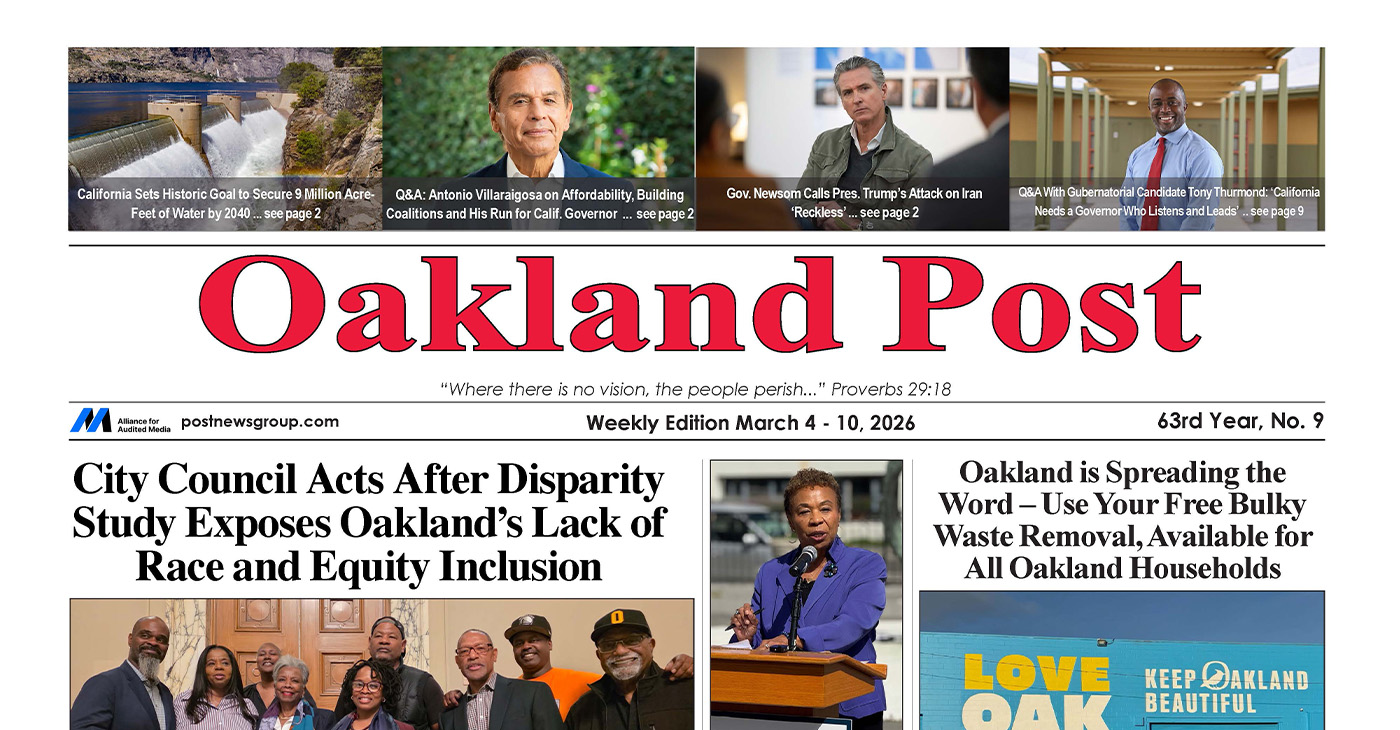
To enlarge your view of this issue, use the slider, magnifying glass icon or full page icon in the lower right corner of the browser window.
Activism
Oakland Post: Week of February 25 – March 3, 2026
The printed Weekly Edition of the Oakland Post: Week of – February 25 – March 3, 2026
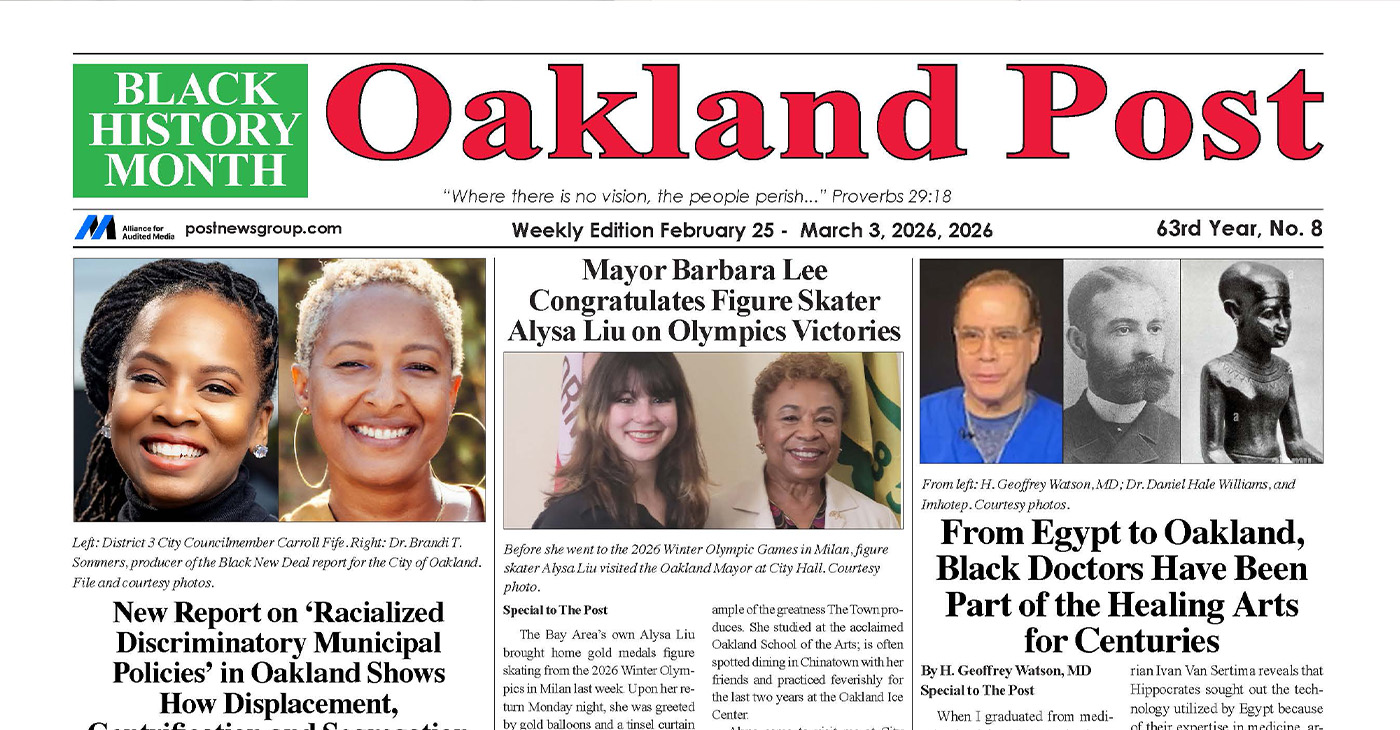
To enlarge your view of this issue, use the slider, magnifying glass icon or full page icon in the lower right corner of the browser window.
Activism
Oakland Post: Week of February 18 – 24, 2026
The printed Weekly Edition of the Oakland Post: Week of – February 18 – 24, 2026
To enlarge your view of this issue, use the slider, magnifying glass icon or full page icon in the lower right corner of the browser window.

WORK FROM HOME
Home-based business with potential monthly income of $10K+ per month. A proven training system and website provided to maximize business effectiveness. Perfect job to earn side and primary income. Contact Lynne for more details: Lynne4npusa@gmail.com 800-334-0540


COMMENTARY: Women of Color Shape Our Past and Future

Woman’s Search for Family’s Roots Leads to Ancestor John T. Ward – A Successful Entrepreneur and Conductor on the Underground Railroad

Advocates Raise Alarm Over ICE Operation, MOU and Detention Risks in Baltimore County

Pete Buttigieg to Join Mayor Randall Woodfin for Community Town Hall in Birmingham

WATCH: Week One – NNPA’s “Leadership Matters” Video Series

Oakland Post: Week of March 4 – 10, 2026

OP-ED: NNPA Launches 2026 “Leadership Matters” Video Series

PRESS ROOM: PMG and Cranbrook Horizons-Upward Bound Launch Journey Fellowship Cohort 2

Los Angeles Summit Brings Together Leaders to Tackle Poverty and Affordability

Civil Rights TV Launches 24/7 Network Focused on Black History, Education and Equity

REVIEW: The Ultimate Hot Girl Summer Getaway: Sunseeker Resort Florida

COMMENTARY: How You Stop a Prescription Medicine is as Important as How You Start

PRESS ROOM: From Congress to Corporate America: NNPA Spotlights Visionaries in New Video Series

Poll Shows Support for Policies That Help Families Afford Child Care

Oakland Post: Week of February 25 – March 3, 2026

Oakland Post: Week of January 28, 2025 – February 3, 2026

Life Expectancy in Marin City, a Black Community, Is 15-17 Years Less than the Rest of Marin County

Community Celebrates Turner Group Construction Company as Collins Drive Becomes Turner Group Drive

California Launches Study on Mileage Tax to Potentially Replace Gas Tax as Republicans Push Back

Discrimination in City Contracts

Book Review: Books on Black History and Black Life for Kids

COMMENTARY: The Biases We Don’t See — Preventing AI-Driven Inequality in Health Care

Black History Events in the East Bay

Post Newspaper Invites NNPA to Join Nationwide Probate Reform Initiative

Medi-Cal Cares for You and Your Baby Every Step of the Way

Art of the African Diaspora Celebrates Legacy and Community at Richmond Art Center

COMMENTARY: The National Protest Must Be Accompanied with Our Votes

New Bill, the RIDER Safety Act, Would Support Transit Ambassadors and Safety on Public Transit

After Don Lemon’s Arrest, Black Officials Raise Concerns About Independent Black Media

Oakland Post: Week of February 4 – 10, 2026

Hyundai Ioniq 5 Parking, Safety, and 360 View #shorts

2025 Ioniq 5 New Wiper & Powerful Performance! #shorts

Electric SUV Range: Is 259 Miles Enough? #shorts

EV Charging: How Fast Can You Charge an Electric Vehicle? #shorts

Biometric Cooling… Messaging Seats…Come on! 2025 Infiniti QX80 Autograph 4WD

Charged Up: Witness the Magic of a Fully Electric Car! #shorts

Range Rover Sport PHEV Included…: See What’s Inside This Luxury SUV! #shorts

Invisible Hood View: Perfect Parking with X-Ray Vision! #shorts

AI Is Reshaping Black Healthcare: Promise, Peril, and the Push for Improved Results in California

ESSAY: Technology and Medicine, a Primary Care Point of View

Sanctuary Cities

The RESISTANCE – FREEDOM NOW

STATE OF THE PEOPLE: Freddie

ECONOMIC BOYCOTT DAY!!!!!

I told You So
-
 Activism4 weeks ago
Discrimination in City Contracts
-
 Activism4 weeks ago
Oakland Post: Week of February 11 – 17, 2026
-
 #NNPA BlackPress2 weeks ago
Reflecting on Black History Milestones in Birmingham AL
-

 Advice4 weeks ago
Rising Optimism Among Small And Middle Market Business Leaders Suggests Growth for California
-
 Bay Area3 weeks ago
CITY OF SAN LEANDRO STATE OF CALIFORNIA PUBLIC WORKS DEPARTMENT ENGINEERING DIVISION NOTICE TO BIDDERS FOR ANNUAL STREET OVERLAY/REHABILITATION 2019-21 – PHASE III
-

 #NNPA BlackPress2 weeks ago
U.S. manufacturing rebounds – how foundry services are adapting to rising demand
-
 #NNPA BlackPress2 weeks ago
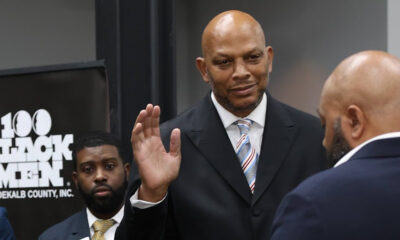
PRESS ROOM: NBA Hall of Fame Nominee Terry Cummings Joins 100 Black Men of DeKalb County to Launch Victory & Values Initiative
-

 #NNPA BlackPress2 weeks ago
Advancements in solar technology that are changing the way we power the world
