
#NNPA BlackPress
OP-ED: How one decision set voting rights back 50 years
NNPA NEWSWIRE — Ray Curry, Secretary-Treasurer, UAW — “What a lot of people don’t realize is that many aspects of the VRA are not permanent law. Many of the provisions are temporary and must be renewed by Congress. So, we must continually fight to protect this critical piece of civil rights legislation. We must fight challenges in the courts, fight to ensure the temporary provisions are renewed and fight to maintain the watchdog provisions of the Act at the state and local levels where we see voter suppression.”

The Mountain Standing Right Behind the Mountain Top

A longtime grassroots activist, Ray Curry is a member of Mount Zion Baptist Church in Nashville, a Silver Life member of the NAACP, and member of the NAACP National Board of Directors. He is also an active member of numerous community and social organizations including but not limited to the Michigan State Democratic Party, American Legion Post 177 in Murfreesboro, Tennessee, Unique Masonic Lodge #85, Charlotte Consistory #35, and Rameses Temple #51 in Charlotte, North Carolina, and various others. He resides in Detroit.
By Ray Curry, Secretary-Treasurer, UAW
This month marks the 54th anniversary of the signing of the Voting Rights Act (VRA), one of the most sweeping pieces of civil rights legislation in U.S. history. This ground-breaking measure, fought over and marched over and bleed over on the streets of Selma, Alabama, was signed into law by President Lyndon B. Johnson on August 6, 1965. It was designed to knock down legal barriers at state and local levels that prevented African Americans from exercising their right to vote.
That essential democratic right to have a say in who can best make government work for its people, had been guaranteed by the 15th Amendment to the Constitution, passed in 1870. The amendment stated that the right to vote could not be denied based on “race, color, or previous condition of servitude.”
And even though that sounds clear as a bell, the road to the polls was made instead an arduous and at times even perilous one with Jim Crow smack in the way, installing roadblocks and tripwire at as many turns as he could get away with. As originally written, the Voting Rights Act took an axe to those barriers.
But in 2013, the Supreme Court delivered a decision that, in effect, gutted VRA protections. Since then, we’ve seen numerous court challenges and legal maneuvering designed to further weaken the VRA. Designed to obfuscate that mountain top view of Dr. Martin Luther King Jr.’s promised land, that momentous decision put another mountain of dehumanizing anti-voting measures in place.
The 2013 decision did its dirty work by seizing on one of the most critical temporary provisions, known as Section 4.
What a lot of people don’t realize is that many aspects of the VRA are not permanent law. Many of the provisions are temporary and must be renewed by Congress. So, we must continually fight to protect this critical piece of civil rights legislation. We must fight challenges in the courts, fight to ensure the temporary provisions are renewed and fight to maintain the watchdog provisions of the Act at the state and local levels where we see voter suppression.
A dagger in the heart of the VRA
The devastating 2013 decision rendered moot, Sections 4 and 5, two of the most critical aspects of the law. Section 4, which was struck down, provided a formula for the federal government to identify locations with documented histories of racial discrimination. The locations identified under the provision were: Alabama, Alaska, Arizona, Georgia, Louisiana, Mississippi, South Carolina, Texas and Virginia; three counties in California; five counties in Florida; three counties in New York; 40 counties in North Carolina; two counties in South Dakota; and two Michigan townships.
Section 5 called for locations identified under Section 4 to submit any changes in voting laws to the Department of Justice for pre-approval. Until 2013, Section 5 proved very effective in blocking discriminatory measures. Between 1998 and 2013, 86 proposed election changes were blocked and hundreds more withdrawn.
The effect of scuttling these critically important checks have turned a fire hose on the people the VRA was meant to protect.
Perhaps John Lewis, Georgia U.S. House representative and well known Freedom Rider in the civil rights movement summed up the decision best: “What the Supreme Court did was to put a dagger in the heart of the Voting Rights Act.”
And we felt the pain across the nation.
‘No, you can’t vote’
Here are but a few examples of the rampant assault on voting rights and voting access since 2013.
At least 17 million voters were purged nationwide between 2016 and 2018, according to a Brennan Center for Justice Report. A similar number was purged between 2014 and 2016, leading up to the 2016 presidential election, the first presidential election in 50 years conducted without the full protection of the VRA.
Of note is the fact that those numbers are much bigger than the purge rates in 2006 and 2008. Moreover, purge rates were significantly higher, reaching up to 40%, in those areas identified under Section 4 as having a history of voter suppression along racial lines.
Georgia, (one of the identified states under Section 4), for example, purged twice as many voters between 2012 and 2016 than it did between 2008 and 2012.
Moreover, at least 17 states have enacted new voting restrictions that make it more difficult to register to vote, that curb voter registration drives and decrease opportunities for early voting, and establish requirements for government-issued IDs (a document that millions of Americans don’t have).
That last provision alone has the potential to suppress millions of voters, and it’s clear that strict voter ID laws disproportionately affect African-American, Latino, Asian-American, young, elderly and poor voters.
A Florida measure barred ex-felons from being eligible to vote after serving their sentences, preventing 1.7 million Floridians from voting in 2016, including 1 in 5 black voting-age citizens.
Fighting back
The assault the Supreme Court enabled on voting rights now threatens our democracy and the principles on which this nation was founded. Enter voting rights champion, Stacy Abrams and her group, Fair Fight Action, which is taking on voter suppression in Georgia in the courts. The Georgia suit doesn’t address Sections 4 and 5 directly, but instead challenges the legitimacy of a system that would allow egregious voting disparities.
A May 2019 Vox article on Abrams noted: “Obstacles to voting have created a two-tiered voting system that disproportionately affects voters of color and limits the power of their votes.”
Heading into the 2020 presidential election, we must work harder than ever to protect our democracy — and the right of every U.S. citizen’s voice to be heard at the ballot box, even if it takes moving mountains to do it.







#NNPA BlackPress
Poll Shows Support for Policies That Help Families Afford Child Care
BLACKPRESSUSA NEWSWIRE — New national polling shows persistent voter concern about the affordability and availability of child care for working parents, alongside broad support across key demographic groups for federal child care policies that help families afford care.



By First Five Years Fund
New national polling shows persistent voter concern about the affordability and availability of child care for working parents, alongside broad support across key demographic groups for federal child care policies that help families afford care.
The national survey was conducted by UpOne Insight on behalf of the First Five Years Fund from January 13–18, 2026.
Key findings include:
• Parents need help: 80% of voters say the ability of working parents to find and afford child care is either in a state of crisis or a major problem.
• This is an affordability issue: 82% believe federal child care funding will help lower costs for working families — including 69% of Republicans, 84% of Independents, and 94% of Democrats.
• And there continues to be strong support (62%) for the Child Care and Development Block Grant (CCDBG), a federal program that makes it possible for hundreds of thousands of families to afford safe, quality care for their children while parents work or go to school, including a majority of Republicans, 63% of Independents and 72% of Democrats.
• Support for funding child care programs remains strong: 75% believe child care funding should be increased or kept at current levels — including 75% of Republicans, 85% of Independents, and 97% of Democrats.
• 74% say funding for child care is an important and good use of tax dollars, including a majority of Republicans, three-quarters of Independents, and nine in ten Democrats.
FFYF Executive Director Sarah Rittling said, “Voters across the country are sending a clear message: federal child care and early learning programs work. These investments help parents stay in the workforce, strengthen families, and support healthy child development. They have also long had strong bipartisan support in Congress. At a time when affordability is top of mind for families, continued federal funding is essential to ensure child care remains accessible and within reach.”
First Five Years Fund works to protect, prioritize, and build bipartisan support for quality child care and early learning programs at the federal level. Reliable, affordable, and high-quality early learning and child care can be transformative, not only enhancing a child’s prospects for a brighter future but also bolstering working parents and fostering economic stability nationwide.
We work with Congress and the Administration to identify federal solutions that work for families with young children, as well as states and communities. We work with policymakers to identify ways to increase access to affordable, high-quality child care and early learning programs for children. And we collaborate with advocacy groups to help align best practices with the best possible policies. http://www.ffyf.org

#NNPA BlackPress
Trump’s MAGA Allies are Creating Executive Order Plan to Steal the 2026 Midterms
NNPA NEWSWIRE — The document that could lead to an executive order proposes using the claim that China interfered with the 2020 elections as grounds to “declare a national emergency.” The move would be an unprecedented step that would grant Trump new authority over the voting systems in the U.S.

By Lauren Victoria Burke, NNPA Newswire Correspondent
A group of MAGA pro-Trump activists, who say they are working in coordination with the White House, are circulating a 17-page draft executive order that would claim without evidence that China interfered with the 2020 presidential election. Donald Trump lost the 2020 presidential to President Joe Biden by over 7 million votes. Since Trump lost to Biden in 2020, he has repeatedly claimed that the election was “stolen” without evidence. The report of a group of “Trump allies” preparing an executive order to give Trump power over elections was first reported by The Washington Post.
The lies around the right-wing campaign that pushed falsehoods that the 2020 election was stolen was trafficked through right-wing media, particularly Fox News. Fox News was then sued for defamation for the claims by Dominion Voting Systems. Fox lost the case and had to settle for the largest defamation amount on record of $787.5 million in April 2023.
The document that could lead to an executive order proposes using the claim that China interfered with the 2020 elections as grounds to “declare a national emergency.” The move would be an unprecedented step that would grant Trump new authority over the voting systems in the U.S.
The story in The Washington Post arrives as Trump increasingly signals that he may take actions that would alter the result of the 2026 midterms. The Republicans are widely expected to lose as their approval ratings plummet as a result of a failing economy under Trump. Over 50 members of Congress have announced they will retire this year and not return in 2027.
The Trump Department of Justice, which now has a large image of Trump on the side of it, “sued five new states Thursday [Feb. 26, 2026] demanding access to their unredacted voter rolls — escalating a campaign that has been rejected by multiple federal courts and faces resistance from Republican-led states as well,” according to Democracy Docket, a group that works to protect voting rights.
Trump claimed back in late 2020, the last year of his first term, that he had the authority to issue an executive order related to mail-in voting for the 2020 elections — which he would then lose. But the Constitution states that control of elections lies with the states. As the GOP works to place hurdles in front of voting, Democrats worked to make voting easier.
In March 2021, President Biden signed an executive order calling on federal agencies to expand voting access as part of the Biden Administration’s effort “to promote and defend the right to vote for all Americans who are legally entitled to participate in elections.”
Trump’s focus is clearly on altering the November 2026 midterm elections. Trump’s polling numbers and the elections and special elections that have taken place around the U.S. over the last year clearly indicate that Republicans are about to be hit by a blue wave of Democratic victories.
Lauren Victoria Burke is an independent investigative journalist and the founder of Black Virginia News. She is a political analyst who appears on #RolandMartinUnfiltered and hosts the show LAUREN LIVE on YouTube @LaurenVictoriaBurke. She can be contacted at LBurke007@gmail.com and on twitter at @LVBurke
#NNPA BlackPress
PRESS ROOM: NBA Hall of Fame Nominee Terry Cummings Joins 100 Black Men of DeKalb County to Launch Victory & Values Initiative
NNPA NEWSWIRE — NBA Hall of Fame nominee and Basketball Legend Terry Cummings was administered the official member’s oath and ceremonially pinned during a special induction ceremony held on Friday, February 20th.

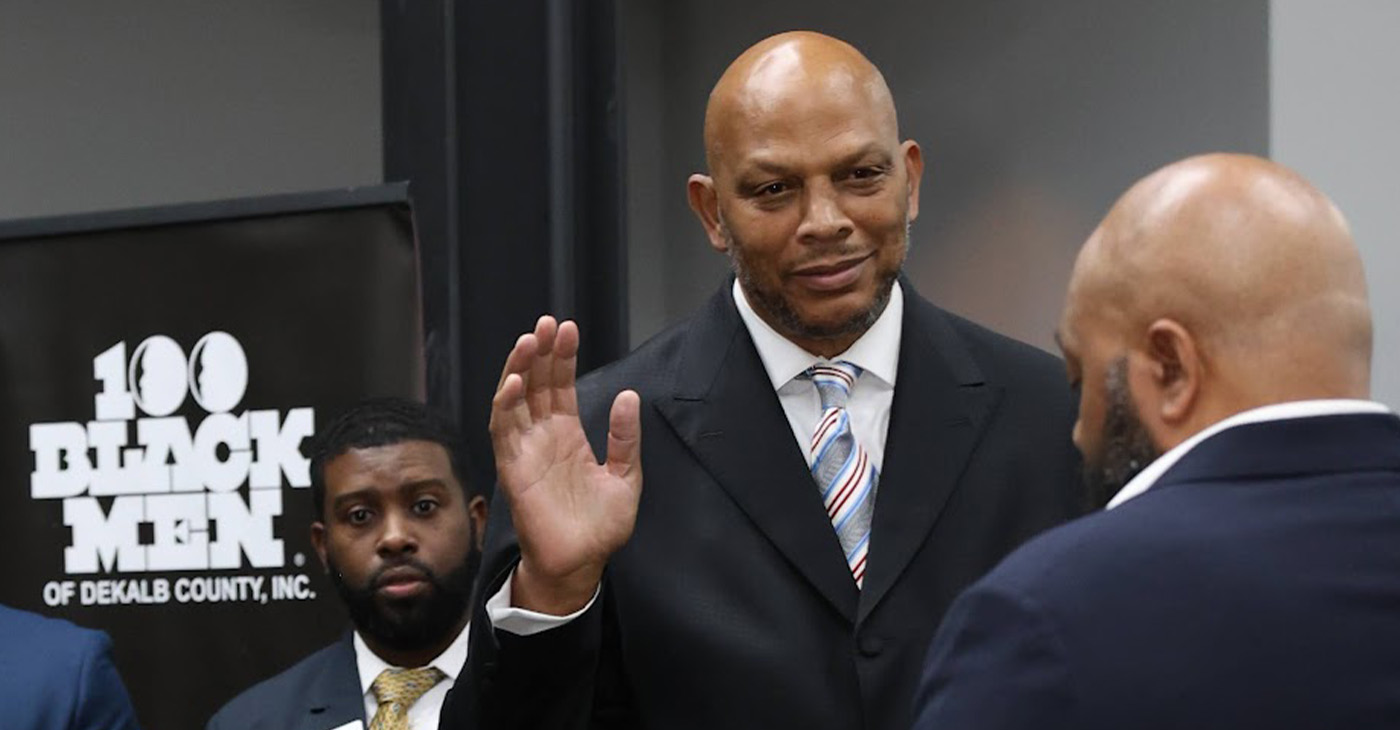
Cummings becomes an honorary member, joining other role model sports stars
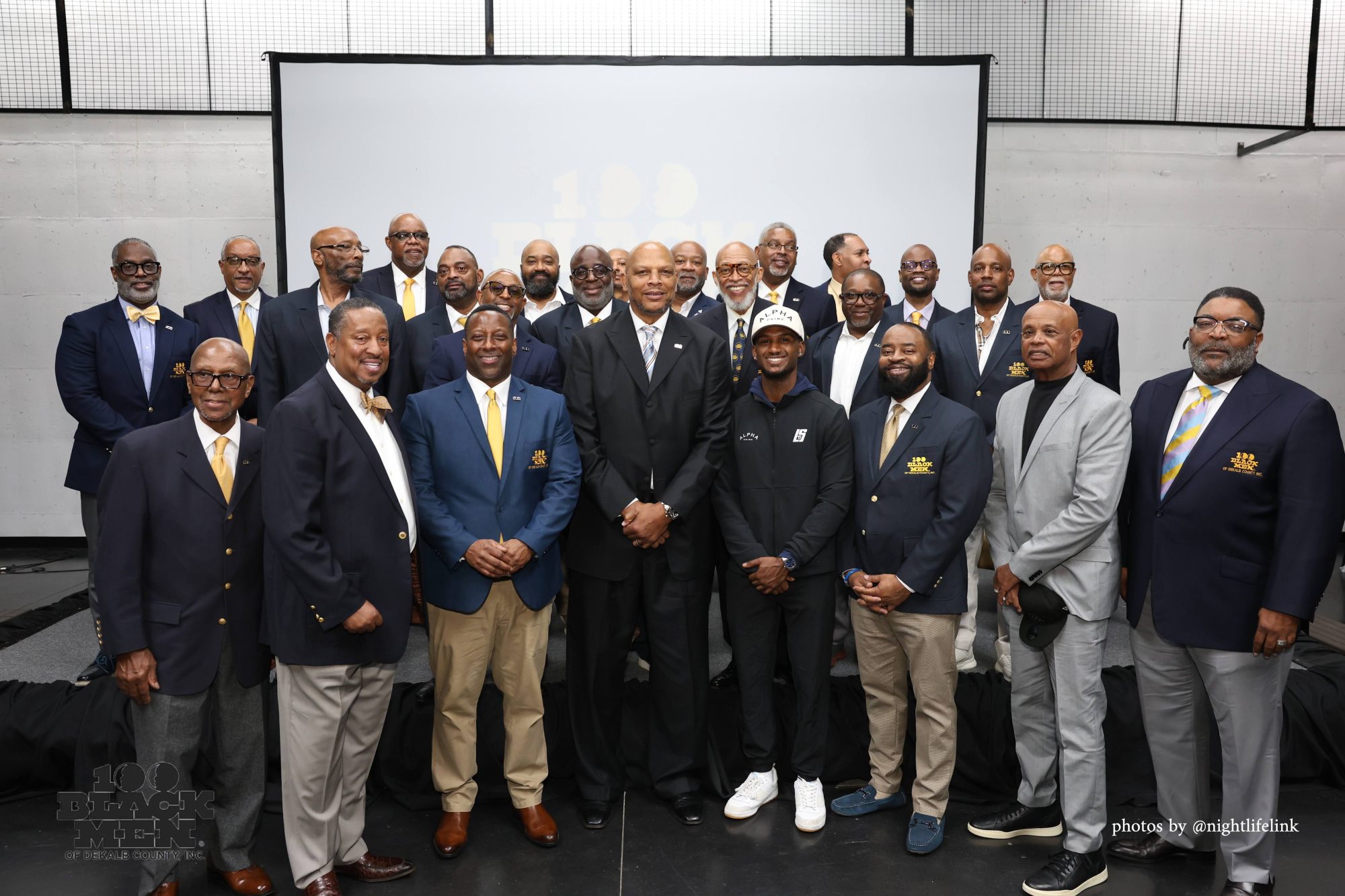
NBA Hall of Fame nominee and Basketball Legend Terry Cummings has officially become an honorary member of the 100 Black Men of DeKalb County, marking a powerful new chapter for the 100 Black Men and youth development across the region.
Cummings was administered the official member’s oath and ceremonially pinned during a special induction ceremony held on Friday, February 20th. The moment signified more than membership — it marked the launch of the organization’s transformative new platform, the Victory & Values Initiative.
The Victory & Values Initiative is a groundbreaking youth development program designed to empower elementary and middle school students through a dynamic blend of sports, mentorship, and STEM exposure. The initiative focuses on building health, discipline, character, leadership, and access to opportunity — creating pathways for long-term academic and personal success.
“This is about more than sports,” said Cummings during the ceremony. “It’s about using the platform of athletics to teach life lessons, create access, and build the next generation of leaders.”

The induction ceremony also featured notable guests including NASCAR’s newest Star Driver, Lavar Scott and NASCAR Director of Athletic Performance, Phil Horton, who joined Cummings for a powerful Victory & Values Town Hall discussion. The Town Hall was moderated by renowned Sports Emcee John Hollins and focused on leadership, resilience, discipline, and the importance of mentorship in shaping young lives.
A “Day at NASCAR” for 75+ Youth

Cummings wasted no time getting to work. On his first full day as an honorary member, he joined his new brothers of the 100 Black Men of DeKalb County to host a “Day at NASCAR,” escorting more than 75 youth to a once-in-a-lifetime experience at EchoPark Motor Speedway (formerly Atlanta Motor Speedway).
The youth participants received behind-the-scenes access including: an exclusive tour of Pit Row, access to the Garage Area and exploration of the interactive Fan Zone.
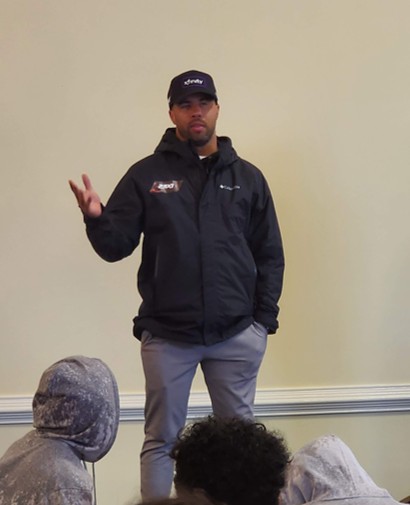
The experience culminated with a surprise meet-and-greet and Q&A session with NASCAR Superstar Bubba Wallace, who shared insights on perseverance, preparation, and breaking barriers in professional sports.
The day served as a living example of the ‘Victory & Values’ Initiative in action — exposing youth to new industries, expanding their vision for the future, and connecting them directly with high- level mentors and role models.
Building Leaders Through Access and Mentorship
The 100 Black Men of DeKalb County – a chapter of the largest, national mentoring organization in the county – continues to expand its footprint with programs focused on academic excellence, economic empowerment, leadership development, and health & wellness.
The launch of ‘Victory & Values’ represents a strategic expansion of the organization’s impact
- intentionally integrating athletics and STEM to engage youth at an early age while reinforcing core principles such as integrity, accountability, teamwork, and perseverance.
“Our mission has always been to mentor the next generation,” said Vaughn Irons, President-Elect of the 100 Black Men of DeKalb County. “With Terry Cummings joining the brotherhood, along with partners in NASCAR and professional sports, we are creating unprecedented access and exposure for our youth. Victory & Values is about turning inspiration into structured opportunity.”
By connecting elementary and middle school students to professional athletes, executives, STEM professionals, and community leaders, the initiative aims to:
- Increase youth exposure to careers in sports business, engineering, and performance science
- Strengthen mentorship pipelines
- Promote physical wellness and mental resilience
- Build character-driven leadership at an early age
Open Invitation to Youth and Families
All youth are invited to participate in the Victory & Values Initiative, along with the other countless, impactful programs offered by the 100 Black Men of DeKalb County.
Parents and guardians seeking mentorship, leadership development, academic enrichment, and transformative exposure opportunities for their children are encouraged to connect with the organization.
As NBA Legend Terry Cummings’ induction demonstrates, Victory & Values is more than a program — it is a movement designed to build champions in life, not just in sports.
For more information about the Victory & Values Initiative or to enroll a student, contact: 100 Black Men of DeKalb County at Phone at 404.241.1338, info@100bmod.org or Tee Foxx at 404.791.6525,

-
 Activism4 weeks ago
Life Expectancy in Marin City, a Black Community, Is 15-17 Years Less than the Rest of Marin County
-
 Activism4 weeks ago
Oakland Post: Week of January 28, 2025 – February 3, 2026
-

 Activism3 weeks ago
Community Celebrates Turner Group Construction Company as Collins Drive Becomes Turner Group Drive
-

 Business3 weeks ago
California Launches Study on Mileage Tax to Potentially Replace Gas Tax as Republicans Push Back
-

 Activism3 weeks ago
Discrimination in City Contracts
-

 Arts and Culture3 weeks ago
Book Review: Books on Black History and Black Life for Kids
-

 Activism3 weeks ago
COMMENTARY: The Biases We Don’t See — Preventing AI-Driven Inequality in Health Care
-

 Activism4 weeks ago
Medi-Cal Cares for You and Your Baby Every Step of the Way
