
Commentary
Opinion: Lessons for Current Student Protesters From a San Francisco State Strike Veteran
How the nation’s first College of Ethnic studies came about, bringing together Latino, African American and Asian American disciplines may offer some clues as to how to ease the current turmoil on American college campuses over the Israel-Hamas war. After the deadline passed to end the Columbia University encampment by 2 p.m. Monday, student protesters blockaded and occupied Hamilton Hall in a symbolic move early Tuesday morning. Protesters did the same in 1968.


By Emil Guillermo
How the nation’s first College of Ethnic studies came about, bringing together Latino, African American and Asian American disciplines may offer some clues as to how to ease the current turmoil on American college campuses over the Israel-Hamas war.
After the deadline passed to end the Columbia University encampment by 2 p.m. Monday, student protesters blockaded and occupied Hamilton Hall in a symbolic move early Tuesday morning.
Protesters did the same in 1968.
That made me think of San Francisco State University, 1968.
The news was filled with call backs to practically every student protest in the past six decades as arrests mounted into hundreds on nearly two dozen campuses around the country.
In 1970, the protests at Kent State were over the Vietnam War. Ohio National Guardsmen came in, opened fire, and killed four students.
Less than two weeks later that year, civil rights activists outside a dormitory at Jackson State were confronted by armed police. Two African American students were killed, twelve injured.
But again, I didn’t hear anyone mention San Francisco State University, 1968.
That protest addressed all the issues of the day and more. The student strike at SFSU was against the Vietnam war.
That final goal was eventually achieved, but there was violence, sparked mostly by “outside agitators,” who were confronted by police.
“People used the term ‘off the pigs’ but it was more rally rhetoric than a call to action (to actually kill police),” said Daniel Phil Gonzales, who was one of the strikers in 1968.
Gonzales, known as the go-to resource among Filipino American scholars for decades, went on to teach at what was the positive outcome of the strike, San Francisco State University’s College of Ethnic Studies. It’s believed to be the first of its kind in the nation. Gonzales recently retired after more than 50 years as professor.
As for today’s protests, Gonzales is dismayed that the students have constantly dealt with charges of antisemitism.
“It stymies conversation and encourages further polarization and the possibility of violent confrontation,” he said. “You’re going to be labeled pro-Hamas or pro-terrorist.”
That’s happening now. But we forget we are dealing not with Hamas proxies. We are dealing with students.
Gonzales said that was a key lesson at SF State’s strike. The main coalition driving the strike was aided by self-policing from inside of the movement. “That’s very difficult to maintain. Once you start this kind of activity, you don’t know who’s going to join,” he said.
Gonzales believes that in the current situation, there is a patch of humanity, common ground, where one can be both pro-Palestine and pro-Israel. He said it’s made difficult if you stand against the belligerent policies of Benjamin Netanyahu. In that case, you’re likely to be labeled antisemitic.
Despite that, Gonzales is in solidarity with the protesters and the people of Gaza, generally. Not Hamas. And he sees how most of the young people protesting are in shock at what he called the “duration of the absolute inhumane kind of persecution and prosecution of the Palestinians carried out by the Israeli government.”
As a survivor of campus protest decades ago, Gonzales offered some advice to the student protesters of 2024.
“You have to have a definable goal, but right now the path to that goal is unclear,” he said.
About the Author
Emil Guillermo is a journalist and commentator. A veteran newsman in TV and print, he is a former host of NPR’s “All Things Considered.”








Activism
Oakland Post: Week of March 4 – 10, 2026
The printed Weekly Edition of the Oakland Post: Week of March 4 – 10, 2026
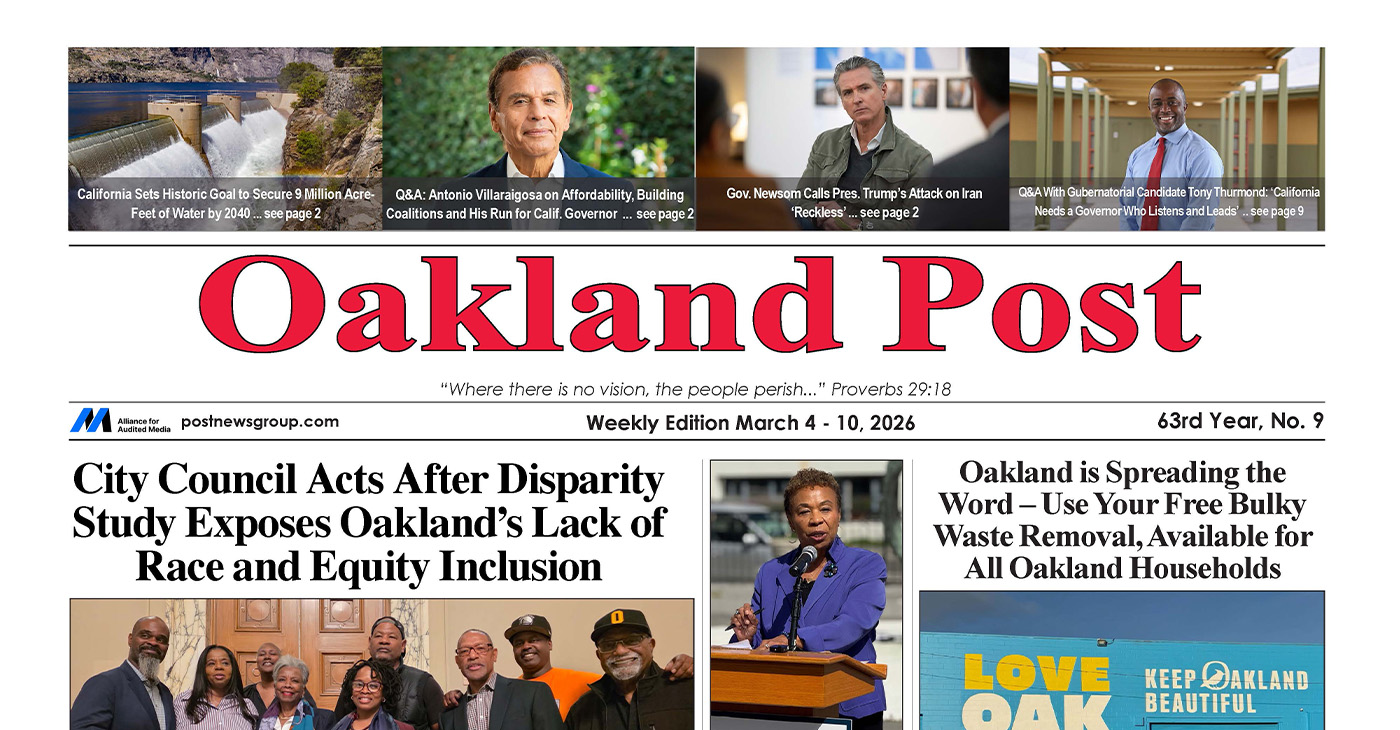
To enlarge your view of this issue, use the slider, magnifying glass icon or full page icon in the lower right corner of the browser window.
Activism
Oakland Post: Week of February 25 – March 3, 2026
The printed Weekly Edition of the Oakland Post: Week of – February 25 – March 3, 2026
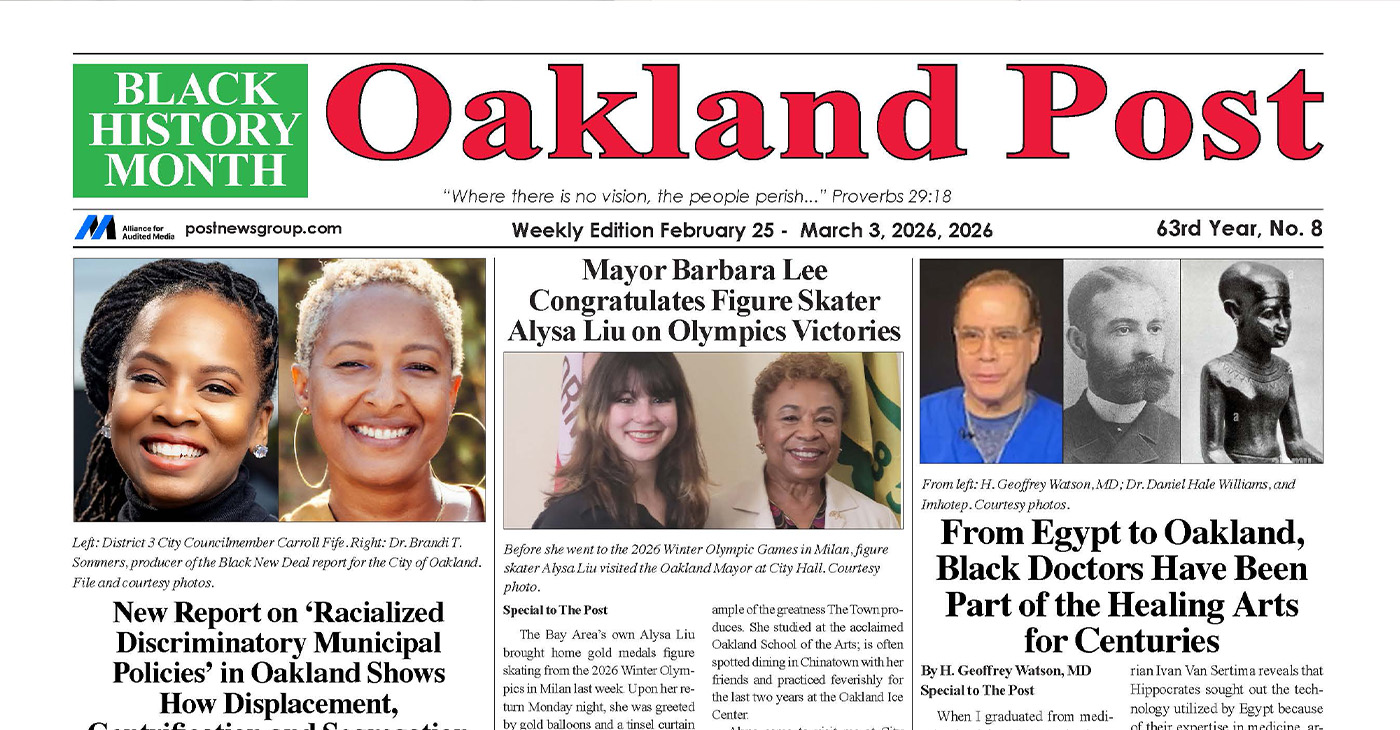
To enlarge your view of this issue, use the slider, magnifying glass icon or full page icon in the lower right corner of the browser window.
Activism
Oakland Post: Week of February 18 – 24, 2026
The printed Weekly Edition of the Oakland Post: Week of – February 18 – 24, 2026
To enlarge your view of this issue, use the slider, magnifying glass icon or full page icon in the lower right corner of the browser window.
WORK FROM HOME
Home-based business with potential monthly income of $10K+ per month. A proven training system and website provided to maximize business effectiveness. Perfect job to earn side and primary income. Contact Lynne for more details: Lynne4npusa@gmail.com 800-334-0540


COMMENTARY: Women of Color Shape Our Past and Future

Woman’s Search for Family’s Roots Leads to Ancestor John T. Ward – A Successful Entrepreneur and Conductor on the Underground Railroad

Advocates Raise Alarm Over ICE Operation, MOU and Detention Risks in Baltimore County

Pete Buttigieg to Join Mayor Randall Woodfin for Community Town Hall in Birmingham

WATCH: Week One – NNPA’s “Leadership Matters” Video Series

Oakland Post: Week of March 4 – 10, 2026

OP-ED: NNPA Launches 2026 “Leadership Matters” Video Series

PRESS ROOM: PMG and Cranbrook Horizons-Upward Bound Launch Journey Fellowship Cohort 2

Los Angeles Summit Brings Together Leaders to Tackle Poverty and Affordability

Civil Rights TV Launches 24/7 Network Focused on Black History, Education and Equity

REVIEW: The Ultimate Hot Girl Summer Getaway: Sunseeker Resort Florida

COMMENTARY: How You Stop a Prescription Medicine is as Important as How You Start

PRESS ROOM: From Congress to Corporate America: NNPA Spotlights Visionaries in New Video Series

Poll Shows Support for Policies That Help Families Afford Child Care

Oakland Post: Week of February 25 – March 3, 2026

Oakland Post: Week of January 28, 2025 – February 3, 2026

Life Expectancy in Marin City, a Black Community, Is 15-17 Years Less than the Rest of Marin County

California Launches Study on Mileage Tax to Potentially Replace Gas Tax as Republicans Push Back

Community Celebrates Turner Group Construction Company as Collins Drive Becomes Turner Group Drive

Discrimination in City Contracts

Book Review: Books on Black History and Black Life for Kids

Oakland Post: Week of January 21 – 27, 2026

COMMENTARY: The Biases We Don’t See — Preventing AI-Driven Inequality in Health Care

Post Newspaper Invites NNPA to Join Nationwide Probate Reform Initiative

Black History Events in the East Bay

Medi-Cal Cares for You and Your Baby Every Step of the Way

Art of the African Diaspora Celebrates Legacy and Community at Richmond Art Center

COMMENTARY: The National Protest Must Be Accompanied with Our Votes

New Bill, the RIDER Safety Act, Would Support Transit Ambassadors and Safety on Public Transit

After Don Lemon’s Arrest, Black Officials Raise Concerns About Independent Black Media

Hyundai Ioniq 5 Parking, Safety, and 360 View #shorts

2025 Ioniq 5 New Wiper & Powerful Performance! #shorts

Electric SUV Range: Is 259 Miles Enough? #shorts

EV Charging: How Fast Can You Charge an Electric Vehicle? #shorts

Biometric Cooling… Messaging Seats…Come on! 2025 Infiniti QX80 Autograph 4WD

Charged Up: Witness the Magic of a Fully Electric Car! #shorts

Range Rover Sport PHEV Included…: See What’s Inside This Luxury SUV! #shorts

Invisible Hood View: Perfect Parking with X-Ray Vision! #shorts

AI Is Reshaping Black Healthcare: Promise, Peril, and the Push for Improved Results in California

ESSAY: Technology and Medicine, a Primary Care Point of View

Sanctuary Cities

The RESISTANCE – FREEDOM NOW

STATE OF THE PEOPLE: Freddie

ECONOMIC BOYCOTT DAY!!!!!

I told You So
-
 Business4 weeks ago
California Launches Study on Mileage Tax to Potentially Replace Gas Tax as Republicans Push Back
-
 Activism4 weeks ago
Community Celebrates Turner Group Construction Company as Collins Drive Becomes Turner Group Drive
-
 Activism4 weeks ago
Discrimination in City Contracts
-
 Arts and Culture4 weeks ago
Book Review: Books on Black History and Black Life for Kids
-
 Activism4 weeks ago
COMMENTARY: The Biases We Don’t See — Preventing AI-Driven Inequality in Health Care
-
 Activism4 weeks ago
Post Newspaper Invites NNPA to Join Nationwide Probate Reform Initiative
-
 #NNPA BlackPress4 weeks ago
COMMENTARY: The National Protest Must Be Accompanied with Our Votes
-
 Activism4 weeks ago
New Bill, the RIDER Safety Act, Would Support Transit Ambassadors and Safety on Public Transit
