
Oakland
Opinion: Stopping the Stadium Mega-Development Was an Important Victory, But Fight Is Far from Over


By Alvina Wong
After four months of organizing by Laney students, faculty, and staff, Chinatown and Eastlake residents, and Lake Merritt environmentalists, the Peralta Board of Trustees decided to end talks with the Oakland A’s about constructing a stadium mega-development next to Laney College.
Their decision is a testament to our communities’ power to fight for a future where we can stay and thrive. We also know that this fight is far from over.
Since 2014 when BART and City officials completed the Lake Merritt Station Area Plan, Chinatown and Eastlake have been bombarded with a wave of luxury condo developments, soaring rents, and mass displacement of longtime residents.
At the time, many of our organizations demanded that we be included in the city-led ‘community-engagement process’. We advocated for affordable housing and storefronts, parks and open space, and resources for working class immigrant and refugee communities.
Despite countless meetings, letters, and petitions to city officials, none of our communities’ needs were reflected in the plan.
Instead, we got a plan that incentivized high-density market-rate development by rezoning the neighborhood to allow developers to build up to 275 feet in some areas, without a conditional use permit.
Our vision for a neighborhood where new immigrants and refugees could stay and thrive was noted, but no policies were put in place to help realize this vision.

The Lake Merritt Station Area plan, like the West Oakland BART plan and many others, has paved the way for developers to turn Chinatown and Eastlake into playgrounds for the wealthy, with 20 and 30 story luxury apartment buildings that literally cast shadows over our communities.
So, when the Oakland A’s decided to build a stadium with upscale stores and hotels next to Laney College, our communities quickly decided that we needed to oppose it. Chinatown and Eastlake groups joined with Laney students, faculty, and staff who were fighting to protect Laney as a public resource.
Groups that had been working for years to restore Lake Merritt and its saltwater channel also joined the fight. We went door-to-door and classroom-to-classroom. Despite the A’s aggressive PR campaign, we found that people overwhelmingly opposed the stadium at Laney.
While we were successful in stopping the A’s stadium mega-development at Laney, we know that there are more developers that want to use this public land for their own profits.
Many of us have been part of building community, culture, and resources in neighborhoods that formed as a result of racist housing covenants, suffered from disinvestment after white flight, and are now threatened with mass displacement. In these times, we’ve learned that our public land is one of the last remaining places where we can build the resources our communities need.
For us, this decision to say no to a stadium at Laney opens the door for our communities to say yes to stewarding this land to serve the public good.
It helps us transition away from looking at land as a commodity that exists to maximize profits for the wealthy, and toward looking at how this land can help sustain our lives and communities for generations to come.
As for big corporations like the A’s that benefit from Oakland’s public infrastructure and diverse communities, they should have been giving back all along – whether that means supporting public education institutions like Laney College, affordable housing and good jobs for local residents, or growing in ways that take leadership from working class people of color who want to stay and thrive.
 We hope the Oakland A’s will stay the right way. Oakland has already invested millions of public dollars in the Coliseum. Now it’s the A’s turn to invest in East Oakland’s communities.
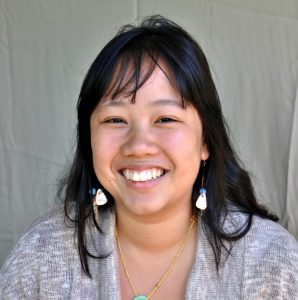
Alvina Wong works with the Stay the Right Way Coalition and is employed by the Asian Pacific Environmental Network (APEN).













Activism
Oakland Post: Week of February 25 – March 3, 2026
The printed Weekly Edition of the Oakland Post: Week of – February 25 – March 3, 2026

To enlarge your view of this issue, use the slider, magnifying glass icon or full page icon in the lower right corner of the browser window.
Activism
Oakland Post: Week of February 18 – 24, 2026
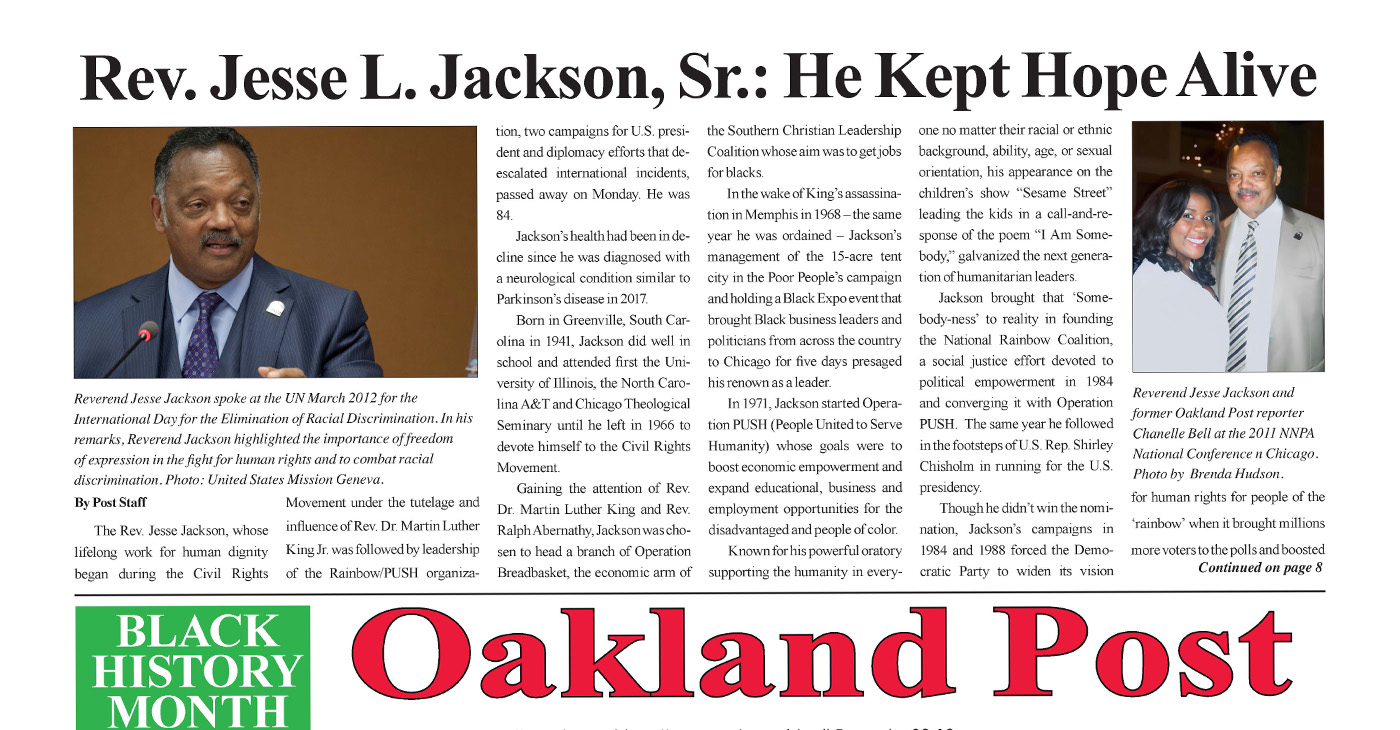
The printed Weekly Edition of the Oakland Post: Week of – February 18 – 24, 2026
To enlarge your view of this issue, use the slider, magnifying glass icon or full page icon in the lower right corner of the browser window.
Activism
Oakland Post: Week of February 11 – 17, 2026
The printed Weekly Edition of the Oakland Post: Week of – February 11 – 17, 2026

To enlarge your view of this issue, use the slider, magnifying glass icon or full page icon in the lower right corner of the browser window.

WORK FROM HOME
Home-based business with potential monthly income of $10K+ per month. A proven training system and website provided to maximize business effectiveness. Perfect job to earn side and primary income. Contact Lynne for more details: Lynne4npusa@gmail.com 800-334-0540


Poll Shows Support for Policies That Help Families Afford Child Care

Oakland Post: Week of February 25 – March 3, 2026

Trump’s MAGA Allies are Creating Executive Order Plan to Steal the 2026 Midterms

PRESS ROOM: NBA Hall of Fame Nominee Terry Cummings Joins 100 Black Men of DeKalb County to Launch Victory & Values Initiative

Reflecting on Black History Milestones in Birmingham AL

OP-ED: One Hundred Years of Black Workers Telling the Truth

PRESS ROOM: Civil Rights TV Launches in Selma as the World’s First 24/7 Civil Rights Television Network

Advancements in solar technology that are changing the way we power the world

U.S. manufacturing rebounds – how foundry services are adapting to rising demand

Why has blood testing become so popular in today’s world?

Ghana Mourns a Son of the African World

OP-ED: Trump’s Policies Hurt Black America—and Everyone Else

OP-ED: Meta Deleted Me. I Still Don’t Know Why. And neither will you.

More than a Mission: Paying It Forward for the Future of Education

Avoid Eviction This Season: Landlord Checklist for Stable Tenancies

Oakland Post: Week of January 28, 2025 – February 3, 2026

Life Expectancy in Marin City, a Black Community, Is 15-17 Years Less than the Rest of Marin County

Community Celebrates Turner Group Construction Company as Collins Drive Becomes Turner Group Drive

California Launches Study on Mileage Tax to Potentially Replace Gas Tax as Republicans Push Back

Discrimination in City Contracts

Book Review: Books on Black History and Black Life for Kids

Oakland Post: Week of January 21 – 27, 2026

COMMENTARY: The Biases We Don’t See — Preventing AI-Driven Inequality in Health Care

Post Newspaper Invites NNPA to Join Nationwide Probate Reform Initiative

Black History Events in the East Bay

Medi-Cal Cares for You and Your Baby Every Step of the Way

Art of the African Diaspora Celebrates Legacy and Community at Richmond Art Center

COMMENTARY: The National Protest Must Be Accompanied with Our Votes

New Bill, the RIDER Safety Act, Would Support Transit Ambassadors and Safety on Public Transit

After Don Lemon’s Arrest, Black Officials Raise Concerns About Independent Black Media

Hyundai Ioniq 5 Parking, Safety, and 360 View #shorts

2025 Ioniq 5 New Wiper & Powerful Performance! #shorts

Electric SUV Range: Is 259 Miles Enough? #shorts

EV Charging: How Fast Can You Charge an Electric Vehicle? #shorts

Biometric Cooling… Messaging Seats…Come on! 2025 Infiniti QX80 Autograph 4WD

Charged Up: Witness the Magic of a Fully Electric Car! #shorts

Range Rover Sport PHEV Included…: See What’s Inside This Luxury SUV! #shorts

Invisible Hood View: Perfect Parking with X-Ray Vision! #shorts

AI Is Reshaping Black Healthcare: Promise, Peril, and the Push for Improved Results in California

ESSAY: Technology and Medicine, a Primary Care Point of View

Sanctuary Cities

The RESISTANCE – FREEDOM NOW

STATE OF THE PEOPLE: Freddie

ECONOMIC BOYCOTT DAY!!!!!

I told You So
-
 Activism4 weeks ago
Community Celebrates Turner Group Construction Company as Collins Drive Becomes Turner Group Drive
-
 Business4 weeks ago
California Launches Study on Mileage Tax to Potentially Replace Gas Tax as Republicans Push Back
-
 Activism4 weeks ago
Discrimination in City Contracts
-
 Arts and Culture4 weeks ago
Book Review: Books on Black History and Black Life for Kids
-
 Activism4 weeks ago
COMMENTARY: The Biases We Don’t See — Preventing AI-Driven Inequality in Health Care
-
 Activism4 weeks ago
Post Newspaper Invites NNPA to Join Nationwide Probate Reform Initiative
-
 Alameda County4 weeks ago
Black History Events in the East Bay
-
 Activism4 weeks ago
Art of the African Diaspora Celebrates Legacy and Community at Richmond Art Center
