
Politics
Record Number of Americans Can Register Online, Vote Early


In this Sept. 19, 2012 file photo, then-California Secretary of State Debra Bowen, shows a online voter registration system as she holds a traditional written form in Sacramento, Calif. (AP Photo/Rich Pedroncelli, File)
Anne Flaherty, ASSOCIATED PRESS
WASHINGTON (AP) — Oh, how times have changed since the days of punch card ballots and hanging chads.
Come 2016 when the nation picks its next president, a record number of Americans will have the option of registering online and voting early. That has some people warning of voter fraud, while others are celebrating the flexibility as a way to make sure more people are heard on Election Day.
“This year has been a good year for opening access,” said Dale Ho, director of the American Civil Liberties Union voting rights project. But “these things can turn on a dime as long as partisans detect ways to gain advantage by changing the rules.”
Among the biggest change next year: more voters will be able to go online to register to vote, according to data released Wednesday by the Pew Charitable Trusts, a nonpartisan public policy group.
When President Barack Obama was first elected in 2008, only two states — Arizona and Washington — offered a website where citizens could register. By 2016, a majority of states may be offering that service, with 20 states already offering online registration and seven more considering it or having passed legislation that would authorize it.
“I think eventually despite resistance among a small number of people … we’re eventually going to see every state adopt this,” said Michael McDonald, a voting expert and associate professor at the University of Florida.
What’s more is that five states will let citizens register to vote online without a state identification or driver’s license: California, Delaware, Minnesota, Missouri, and Virginia.
The Pew Charitable Trusts says online voting systems, which cost an average $249,000 each, help cut down on errors resulting from bad handwriting and will reduce time spent by voters in line on Election Day.
Also continuing a trend, more Americans are expected to vote before Election Day in 2016.
In 2000, when George W. Bush and Al Gore were in a tight race for the presidency, less than 16 percent of Americans voted in advance, either by mail-in ballots or in-person at a designated county site. By the 2008 presidential election, the number of advance votes nationwide jumped to 34 percent.
The increase in advance voting comes in part because states are loosening the rules with mail-in ballots or setting up centers that accept ballots before Election Day. In 2014, Colorado, Washington and Oregon relied entirely on mail-in ballots.
McDonald said he thinks the next major development in voting will be emailed ballots, something already being done for many military voters stationed overseas and in places like Alaska where residents are more remote.
“Voters like the convenience of receiving their ballots electronically, and I think we’re just going to see more of this in the future,” McDonald said.
Perhaps the only aspect of voting that hasn’t changed since the turn of the century is the reluctance by states to let people cast ballots online because of security concerns. When the District of Columbia experimented with an online voting system in 2010, hackers broke in and changed votes to go to fictional characters.
“I think we’re a long way from the security that we’d need to have voting online,” said the ACLU’s Ho.
Here’s a look at what else has changed since the last U.S. presidential election:
— Several states are tweaking their registration sites with smartphones in mind, offering mobile friendly features.
— States are using technology to analyze voter data. Colorado, for example, notes the number of new online voter registrations in a certain time period and updates to old ones. That can help states identify trends.
— States are doing more to accommodate citizens who struggle with English or have disabilities, such as offering text-to-speech software for blind people.
___
Online:
http://www.pewtrusts.org/en/research-and-analysis/issue-briefs/2015/05/online-voter-registration
Follow Anne Flaherty on Twitter at https://twitter.com/annekflaherty.
Copyright 2015 The Associated Press. All rights reserved. This material may not be published, broadcast, rewritten or redistributed.
###





Activism
Oakland Post: Week of March 4 – 10, 2026
The printed Weekly Edition of the Oakland Post: Week of March 4 – 10, 2026


To enlarge your view of this issue, use the slider, magnifying glass icon or full page icon in the lower right corner of the browser window.

Activism
Oakland Post: Week of February 25 – March 3, 2026
The printed Weekly Edition of the Oakland Post: Week of – February 25 – March 3, 2026

To enlarge your view of this issue, use the slider, magnifying glass icon or full page icon in the lower right corner of the browser window.
Activism
Oakland Post: Week of February 18 – 24, 2026
The printed Weekly Edition of the Oakland Post: Week of – February 18 – 24, 2026
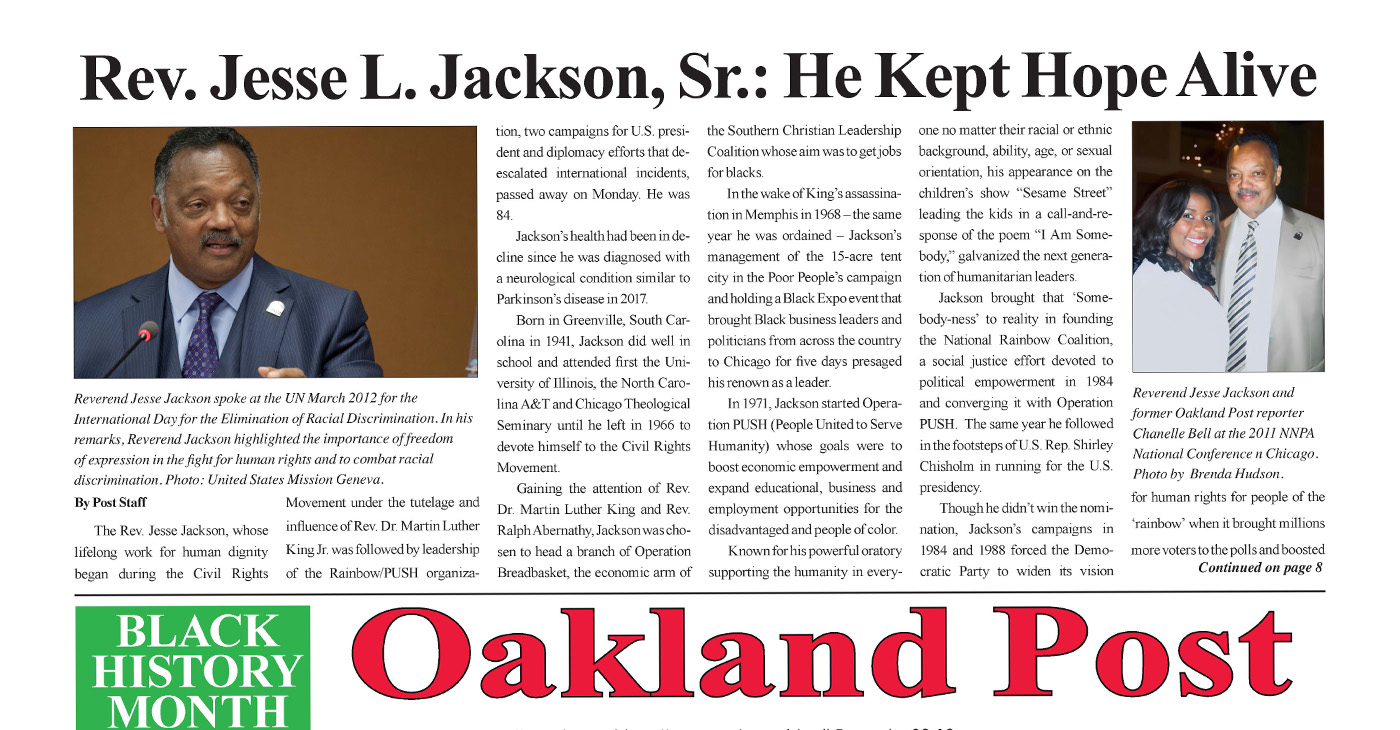
To enlarge your view of this issue, use the slider, magnifying glass icon or full page icon in the lower right corner of the browser window.

WORK FROM HOME
Home-based business with potential monthly income of $10K+ per month. A proven training system and website provided to maximize business effectiveness. Perfect job to earn side and primary income. Contact Lynne for more details: Lynne4npusa@gmail.com 800-334-0540


COMMENTARY: Women of Color Shape Our Past and Future

Woman’s Search for Family’s Roots Leads to Ancestor John T. Ward – A Successful Entrepreneur and Conductor on the Underground Railroad

Advocates Raise Alarm Over ICE Operation, MOU and Detention Risks in Baltimore County

Pete Buttigieg to Join Mayor Randall Woodfin for Community Town Hall in Birmingham

WATCH: Week One – NNPA’s “Leadership Matters” Video Series

Oakland Post: Week of March 4 – 10, 2026

OP-ED: NNPA Launches 2026 “Leadership Matters” Video Series

PRESS ROOM: PMG and Cranbrook Horizons-Upward Bound Launch Journey Fellowship Cohort 2

Los Angeles Summit Brings Together Leaders to Tackle Poverty and Affordability

Civil Rights TV Launches 24/7 Network Focused on Black History, Education and Equity

REVIEW: The Ultimate Hot Girl Summer Getaway: Sunseeker Resort Florida

COMMENTARY: How You Stop a Prescription Medicine is as Important as How You Start

PRESS ROOM: From Congress to Corporate America: NNPA Spotlights Visionaries in New Video Series

Poll Shows Support for Policies That Help Families Afford Child Care

Oakland Post: Week of February 25 – March 3, 2026

Oakland Post: Week of January 28, 2025 – February 3, 2026

Life Expectancy in Marin City, a Black Community, Is 15-17 Years Less than the Rest of Marin County

California Launches Study on Mileage Tax to Potentially Replace Gas Tax as Republicans Push Back

Community Celebrates Turner Group Construction Company as Collins Drive Becomes Turner Group Drive

Discrimination in City Contracts

Book Review: Books on Black History and Black Life for Kids

Oakland Post: Week of January 21 – 27, 2026

COMMENTARY: The Biases We Don’t See — Preventing AI-Driven Inequality in Health Care

Post Newspaper Invites NNPA to Join Nationwide Probate Reform Initiative

Black History Events in the East Bay

Medi-Cal Cares for You and Your Baby Every Step of the Way

Art of the African Diaspora Celebrates Legacy and Community at Richmond Art Center

COMMENTARY: The National Protest Must Be Accompanied with Our Votes

New Bill, the RIDER Safety Act, Would Support Transit Ambassadors and Safety on Public Transit

After Don Lemon’s Arrest, Black Officials Raise Concerns About Independent Black Media

Hyundai Ioniq 5 Parking, Safety, and 360 View #shorts

2025 Ioniq 5 New Wiper & Powerful Performance! #shorts

Electric SUV Range: Is 259 Miles Enough? #shorts

EV Charging: How Fast Can You Charge an Electric Vehicle? #shorts

Biometric Cooling… Messaging Seats…Come on! 2025 Infiniti QX80 Autograph 4WD

Charged Up: Witness the Magic of a Fully Electric Car! #shorts

Range Rover Sport PHEV Included…: See What’s Inside This Luxury SUV! #shorts

Invisible Hood View: Perfect Parking with X-Ray Vision! #shorts

AI Is Reshaping Black Healthcare: Promise, Peril, and the Push for Improved Results in California

ESSAY: Technology and Medicine, a Primary Care Point of View

Sanctuary Cities

The RESISTANCE – FREEDOM NOW

STATE OF THE PEOPLE: Freddie

ECONOMIC BOYCOTT DAY!!!!!

I told You So
-
 Activism4 weeks ago
Discrimination in City Contracts
-

 Activism4 weeks ago
Oakland Post: Week of February 11 – 17, 2026
-

 #NNPA BlackPress2 weeks ago
Reflecting on Black History Milestones in Birmingham AL
-

 Advice4 weeks ago
Rising Optimism Among Small And Middle Market Business Leaders Suggests Growth for California
-

 Bay Area3 weeks ago
CITY OF SAN LEANDRO STATE OF CALIFORNIA PUBLIC WORKS DEPARTMENT ENGINEERING DIVISION NOTICE TO BIDDERS FOR ANNUAL STREET OVERLAY/REHABILITATION 2019-21 – PHASE III
-

 #NNPA BlackPress2 weeks ago
U.S. manufacturing rebounds – how foundry services are adapting to rising demand
-
 #NNPA BlackPress2 weeks ago
PRESS ROOM: NBA Hall of Fame Nominee Terry Cummings Joins 100 Black Men of DeKalb County to Launch Victory & Values Initiative
-

 #NNPA BlackPress2 weeks ago
Advancements in solar technology that are changing the way we power the world
