
Housing
Report: How to House Oakland’s Unhoused Within Six Months

The following is the third part of a series profiling the new report from the Dellums Institute/Just Cities for the Housing and Dignity Project led by The Village and East Oakland Collective, Housing Oakland’s Unhoused, focuses on what we’ve all been waiting for—solutions to Oakland’s new homelessness crisis.
The Housing Oakland’s Unhoused Report very powerfully establishes that the traditional approach to homelessness does not address today’s realities where the majority of the homeless only need housing, rather than intensive services, and the costs and time needed to build multi-family housing is insufficient. Instead, the report offers innovative solutions that would result in providing safe, dignified, and affordable housing to over 2,000 people within 6 months, IF the political will in City Hall and the County exists.
Perhaps the innovativeness of the solutions comes from the fact that the Dellums Institute and the Goldman School for Public Policy partnered with unhoused people and activists from The Village and the East Oakland Collective.
This authentic participatory research model relied directly on the voices, experiences, and brilliant ideas from the people most impacted by the housing crisis. Different from most government community “input” sessions, the research findings and final recommendations were then vetted and approved by the same unhoused people and activists.
The report’s Short Term Solutions are implementable within 6 to 12 months. They include low cost and immediate housing building models such as tiny, mobile, or container homes which cost between $7,500 to $35,000 to build, including infrastructure costs.
The report states that it would cost around $23 million to immediately build 1,600 new housing units that could provide dignified housing for 2,000 people.
The report identifies specific resources that are currently available to implement this critical plan, including available public land parcels and new monies for homeless housing from the City, County, and State.
Not stopping at short-term solutions, the Housing Oakland’s Unhoused Report also lays out Long Term Solutions to build 2,000 units of permanent housing for extremely low income to no income residents.
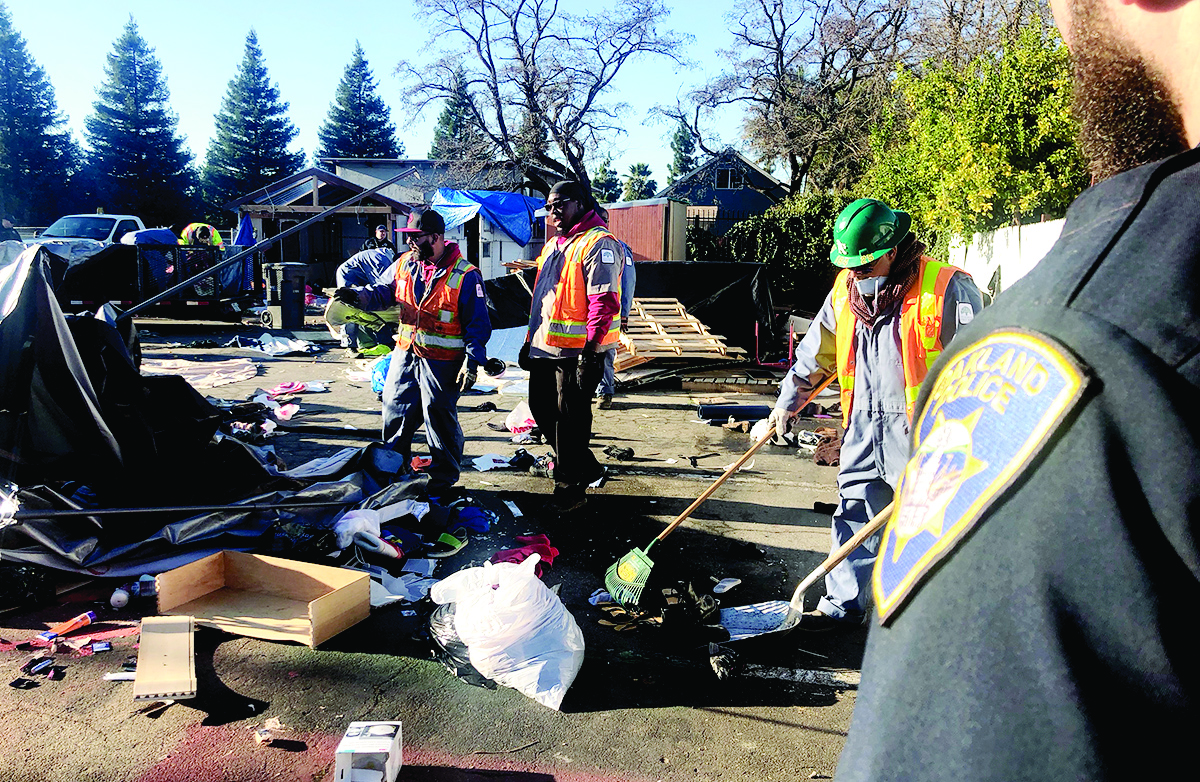
City workers and police officers evict homeless residents Thursday afternoon from Housing and Dignity Village, an encampment of 13 women and children on city-owned land at Edes and South Elmhurst avenues in East Oakland. Photo by Amir Saadiq.
These longer term solutions include the traditional multi-family housing model that would cost a public subsidy of about $150,000 per unit.
In addition, the report recommends utilizing alternative housing models that are cheaper and faster to build such as container, modular, and prefab homes, which would range from $13,500 to $125,000 of public subsidy per unit.
The report also identifies new funds for implementing these long-term solutions such as the new County Measure A1 funds and the City’s new ballot measures increasing the real estate transfer tax on properties selling for over $2 million championed by Councilmember Dan Kalb and also the new vacant lots tax championed by Councilmember Rebecca Kaplan.
Ultimately, the Dellums Institute’s Housing the Unhoused Report for the Housing and Dignity Project represents a call to action for all of us who care about Oakland.
No longer can we turn away from the growing homeless crisis, throwing up our hands and saying that there’s nothing we can do. There’s plenty of strategic solutions available. All it takes is political and moral leadership.
Let’s exercise our rights in a democratic society and call our elected officials to implement the Housing and Dignity Project’s solutions designed by unhoused people.
See the full report on the Dellums Institute’s website at http://dellumsinstitute.org/community-justice-data/








Activism
BRIDGE Housing President and CEO Ken Lombard Scores Top Honors for Affordable Housing Leadership
The Development Company of the Year honor represents a milestone for BRIDGE Housing, which received the Gold award—its top designation—in a category that included both affordable and market-rate developers. The recognition caps what has been one of the strongest growth periods in the organization’s 42-year history.


By the Oakland Post Staff
San Francisco-based BRIDGE Housing and its president and CEO, Ken Lombard, have been named among the nation’s housing industry standouts, earning two of the top prizes at the 2025 Multi-Housing News Excellence Awards.
BRIDGE Housing was named Development Company of the Year, while Lombard received Executive of the Year, recognition that places the nonprofit affordable housing provider alongside leading national developers of both affordable and market-rate housing.
The awards were announced in New York for the accomplishments achieved during 2024.
Multi-Housing News is one of the industry’s most respected publications. Award winners are selected by a panel of housing professionals, including multifamily developers, architects, and owners.
“BRIDGE Housing is deeply honored to be recognized by Multi-Housing News and our industry peers,” Lombard said. “These awards are a testament to the high-impact, mission-driven work by BRIDGE’s exceptional team to deliver quality affordable housing and support services that empower residents to improve their lives.”
The Development Company of the Year honor represents a milestone for BRIDGE Housing, which received the Gold award—its top designation—in a category that included both affordable and market-rate developers. The recognition caps what has been one of the strongest growth periods in the organization’s 42-year history.
In 2024, BRIDGE significantly expanded its footprint across California, Oregon, and Washington. That momentum continued into 2025, with portfolio growth of 9%, including the addition of nine new communities and 1,187 new or acquired affordable housing units. The nonprofit also added three new projects to its development pipeline as it nears a portfolio of 16,000 units.

The growth reflects a broader strategy aimed at accelerating both acquisitions and ground-up development, supported by partnerships with major financial institutions and innovative capital markets strategies. BRIDGE has also emphasized high-quality design and deep community engagement as central elements of its approach.
BRIDGE became the first affordable housing developer to issue tax-exempt construction bonds for one of the largest affordable housing projects in Portland, Ore., leveraging its strong credit rating.
Earlier this year, the nonprofit launched the BRIDGE Housing Impact Fund, with a goal of investing $1 billion to preserve and create affordable housing. It also closed on $175 million in taxable general-obligation bonds after increasing the offering in response to strong investor demand.
The company’s performance also underscores the role of Lombard, who has led BRIDGE since 2021 and was honored individually for his leadership.
Under Lombard’s tenure, BRIDGE has built a new leadership team with experience drawn from both the nonprofit and private sectors, with a particular focus on what the organization describes as efforts to “break the status quo,” especially in affordable housing finance. Those initiatives have helped reduce capital and construction costs, strengthen relationships with institutional investors, and expand resident support services.
Today, BRIDGE Housing serves more than 33,000 residents across 139 communities on the West Coast.
“Ken has dedicated his career to innovative real estate solutions that improve the quality of life in underserved neighborhoods,” said Kenneth Novack, chair of BRIDGE Housing’s board of directors. “His visionary leadership and the work of our incredible team have positioned BRIDGE for long-term growth that will extend our impact throughout the West Coast.”
Founded in 1983, BRIDGE Housing has helped create more than 23,000 affordable homes with a total development cost of $6 billion.

Activism
Mayor Lee, City Leaders Announce $334 Million Bond Sale for Affordable Housing, Roads, Park Renovations, Libraries and Senior Centers
Saying “Oakland is on the move,” Mayor Barbara Lee announces results of Measure U bond sale, Dec. 9, at Oakland City Hall with city councilmembers and city staff among those present. Photo courtesy of the City of Oakland.

By Post Staff
The City of Oakland announced this week that it is successfully moving forward on the sale of $334 million of General Obligation bonds, a milestone that will provide the city with capital funding for city departments to deliver paved roads, restored public facilities, and investments in affordable housing.
“Oakland is on the move and building momentum with this bond sale,” said Oakland Mayor Barbara Lee. “We are reviving access to funding for paving our streets, restoring public facilities we all use and depend upon, and investing in affordable housing for our community, all while maintaining transparency and fiscal discipline.”
“These bonds represent our city’s continued commitment to sound financial management and responsible investment in Oakland’s future,” said Lee.
“Together, we are strengthening our foundation for generations to come,” she said. “I’m grateful to our partners in the City Council for their leadership and support, and to City Administrator Jestin Johnson for driving this process and ensuring we brought it home.”
According to the city, $285 million of the bonds will support new projects and $49 million of the bonds will refund existing bonds for debt service savings.
Oakland issued the Measure U bonds on Dec. 4 after two years of delays over concerns about the city’s financial outlook. They all sold in less than a week.
The new money bonds will pay for affordable housing, roadway safety and infrastructure improvements, and renovations to parks, libraries, senior centers, and other public facilities under the city’s Measure U Authorization.
Citywide paving and streetscape projects will create safer streets for Oaklanders. Additionally, critical facilities like the East Oakland Senior Center and San Antonio Park will receive much-needed renovations, according to the city.
Some of the projects:
- $50.5 million – Citywide Street Resurfacing
- $13 million – Complete Streets Capital Program
- $9.5 million – Curb Ramps Program
- $30 million – Acquisition & Preservation of Existing Affordable Housing
- $33 million – District 3: Mandela Transit-Oriented Development
- $28 million – District 6: Liberation Park Development
- $3 million – District 5: Brookdale Recreation Center Capital Project
- $1.5 million – District 1: Oakland Tool Lending Library (Temescal Branch Library)
- $10 million – District 3: Oakland Ice Center
“I recognize that many naysayers said we couldn’t do it,” said Johnson. “Well, you know what? We’re here now. And we’re going to be here next year and the year after. The fact is we’re getting our fiscal house in order. We said we were going to do it — and we’re doing it.”
Investors placed $638 million in orders for the $334 million of bonds offered by the City. There was broad investor demand with 26 separate investment firms placing orders. The oversubscription ultimately allowed the city to lower the final interest rates offered to investors and reduce the city’s borrowing cost.
“The oversubscription ultimately allowed the City to lower the final interest rates offered to investors and reduce the City’s borrowing cost,” said Sean Maher, the city’s communications director.
“The Oakland City Council worked closely with the administration to both advance the bond issuance process and ensure that the community had a clear understanding of the City’s timeline and approach,” said Councilmember at-Large Rowena Brown.
“In September, the City Council took unanimous action to authorize the Administration to move forward with the bond sale because these funds are essential to delivering the very improvements our communities have long asked for – safer streets, restored public facilities, and expanded affordable housing,” she said.
Continuing, Brown said, “I want to extend my sincere thanks to City Administrator Jestin Johnson, Finance Director Bradley Johnson, and Mayor Barbara Lee for their leadership, diligence, and steady guidance throughout the City’s bond sale efforts.
“Navigating complex market conditions while keeping Oakland’s long-term infrastructure needs front and center is no small task, and this moment reflects tremendous professionalism and persistence,” she said.
Moody’s gave the city an AA2 rating on the bonds, its third-highest rating, which it gives to high-quality investment-grade securities.
There was both a tax-exempt portion and a taxable portion for the bond offering, reflecting the various uses of the bond proceeds, according to a statement released by the city.
The $143.5 million of tax-exempt bonds have a 30-year final maturity and received an all-in borrowing cost of 3.99%. The $191 million of taxable bonds have a 24-year final maturity and received an all-in borrowing cost of 5.55%.
The $49 million in tax-exempt bonds that refinance existing obligations of the City resulted in $5.6 million of debt service savings for taxpayers through 2039, or $4.7 million on a present value basis.
Mayor Lee said that, based on her experience serving on the House Financial Services Committee of the U.S. Congress for more than 10 years, city staff has done an exemplary job.
“I have witnessed many cities go to the bond market throughout the years,” she said. “I can tell you with certainty that Oakland’s team is remarkable, and our residents should be proud of their reputation, their competence, and their deep knowledge of this very sophisticated market.”
Looking ahead to the final sale of the bonds, according to the city press statement, pricing marks the point at which the City and investors locked in the final dollar amounts, interest rates, and other key terms of the bond sale. This stage is commonly referred to as the sale date. At pricing, no funds are exchanged. The actual delivery of bonds and receipt of monies occurs at closing, which is scheduled within the next two weeks.
Capital projects receiving this funding will proceed on individual timelines based on their individual conditions and needs. At the time of closing, funding will be immediately available to those projects.
Activism
We Fought on Opposite Sides of the Sheng Thao Recall. Here’s Why We’re Uniting Behind Barbara Lee for Oakland Mayor
Today, we are coming together to do all we can to make sure Barbara Lee is elected Mayor in the April 15 Oakland special election. Here’s why. Now more than ever, Oakland needs a respected, hands-on leader who will unite residents behind a clear vision for change. The next mayor will have to hit the ground running with leaders and stakeholders across our political divide to get to work solving the problems standing in the way of Oakland’s progress. Job No. 1: improving public safety. Everyone agrees that all Oaklanders deserve to feel safe in their neighborhoods. But sadly, too many of us do not.

By Robert Harris and Richard Fuentes
Special to The Post
The City of Oakland is facing a number of urgent challenges, from housing and public safety to a pressing need for jobs and economic development. One of us, Robert Harris, supported the November recall vote that removed Mayor Sheng Thao from office. Meanwhile, Richard Fuentes believed the recall was the wrong strategy to tackle Oakland’s challenges.
Today, we are coming together to do all we can to make sure Barbara Lee is elected Mayor in the April 15 Oakland special election. Here’s why.
Now more than ever, Oakland needs a respected, hands-on leader who will unite residents behind a clear vision for change.
The next mayor will have to hit the ground running with leaders and stakeholders across our political divide to get to work solving the problems standing in the way of Oakland’s progress.
Job No. 1: improving public safety. Everyone agrees that all Oaklanders deserve to feel safe in their neighborhoods. But sadly, too many of us do not.

During her three decades in the state Legislature and Congress, Lee made public safety a priority, securing funding for police and firefighters in Oakland, delivering $15.8 million in community safety funding, and more. Today, she has a plan for making Oakland safer. It starts with making sure police are resourced, ready, and on patrol to stop the most dangerous criminals on our streets.
Oakland residents and business owners are feeling the impact of too many assaults, smash/grabs, retail thefts, and home robberies. Lee will increase the number of police on the streets, make sure they are focused on the biggest threats, and invest in violence prevention and proven alternatives that prevent crime and violence in the first place.
In addition, on day one, Barbara Lee will focus on Oakland’s business community, creating an advisory cabinet of business owners and pushing to ensure Oakland can attract and keep businesses of all sizes.
The other top issue facing Oakland is housing and homelessness. As of May 2024, over 5,500 people were unhoused in the city. Oaklanders are just 25% of the population of Alameda County, but the city has 57% of the unhoused population.
Unhoused people include seniors, veterans, single women, women with children, people who suffer physical and mental illness, unemployed and undereducated people, and individuals addicted to drugs. Some are students under 18 living on the streets without their parents or a guardian. Research shows that 53% of Oakland’s homeless population is Black.
Starting on her first day in office, Lee will use her national profile and experience to bring new resources to the city to reduce homelessness and expand affordable housing. And she will forge new public/private partnerships and collaboration between the City, Alameda County, other public agencies, and local nonprofits to ensure that Oakland gets its fair share of resources for everything from supportive services to affordable housing.
Besides a public safety and housing crisis, Oakland has a reputational crisis at hand. Too many people locally and nationally believe Oakland does not have the ability to tackle its problems.
Lee has the national reputation and the relationships she can use to assert a new narrative about our beloved Oakland – a vibrant, diverse, and culturally rich city with a deep history of activism and innovation.
Everyone remembers how Lee stood up for Oakland values as the only member of Congress not to authorize the disastrous Iraq War in 2001. She has led the fight in Congress for ethics reform and changes to the nation’s pay-to-play campaign finance laws.
Lee stands alone among the candidates for mayor as a longtime champion of honest, transparent, and accountable government—and she has the reputation and the skills to lead an Oakland transformation that puts people first.
The past few years have been a trying period for our hometown.
Robert Harris supported the recall because of Thao’s decision to fire LeRonne Armstrong; her refusal to meet with certain organizations, such as the Oakland Branch of the NAACP; and the city missing the deadline for filing for a state grant to deal with serious retail thefts in Oakland.
Richard Fuentes opposed the recall, believing that Oakland was making progress in reducing crime. The voters have had their say; now, it is time for us to move forward together and turn the page to a new era.
The two of us don’t agree on everything, but we agree on this: the next few years will be safer, stronger, and more prosperous if Oaklanders elect Barbara Lee as our next mayor on April 15.
Robert Harris is a retired attorney at PG&E and former legal counsel for NAACP.
Richard Fuentes is co-owner of FLUID510 and chair of the Political Action Committee, American Federation of State, County, and Municipal Employees (AFSCME) Council 57.

WORK FROM HOME
Home-based business with potential monthly income of $10K+ per month. A proven training system and website provided to maximize business effectiveness. Perfect job to earn side and primary income. Contact Lynne for more details: Lynne4npusa@gmail.com 800-334-0540


Oakland Post: Week of December 31, 2025 – January 6, 2026

Big God Ministry Gives Away Toys in Marin City

First 5 Alameda County Distributes Over $8 Million in First Wave of Critical Relief Funds for Historically Underpaid Caregivers

2025 in Review: Seven Questions for Assemblymember Lori Wilson — Advocate for Equity, the Environment, and More

2025 in Review: Seven Questions for Assemblymember Tina McKinnor, Champion of Reparations, Housing and Workers’ Rights

2025 in Review: Seven Questions for Sen. Laura Richardson, Who Made Legislative History This Year

2025 in Review: Seven Questions for Sen. Lola Smallwood-Cuevas – an Advocate for Jobs and Justice

Alfred Cralle: Inventor of the Ice Cream Scoop

BOOK REVIEW: Let Me Be Real With You

Oakland Post: Week of December 24 – 30, 2025

Bling It On: Holiday Lights Brighten Dark Nights All Around the Bay

Oakland Council Expands Citywide Security Cameras Despite Major Opposition

Lu Lu’s House is Not Just Toying Around with the Community

Desmond Gumbs — Visionary Founder, Mentor, and Builder of Opportunity

Families Across the U.S. Are Facing an ‘Affordability Crisis,’ Says United Way Bay Area

Oakland Post: Week of November 26 – December 2, 2025

Oakland Post: Week of November 19 – 25, 2025

Seth Curry Makes Impressive Debut with the Golden State Warriors

LIHEAP Funds Released After Weeks of Delay as States and the District Rush to Protect Households from the Cold

Seven Steps to Help Your Child Build Meaningful Connections

Beyoncé and Jay-Z make rare public appearance with Lewis Hamilton at Las Vegas Grand Prix

Seven Steps to Help Your Child Build Meaningful Connections

Post Salon to Discuss Proposal to Bring Costco to Oakland Community meeting to be held at City Hall, Thursday, Dec. 18

Mayor Lee, City Leaders Announce $334 Million Bond Sale for Affordable Housing, Roads, Park Renovations, Libraries and Senior Centers

Trinidad and Tobago – Prime Minister Confirms U.S. Marines Working on Tobago Radar System

FBI Report Warns of Fear, Paralysis, And Political Turmoil Under Director Kash Patel

Oakland Post: Week of December 10 – 16, 2025

Teens Reject Today’s News as Trump Intensifies His Assault on the Press

Thanksgiving Celebrated Across the Tri-State

Oakland School Board Grapples with Potential $100 Million Shortfall Next Year

Hyundai Ioniq 5 Parking, Safety, and 360 View #shorts

2025 Ioniq 5 New Wiper & Powerful Performance! #shorts

Electric SUV Range: Is 259 Miles Enough? #shorts

EV Charging: How Fast Can You Charge an Electric Vehicle? #shorts

Biometric Cooling… Messaging Seats…Come on! 2025 Infiniti QX80 Autograph 4WD

Charged Up: Witness the Magic of a Fully Electric Car! #shorts

Range Rover Sport PHEV Included…: See What’s Inside This Luxury SUV! #shorts

Invisible Hood View: Perfect Parking with X-Ray Vision! #shorts

AI Is Reshaping Black Healthcare: Promise, Peril, and the Push for Improved Results in California

ESSAY: Technology and Medicine, a Primary Care Point of View

Sanctuary Cities

The RESISTANCE – FREEDOM NOW

STATE OF THE PEOPLE: Freddie

ECONOMIC BOYCOTT DAY!!!!!

I told You So

-
 Bay Area3 weeks ago
Post Salon to Discuss Proposal to Bring Costco to Oakland Community meeting to be held at City Hall, Thursday, Dec. 18
-
 Activism3 weeks ago
Mayor Lee, City Leaders Announce $334 Million Bond Sale for Affordable Housing, Roads, Park Renovations, Libraries and Senior Centers
-
 Activism4 weeks ago
Oakland Post: Week of December 10 – 16, 2025
-
 Activism3 weeks ago
Oakland School Board Grapples with Potential $100 Million Shortfall Next Year
-

 Arts and Culture3 weeks ago
Fayeth Gardens Holds 3rd Annual Kwanzaa Celebration at Hayward City Hall on Dec. 28
-

 Activism3 weeks ago
2025 in Review: Seven Questions for Black Women’s Think Tank Founder Kellie Todd Griffin
-

 Advice3 weeks ago
COMMENTARY: If You Don’t Want Your ‘Black Card’ Revoked, Watch What You Bring to Holiday Dinners
-

 Activism3 weeks ago
Ann Lowe: The Quiet Genius of American Couture
