
Politics
Some Examples of Confederate Tributes Around the South


The Mississippi flag hangs, with the other state flags, in the subway between the U.S. Capitol and Dirksen Senate Office Building in Washington, Tuesday, June 23, 2015. In the wake of a massacre at a black church in Charleston, S.C., a bipartisan mix of officials across the country is calling for the removal of Confederate flags and other symbols of the Confederacy. (AP Photo/Cliff Owen)
The Associated Press
ATLANTA (AP) — Tributes to the Confederacy and the Jim Crow era that have existed still abound in the Deep South and beyond more than a century after the end of the Civil War.
Here are some of the most high-profile displays, including several that are being criticized anew following the fatal shooting of nine parishioners at a historic black church in Charleston, South Carolina:
— ALABAMA: An 88 -foot-tall Confederate memorial sits at the Capitol entrance nearest the governor’s office. It features four different Confederate banners, including the battle flag. Jefferson Davis, the lone president of the Confederacy, is said to have laid the cornerstone at a ceremony in 1886. Two nearby public high schools, now with nearly all-black student bodies, are named for Davis and Robert E. Lee, commander of the Confederate forces.
— ARKANSAS: There are two Confederate monuments on the Capitol grounds, one honoring Confederate women, the other soldiers.
— FLORIDA: No confederate flag flies at the Florida Capitol, but the state flag, whose main design was adopted in 1900, features a St. Andrew’s Cross — an ‘X’ emblazoned across the banner. The imagery is similar to the Battle Flag, though it also reflects a flag of the Spanish empire when it ruled Florida from the early 16th century until 1763. Several county courthouses and local public squares or parks feature Confederate veterans monuments.
— GEORGIA: The Capitol and surrounding grounds feature multiple statues, busts and portraits of Confederate war heroes and segregationist politicians. In the Capitol rotunda is a portrait of Alexander H. Stephens, vice president of the Confederacy. A bust of Stephens sits just outside the rotunda. The Georgia state flag, a compromise version that replaced a design with the battle flag, is modeled after the “Stars and Bars,” the first national flag of the Confederacy. Twenty miles from the Capitol is Stone Mountain, which features a massive carving of Jefferson Davis, Stonewall Jackson and Robert E. Lee, all on horseback.
— KENTUCKY: Jefferson Davis is among the statues included in the Capitol rotunda. The Davis statue is situated behind the Abraham Lincoln statute that sits in the rotunda’s center, so that the president of the Confederacy appears to be looking over the shoulder of the 16th U.S. president who governed during the Civil War.
— LOUISIANA: A statue of Robert E. Lee sits at the center of Lee Circle, a major traffic circle connecting downtown New Orleans to the Garden District neighborhood. Another city thoroughfare is named for Jefferson Davis and includes a statue of the Confederate president.
— MISSISSIPPI: The state flag is the last U.S. state banner to include an explicit image of the Confederate battle flag. At one Capitol entrance sits a monument to the women of the Confederacy. The University of Mississippi’s athletics teams are knowns as the “Ole Miss Rebels,” and the school’s band often plays “Dixie” at sporting events.
— NORTH CAROLINA: An obelisk memorial to the state’s Confederate war dead and a monument to the “North Carolina Women of the Confederacy” are located on the old Capitol grounds in Raleigh. The Capitol square also includes statues of Civil War-era Gov. Zebulon Vance and Gov. Charles Aycock, known partly for his anti-black rhetoric at the end of the 19th century.
— SOUTH CAROLINA: The Confederate battle flag flies at the base of a Confederate monument in front of the Capitol. It flies between a Confederate monument and a statue of Benjamin Tillman, a noted white supremacist who spent three decades — from 1890 to 1918 — as governor and U.S. senator. Behind the Capitol is a statue of Strom Thurmond, a long-serving U.S. senator who ran for president in 1948 as a “Dixiecrat” to protest the national Democratic Party’s softening stance on segregation.
— TENNESSEE: A bust of Nathan Bedford Forrest, an early Grand Wizard of the Ku Klux Klan, is inside the Capitol.
— VIRGINIA: Arlington National Cemetery, formerly the plantation of Robert E. Lee, includes a Confederate section with almost 500 graves surrounding a memorial. Future President William Howard Taft authorized the memorial in 1906, when he served as secretary of war for President Theodore Roosevelt.
___
Compiled by Bill Barrow in Atlanta; Kim Chandler in Montgomery, Alabama; Andrew DeMillo in Little Rock, Arkansas; Emily Wagster Pettus in Jackson, Mississippi; and Gary Robertson in Raleigh, North Carolina.
Copyright 2015 The Associated Press. All rights reserved. This material may not be published, broadcast, rewritten or redistributed.









Activism
Oakland Post: Week of March 4 – 10, 2026
The printed Weekly Edition of the Oakland Post: Week of March 4 – 10, 2026

To enlarge your view of this issue, use the slider, magnifying glass icon or full page icon in the lower right corner of the browser window.
Activism
Oakland Post: Week of February 25 – March 3, 2026
The printed Weekly Edition of the Oakland Post: Week of – February 25 – March 3, 2026

To enlarge your view of this issue, use the slider, magnifying glass icon or full page icon in the lower right corner of the browser window.
Activism
Oakland Post: Week of February 18 – 24, 2026
The printed Weekly Edition of the Oakland Post: Week of – February 18 – 24, 2026
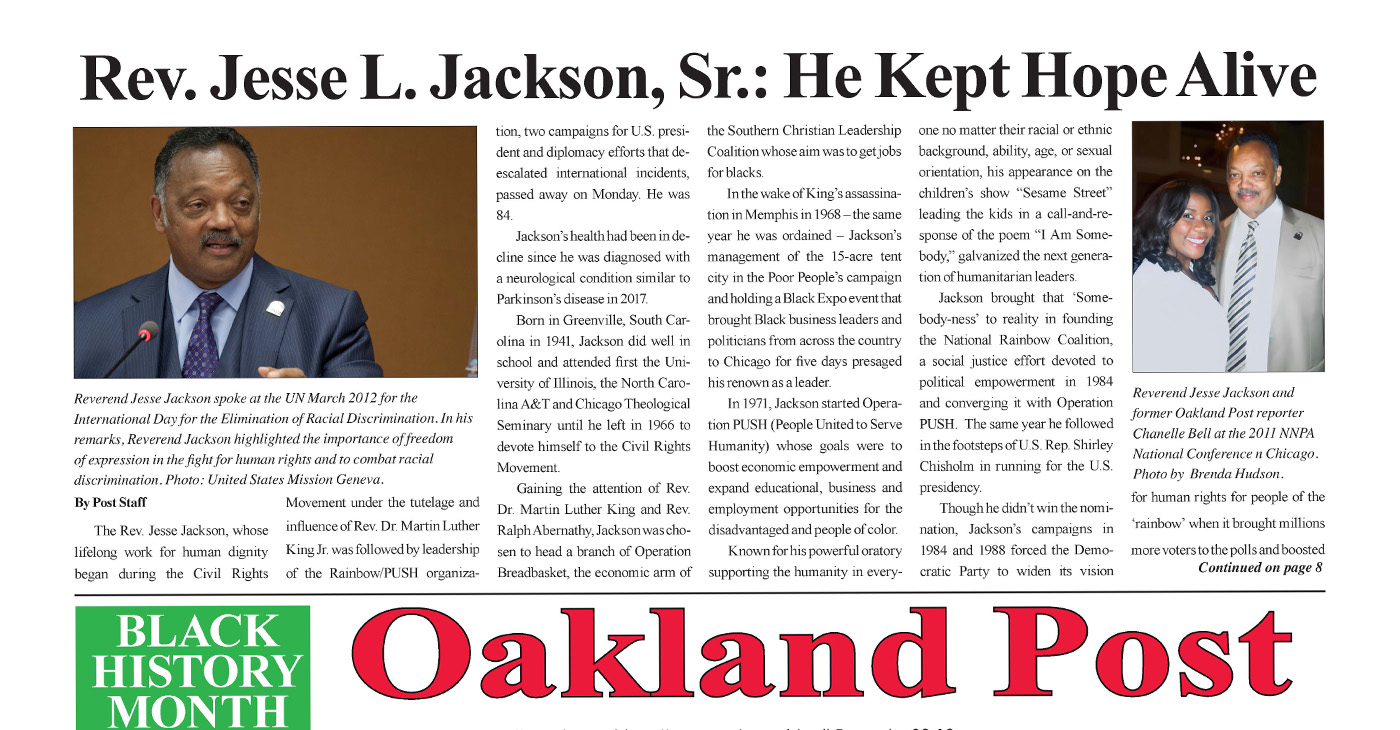
To enlarge your view of this issue, use the slider, magnifying glass icon or full page icon in the lower right corner of the browser window.


WORK FROM HOME
Home-based business with potential monthly income of $10K+ per month. A proven training system and website provided to maximize business effectiveness. Perfect job to earn side and primary income. Contact Lynne for more details: Lynne4npusa@gmail.com 800-334-0540


COMMENTARY: Women of Color Shape Our Past and Future

Woman’s Search for Family’s Roots Leads to Ancestor John T. Ward – A Successful Entrepreneur and Conductor on the Underground Railroad

Advocates Raise Alarm Over ICE Operation, MOU and Detention Risks in Baltimore County

Pete Buttigieg to Join Mayor Randall Woodfin for Community Town Hall in Birmingham

WATCH: Week One – NNPA’s “Leadership Matters” Video Series

Oakland Post: Week of March 4 – 10, 2026

OP-ED: NNPA Launches 2026 “Leadership Matters” Video Series

PRESS ROOM: PMG and Cranbrook Horizons-Upward Bound Launch Journey Fellowship Cohort 2

Los Angeles Summit Brings Together Leaders to Tackle Poverty and Affordability

Civil Rights TV Launches 24/7 Network Focused on Black History, Education and Equity

REVIEW: The Ultimate Hot Girl Summer Getaway: Sunseeker Resort Florida

COMMENTARY: How You Stop a Prescription Medicine is as Important as How You Start

PRESS ROOM: From Congress to Corporate America: NNPA Spotlights Visionaries in New Video Series

Poll Shows Support for Policies That Help Families Afford Child Care

Oakland Post: Week of February 25 – March 3, 2026

Oakland Post: Week of January 28, 2025 – February 3, 2026

Life Expectancy in Marin City, a Black Community, Is 15-17 Years Less than the Rest of Marin County

Community Celebrates Turner Group Construction Company as Collins Drive Becomes Turner Group Drive

California Launches Study on Mileage Tax to Potentially Replace Gas Tax as Republicans Push Back

Discrimination in City Contracts

Book Review: Books on Black History and Black Life for Kids

COMMENTARY: The Biases We Don’t See — Preventing AI-Driven Inequality in Health Care

Black History Events in the East Bay

Post Newspaper Invites NNPA to Join Nationwide Probate Reform Initiative

Medi-Cal Cares for You and Your Baby Every Step of the Way

Art of the African Diaspora Celebrates Legacy and Community at Richmond Art Center

COMMENTARY: The National Protest Must Be Accompanied with Our Votes

New Bill, the RIDER Safety Act, Would Support Transit Ambassadors and Safety on Public Transit

After Don Lemon’s Arrest, Black Officials Raise Concerns About Independent Black Media

Oakland Post: Week of February 4 – 10, 2026

Hyundai Ioniq 5 Parking, Safety, and 360 View #shorts

2025 Ioniq 5 New Wiper & Powerful Performance! #shorts

Electric SUV Range: Is 259 Miles Enough? #shorts

EV Charging: How Fast Can You Charge an Electric Vehicle? #shorts

Biometric Cooling… Messaging Seats…Come on! 2025 Infiniti QX80 Autograph 4WD

Charged Up: Witness the Magic of a Fully Electric Car! #shorts

Range Rover Sport PHEV Included…: See What’s Inside This Luxury SUV! #shorts

Invisible Hood View: Perfect Parking with X-Ray Vision! #shorts

AI Is Reshaping Black Healthcare: Promise, Peril, and the Push for Improved Results in California

ESSAY: Technology and Medicine, a Primary Care Point of View

Sanctuary Cities

The RESISTANCE – FREEDOM NOW

STATE OF THE PEOPLE: Freddie

ECONOMIC BOYCOTT DAY!!!!!

I told You So
-
 Activism4 weeks ago
Discrimination in City Contracts
-

 Activism4 weeks ago
Oakland Post: Week of February 11 – 17, 2026
-
 #NNPA BlackPress2 weeks ago
Reflecting on Black History Milestones in Birmingham AL
-

 Advice4 weeks ago
Rising Optimism Among Small And Middle Market Business Leaders Suggests Growth for California
-
 Bay Area3 weeks ago
CITY OF SAN LEANDRO STATE OF CALIFORNIA PUBLIC WORKS DEPARTMENT ENGINEERING DIVISION NOTICE TO BIDDERS FOR ANNUAL STREET OVERLAY/REHABILITATION 2019-21 – PHASE III
-

 #NNPA BlackPress2 weeks ago
U.S. manufacturing rebounds – how foundry services are adapting to rising demand
-
 #NNPA BlackPress2 weeks ago
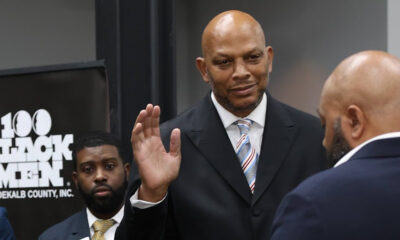
PRESS ROOM: NBA Hall of Fame Nominee Terry Cummings Joins 100 Black Men of DeKalb County to Launch Victory & Values Initiative
-

 #NNPA BlackPress2 weeks ago
Advancements in solar technology that are changing the way we power the world
