
Activism
State Fiscal Austerity Agency Says 11 School Districts Face Similar Fate as OUSD
It is now becoming clear to many local education advocates that under FCMAT, the state’s enforcer, or the whip hand of education austerity, K-12 school districts and community colleges statewide are being threatened with cuts, layoffs, and the possibility of loss of local control, even while the state is awash in an almost $50 billion surplus.


West Contra Costa Unified School Board Defies FCMAT demand to lay off teachers.
By Ken Epstein
The financial austerity arm overseeing public education in California, the Fiscal Crisis Management and Assistance Team (FCMAT), has performed a behind-the-scenes role determining budgets, repeated cutbacks, layoffs, and the closures of 21 schools since they moved into Oakland along with the state receiver in 2003.
One district, West Contra Costa Unified, recently defied pressure from a FCMAT spokesman to lay off school staff, voting against the layoff recommendation proposed by the district administration.
It is now becoming clear to many local education advocates that under FCMAT, the state’s enforcer, or the whip hand of education austerity, K-12 school districts and community colleges statewide are being threatened with cuts, layoffs, and the possibility of loss of local control, even while the state is awash in an almost $50 billion surplus.
Every year, the California Legislature appropriates funding for FCMAT’s operation, providing most of the nonprofit agency’s financial support. Over the years, FCMAT’s scope has expanded, but it remains an extra-governmental agency, not subject to typical governmental oversight. Formed by the state in 1991, FCMAT’s authority has evolved as new state laws were passed.
Oakland Unified is not the only public school system labeled by FCMAT to be a “lack of going concern,” which FCMAT defines as a “message that a district is in jeopardy of not being able to continue on its own.”

At present, FCMAT says that there are 11 school districts in California “that have been designated as a ‘lack of going concern’ in 2021 for a variety of budget and non-budget concerns.”
These districts are Bellflower USD, Curtis Creek ESD, East San Gabriel Valley ROP, Loleta Union SD, Montebello USD, Oakland USD, Sacramento City USD, San Bruno Park USD, San Francisco COE, San Francisco USD and Sonora ESD, according to a report published Feb. 2 by FCMAT to the State Senate Budget and Fiscal Review Subcommittee.
Looking at “solvency trends,” FCMAT’s report cites a number of financial difficulties, which many see as connected to the pandemic crisis or ongoing insufficient state funding. FCMAT says the most common reason for less-than-satisfactory certifications of fiscal health “is declining enrollment.”
Other negative conditions include:
- Decreased attendance rates
- Expiring one-time funds.
- Inflationary cost increases.
- Increasing staff pension contribution rates
However, the report admits that Gov. Gavin Newsom’s Jan. 10 budget proposal could eliminate the “lack of going concern designation” for 50% of the districts on the list.
In addition, five Community College systems are on FCMAT’s “Distress or Watch List.”
Districts considered in distress are Gavilan in San Benito, Napa Valley in Napa and Peralta in Alameda. City College of San Francisco is on the watch list, and Compton in Los Angeles is categorized as in a borderline state of “Transition Planning.”
Although Richmond schools were not on FCMAT’s list, the West Contra Costa Unified School District (WCCUSD) is experiencing FCMAT’s heavy hand.
FCMAT CEO Michael Fine showed up at the school board meeting March 9 to support the administration’s proposal to lay off teachers and other school staff this year. Fine told the Board that the district has a choice to accept the cuts, or the Contra Costa County Superintendent of Schools will first declare a “Lack of Going Concern” and appoint an “advisor” to review the district’s budget and suggest changes.
If the board continues to refuse to make cuts, an overseer would be appointed with the right to veto WCCUSD financial decisions. If the board still ignores the ‘recommendations,’ the state could take over and give the WCCUSD a loan.
“A state loan is disastrous — it’s not good for the community, and it’s not good for the school district,” Fine told the Board, explaining that along with the loan, the superintendent would be dismissed, and the Board would lose its ability to govern. A state-imposed administrator would act as both the Board and superintendent.
Despite those threats, the Board voted 3-2 not to issue the layoffs, responding to pressure from employee unions. View the WCCUSD board meeting at www.youtube.com/watch?v=0kNZpHPM3yE
WCCUSD has a long history of dealing with FCMAT and state intervention. Formerly known as Richmond Unified, the district was under state control from April 1990 to June 2012.
According to officials, the takeover was the “salvation” of the district, keeping it from going bankrupt at that time. “But state control…was the polar opposite of salvation,” according to former school Board President Charles Ramsey, who served on the board during that time.
During the takeover, the district enforced pay cuts, mid-year elimination of enrichment courses and athletic programs, closed libraries and paid $2 million in annual loan payments at 6% interest. The community responded with a 75-mile protest march on Sacramento in 2004, with some participants holding a hunger strike.
“You have this shadow overlooking you,” Ramsey said in an interview in 2012 with the California School Board Association blog. “We barely survived, but we’re pleased that we’re now through it.”
Future articles will examine FCMAT’s impact on schools in Inglewood and San Francisco, as well as on San Francisco City College, which faces layoffs of 50 full-time faculty members.









Activism
Chase Oakland Community Center Hosts Alley-Oop Accelerator Building Community and Opportunity for Bay Area Entrepreneurs
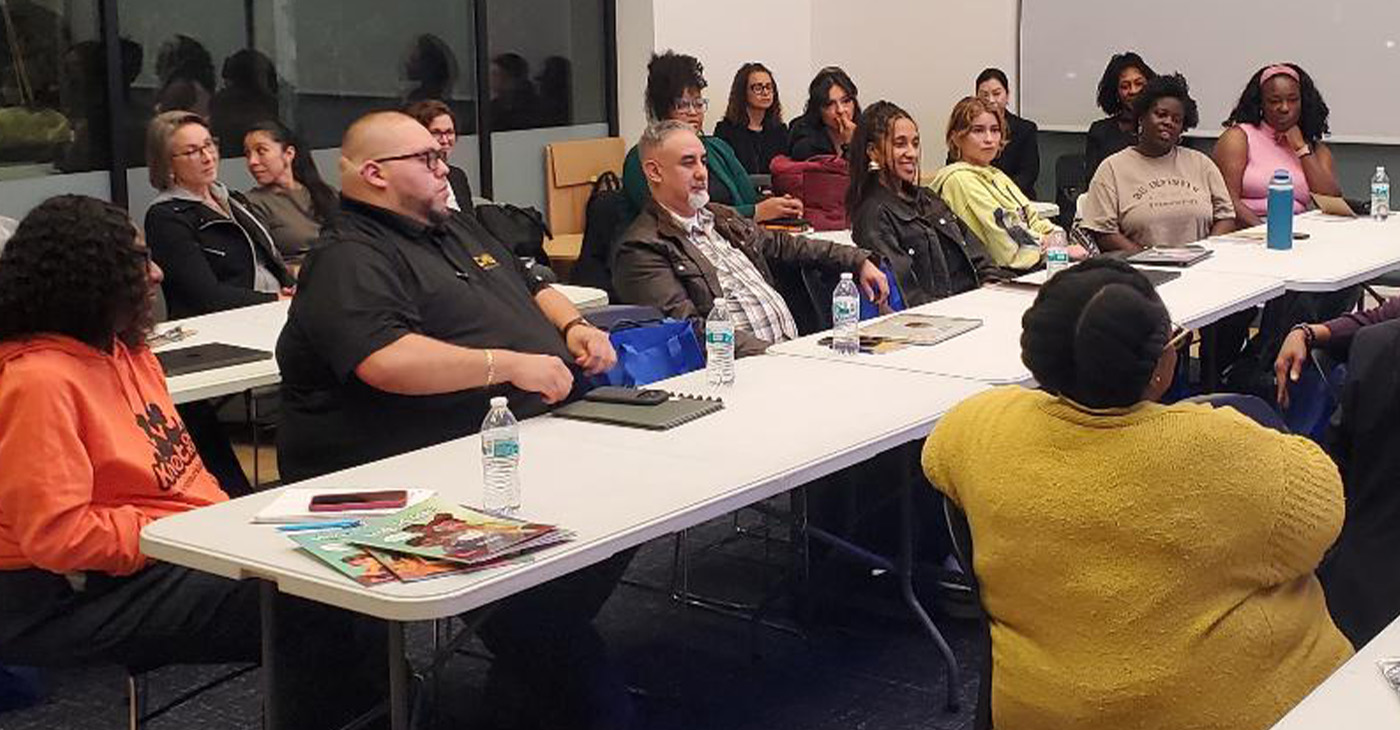
Over the past three years, the Alley-Oop Accelerator has helped more than 20 Bay Area businesses grow, connect, and gain meaningful exposure. The program combines hands-on training, mentorship, and community-building to help participants navigate the legal, financial, and marketing challenges of small business ownership.

By Carla Thomas

The Golden State Warriors and Chase bank hosted the third annual Alley-Oop Accelerator this month, an empowering eight-week program designed to help Bay Area entrepreneurs bring their visions for business to life.
The initiative kicked off on Feb. 12 at Chase’s Oakland Community Center on Broadway Street, welcoming 15 small business owners who joined a growing network of local innovators working to strengthen the region’s entrepreneurial ecosystem.
Over the past three years, the Alley-Oop Accelerator has helped more than 20 Bay Area businesses grow, connect, and gain meaningful exposure. The program combines hands-on training, mentorship, and community-building to help participants navigate the legal, financial, and marketing challenges of small business ownership.
At its core, the accelerator is designed to create an ecosystem of collaboration, where local entrepreneurs can learn from one another while accessing the resources of a global financial institution.
“This is our third year in a row working with the Golden State Warriors on the Alley-Oop Accelerator,” said Jaime Garcia, executive director of Chase’s Coaching for Impact team for the West Division. “We’ve already had 20-plus businesses graduate from the program, and we have 15 enrolled this year. The biggest thing about the program is really the community that’s built amongst the business owners — plus the exposure they’re able to get through Chase and the Golden State Warriors.”
According to Garcia, several graduates have gone on to receive vendor contracts with the Warriors and have gained broader recognition through collaborations with JPMorgan Chase.
“A lot of what Chase is trying to do,” Garcia added, “is bring businesses together because what they’ve asked for is an ecosystem, a network where they can connect, grow, and thrive organically.”
This year’s Alley-Oop Accelerator reflects that vision through its comprehensive curriculum and emphasis on practical learning. Participants explore the full spectrum of business essentials including financial management, marketing strategy, and legal compliance, while also preparing for real-world experiences such as pop-up market events.
Each entrepreneur benefits from one-on-one mentoring sessions through Chase’s Coaching for Impact program, which provides complimentary, personalized business consulting.
Garcia described the impact this hands-on approach has had on local small business owners. He recalled one candlemaker, who, after participating in the program, was invited to provide candles as gifts at Chase events.
“We were able to help give that business exposure,” he explained. “But then our team also worked with them on how to access capital to buy inventory and manage operations once those orders started coming in. It’s about preparation. When a hiccup happens, are you ready to handle it?”
The Coaching for Impact initiative, which launched in 2020 in just four cities, has since expanded to 46 nationwide.
“Every business is different,” Garcia said. “That’s why personal coaching matters so much. It’s life-changing.”
Participants in the 2026 program will each receive a $2,500 stipend, funding that Garcia said can make an outsized difference. “It’s amazing what some people can do with just $2,500,” he noted. “It sounds small, but it goes a long way when you have a plan for how to use it.”
For Chase and the Warriors, the Alley-Oop Accelerator represents more than an educational initiative, it’s a pathway to empowerment and economic inclusion. The program continues to foster lasting relationships among the entrepreneurs who, as Garcia put it, “build each other up” through shared growth and opportunity.
“Starting a business is never easy, but with the right support, it becomes possible, and even exhilarating,” said Oscar Lopez, the senior business consultant for Chase in Oakland.

Activism
Oakland Post: Week of February 18 – 24, 2026
The printed Weekly Edition of the Oakland Post: Week of – February 18 – 24, 2026
To enlarge your view of this issue, use the slider, magnifying glass icon or full page icon in the lower right corner of the browser window.
Activism
Oakland Post: Week of February 11 – 17, 2026
The printed Weekly Edition of the Oakland Post: Week of – February 11 – 17, 2026

To enlarge your view of this issue, use the slider, magnifying glass icon or full page icon in the lower right corner of the browser window.

WORK FROM HOME
Home-based business with potential monthly income of $10K+ per month. A proven training system and website provided to maximize business effectiveness. Perfect job to earn side and primary income. Contact Lynne for more details: Lynne4npusa@gmail.com 800-334-0540


PRESS ROOM: NBA Hall of Fame Nominee Terry Cummings Joins 100 Black Men of DeKalb County to Launch Victory & Values Initiative

Reflecting on Black History Milestones in Birmingham AL

OP-ED: One Hundred Years of Black Workers Telling the Truth

PRESS ROOM: Civil Rights TV Launches in Selma as the World’s First 24/7 Civil Rights Television Network

Advancements in solar technology that are changing the way we power the world

U.S. manufacturing rebounds – how foundry services are adapting to rising demand

Why has blood testing become so popular in today’s world?

Ghana Mourns a Son of the African World

OP-ED: Trump’s Policies Hurt Black America—and Everyone Else

OP-ED: Meta Deleted Me. I Still Don’t Know Why. And neither will you.

More than a Mission: Paying It Forward for the Future of Education

Avoid Eviction This Season: Landlord Checklist for Stable Tenancies

How chronic back problems affect Black communities differently

How cancer care is evolving with modern medicine

Diabetes disparity: Understanding Type 2 risks for Black Americans

Life Expectancy in Marin City, a Black Community, Is 15-17 Years Less than the Rest of Marin County

Oakland Post: Week of January 28, 2025 – February 3, 2026

Community Celebrates Turner Group Construction Company as Collins Drive Becomes Turner Group Drive

California Launches Study on Mileage Tax to Potentially Replace Gas Tax as Republicans Push Back

Discrimination in City Contracts

Oakland Post: Week of January 21 – 27, 2026

Book Review: Books on Black History and Black Life for Kids

Medi-Cal Cares for You and Your Baby Every Step of the Way

COMMENTARY: The Biases We Don’t See — Preventing AI-Driven Inequality in Health Care

After Don Lemon’s Arrest, Black Officials Raise Concerns About Independent Black Media

Post Newspaper Invites NNPA to Join Nationwide Probate Reform Initiative

OP-ED: The Dream Cannot be Realized Without Financial Freedom

COMMENTARY: The National Protest Must Be Accompanied with Our Votes

Four Stolen Futures: Will H-E-B Do The Right Thing?

Black History Events in the East Bay

Hyundai Ioniq 5 Parking, Safety, and 360 View #shorts

2025 Ioniq 5 New Wiper & Powerful Performance! #shorts

Electric SUV Range: Is 259 Miles Enough? #shorts

EV Charging: How Fast Can You Charge an Electric Vehicle? #shorts

Biometric Cooling… Messaging Seats…Come on! 2025 Infiniti QX80 Autograph 4WD

Charged Up: Witness the Magic of a Fully Electric Car! #shorts

Range Rover Sport PHEV Included…: See What’s Inside This Luxury SUV! #shorts

Invisible Hood View: Perfect Parking with X-Ray Vision! #shorts

AI Is Reshaping Black Healthcare: Promise, Peril, and the Push for Improved Results in California

ESSAY: Technology and Medicine, a Primary Care Point of View

Sanctuary Cities

The RESISTANCE – FREEDOM NOW

STATE OF THE PEOPLE: Freddie

ECONOMIC BOYCOTT DAY!!!!!

I told You So

-
 Activism4 weeks ago
Life Expectancy in Marin City, a Black Community, Is 15-17 Years Less than the Rest of Marin County
-
 Activism4 weeks ago
Oakland Post: Week of January 28, 2025 – February 3, 2026
-
 Activism3 weeks ago
Community Celebrates Turner Group Construction Company as Collins Drive Becomes Turner Group Drive
-
 Business3 weeks ago
California Launches Study on Mileage Tax to Potentially Replace Gas Tax as Republicans Push Back
-
 Activism3 weeks ago
Discrimination in City Contracts
-
 Arts and Culture3 weeks ago
Book Review: Books on Black History and Black Life for Kids
-
 Activism4 weeks ago
Medi-Cal Cares for You and Your Baby Every Step of the Way
-
 Activism3 weeks ago
COMMENTARY: The Biases We Don’t See — Preventing AI-Driven Inequality in Health Care
