
California Black Media
U.S. Rep. Kamlager-Dove Leads Discussion on Improving Black Student Learning, Test Scores
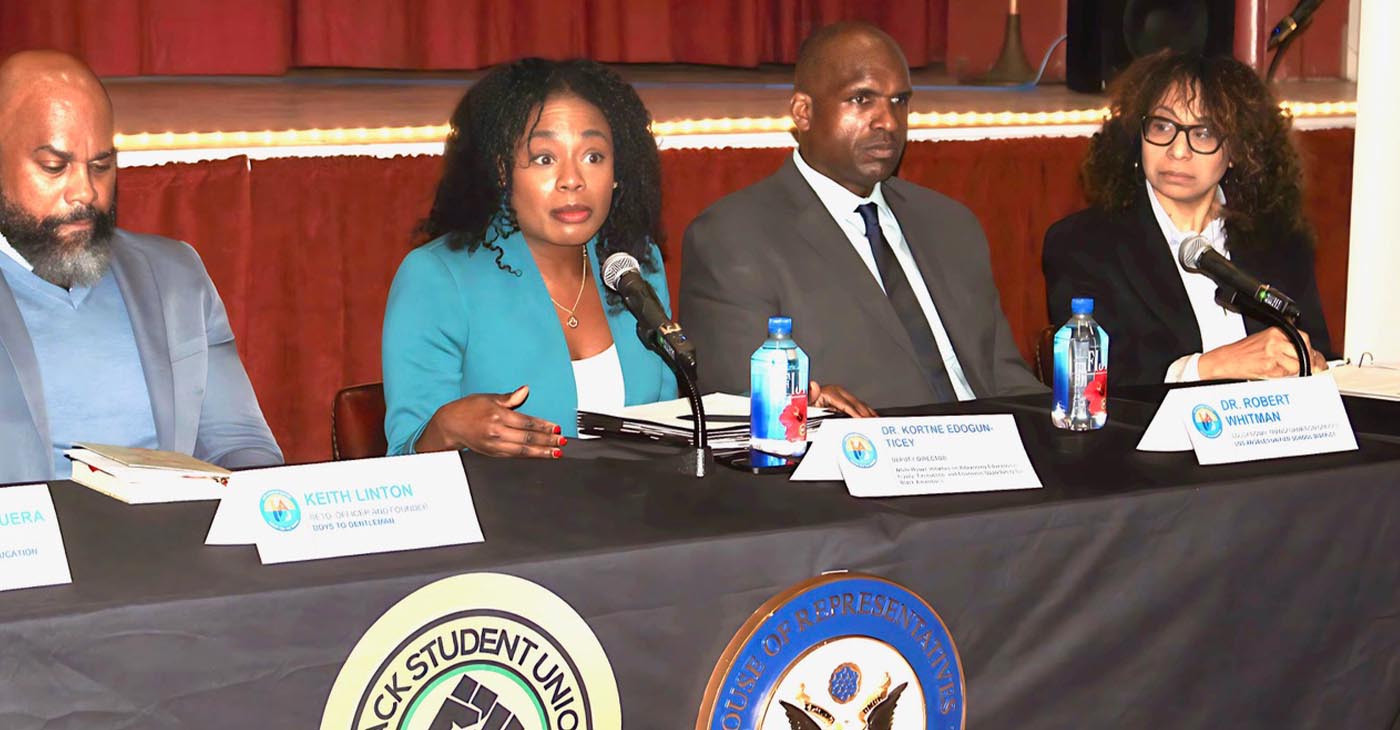
On April 8, U.S. Congressmember Sydney Kamlager-Dove (D-CA-37) moderated a roundtable focused on Los Angeles Unified School District’s (LAUSD) strategies to improve Black student performance in classrooms. Kamlager-Dove, who represents a district that covers parts of Los Angeles County, hopes that ideas shared at the event can be incorporated into models that can impact other regions across California, where Black students continue to fall behind their peers of other races and ethnicities.

By Lila Brown, California Black Media

On April 8, U.S. Congressmember Sydney Kamlager-Dove (D-CA-37) moderated a roundtable focused on Los Angeles Unified School District’s (LAUSD) strategies to improve Black student performance in classrooms.
Kamlager-Dove, who represents a district that covers parts of Los Angeles County, hopes that ideas shared at the event can be incorporated into models that can impact other regions across California, where Black students continue to fall behind their peers of other races and ethnicities.
Discussions at the event centered on LAUSD’s Black Student Achievement Plan (BSAP) and other educational initiatives aimed at enhancing learning and boosting test scores.
“The Black Student Achievement Plan is unique in that it takes a community-centered approach to uplifting Black students,” said Kamlager-Dove during the event held at John Muir Middle School in Los Angeles.
“We must implement culturally responsive education in the classroom to challenge our students academically while giving them a sense of purpose,” she continued.
In 2023, nearly 70% of Black children in California fell below a passing mark on the state standardized English Language Arts exam, and only about 20% of those students were performing at grade level based on their scores on the math assessment test.
A variety of public education experts joined Kamlager on the panel, including Dr. Kortne Edogun-Ticey, Senior Advisor, U.S. Department of Education; Dr. Robert Whitman, Educational Transformation Officer at LAUSD; Dr. Pedro Noguera, Professor and Dean at the University of Southern California Rossier School of Education; and Keith Linton, founder of the non-profit Boys to Gentlemen.
Jonathan McGee, a student who sits on the BSAP Student Advisory Council, also spoke during the panel.
The BSAP was approved by the LAUSD Board of Education in February of the 2020-21 school year. Funds have been earmarked to address the longstanding disparities in educational outcomes between Black students and their non-Black peers. Dating back to the landmark case, Brown v. the Board of Education of Topeka, Kan., in which the U.S. Supreme Court declared that segregated schools were unconstitutional, positive outcomes for Black students continue to lag behind district and national averages for their non-Black counterparts.
Edogun-Ticey spoke about broader investments the federal government is making in education that directly impact Black students through The White House Initiative on Advancing Educational Equity, Excellence, and Economic Opportunity for Black Americans.
‘This administration did not shy away from the idea that we need resources for support which means billions of dollars in investment for HBCUs,” she explained.
BSAP strategies include partnering with Black families and local community; supporting the implementation of culturally and linguistically responsive and anti-racist practices; offering wrap-around support structures; and highlighting experiences that uplift the contributions of the Black community as motivation and models to develop positive Black student identity. Additionally, the BSAP provides increased staffing to support Black students’ academic and social-emotional needs.
“School districts across the country must push back against attacks on marginalized students by implementing programs like the BSAP, which should serve as a model for future initiatives,” Kamlager said.










Activism
Oakland Post: Week of February 18 – 24, 2026
The printed Weekly Edition of the Oakland Post: Week of – February 18 – 24, 2026
To enlarge your view of this issue, use the slider, magnifying glass icon or full page icon in the lower right corner of the browser window.
Activism
Oakland Post: Week of February 11 – 17, 2026
The printed Weekly Edition of the Oakland Post: Week of – February 11 – 17, 2026

To enlarge your view of this issue, use the slider, magnifying glass icon or full page icon in the lower right corner of the browser window.
Bo Tefu
Trump’s White House Pushes to Control California Wildfire Recovery
The executive order signed Jan. 27 by President Donald Trump directs federal agencies to explore regulations that could override California and municipal permitting rules for homes and other structures destroyed in the fires. Land-use and rebuilding permits have traditionally been handled by cities and counties, making the move an unprecedented federal intervention into disaster recovery.

By Bo Tefu, California Black Media
The White House is moving to take control of wildfire recovery efforts in the Los Angeles County area, issuing an executive order that would shift rebuilding permit authority from state and local governments to the federal government following the January 2025 Palisades and Eaton fires.
The executive order signed Jan. 27 by President Donald Trump directs federal agencies to explore regulations that could override California and municipal permitting rules for homes and other structures destroyed in the fires. Land-use and rebuilding permits have traditionally been handled by cities and counties, making the move an unprecedented federal intervention into disaster recovery.
“I want to see if we can take over the city and state and just give the people their permits they want to build,” Trump told the media when signing the order.
The Palisades and Eaton fires destroyed about 16,000 homes, businesses, and other structures across Pacific Palisades, Altadena, and surrounding areas. According to local data, roughly 4,700 applications to rebuild have been submitted, with about 2,000 approved so far. Officials say the pace of rebuilding is consistent with recovery timelines from other major wildfires in California, where reconstruction often takes several years.
Gov. Gavin Newsom and Los Angeles Mayor Karen Bass quickly condemned the order, stating that it is unnecessary and legally questionable. Disaster recovery experts echoed those concerns, pointing to constitutional limits on federal authority over land-use decisions.
Trump’s order calls on the Federal Emergency Management Agency (FEMA) and the Small Business Administration to consider allowing builders to self-certify compliance with health and safety regulations to receive federal approval.
The dispute has become another flashpoint in the ongoing political battle between Trump and Newsom. The governor has requested $33 billion in federal disaster aid that has not yet been approved, while survivors continue to face challenges related to insurance payouts, high rebuilding costs, and legal disputes tied to the cause of the fires.
“Instead of finally sending to Congress the federal relief Los Angeles needs to rebuild from last year’s firestorms, Donald Trump continues to live in fantasy land,” Newsom wrote on X.
Bass said the White House could speed recovery by approving disaster aid and pushing insurers and lenders to support affected residents.
Trump’s order calls for draft regulations within 30 days and final rules within 90 days.


WORK FROM HOME
Home-based business with potential monthly income of $10K+ per month. A proven training system and website provided to maximize business effectiveness. Perfect job to earn side and primary income. Contact Lynne for more details: Lynne4npusa@gmail.com 800-334-0540


PRESS ROOM: NBA Hall of Fame Nominee Terry Cummings Joins 100 Black Men of DeKalb County to Launch Victory & Values Initiative

Reflecting on Black History Milestones in Birmingham AL

OP-ED: One Hundred Years of Black Workers Telling the Truth

PRESS ROOM: Civil Rights TV Launches in Selma as the World’s First 24/7 Civil Rights Television Network

Advancements in solar technology that are changing the way we power the world

U.S. manufacturing rebounds – how foundry services are adapting to rising demand

Why has blood testing become so popular in today’s world?

Ghana Mourns a Son of the African World

OP-ED: Trump’s Policies Hurt Black America—and Everyone Else

OP-ED: Meta Deleted Me. I Still Don’t Know Why. And neither will you.

More than a Mission: Paying It Forward for the Future of Education

Avoid Eviction This Season: Landlord Checklist for Stable Tenancies

How chronic back problems affect Black communities differently

How cancer care is evolving with modern medicine

Diabetes disparity: Understanding Type 2 risks for Black Americans

Life Expectancy in Marin City, a Black Community, Is 15-17 Years Less than the Rest of Marin County

Oakland Post: Week of January 28, 2025 – February 3, 2026

Community Celebrates Turner Group Construction Company as Collins Drive Becomes Turner Group Drive

California Launches Study on Mileage Tax to Potentially Replace Gas Tax as Republicans Push Back

Discrimination in City Contracts

Oakland Post: Week of January 21 – 27, 2026

Book Review: Books on Black History and Black Life for Kids

Medi-Cal Cares for You and Your Baby Every Step of the Way

COMMENTARY: The Biases We Don’t See — Preventing AI-Driven Inequality in Health Care

Post Newspaper Invites NNPA to Join Nationwide Probate Reform Initiative

After Don Lemon’s Arrest, Black Officials Raise Concerns About Independent Black Media

OP-ED: The Dream Cannot be Realized Without Financial Freedom

COMMENTARY: The National Protest Must Be Accompanied with Our Votes

Black History Events in the East Bay

Art of the African Diaspora Celebrates Legacy and Community at Richmond Art Center

Hyundai Ioniq 5 Parking, Safety, and 360 View #shorts

2025 Ioniq 5 New Wiper & Powerful Performance! #shorts

Electric SUV Range: Is 259 Miles Enough? #shorts

EV Charging: How Fast Can You Charge an Electric Vehicle? #shorts

Biometric Cooling… Messaging Seats…Come on! 2025 Infiniti QX80 Autograph 4WD

Charged Up: Witness the Magic of a Fully Electric Car! #shorts

Range Rover Sport PHEV Included…: See What’s Inside This Luxury SUV! #shorts

Invisible Hood View: Perfect Parking with X-Ray Vision! #shorts

AI Is Reshaping Black Healthcare: Promise, Peril, and the Push for Improved Results in California

ESSAY: Technology and Medicine, a Primary Care Point of View

Sanctuary Cities

The RESISTANCE – FREEDOM NOW

STATE OF THE PEOPLE: Freddie

ECONOMIC BOYCOTT DAY!!!!!

I told You So

-
 Activism4 weeks ago
Life Expectancy in Marin City, a Black Community, Is 15-17 Years Less than the Rest of Marin County
-
 Activism4 weeks ago
Oakland Post: Week of January 28, 2025 – February 3, 2026
-
 Activism3 weeks ago
Community Celebrates Turner Group Construction Company as Collins Drive Becomes Turner Group Drive
-
 Business3 weeks ago
California Launches Study on Mileage Tax to Potentially Replace Gas Tax as Republicans Push Back
-
 Activism3 weeks ago
Discrimination in City Contracts
-
 Arts and Culture3 weeks ago
Book Review: Books on Black History and Black Life for Kids
-
 Activism4 weeks ago
Medi-Cal Cares for You and Your Baby Every Step of the Way
-
 Activism3 weeks ago
COMMENTARY: The Biases We Don’t See — Preventing AI-Driven Inequality in Health Care
