
Commentary
Will Alameda’s Rob Bonta Save Assault Weapons Ban and Make His Mark?
Instead of strengthening or fixing the law, federal judge Roger Benitez, a Bush appointee based in Southern California, just declared it unconstitutional on June 4.


When was the last time you heard about an assault weapon wreaking havoc in California? How about two weeks ago in San Jose when nine innocent lives were lost when they were shot and killed by a disgruntled white male who had a problem with diversity.
Technically, the weapon used wasn’t an assault rifle, but a 9mm pistol jacked up with a high capacity magazine. Still, it’s illegal in California. The point is, there are laws and there are loopholes. But it’s no reason to get rid of California’s assault weapons ban, the first such law in the nation.
Instead of strengthening or fixing the law, federal judge Roger Benitez, a Bush appointee based in Southern California, just declared it unconstitutional on June 4.
And now, the ban that Asian Americans as victims brought 32 years ago in California will need the new Asian American Filipino attorney general to show his true mettle to make sure he reverses the judge and stays the law.
Bet you didn’t know there even was such a ban in California? Yep, and in states like New York, New Jersey, Connecticut, Hawaii, Maryland, and Massachusetts, as well as Wash., D.C.
There was even a ban in place for a brief time nationwide.
The pro-gun logic of the judge essentially was that since people in other states could get assault weapons and the ban hasn’t stopped mass shootings, what good was the law? “A 30-year-old failed experiment,” said Benitez, who called the AR-15 assault weapons “fairly ordinary, popular modern rifles.” For example, the law allowed those who owned assault weapons before the ban to register their guns. To date, there are 185,569 assault weapons in the state even with a ban.
But popularity doesn’t make them benign.
Benitez even compared the AR-15 to a Swiss Army knife as “a perfect combination of home defense weapon and homeland defense equipment.”
That’s such a strange comparison.
I have a small Swiss Army knife that comes with a toothpick and tweezers. I’ve never seen an AR-15 come with either. Does that make the SA knife the superior tool?
Of course, you’re not really looking to pick the spinach off anyone’s teeth, nor pluck a splinter from a finger, with an AR-15. It’s a weapon with one purpose— to kill. And keep killing. Fast.
Not just one, but many. E pluribus Mass Shootings.
That makes the comparison to a Swiss Army anything absurd. But the judge piled it on. He added that knives kill seven times more people in California than rifles do. Maybe. But around the nation, assault rifles are the death-per-minute king.
The AR-15 was used at Orlando’s Pulse nightclub in 2016, when 49 people were killed. In Las Vegas, an AR-15 was used to kill 58 people at an outdoor concert in 2017.
Imagine the killings in California if the state ban wasn’t in place. That’s an unknowable statistic. But the most important one.
Without the ban, is there any doubt deaths by assault rifles would rise? More assault rifles. More incidents. More deaths per minute.
Asian Victims Brought on Ban
The reason we have the law in the first place was because of a school shooting in 1989 in Stockton when Patrick Purdy killed five children of Southeast Asian refugees and wounded 30 others.
Purdy, a 25-year-old unemployed welder was reported to have said he hated Vietnamese immigrants, whom he believed were stealing jobs from native-born Americans. He was also fond of carrying a book from the white supremacy group, Aryan Nations.
That was his book of choice. But his gun of choice was an assault-style weapon, not the AR-15, but a Chinese-made AK-47. On Jan. 17, 1989, Purdy went to the Cleveland School and fired 106 rounds in three minutes, before taking a pistol and shooting himself in the head.
Because of that crime, the state passed the nation’s first assault weapons ban, signed by a Republican governor, George Deukmejian. What a different time. It seems like such a normal reaction. Nowadays, the deaths at Sandy Hook or Parkland schools aren’t enough to get any law passed, and we fight over gadgets that make regular guns emulate semi-automatic weapons.
Bonta to the Rescue?
Enter Rob Bonta, Oakland’s former state Assemblyman, a little more than a month into his new job as state Attorney General. He’s called the decision “fundamentally flawed” and now has 30 days to appeal the ruling to the U.S. Court of Appeals for the Ninth Circuit. From there, whatever the decision, the case will likely go to the U.S. Supreme Court to weigh in on the constitutional right to have assault weapons.
I imagine the six conservative justices are dying to inject some steroids into the Second Amendment.
But this could also be the case where Bonta, the pride of the Filipino American community, gets to showcase his mettle on a national scale. After just being appointed, he’s already thrust into campaign mode and has at least one strong victims’ rights candidate, vying for his job.
This could be a big-time moment for him and for us. Let’s hope he’s up for the polarizing fight against a gun lobby that twists the 2nd Amendment and forces us to live with unwanted and excessive violence.











Activism
Oakland Post: Week of February 25 – March 3, 2026
The printed Weekly Edition of the Oakland Post: Week of – February 25 – March 3, 2026


To enlarge your view of this issue, use the slider, magnifying glass icon or full page icon in the lower right corner of the browser window.

Activism
Oakland Post: Week of February 18 – 24, 2026
The printed Weekly Edition of the Oakland Post: Week of – February 18 – 24, 2026
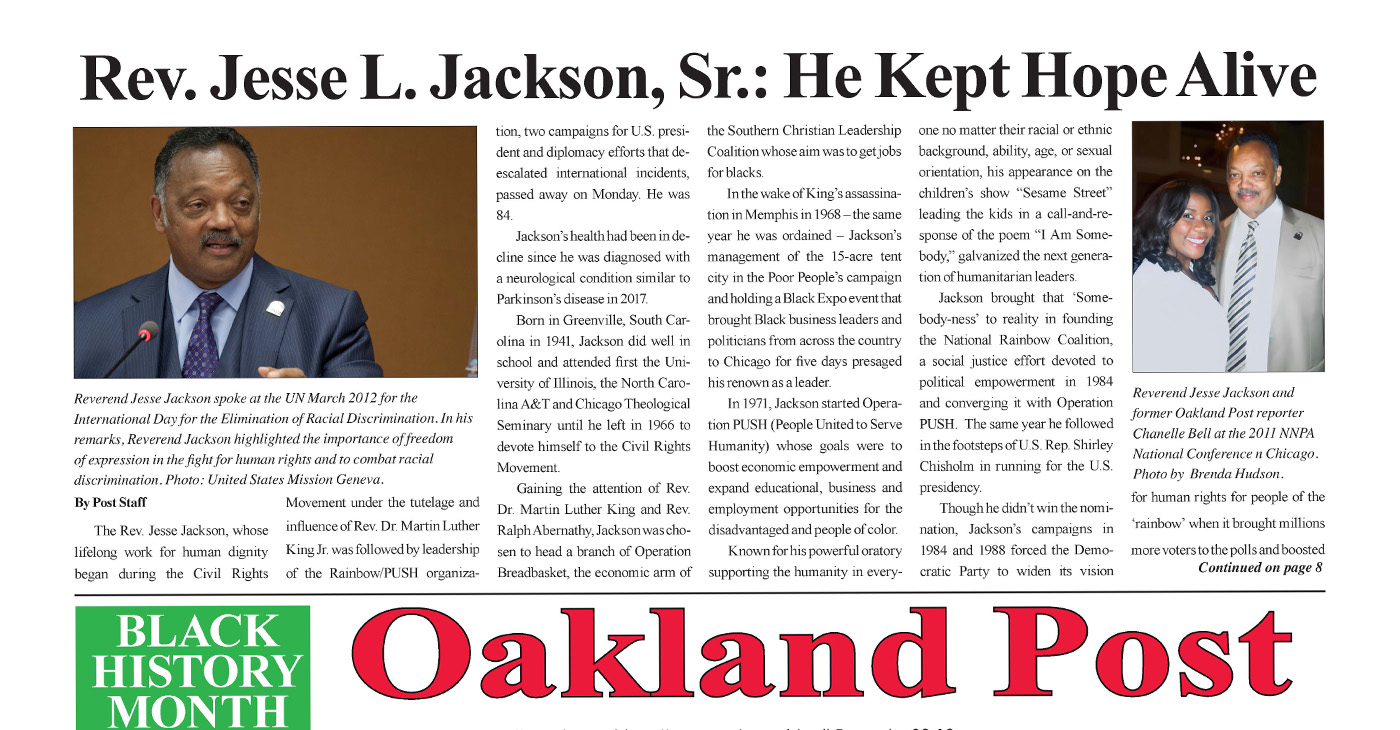
To enlarge your view of this issue, use the slider, magnifying glass icon or full page icon in the lower right corner of the browser window.
Activism
Oakland Post: Week of February 11 – 17, 2026
The printed Weekly Edition of the Oakland Post: Week of – February 11 – 17, 2026

To enlarge your view of this issue, use the slider, magnifying glass icon or full page icon in the lower right corner of the browser window.

WORK FROM HOME
Home-based business with potential monthly income of $10K+ per month. A proven training system and website provided to maximize business effectiveness. Perfect job to earn side and primary income. Contact Lynne for more details: Lynne4npusa@gmail.com 800-334-0540


Poll Shows Support for Policies That Help Families Afford Child Care

Oakland Post: Week of February 25 – March 3, 2026

Trump’s MAGA Allies are Creating Executive Order Plan to Steal the 2026 Midterms

PRESS ROOM: NBA Hall of Fame Nominee Terry Cummings Joins 100 Black Men of DeKalb County to Launch Victory & Values Initiative

Reflecting on Black History Milestones in Birmingham AL

OP-ED: One Hundred Years of Black Workers Telling the Truth

PRESS ROOM: Civil Rights TV Launches in Selma as the World’s First 24/7 Civil Rights Television Network

Advancements in solar technology that are changing the way we power the world

U.S. manufacturing rebounds – how foundry services are adapting to rising demand

Why has blood testing become so popular in today’s world?

Ghana Mourns a Son of the African World

OP-ED: Trump’s Policies Hurt Black America—and Everyone Else

OP-ED: Meta Deleted Me. I Still Don’t Know Why. And neither will you.

More than a Mission: Paying It Forward for the Future of Education

Avoid Eviction This Season: Landlord Checklist for Stable Tenancies

Oakland Post: Week of January 28, 2025 – February 3, 2026

Life Expectancy in Marin City, a Black Community, Is 15-17 Years Less than the Rest of Marin County

Community Celebrates Turner Group Construction Company as Collins Drive Becomes Turner Group Drive

California Launches Study on Mileage Tax to Potentially Replace Gas Tax as Republicans Push Back

Discrimination in City Contracts

Book Review: Books on Black History and Black Life for Kids

Oakland Post: Week of January 21 – 27, 2026

COMMENTARY: The Biases We Don’t See — Preventing AI-Driven Inequality in Health Care

Post Newspaper Invites NNPA to Join Nationwide Probate Reform Initiative

Black History Events in the East Bay

Medi-Cal Cares for You and Your Baby Every Step of the Way

Art of the African Diaspora Celebrates Legacy and Community at Richmond Art Center

COMMENTARY: The National Protest Must Be Accompanied with Our Votes

New Bill, the RIDER Safety Act, Would Support Transit Ambassadors and Safety on Public Transit

After Don Lemon’s Arrest, Black Officials Raise Concerns About Independent Black Media

Hyundai Ioniq 5 Parking, Safety, and 360 View #shorts

2025 Ioniq 5 New Wiper & Powerful Performance! #shorts

Electric SUV Range: Is 259 Miles Enough? #shorts

EV Charging: How Fast Can You Charge an Electric Vehicle? #shorts

Biometric Cooling… Messaging Seats…Come on! 2025 Infiniti QX80 Autograph 4WD

Charged Up: Witness the Magic of a Fully Electric Car! #shorts

Range Rover Sport PHEV Included…: See What’s Inside This Luxury SUV! #shorts

Invisible Hood View: Perfect Parking with X-Ray Vision! #shorts

AI Is Reshaping Black Healthcare: Promise, Peril, and the Push for Improved Results in California

ESSAY: Technology and Medicine, a Primary Care Point of View

Sanctuary Cities

The RESISTANCE – FREEDOM NOW

STATE OF THE PEOPLE: Freddie

ECONOMIC BOYCOTT DAY!!!!!

I told You So
-
 Activism4 weeks ago
Community Celebrates Turner Group Construction Company as Collins Drive Becomes Turner Group Drive
-
 Business4 weeks ago
California Launches Study on Mileage Tax to Potentially Replace Gas Tax as Republicans Push Back
-
 Activism4 weeks ago
Discrimination in City Contracts
-
 Arts and Culture4 weeks ago
Book Review: Books on Black History and Black Life for Kids
-
 Activism4 weeks ago
COMMENTARY: The Biases We Don’t See — Preventing AI-Driven Inequality in Health Care
-
 Activism4 weeks ago
Post Newspaper Invites NNPA to Join Nationwide Probate Reform Initiative
-
 Alameda County4 weeks ago
Black History Events in the East Bay
-
 Activism4 weeks ago
Art of the African Diaspora Celebrates Legacy and Community at Richmond Art Center
