
Politics
Younger Calif. Democrats Will Jockey to Replace Boxer


In this July 13, 1995 file photo, Sen. Barbara Boxer, D-Calif. speaks to reporters on Capitol Hill in Washington to discuss President Clintons decision to approve the Defense base Closure and Realignment Commission base closure recommendations. Boxer, one of the chamber’s most tenacious liberals, announced Thursday she will not seek re-election in 2016 to a fifth term. (AP Photo/Joe Marquette, File)
KEVIN FREKING, Associated Press
WASHINGTON (AP) — Sen. Barbara Boxer’s decision not to seek re-election to a fifth term provides a rare opening for ambitious California Democrats who have been waiting patiently to move up the political ranks.
Boxer, 74, and her Senate colleague, Dianne Feinstein, 81, won election to the Senate in 1992 and have pretty much had a lock on their jobs for as long as they have wanted to keep them. Another venerable Democrat is Gov. Jerry Brown, 76, who was just sworn in for a record fourth term, including two in the 1970s and 1980s.
“The number of Democratic rock stars that have been sitting on the bench is becoming longer and longer,” said Michael Trujillo, a Democratic strategist based in Los Angeles. “Now, I think a lot of these folks are ready to bring their brand to a larger stage.”
Among the Democrats who might try to succeed Boxer: Lt. Gov. Gavin Newsom, a former San Francisco mayor; state Attorney General Kamala Harris; former Los Angeles Mayor Antonio Villaraigosa; and Tom Steyer, a retired San Francisco hedge fund billionaire who sought to make climate change an issue in the midterm elections.
While lauding Boxer in prepared statements, none of the potential candidates indicated a possible Senate run.
Democratic Reps. Loretta Sanchez and Adam Schiff are also considered names to watch.
Boxer made it clear she felt no pressure to make room for a new generation of Democrats.
“I don’t think it’s fair to say because you reached a certain age, it’s time to retire,” she said during a telephone call with reporters.
Still, she said she wanted to announce her decision early enough in the election cycle to give potential successors plenty of time to organize.
“I don’t know if one person will come forward or 15 will come forward,” Boxer said.
Boxer has been a staunch supporter of abortion rights, gun control and environmental protections. She has said she is most proud of the vote that she cast against the war in Iraq, but also told reporters Thursday that she wished she had done more to galvanize opposition.
“It just weighs on me,” she said.
Political observers say Boxer’s work to protect the environment is one of her legacies. Boxer authored legislation that has designated more than 1 million acres of land in California as wilderness, a classification that generally does not allow for motor vehicles, new roads and mining. She also led efforts to prevent oil drilling in the Arctic National Wildlife Refuge in Alaska.
However, she has failed to help pass meaningful legislation to curb global warming, a longtime goal that became even more distant when Republicans won control of the Senate and Boxer lost her prized role as chairman of the Senate Committee on Environment and Public Works.
Boxer was elected to the House in 1982 and to the Senate one decade later. That was an election that marked a watershed year for women in politics, with four winning U.S. Senate seats.
Boxer would have been a prohibitive favorite to win re-election in a state where only 28 percent of the registered voters are Republicans. In California’s open primary system, the top two vote-getters advance to the general election regardless of party.
Republicans view the retirement as positive for the 2016 elections in part because it could mean that Democrats will have to spend money to retain the seat, which they probably would not have done if Boxer were in the race. Still, it would be a huge upset if a Republican were to win.
“A California Republican starts every statewide race 15 points behind and is competing against arguably the most effective state political party in the country,” said Republican strategist Aaron McLear.
Elections in California are hugely expensive and could require Republicans to side with a candidate able to fund his or her own campaign, such as Rep. Darrell Issa or business executive Carly Fiorina, who lost to Boxer in her last race and is weighing a run for president. An aide said Issa had no plans to run for the Senate.
One potential Republican candidate is Fresno Mayor Ashley Swearengin, who ran a competitive race for state controller last year. Her spokesman, Tim Clark, said the mayor had preliminary discussions about the possibility of running for Boxer’s seat and will revisit the issue now that she has announced her retirement. Swearengin cannot run again for Fresno mayor in 2016 because of term limits.
____
Associated Press writers Erica Werner and Donna Cassata in Washington and Fenit Nirappil in Sacramento contributed to this report.
Copyright 2015 The Associated Press. All rights reserved. This material may not be published, broadcast, rewritten or redistributed.







Activism
Oakland Post: Week of March 4 – 10, 2026
The printed Weekly Edition of the Oakland Post: Week of March 4 – 10, 2026

To enlarge your view of this issue, use the slider, magnifying glass icon or full page icon in the lower right corner of the browser window.
Activism
Oakland Post: Week of February 25 – March 3, 2026
The printed Weekly Edition of the Oakland Post: Week of – February 25 – March 3, 2026

To enlarge your view of this issue, use the slider, magnifying glass icon or full page icon in the lower right corner of the browser window.
Activism
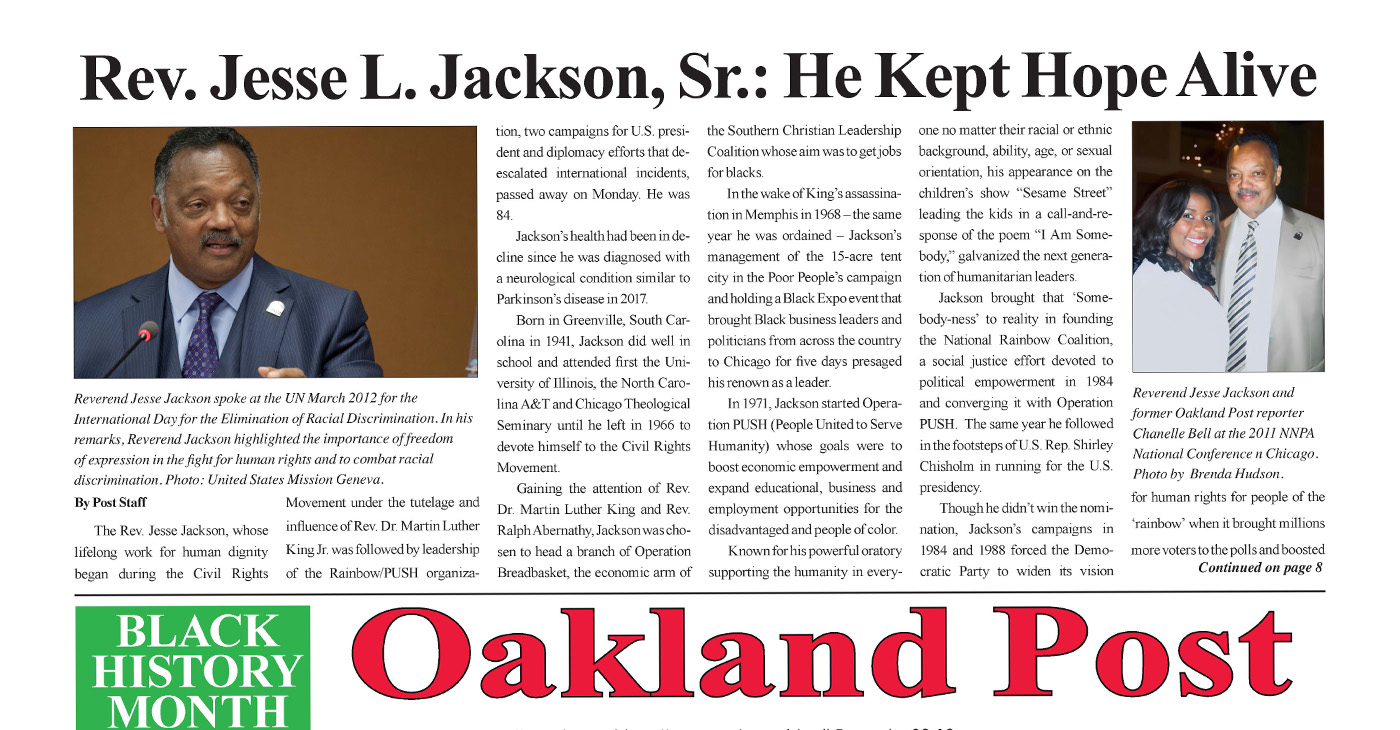
Oakland Post: Week of February 18 – 24, 2026
The printed Weekly Edition of the Oakland Post: Week of – February 18 – 24, 2026
To enlarge your view of this issue, use the slider, magnifying glass icon or full page icon in the lower right corner of the browser window.


WORK FROM HOME
Home-based business with potential monthly income of $10K+ per month. A proven training system and website provided to maximize business effectiveness. Perfect job to earn side and primary income. Contact Lynne for more details: Lynne4npusa@gmail.com 800-334-0540


COMMENTARY: Women of Color Shape Our Past and Future

Woman’s Search for Family’s Roots Leads to Ancestor John T. Ward – A Successful Entrepreneur and Conductor on the Underground Railroad

Advocates Raise Alarm Over ICE Operation, MOU and Detention Risks in Baltimore County

Pete Buttigieg to Join Mayor Randall Woodfin for Community Town Hall in Birmingham

WATCH: Week One – NNPA’s “Leadership Matters” Video Series

Oakland Post: Week of March 4 – 10, 2026

OP-ED: NNPA Launches 2026 “Leadership Matters” Video Series

PRESS ROOM: PMG and Cranbrook Horizons-Upward Bound Launch Journey Fellowship Cohort 2

Los Angeles Summit Brings Together Leaders to Tackle Poverty and Affordability

Civil Rights TV Launches 24/7 Network Focused on Black History, Education and Equity

REVIEW: The Ultimate Hot Girl Summer Getaway: Sunseeker Resort Florida

COMMENTARY: How You Stop a Prescription Medicine is as Important as How You Start

PRESS ROOM: From Congress to Corporate America: NNPA Spotlights Visionaries in New Video Series

Poll Shows Support for Policies That Help Families Afford Child Care

Oakland Post: Week of February 25 – March 3, 2026

Oakland Post: Week of January 28, 2025 – February 3, 2026

Life Expectancy in Marin City, a Black Community, Is 15-17 Years Less than the Rest of Marin County

Community Celebrates Turner Group Construction Company as Collins Drive Becomes Turner Group Drive

California Launches Study on Mileage Tax to Potentially Replace Gas Tax as Republicans Push Back

Discrimination in City Contracts

Book Review: Books on Black History and Black Life for Kids

COMMENTARY: The Biases We Don’t See — Preventing AI-Driven Inequality in Health Care

Black History Events in the East Bay

Post Newspaper Invites NNPA to Join Nationwide Probate Reform Initiative

Medi-Cal Cares for You and Your Baby Every Step of the Way

Art of the African Diaspora Celebrates Legacy and Community at Richmond Art Center

COMMENTARY: The National Protest Must Be Accompanied with Our Votes

New Bill, the RIDER Safety Act, Would Support Transit Ambassadors and Safety on Public Transit

Oakland Post: Week of February 4 – 10, 2026

After Don Lemon’s Arrest, Black Officials Raise Concerns About Independent Black Media

Hyundai Ioniq 5 Parking, Safety, and 360 View #shorts

2025 Ioniq 5 New Wiper & Powerful Performance! #shorts

Electric SUV Range: Is 259 Miles Enough? #shorts

EV Charging: How Fast Can You Charge an Electric Vehicle? #shorts

Biometric Cooling… Messaging Seats…Come on! 2025 Infiniti QX80 Autograph 4WD

Charged Up: Witness the Magic of a Fully Electric Car! #shorts

Range Rover Sport PHEV Included…: See What’s Inside This Luxury SUV! #shorts

Invisible Hood View: Perfect Parking with X-Ray Vision! #shorts

AI Is Reshaping Black Healthcare: Promise, Peril, and the Push for Improved Results in California

ESSAY: Technology and Medicine, a Primary Care Point of View

Sanctuary Cities

The RESISTANCE – FREEDOM NOW

STATE OF THE PEOPLE: Freddie

ECONOMIC BOYCOTT DAY!!!!!

I told You So
-
 Activism4 weeks ago
Discrimination in City Contracts
-

 Activism4 weeks ago
Oakland Post: Week of February 11 – 17, 2026
-
 #NNPA BlackPress2 weeks ago
Reflecting on Black History Milestones in Birmingham AL
-

 Advice4 weeks ago
Rising Optimism Among Small And Middle Market Business Leaders Suggests Growth for California
-

 Bay Area3 weeks ago
CITY OF SAN LEANDRO STATE OF CALIFORNIA PUBLIC WORKS DEPARTMENT ENGINEERING DIVISION NOTICE TO BIDDERS FOR ANNUAL STREET OVERLAY/REHABILITATION 2019-21 – PHASE III
-

 #NNPA BlackPress2 weeks ago
U.S. manufacturing rebounds – how foundry services are adapting to rising demand
-
 #NNPA BlackPress2 weeks ago
PRESS ROOM: NBA Hall of Fame Nominee Terry Cummings Joins 100 Black Men of DeKalb County to Launch Victory & Values Initiative
-
 Activism3 weeks ago
Oakland Post: Week of February 18 – 24, 2026
