
Entertainment
Jody Watley: New Tour, New Music and New Shalamar


By Mary L. Datcher
Speical to the NNPA via The Chicago Defender
If you grew up in the era of cultural identity, sexual exploration, political uprise and post-Vietnam—most likely you’re either a baby of the late 60’s and 70’s period. Each of us could probably recount a song, album or musical artist that influenced our daily moods. As we developed our musical palette into the 80’s, the world of hip hop, punk rock, funk and post disco transcended into dance—launched the power of a new generation of young women entertainers who took centerstage.
Among this breakout group of artists, was Jody Watley—a former member of the R&B group, Shalamar. A native of Chicago, Watley relocated and was raised in Los Angeles often gracing the Soul Train dance floor. Signed to Dick Griffey’s Solar Records, Shalamar was a regular fixture on Soul Train. Joining the group at the age of 18, Watley shared the spotlight with fellow group members; Jeffrey Daniels and Howard Hewitt. The group topped the R&B charts with hits such as “Second Time Around”, “A Night to Remember” and “There it Is” making them one of the most sought after groups on the international circuit. After a 3-year run with the group and creative differences, Watley left the group.
“As a child I wanted to do a lot of things – sing, dance, design and own my own business. The beginning days of Shalamar was a learning experience for me from ’77-’83 over the course of those albums there was a lot going on. The business was wrong, no one in the group was getting along and my Dad had died in 1982. It changed my life. I didn’t want to take things for granted, not wasting time, not wanting to be around people who were negative.” she said.
Soon after, she moved to England for some soul searching, where she participated on the Band Aid charity concert organized by rockstar, Bob Geldof to raise money for anti-poverty efforts in Ethiopia.
She explained. “When I left the group in ’83, most of all I wanted to be happy in my life. As long as I’m happy, I’m good. I moved to England and lived there for 3 years. I made a plan for myself in what I wanted to do, what kind of music I wanted to do. I was able to do something that not many singers from a group are able to do. To establish your own identity and create hits on your own. It doesn’t happen that often.”
Returning to the U.S., after a couple of years performing at the Band Aid charity concert, she pursued her dream of going solo as an artist. At the time, Jheryl Busby was the President of the Black Music Division at MCA Records and signed Watley knowing she had a unique appeal with the potential of crossing over into the Pop music market. Watley trusted him immensely.
“Coming back to the U.S. and I met with the various companies. When I met with Jheryl Busby, we just connected right away. He got my creativity, he instantly appreciated the fact that I knew what I wanted. All of artists at the time, had looked the same to me.” she said.
“My first album cover, I wanted to be black and white because it’s timeless. I like classic Hollywood glamour. He said, ‘black and white’ album covers don’t sale and I told him mine was going to sell. He loved it and had so much respect for me from the beginning. It wasn’t because I was girl, or just trusting the label but as a woman he empowered me. He empowered MCA Records to rally with us and me to make it happen.”
As we witnessed her rise as one of the most influential Pop music entertainers during the late 80’s into the 90’s, Watley earned a Grammy for Best New Artist, for her debut single, “Looking for a New Love” following up with another hit, “Still a Thrill”. She’s been recognized for numerous accolades for a style fashionista, gracing international magazine covers and holding her place among Pop music royalty like Madonna, Janet Jackson and Tina Turner.
“Through the moments when some people at the company didn’t think I sounded Black enough or I wasn’t street enough. Not everyone is going to get it but that’s how you become a trendsetter. I’m not trying to be Janet Jackson. I’m a freestyle girl, I’m doing fashion – the jumbo hoop eye rings, the ripped jeans so they were like, ‘what is this?’”
Most of us can remember her collabo with Hip Hop Gods, Eric B. and Rakim on “Friends” infusing R&B Dance with Hip Hop meshing the two worlds together.
With the music industry changing, being married, divorced and raising two children as a single mom—has not stopped Watley’s continual drive in her career. She’s taken time out in between projects to raise her children, nurture her independent label and release music throughout the last couple of decades.
“My daughter just graduated from college. My son is currently in college so in the midst of being ‘Jody Watley’ , to be a sane person and to have grounded children is really number one. I’ve never been afraid to step away from the spotlight and take my son and daughter to their school events. To be there to cheer them on because time goes very fast.”
Today, we still see her influence with the next generation rocking the mega hoop earrings, chunky gold jewelry, ripped jeans and a freestyle spirit of creating trends from Beyonce, Nicki Minaj, Miley Cyrus and others. Everything goes full circle.
“I was determined to have it to be my own style–how I looked, the songs I was writing, who the photographers were and who I was working with. It was an easy transition and I still enjoy being a solo artist. The unique thing with the new Shalamar it feels very collaborative. It’s refreshing for me to not think of every detail.”
Watley not only has a new project gearing up for a summer release but she has recently brought together new members to launch the new Shalamar. After years of re-issues of the Shalamar catalog through various companies between the U.S. and abroad, Watley was frustrated at her likeness and image being misused. After a long search and the advice of her attorney, she found out the group’s name had not been trademarked.
“In life and in business, you have to have good people around you that are trying to protect you. That’s what led me to it. It was a thorough process for two years so that there was no shady business going on. With a trademark, it’s a long and exhaustive process. So, with a brand – what do you do with it? How can you make it fresh and honor the legacy of it but also bring some younger people on board? Make it something that is marketable and not for just the older fans – the classics.” she said.
###


Advice
COMMENTARY: If You Don’t Want Your ‘Black Card’ Revoked, Watch What You Bring to Holiday Dinners
From Thanksgiving to Christmas to New Year’s Day, whether it’s the dining room table or the bid whist (Spades? Uno, anyone?) table, your card may be in danger.


By Wanda Ravernell
Post Staff
From the fourth week of November to the first week in January, if you are of African descent, but particularly African American, certain violations of cultural etiquette will get your ‘Black card’ revoked.
From Thanksgiving to Christmas to New Year’s Day, whether it’s the dining room table or the bid whist (Spades? Uno, anyone?) table, your card may be in danger.
It could take until Super Bowl Sunday for reinstatement.
I don’t know much about the card table, but for years I was on probation by the ‘Aunties,’ the givers and takers of Black cards.
How I Got into Trouble
It was 1970-something and I was influenced by the health food movement that emerged from the hippie era. A vegetarian (which was then considered sacrilegious by most Black people I knew) prepared me a simple meal: grated cheese over steamed broccoli, lentils, and brown rice.
I introduced the broccoli dish at the Friday night supper with my aunt and grandfather. She pronounced the bright green broccoli undone, but she ate it. (I did not, of course, try brown rice on them.)
I knew that I would be allowed back in the kitchen when she attempted the dish, but the broccoli had been cooked to death. (Y’all remember when ALL vegetables, not just greens, were cooked to mush?)

My Black card, which had been revoked was then reattained because they ate what I prepared and imitated it.
Over the decades, various transgressions have become normalized. I remember when having a smoked turkey neck instead of a ham hock in collard greens was greeted with mumblings and murmurings at both the dining room and card tables. Then came vegan versions with just olive oil (What? No Crisco? No bacon, at least?) and garlic. And now my husband stir fries his collards in a wok.
But No Matter How Things Have Changed…
At holiday meals, there are assigned tasks. Uncle Jack chopped raw onions when needed. Uncle Buddy made the fruit salad for Easter. My mother brought the greens in winter, macaroni salad in summer. Aunt Deanie did the macaroni and cheese, and the great aunts, my deceased grandmother’s sisters, oversaw the preparation of the roast beef, turkey, and ham. My father, if he were present, did the carving.
These designations/assignments were binding agreements that could stand up in a court of law. Do not violate the law of assignments by bringing some other version of a tried-and-true dish, even if you call it a new ‘cheese and noodle item’ to ‘try out.’ The auntie lawgivers know what you are trying to do. It’s called a menu coup d’état, and they are not having it.
The time for experiments is in your own home: your spouse and kids are the Guinea pigs.
My mother’s variation of a classic that I detested from that Sunday to the present was adding crushed pineapple to mashed sweet potatoes. A relative stops by, tries it, and then it can be introduced as an add-on to the standard holiday menu.
My Aunt Vivian’s concoctions from Good Housekeeping or Ladies’ Home Journal magazine also made it to the Black people’s tables all over the country in the form of a green bean casserole.
What Not to Do and How Did It Cross Your Mind?
People are, of all things holy, preparing mac ‘n’ cheese with so much sugar it tastes like custard with noodles in it.
Also showing up in the wrong places: raisins. Raisins have been reported in the stuffing (makes no sense unless it’s in a ‘sweet meats’ dish), in a pan of corn bread, and – heresy in the Black kitchen – the MAC ‘n’ CHEESE.
These are not mere allegations: There is photographic evidence of these Black card violations, but I don’t want to defame witnesses who remained present at the scene of the crimes.
The cook – bless his/her heart – was probably well-meaning, if ignorant. Maybe they got the idea from a social media influencer, much like Aunt Viv got recipes from magazines.
Thankfully, a long-winded blessing of the food at the table can give the wary attendee time to locate the oddity’s place on the table and plan accordingly.
But who knows? Innovation always prevails, for, as the old folks say, ‘waste makes want.’ What if the leftovers were cut up, dipped in breadcrumbs and deep fried? The next day, that dish might make it to the TV tray by the card table.
An older cousin – on her way to being an Auntie – in her bonnet, leggings, T-shirt, and bunny slippers and too tired to object, might try it and like it….
And if she ‘rubs your head’ after eating it, the new dish might be a winner and (Whew!) everybody, thanks God, keeps their Black cards.
Until the next time.

Arts and Culture
Fayeth Gardens Holds 3rd Annual Kwanzaa Celebration at Hayward City Hall on Dec. 28
Kwanzaa celebrates seven principles – Nguzu Saba – that support an ideal of community, beginning from Dec. 26 to Jan. 1. Those principles, in Swahili, are: Umoja (Unity), Kujichagulia (Self-Determination), Ujima (Collective Work & Responsibility), Ujamaa (Collective Economics), Nia (Purpose), Kuumba (Creativity) and Imani (Faith).

Entertainment, vendors, and special honors for Sankofa Lifetime Achievement awardees
Special to The Post
Celebrating Ujima, the principle of ‘Collective Work and Responsibility,’ Fayeth Gardens’ 3rd Annual Kwanzaa Celebration will be held on Dec. 28, from 12 noon to 5 p.m.
Kwanzaa celebrates seven principles – Nguzu Saba – that support an ideal of community, beginning from Dec. 26 to Jan. 1.
Those principles, in Swahili, are: Umoja (Unity), Kujichagulia (Self-Determination), Ujima (Collective Work & Responsibility), Ujamaa (Collective Economics), Nia (Purpose), Kuumba (Creativity) and Imani (Faith).
The free event at Hayward City Hall at 777 B St. will feature live entertainment, a guest speaker, awards for community activists whose work reflects the principle of Ujima, vendors and an honoring of the ancestors by Awon Ohun Omnira (Voices of Freedom).
On stage will be the Touch of Class Band, a New Orleans Second-Line Band, and the California Griot Storytellers. Bring the children to have fun in the Kids Korner.
Velda Goe, who has been celebrating Kwanzaa since it started in the 1960s, noticed there was no public celebration of the holiday in Hayward when she moved to the city in 2008.
“I started it a couple of years ago,” she said, “and hopefully it will continue just like the cultural events by other nationalities (in Hayward). The Afro-descendent people of Hayward deserve cultural recognition as well.”
Goe also believes it’s important that Kwanzaa gets its due because “there are so many misconceptions,” particularly by people of other nationalities, who are under the impression “that Kwanzaa is a cult, a religion, or replaces Christmas.”
The celebration, which is open to all, can have the effect of helping guests see that Kwanzaa’a principles and purpose are common to all
This year’s Sankofa Lifetime Awardees are:
- Mrs. Freddye M. Davis: President of the South Hayward NAACP
•Baba Arnold X.C. Perkins: Co-founder of the Brotherhood of Elders
•Frederick Jordan,: Legendary founder of F.E. Jordan & Associates and the Design Engineer for the Charles P. Howard Container Terminal at the Port of Oakland + 1,000 Projects
Come dressed up in your best African wear to enter a raffle for a prize for best-dressed Afrocentric King and Queen.A free, healthy soul food lunch is available with an Eventbrite ticket, which can be found at for free lunch is available from for 11:30 to 12 p.m.
In its third year, the event is the brainchild of Velda Goe, founder of Fayeth Gardens, a community planting site to educate and provide a means for urban dwellers to grow healthy food for their families and develop life-sustaining eating habits.
Interested in being a vendor, volunteer, or sponsor? Reach out to FayethGardens@gmail.com
For tickets, go to: https://www.eventbrite.com/e/fayeth-gardens-3rd-annual-kwanzaa-celebration-at-hayward-city-hall-tickets-1974966953322
Activism
Oakland Post: Week of December 10 – 16, 2025
The printed Weekly Edition of the Oakland Post: Week of – December 10 – 16, 2025
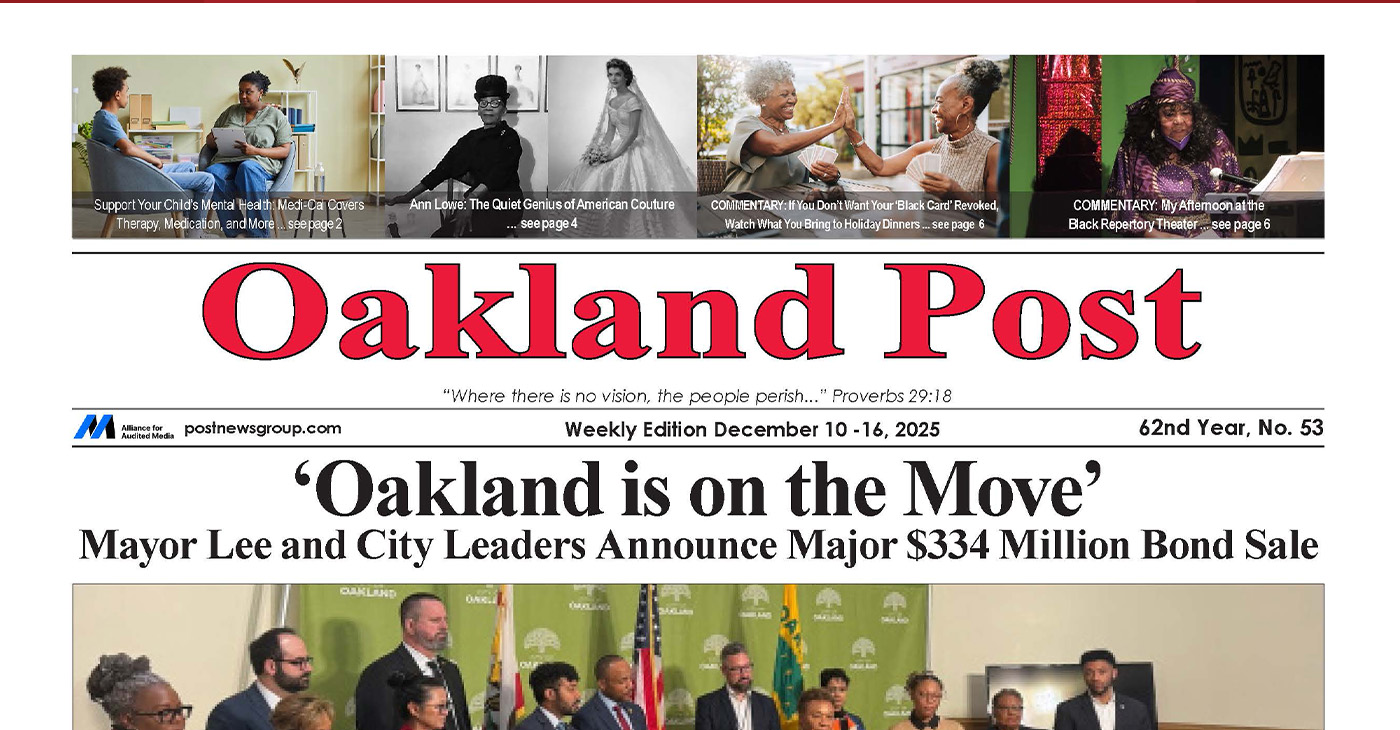
To enlarge your view of this issue, use the slider, magnifying glass icon or full page icon in the lower right corner of the browser window.

WORK FROM HOME
Home-based business with potential monthly income of $10K+ per month. A proven training system and website provided to maximize business effectiveness. Perfect job to earn side and primary income. Contact Lynne for more details: Lynne4npusa@gmail.com 800-334-0540


Support Your Child’s Mental Health: Medi-Cal Covers Therapy, Medication, and More

Ann Lowe: The Quiet Genius of American Couture

2025 in Review: Seven Questions for Black Women’s Think Tank Founder Kellie Todd Griffin

BRIDGE Housing President and CEO Ken Lombard Scores Top Honors for Affordable Housing Leadership

Oakland School Board Grapples with Potential $100 Million Shortfall Next Year

COMMENTARY: If You Don’t Want Your ‘Black Card’ Revoked, Watch What You Bring to Holiday Dinners

Mayor Lee, City Leaders Announce $334 Million Bond Sale for Affordable Housing, Roads, Park Renovations, Libraries and Senior Centers

Fayeth Gardens Holds 3rd Annual Kwanzaa Celebration at Hayward City Hall on Dec. 28

Post Salon to Discuss Proposal to Bring Costco to Oakland Community meeting to be held at City Hall, Thursday, Dec. 18

Oakland Post: Week of December 10 – 16, 2025

Seth Curry Makes Impressive Debut with the Golden State Warriors

A Nation in Freefall While the Powerful Feast: Trump Calls Affordability a ‘Con Job’

The Numbers Behind the Myth of the Hundred Million Dollar Contract

FBI Report Warns of Fear, Paralysis, And Political Turmoil Under Director Kash Patel

ACA Deadline Nears as 20 million Brace for Higher Health Costs

Oakland Post: Week of November 5 – 11, 2025

Oakland Post: Week of November 12 – 18, 2025

IN MEMORIAM: William ‘Bill’ Patterson, 94

How Charles R. Drew University Navigated More Than $20 Million in Fed Cuts – Still Prioritizing Students and Community Health

No Justice in the Justice System

Oakland Post: Week of November 19 – 25, 2025

LIHEAP Funds Released After Weeks of Delay as States and the District Rush to Protect Households from the Cold

Beyoncé and Jay-Z make rare public appearance with Lewis Hamilton at Las Vegas Grand Prix
Seth Curry Makes Impressive Debut with the Golden State Warriors

Oakland Post: Week of November 26 – December 2, 2025

Seven Steps to Help Your Child Build Meaningful Connections

Lewis Hamilton set to start LAST in Saturday Night’s Las Vegas Grand Prix

Seven Steps to Help Your Child Build Meaningful Connections

Protecting Pedophiles: The GOP’s Warped Crusade Against Its Own Lies

The Perfumed Hand of Hypocrisy: Trump Hosted Former Terror Suspect While America Condemns a Muslim Mayor

Hyundai Ioniq 5 Parking, Safety, and 360 View #shorts

2025 Ioniq 5 New Wiper & Powerful Performance! #shorts

Electric SUV Range: Is 259 Miles Enough? #shorts

EV Charging: How Fast Can You Charge an Electric Vehicle? #shorts

Biometric Cooling… Messaging Seats…Come on! 2025 Infiniti QX80 Autograph 4WD

Charged Up: Witness the Magic of a Fully Electric Car! #shorts

Range Rover Sport PHEV Included…: See What’s Inside This Luxury SUV! #shorts

Invisible Hood View: Perfect Parking with X-Ray Vision! #shorts

AI Is Reshaping Black Healthcare: Promise, Peril, and the Push for Improved Results in California

ESSAY: Technology and Medicine, a Primary Care Point of View

Sanctuary Cities

The RESISTANCE – FREEDOM NOW

STATE OF THE PEOPLE: Freddie

ECONOMIC BOYCOTT DAY!!!!!

I told You So
-
 Activism4 weeks ago
IN MEMORIAM: William ‘Bill’ Patterson, 94
-
 Activism4 weeks ago
Oakland Post: Week of November 19 – 25, 2025
-
 #NNPA BlackPress3 weeks ago
LIHEAP Funds Released After Weeks of Delay as States and the District Rush to Protect Households from the Cold
-
 #NNPA BlackPress4 weeks ago
Beyoncé and Jay-Z make rare public appearance with Lewis Hamilton at Las Vegas Grand Prix
-
 Alameda County2 weeks ago
Seth Curry Makes Impressive Debut with the Golden State Warriors
-
 Activism3 weeks ago
Oakland Post: Week of November 26 – December 2, 2025
-
 #NNPA BlackPress3 weeks ago
Seven Steps to Help Your Child Build Meaningful Connections
-
 #NNPA BlackPress4 weeks ago
Lewis Hamilton set to start LAST in Saturday Night’s Las Vegas Grand Prix
