
National
Officials: US Report Finds Racial Bias in Ferguson Police


In this Nov. 26, 2014, file photo, nembers of Missouri National Guard stand outside of the Ferguson Police Department and the Municipal Court in Ferguson, Mo. A Justice Department investigation has found patterns of racial bias in the Ferguson police department and at the municipal jail and court. The full report, to be publicly released on March 4, says the investigation found Ferguson officers disproportionately used excessive force against blacks and too often charged them with petty offenses. (AP Photo/Jeff Roberson, File)
ERIC TUCKER, Associated Press
WASHINGTON (AP) — A Justice Department investigation found sweeping patterns of racial bias within the Ferguson, Missouri, police department, with officers routinely discriminating against blacks by using excessive force, issuing petty citations and making baseless traffic stops, according to law enforcement officials familiar with its findings.
The report, which Ferguson city officials said would be released Wednesday, marks the culmination of a months-long investigation into a police department that federal officials have described as troubled and that commanded national attention after one of its officers shot and killed an unarmed black man, 18-year-old Michael Brown, last summer.
It chronicles discriminatory practices across the city’s criminal justice system, detailing problems from initial encounters with patrol officers to treatment in the municipal court and jail. Federal law enforcement officials described its contents on condition of anonymity because they were not authorized to speak publicly before the report is released.
The full report could serve as a roadmap for significant changes by the department, if city officials accept its findings. Past federal investigations of local police departments have encouraged overhauls of fundamental police procedures such as traffic stops and the use of service weapons. The Justice Department maintains the right to sue police departments that resist making changes.
The city of Ferguson released a statement acknowledging that Justice Department officials supplied a copy of the report to the mayor, city manager, police chief and city attorney during a private meeting Tuesday in downtown St. Louis. The statement offered no details about the report, which the city said it was reviewing and would discuss Wednesday after the Justice Department makes it public.
The investigation, which began weeks after Brown’s killing last August, is being released as Attorney General Eric Holder prepares to leave his job following a six-year tenure that focused largely on civil rights. The findings are based on interviews with police leaders and residents, a review of more than 35,000 pages of police records and analysis of data on stops, searches and arrests.
Federal officials found that black motorists from 2012 to 2014 were more than twice as likely as whites to be searched during traffic stops, even though they were 26 percent less likely to be found carrying contraband, according to a summary of the findings.
The review also found that blacks were 68 percent less likely than others to have their cases dismissed by a municipal court judge. And from April to September of last year, 95 percent of people kept at the city jail for more than two days were black, it found.
Of the cases in which the police department documented the use of force, 88 percent involved blacks, and of the 14 dog bites for which racial information is available, all 14 victims were black.
Overall, African-Americans make up 67 percent of the population of Ferguson, about 10 miles north of downtown St. Louis. The police department has been criticized as racially imbalanced and not reflective of the community’s demographic makeup. At the time of the shooting, just three of 53 officers were black, though the mayor has said he’s trying to create a more diverse police force.
Brown’s killing set off weeks of protests and initiated a national dialogue about police officers’ use of force and their relations with minority communities. A separate report to be issued soon is expected to clear Darren Wilson, the officer who shot Brown, of federal civil rights charges. A state grand jury declined to indict Wilson in November, and he resigned from the department.
Benjamin Crump, the attorney for the Brown family, said that if the reports about the findings are true, they “confirm what Michael Brown’s family has believed all along — and that is that the tragic killing of an unarmed 18-year-old black teenager was part of a systemic pattern of inappropriate policing of African-American citizens in the Ferguson community.”
The report says there is direct evidence of racial bias among police officers and court workers, and details a criminal justice system that issues citations for petty infractions such as walking in the middle of the street, putting the raising of revenue from fines ahead of public safety. The physical tussle that led to Brown’s death began after Wilson told him and a friend to move from the street to the sidewalk.
The practice hits poor people especially hard, sometimes leading to jail time when they can’t pay, the report says, and has contributed to a cynicism about the police on the part of citizens.
Among the report’s findings was a racially tinged 2008 message in a municipal email account stating that President Barack Obama would not be president for very long because “what black man holds a steady job for four years.”
The department has conducted roughly 20 broad civil rights investigations of police departments during Holder’s tenure, including Cleveland, Newark, New Jersey, and Albuquerque, New Mexico. Most such investigations end with police departments agreeing to change their practices.
John Gaskin III, a St. Louis community activist, praised the findings, saying, “Ferguson police have to see the light in how they deal with people of color.
“It’s quite evident that change is coming down the pike. This is encouraging,” he said. “It’s so unfortunate that Michael Brown had to be killed. But in spite of that, I feel justice is coming.”
____
Associated Press writers Jim Salter and Jim Suhr in St. Louis and Alan Scher Zagier in Ferguson contributed to this report.
Copyright 2015 The Associated Press. All rights reserved. This material may not be published, broadcast, rewritten or redistributed.





Activism
Ann Lowe: The Quiet Genius of American Couture
Lowe was born in Clayton, Alabama, into a family of gifted seamstresses. Her mother and grandmother were well-known dressmakers who created exquisite gowns for women in the area. By the time Lowe was a young girl, she was already showing extraordinary talent — cutting, sewing, and decorating fabric with a skill that far exceeded her age. When her mother died unexpectedly, Lowe – only 16 years old then – took over her mother’s sewing business, completing all the orders herself.
By Tamara Shiloh
Ann Cole Lowe, born Dec.14, 1898, was a pioneering American fashion designer whose extraordinary talent shaped some of the most widely recognized and celebrated gowns in U.S. history.
Although she designed dresses for society’s wealthiest families and created masterpieces worn at historic events, Lowe spent much of her life in the shadows — uncredited, underpaid, yet unmatched in skill. Today, she is celebrated as one of the first nationally recognized African American fashion designers and a true visionary in American couture.
Lowe was born in Clayton, Alabama, into a family of gifted seamstresses. Her mother and grandmother were well-known dressmakers who created exquisite gowns for women in the area. By the time Lowe was a young girl, she was already showing extraordinary talent — cutting, sewing, and decorating fabric with a skill that far exceeded her age. When her mother died unexpectedly, Lowe – only 16 years old then – took over her mother’s sewing business, completing all the orders herself. This early responsibility would prepare her for a lifetime of professional excellence.
In 1917, Lowe moved to New York City to study at the S.T. Taylor Design School. Although she was segregated from White students and forced to work separately, she, of course, excelled, graduating earlier than expected. Her instructors quickly recognized that her abilities were far above the typical student, especially her skill in hand-sewing, applique, and intricate floral embellishment – techniques that would become her signature.

Throughout the 1920s and 1930s, she designed gowns for high-society women in Florida and New York, operating boutiques and working for prestigious department stores. Her reputation for craftsmanship, originality, and elegance grew increasingly. She was known for creating gowns that moved beautifully, featured delicate hand-made flowers, and looked sculpted rather than sewn. Many wealthy clients specifically requested “an Ann Lowe gown” for weddings, balls, and galas.
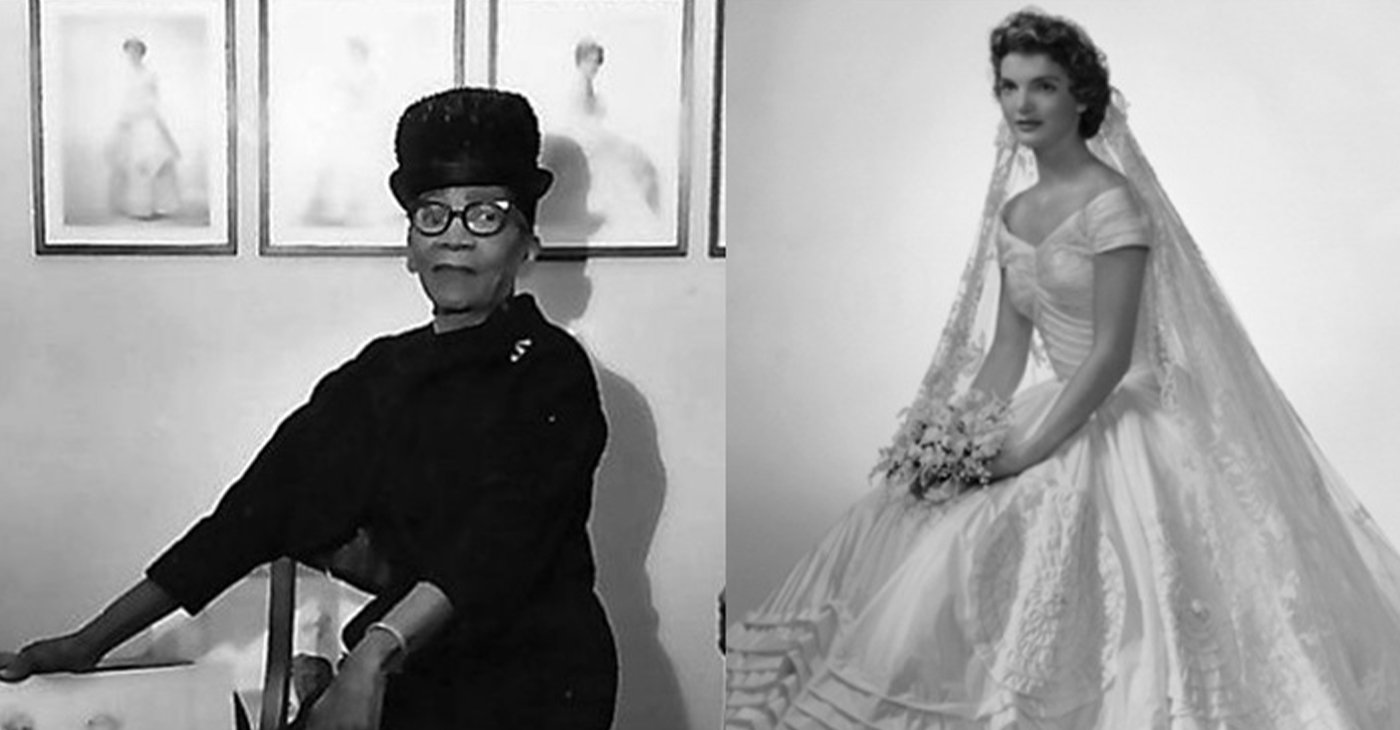
Her most famous creation came in 1953: the wedding gown worn by Jacqueline Bouvier when she married Massachusetts Sen. John F. Kennedy. The dress – crafted from ivory silk taffeta with dozens of tiny, pleated rosettes – became one of the most photographed bridal gowns in American history. Despite this achievement, Lowe received no public credit at the time. When a flood destroyed her completed gowns 10 days before the wedding, she and her seamstresses worked day and night to remake everything – at her own expense. Her dedication and perfectionism never wavered.
She eventually opened “Ann Lowe Originals,” her own salon on New York’s Madison Avenue. She served clients such as the Rockefellers, DuPonts, Vanderbilts, and actresses like Olivia de Havilland. Yet even with her wealthy clientele, she struggled financially, often undercharging because she wanted every dress to be perfect, even if it meant losing money.
Lowe’s contributions were finally recognized later in life. Today, her exquisite gowns are preserved in museums, including the Smithsonian National Museum of African American History and Culture and the Metropolitan Museum of Art.
In the last five years of her life, Lowe lived with her daughter Ruth in Queens, N.Y. She died at her daughter’s home on Feb. 25, 1981, at the age of 82, after an extended illness.
Activism
Oakland Post: Week of December 10 – 16, 2025
The printed Weekly Edition of the Oakland Post: Week of – December 10 – 16, 2025

To enlarge your view of this issue, use the slider, magnifying glass icon or full page icon in the lower right corner of the browser window.
Alameda County
Seth Curry Makes Impressive Debut with the Golden State Warriors
Seth looked comfortable in his new uniform, seamlessly fitting into the Warriors’ offensive and defensive system. He finished the night with an impressive 14 points, becoming one of the team’s top scorers for the game. Seth’s points came in a variety of ways – floaters, spot-up three-pointers, mid-range jumpers, and a handful of aggressive drives that kept the Oklahoma City Thunder defense on its heels.

By Y’Anad Burrell
Tuesday night was anything but ordinary for fans in San Francisco as Seth Curry made his highly anticipated debut as a new member of the Golden State Warriors. Seth didn’t disappoint, delivering a performance that not only showcased his scoring ability but also demonstrated his added value to the team.
At 35, the 12-year NBA veteran on Monday signed a contract to play with the Warriors for the rest of the season.
Seth looked comfortable in his new uniform, seamlessly fitting into the Warriors’ offensive and defensive system. He finished the night with an impressive 14 points, becoming one of the team’s top scorers for the game. Seth’s points came in a variety of ways – floaters, spot-up three-pointers, mid-range jumpers, and a handful of aggressive drives that kept the Oklahoma City Thunder defense on its heels.
One of the most memorable moments of the evening came before Seth even scored his first points. As he checked into the game, the Chase Center erupted into applause, with fans rising to their feet to give the newest Warrior a standing ovation.
The crowd’s reaction was a testament not only to Seth’s reputation as a sharpshooter but also to the excitement he brings to the Warriors. It was clear that fans quickly embraced Seth as one of their own, eager to see what he could bring to the team’s championship aspirations.
Warriors’ superstar Steph Curry – Seth’s brother – did not play due to an injury. One could only imagine what it would be like if the Curry brothers were on the court together. Magic in the making.
Seth’s debut proved to be a turning point for the Warriors. Not only did he contribute on the scoreboard, but he also brought a sense of confidence and composure to the floor.
While their loss last night, OKC 124 – GSW 112, Seth’s impact was a game-changer and there’s more yet to come. Beyond statistics, it was clear that Seth’s presence elevated the team’s performance, giving the Warriors a new force as they look to make a deep playoff run.

WORK FROM HOME
Home-based business with potential monthly income of $10K+ per month. A proven training system and website provided to maximize business effectiveness. Perfect job to earn side and primary income. Contact Lynne for more details: Lynne4npusa@gmail.com 800-334-0540


Support Your Child’s Mental Health: Medi-Cal Covers Therapy, Medication, and More

Ann Lowe: The Quiet Genius of American Couture

2025 in Review: Seven Questions for Black Women’s Think Tank Founder Kellie Todd Griffin

BRIDGE Housing President and CEO Ken Lombard Scores Top Honors for Affordable Housing Leadership

Oakland School Board Grapples with Potential $100 Million Shortfall Next Year

COMMENTARY: If You Don’t Want Your ‘Black Card’ Revoked, Watch What You Bring to Holiday Dinners

Mayor Lee, City Leaders Announce $334 Million Bond Sale for Affordable Housing, Roads, Park Renovations, Libraries and Senior Centers

Fayeth Gardens Holds 3rd Annual Kwanzaa Celebration at Hayward City Hall on Dec. 28

Post Salon to Discuss Proposal to Bring Costco to Oakland Community meeting to be held at City Hall, Thursday, Dec. 18

Oakland Post: Week of December 10 – 16, 2025

Seth Curry Makes Impressive Debut with the Golden State Warriors

A Nation in Freefall While the Powerful Feast: Trump Calls Affordability a ‘Con Job’

The Numbers Behind the Myth of the Hundred Million Dollar Contract

FBI Report Warns of Fear, Paralysis, And Political Turmoil Under Director Kash Patel

ACA Deadline Nears as 20 million Brace for Higher Health Costs

Oakland Post: Week of October 29 – November 4, 2025

Oakland Post: Week of November 12 – 18, 2025

Oakland Post: Week of November 5 – 11, 2025

IN MEMORIAM: William ‘Bill’ Patterson, 94

How Charles R. Drew University Navigated More Than $20 Million in Fed Cuts – Still Prioritizing Students and Community Health

No Justice in the Justice System

Beyoncé and Jay-Z make rare public appearance with Lewis Hamilton at Las Vegas Grand Prix

Oakland Post: Week of November 19 – 25, 2025

Lewis Hamilton set to start LAST in Saturday Night’s Las Vegas Grand Prix

LIHEAP Funds Released After Weeks of Delay as States and the District Rush to Protect Households from the Cold
Seth Curry Makes Impressive Debut with the Golden State Warriors

Oakland Post: Week of November 26 – December 2, 2025

Protecting Pedophiles: The GOP’s Warped Crusade Against Its Own Lies

Seven Steps to Help Your Child Build Meaningful Connections

The Perfumed Hand of Hypocrisy: Trump Hosted Former Terror Suspect While America Condemns a Muslim Mayor

Hyundai Ioniq 5 Parking, Safety, and 360 View #shorts

2025 Ioniq 5 New Wiper & Powerful Performance! #shorts

Electric SUV Range: Is 259 Miles Enough? #shorts

EV Charging: How Fast Can You Charge an Electric Vehicle? #shorts

Biometric Cooling… Messaging Seats…Come on! 2025 Infiniti QX80 Autograph 4WD

Charged Up: Witness the Magic of a Fully Electric Car! #shorts

Range Rover Sport PHEV Included…: See What’s Inside This Luxury SUV! #shorts

Invisible Hood View: Perfect Parking with X-Ray Vision! #shorts

AI Is Reshaping Black Healthcare: Promise, Peril, and the Push for Improved Results in California

ESSAY: Technology and Medicine, a Primary Care Point of View

Sanctuary Cities

The RESISTANCE – FREEDOM NOW

STATE OF THE PEOPLE: Freddie

ECONOMIC BOYCOTT DAY!!!!!

I told You So
-
 Activism4 weeks ago
Oakland Post: Week of November 12 – 18, 2025
-
 Activism4 weeks ago
IN MEMORIAM: William ‘Bill’ Patterson, 94
-
 Activism4 weeks ago
How Charles R. Drew University Navigated More Than $20 Million in Fed Cuts – Still Prioritizing Students and Community Health
-
 Bay Area4 weeks ago
No Justice in the Justice System
-
 #NNPA BlackPress3 weeks ago
Beyoncé and Jay-Z make rare public appearance with Lewis Hamilton at Las Vegas Grand Prix
-
 Activism3 weeks ago
Oakland Post: Week of November 19 – 25, 2025
-
 #NNPA BlackPress3 weeks ago
Lewis Hamilton set to start LAST in Saturday Night’s Las Vegas Grand Prix
-
 #NNPA BlackPress2 weeks ago
LIHEAP Funds Released After Weeks of Delay as States and the District Rush to Protect Households from the Cold

Pingback: Officials: US Report Finds Racial Bias in Ferguson Police | Milwaukee Courier Weekly Newspaper
Pingback: Officials: US Report Finds Racial Bias in Ferguson Police | Milwaukee Courier Weekly Newspaper