
Commentary
Oakland Shows Ohtani, But ESPN’s Stephen A. Smith Remarks Still Sting
Anything to suggest Ohtani couldn’t be MLB’s marquee player? Of course not. He’s a smiling, charming gigantic Asian presence who is the best thing in baseball.


Shohei Ohtani is the biggest draw in Major League Baseball since coming to America and overshadowing Babe Ruth as the first player since the Babe to both dominate as a hitter (33 home runs) and as a pitcher (4-1 record).
In town this week with the LA Angels, would Ohtani turn the Coliseum into Ohkland?
The myth was on display on July 19. When Ohtani pitched, the A’s were mastered and struck out eight times. When Ohtani hit, he doubled and would have given the Angels a lead were it not for a great defensive relay by the A’s. It was scoreless in the seventh inning when Ohtani was done pitching and went to play right field. That’s when the A’s beat up on his sub and went on to win the game, 4-1.
Anything to suggest Ohtani couldn’t be MLB’s marquee player? Of course not. He’s a smiling, charming gigantic Asian presence who is the best thing in baseball.
And that’s why ESPN/Disney’s Stephen A. Smith’s remarks about Ohtani last week were so offensive.
ESPN pays Stephen A. $12 million a year to be controversial. But that doesn’t mean racist and xenophobic. On the July 12 “First Take” show, Smith said this about Ohtani:
“But the fact that you have a foreign player who doesn’t speak English that needs an interpreter, believe it or not , I think contributes to harming the game to some degree, when that’s your box office appeal. It needs to be somebody like Bryce Harper, Mike Trout, those guys, and unfortunately, at this moment in time, that’s not the case.”
That paragraph is couched in criticism of MLB’s marketing, but that’s no excuse for racism. We’ve got to break down what is just one big rolling snowball of hate.
A Black man calling Ohtani a foreigner is worse than racist. It’s xenophobic, against anyone not of this country. Asian Americans are always confused as being Asian nationals. Hence, going after Ohtani’s for being “foreign” is an attack on anyone of Asian ancestry, as well as anyone from another country.
Rest assured, the scapegoating hatemongers who have attacked and harassed Asians and Asian Americans more than 7,000 times during the pandemic didn’t ask for green cards.
But Smith then goes after Ohtani’s lack of English skills and the need for an interpreter. That’s similar to political conservatives advocating English-only policies in America. Is Smith saying American sports—and America’s pastime, baseball–should be English-only?
Smith is in Tucker Carlson/Fox News territory.
Smith uses national origin, and language to “other” Ohtani, then concludes that being Asian “contributes to harming the game to some degree when that’s your box office appeal.”
But he’s really saying a yellow face is not a good face for MLB, not even a yellow face with 33 home runs and a 4-1 pitching record.
So, who should be the face of baseball? The African American Smith says it should be “Bryce Harper, Mike Trout, those guys…”
Oh, the white guys. THE WHITE GUYS?
It’s astonishing to hear that coming from a Black man in sports, who should know all about the segregation of the Negro Leagues from baseball. Now he’s saying MLB IS a white man’s game?
Jackie Robinson is rolling in his grave.
Smith has apologized on Twitter and on the air. But there’s not enough sugar to fill the hole he’s dug.
ESPN must weigh in on their $12 million man. It has already suffered on the race front in recent weeks when Rachel Nichols, a white show host, was caught criticizing ESPN’s diversity record as the excuse for hiring a Black colleague.
Now they have the xenophobic and ignorant Smith.
And that brings us to Al Campanis, who has a special place in the American Racism Hall of Shame. It was Campanis, an executive of the Los Angeles Dodgers, who appeared on ABC’s “Nightline” with Ted Koppel in 1987. Campanis told Koppel that Blacks “may not have some of the necessities to be a field manager or general manager in baseball.”
For that racist comment, Campanis lost his career.
But he also made other stereotypical remarks about Blacks as “gifted” athletes, except for swimming, “because they don’t have buoyancy.”
Smith may have buoyancy if he survives his xenophobic Ohtani comments.
But is there any doubt Smith deserves to be the Al Campanis of 2021?
Emil Guillermo is an award-winning journalist and commentator. He vlogs at www.amok.com. Twitter @emilamok. Facebook @emilguillermo.media








Activism
Oakland Post: Week of March 4 – 10, 2026
The printed Weekly Edition of the Oakland Post: Week of March 4 – 10, 2026


To enlarge your view of this issue, use the slider, magnifying glass icon or full page icon in the lower right corner of the browser window.

Activism
Oakland Post: Week of February 25 – March 3, 2026
The printed Weekly Edition of the Oakland Post: Week of – February 25 – March 3, 2026

To enlarge your view of this issue, use the slider, magnifying glass icon or full page icon in the lower right corner of the browser window.
Activism
Oakland Post: Week of February 18 – 24, 2026
The printed Weekly Edition of the Oakland Post: Week of – February 18 – 24, 2026
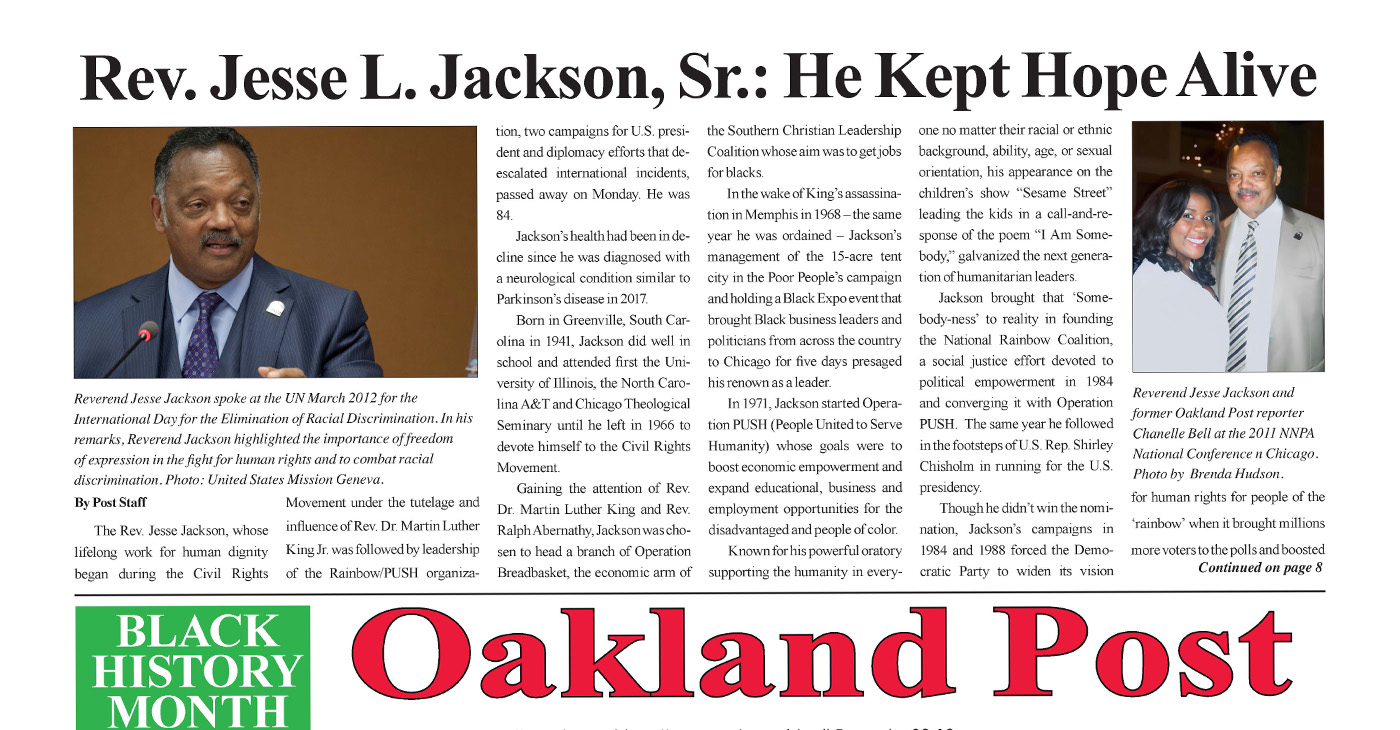
To enlarge your view of this issue, use the slider, magnifying glass icon or full page icon in the lower right corner of the browser window.
WORK FROM HOME
Home-based business with potential monthly income of $10K+ per month. A proven training system and website provided to maximize business effectiveness. Perfect job to earn side and primary income. Contact Lynne for more details: Lynne4npusa@gmail.com 800-334-0540


COMMENTARY: Women of Color Shape Our Past and Future

Woman’s Search for Family’s Roots Leads to Ancestor John T. Ward – A Successful Entrepreneur and Conductor on the Underground Railroad

Advocates Raise Alarm Over ICE Operation, MOU and Detention Risks in Baltimore County

Pete Buttigieg to Join Mayor Randall Woodfin for Community Town Hall in Birmingham

WATCH: Week One – NNPA’s “Leadership Matters” Video Series

Oakland Post: Week of March 4 – 10, 2026

OP-ED: NNPA Launches 2026 “Leadership Matters” Video Series

PRESS ROOM: PMG and Cranbrook Horizons-Upward Bound Launch Journey Fellowship Cohort 2

Los Angeles Summit Brings Together Leaders to Tackle Poverty and Affordability

Civil Rights TV Launches 24/7 Network Focused on Black History, Education and Equity

REVIEW: The Ultimate Hot Girl Summer Getaway: Sunseeker Resort Florida

COMMENTARY: How You Stop a Prescription Medicine is as Important as How You Start

PRESS ROOM: From Congress to Corporate America: NNPA Spotlights Visionaries in New Video Series

Poll Shows Support for Policies That Help Families Afford Child Care

Oakland Post: Week of February 25 – March 3, 2026

Oakland Post: Week of January 28, 2025 – February 3, 2026

Life Expectancy in Marin City, a Black Community, Is 15-17 Years Less than the Rest of Marin County

California Launches Study on Mileage Tax to Potentially Replace Gas Tax as Republicans Push Back

Community Celebrates Turner Group Construction Company as Collins Drive Becomes Turner Group Drive

Discrimination in City Contracts

Book Review: Books on Black History and Black Life for Kids

Oakland Post: Week of January 21 – 27, 2026

COMMENTARY: The Biases We Don’t See — Preventing AI-Driven Inequality in Health Care

Post Newspaper Invites NNPA to Join Nationwide Probate Reform Initiative

Black History Events in the East Bay

Medi-Cal Cares for You and Your Baby Every Step of the Way

Art of the African Diaspora Celebrates Legacy and Community at Richmond Art Center

COMMENTARY: The National Protest Must Be Accompanied with Our Votes

New Bill, the RIDER Safety Act, Would Support Transit Ambassadors and Safety on Public Transit

After Don Lemon’s Arrest, Black Officials Raise Concerns About Independent Black Media

Hyundai Ioniq 5 Parking, Safety, and 360 View #shorts

2025 Ioniq 5 New Wiper & Powerful Performance! #shorts

Electric SUV Range: Is 259 Miles Enough? #shorts

EV Charging: How Fast Can You Charge an Electric Vehicle? #shorts

Biometric Cooling… Messaging Seats…Come on! 2025 Infiniti QX80 Autograph 4WD

Charged Up: Witness the Magic of a Fully Electric Car! #shorts

Range Rover Sport PHEV Included…: See What’s Inside This Luxury SUV! #shorts

Invisible Hood View: Perfect Parking with X-Ray Vision! #shorts

AI Is Reshaping Black Healthcare: Promise, Peril, and the Push for Improved Results in California

ESSAY: Technology and Medicine, a Primary Care Point of View

Sanctuary Cities

The RESISTANCE – FREEDOM NOW

STATE OF THE PEOPLE: Freddie

ECONOMIC BOYCOTT DAY!!!!!

I told You So
-
 Business4 weeks ago
California Launches Study on Mileage Tax to Potentially Replace Gas Tax as Republicans Push Back
-
 Activism4 weeks ago
Community Celebrates Turner Group Construction Company as Collins Drive Becomes Turner Group Drive
-
 Activism4 weeks ago
Discrimination in City Contracts
-
 Arts and Culture4 weeks ago
Book Review: Books on Black History and Black Life for Kids
-
 Activism4 weeks ago
COMMENTARY: The Biases We Don’t See — Preventing AI-Driven Inequality in Health Care
-
 Activism4 weeks ago
Post Newspaper Invites NNPA to Join Nationwide Probate Reform Initiative
-
 #NNPA BlackPress4 weeks ago
COMMENTARY: The National Protest Must Be Accompanied with Our Votes
-
 Activism4 weeks ago
New Bill, the RIDER Safety Act, Would Support Transit Ambassadors and Safety on Public Transit
