
California Black Media
Elected Officials, Faith Leaders Join State Ed Chief Thurmond to Discuss Antisemitism Solutions
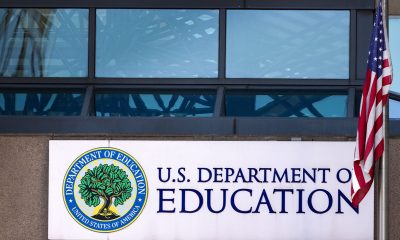
State Superintendent of Public Instruction Tony Thurmond organized a virtual roundtable discussion titled “Education to End Hate: Countering Antisemitism” that brought together about 350 attendees, including elected officials and faith leaders, according to the Department of Education (CDE).


By Joe W. Bowers Jr.
California Black Media
State Superintendent of Public Instruction Tony Thurmond organized a virtual roundtable discussion titled “Education to End Hate: Countering Antisemitism” that brought together about 350 attendees, including elected officials and faith leaders, according to the Department of Education (CDE).
The aim of the discussion, which was held Aug. 23, was to address the role of education in combating the recent increase in antisemitism.
Steve Zimmer, deputy superintendent of public instruction, moderated the discussion and cited statistics on the increase of antisemitism and hate crimes in California.
Antisemitism and other hate crimes have surged in California, rising by more than 20% last year. The main targets were Black, LGBTQ+ and Jewish people.
The Anti-Defamation League (ADL) reported that antisemitic hate crimes had increased by over 40% between 2021 and 2022, especially in Los Angeles, San Bernardino and Kern counties.
Thurmond is involved in initiatives related to Holocaust and genocide education, and he aims to utilize education to reduce acts of hate. He is co-chair of the Governor’s Council on Holocaust and Genocide Education along with Dr. Anita Friedman, executive director of Jewish Family and Children’s Services of San Francisco, the Peninsula, Marin and Sonoma counties; Sen. Henry Stern (D-Calabasas), and Attorney General Rob Bonta.
Thurmond has also partnered with the National Equity Project to help implement the $20 million Antibias Education Grant Program to empower educators and students in addressing hate, bigotry, and racism.
“I have pledged that the CDE will intervene whenever we learn about an antisemitic act or other forms of hate at a California public school,” said Thurmond.
He said he would work side-by-side with school and district leaders to ensure that teachers have the resources and partnerships needed to address both the immediate crisis and the long-term educational implications.
“My priority is to empower educators and students to confront the hate, bigotry, and racism rising against several communities in the state and nation,” said Thurmond.
Thurmond initiated the “Education to End Hate” series to tackle hate and racism through education. The next event in the series occurred on Sept. 12.
Several members of the Jewish Legislative Caucus, Senators Stern, Scott Wiener (D-San Francisco), and Josh Becker (D-Menlo Park) and Assemblymembers Laura Friedman (D-Burbank) and Jesse Gabriel (D-Encino), gave opening remarks for the roundtable.
The caucus members urged schools to adopt the Ethnic Studies Model Curriculum, which includes a unit on Jewish American studies, to foster understanding and appreciation of diverse cultures and identities.
“It is no secret if you are Jewish or if you have Jewish friends or interact with Jewish students or folks in the community, the tremendous levels of anxiety that our community is feeling at this moment [is] really unprecedented for my lifetime,” caucus co-chair Gabriel said.
Following the remarks from the Jewish legislators, a panel of Jewish community leaders presented different perspectives on the issue of antisemitism.
On the panel were Rabbi Meyer May, executive director of the Simon Wiesenthal Center and Museums of Tolerance; Dr. Friedman; and Sarah Levin, executive director of Jews Indigenous to the Middle East and North Africa.
The panel members discussed the rich history and multifaceted elements of Jewish identity, the rise in antisemitism across the political spectrum, the intersectionality of antisemitism with other forms of oppression, and the specific ways that education can play a role in countering antisemitism throughout the state.
They also identified important resources that teachers can use to address antisemitism and all forms of hate.
Rabbi May said that being Jewish means caring for the community and treating others with dignity: “Judaism for me is an all-encompassing experience … I have an equal responsibility every day to treat my fellow persons with human dignity. That should be the core value for every human being: that we treat others with human dignity and understand that everyone has the same basic needs, that they want to support their families, have joy, and pride in their families and perpetuate their culture.”
Friedman said that antisemitism affects not only Jews but American society, more broadly. She warned that it is a sign of something wrong that needs to be fixed.
“It’s a signal, like the canary in the coal mine, that something is not right and needs to be fixed,” Friedman said.
The state’s ethnic studies curriculum, which faced strong backlash when it was first released in 2019, was a recurring topic during the discussion.
Wiener said the first draft of the state’s ethnic studies curriculum, had “despicable” and “straight-up antisemitic” language.
He said Jewish groups lobbied to change the final version, but some districts are being pressed to use the old draft, which is illegal. He also said some authors responsible for antisemitic language in the curriculum are shopping their services as “liberated ethnic studies.”
In response to Wiener’s concern, Thurmond said he had sent many letters to districts reminding them of the legal limits of ethnic studies, which should not be antisemitic or use any unapproved version of the curriculum. He also urged anyone who witnessed antisemitism in schools to contact his office.
“We’d like to get that phone call,” Thurmond said.
A full recording of the webinar can be viewed on the CDE Facebook page.
This article was supported in whole or in part by funding provided by the State of California, administered by the California State Library.








Activism
2025 in Review: Seven Questions for Black Women’s Think Tank Founder Kellie Todd Griffin
As the president and CEO of the California Black Women’s Collective Empowerment Institute, Griffin is on a mission to shift the narrative and outcomes for Black women and girls. She founded the nation’s first Black Women’s Think Tank, securing $5 million in state funding to fuel policy change.

By Edward Henderson
California Black Media
With more than 25 years of experience spanning public affairs, community engagement, strategy, marketing, and communications, Kellie Todd Griffin is recognized across California as a leader who mobilizes people and policy around issues that matter.
As the president and CEO of the California Black Women’s Collective Empowerment Institute, Griffin is on a mission to shift the narrative and outcomes for Black women and girls. She founded the nation’s first Black Women’s Think Tank, securing $5 million in state funding to fuel policy change.
Griffin spoke with California Black Media (CBM) about her successes and setbacks in 2025 and her hopes for 2026.
Looking back at 2025, what stands out to you as your most important achievement and why?
Our greatest achievement in this year is we got an opportunity to honor the work of 35 Black women throughout California who are trailblazing the way for the next generation of leaders.
How did your leadership, efforts and investments as president and CEO California Black Women’s Collective Empowerment Institute contribute to improving the lives of Black Californians?
We’re training the next leaders. We have been able to train 35 women over a two-year period, and we’re about to start a new cohort of another 30 women. We also have trained over 500 middle and high school girls in leadership, advocacy, and financial literacy.
What frustrated you the most over the last year?
Getting the question, “why.” Why advocate for Black women? Why invest in Black people, Black communities? It’s always constantly having to explain that, although we are aware that there are other populations that are in great need, the quality-of-life indices for Black Californians continue to decrease. Our life expectancies are decreasing. Our unhoused population is increasing. Our health outcomes remain the worst.
We’re not asking anyone to choose one group to prioritize. We are saying, though, in addition to your investments into our immigrant brothers and sisters – or our religious brothers and sisters – we are also asking you to uplift the needs of Black Californians. That way, all of us can move forward together.
What inspired you the most over the last year?
I’ve always been amazed by the joy of Black women in the midst of crisis.
That is really our secret sauce. We don’t let the current state of any issue take our joy from us. It may break us a little bit. We may get tired a little bit. But we find ways to express that – through the arts, through music, through poetry.
What is one lesson you learned in 2025 that will inform your decision-making next year?
Reset. It’s so important not to be sitting still. We have a new administration. We’re seeing data showing that Black women have the largest unemployment rate. We’ve lost so many jobs. We can have rest – we can be restful – but we have to continue the resistance.
In one word, what is the biggest challenge Black Californians faced in 2025?
Motivation.
I choose motivation because of the tiredness. What is going to motivate us to be involved in 2026?
What is the goal you want to achieve most in 2026?
I want to get Black Californians in spaces and places of power and influence – as well as opportunities to thrive economically, socially, and physically.
Activism
Oakland Post: Week of December 10 – 16, 2025
The printed Weekly Edition of the Oakland Post: Week of – December 10 – 16, 2025

To enlarge your view of this issue, use the slider, magnifying glass icon or full page icon in the lower right corner of the browser window.
Activism
Oakland Post: Week of November 26 – December 2, 2025
The printed Weekly Edition of the Oakland Post: Week of November 26 – December 2, 2025
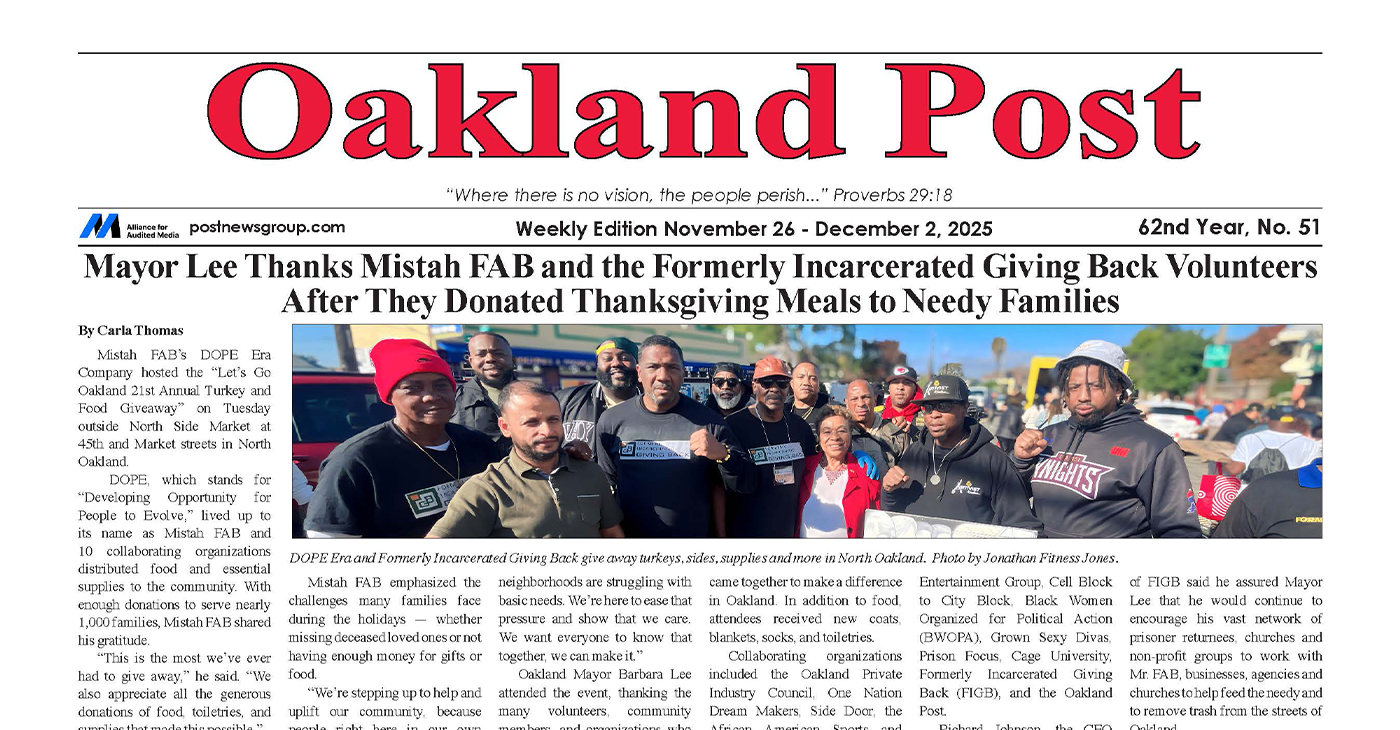
To enlarge your view of this issue, use the slider, magnifying glass icon or full page icon in the lower right corner of the browser window.


WORK FROM HOME
Home-based business with potential monthly income of $10K+ per month. A proven training system and website provided to maximize business effectiveness. Perfect job to earn side and primary income. Contact Lynne for more details: Lynne4npusa@gmail.com 800-334-0540


Support Your Child’s Mental Health: Medi-Cal Covers Therapy, Medication, and More

Ann Lowe: The Quiet Genius of American Couture

2025 in Review: Seven Questions for Black Women’s Think Tank Founder Kellie Todd Griffin

BRIDGE Housing President and CEO Ken Lombard Scores Top Honors for Affordable Housing Leadership

Oakland School Board Grapples with Potential $100 Million Shortfall Next Year

COMMENTARY: If You Don’t Want Your ‘Black Card’ Revoked, Watch What You Bring to Holiday Dinners

Mayor Lee, City Leaders Announce $334 Million Bond Sale for Affordable Housing, Roads, Park Renovations, Libraries and Senior Centers

Fayeth Gardens Holds 3rd Annual Kwanzaa Celebration at Hayward City Hall on Dec. 28

Post Salon to Discuss Proposal to Bring Costco to Oakland Community meeting to be held at City Hall, Thursday, Dec. 18

Oakland Post: Week of December 10 – 16, 2025

Seth Curry Makes Impressive Debut with the Golden State Warriors

A Nation in Freefall While the Powerful Feast: Trump Calls Affordability a ‘Con Job’

The Numbers Behind the Myth of the Hundred Million Dollar Contract

FBI Report Warns of Fear, Paralysis, And Political Turmoil Under Director Kash Patel

ACA Deadline Nears as 20 million Brace for Higher Health Costs

Oakland Post: Week of October 29 – November 4, 2025

Oakland Post: Week of November 5 – 11, 2025

Oakland Post: Week of November 12 – 18, 2025

IN MEMORIAM: William ‘Bill’ Patterson, 94

How Charles R. Drew University Navigated More Than $20 Million in Fed Cuts – Still Prioritizing Students and Community Health

No Justice in the Justice System

Oakland Post: Week of November 19 – 25, 2025

Beyoncé and Jay-Z make rare public appearance with Lewis Hamilton at Las Vegas Grand Prix

LIHEAP Funds Released After Weeks of Delay as States and the District Rush to Protect Households from the Cold

Lewis Hamilton set to start LAST in Saturday Night’s Las Vegas Grand Prix
Seth Curry Makes Impressive Debut with the Golden State Warriors

Oakland Post: Week of November 26 – December 2, 2025

Seven Steps to Help Your Child Build Meaningful Connections

Seven Steps to Help Your Child Build Meaningful Connections

Protecting Pedophiles: The GOP’s Warped Crusade Against Its Own Lies

Hyundai Ioniq 5 Parking, Safety, and 360 View #shorts

2025 Ioniq 5 New Wiper & Powerful Performance! #shorts

Electric SUV Range: Is 259 Miles Enough? #shorts

EV Charging: How Fast Can You Charge an Electric Vehicle? #shorts

Biometric Cooling… Messaging Seats…Come on! 2025 Infiniti QX80 Autograph 4WD

Charged Up: Witness the Magic of a Fully Electric Car! #shorts

Range Rover Sport PHEV Included…: See What’s Inside This Luxury SUV! #shorts

Invisible Hood View: Perfect Parking with X-Ray Vision! #shorts

AI Is Reshaping Black Healthcare: Promise, Peril, and the Push for Improved Results in California

ESSAY: Technology and Medicine, a Primary Care Point of View

Sanctuary Cities

The RESISTANCE – FREEDOM NOW

STATE OF THE PEOPLE: Freddie

ECONOMIC BOYCOTT DAY!!!!!

I told You So
-
 Activism4 weeks ago
IN MEMORIAM: William ‘Bill’ Patterson, 94
-
 Activism3 weeks ago
Oakland Post: Week of November 19 – 25, 2025
-
 #NNPA BlackPress3 weeks ago
Beyoncé and Jay-Z make rare public appearance with Lewis Hamilton at Las Vegas Grand Prix
-
 #NNPA BlackPress2 weeks ago
LIHEAP Funds Released After Weeks of Delay as States and the District Rush to Protect Households from the Cold
-
 #NNPA BlackPress4 weeks ago
Lewis Hamilton set to start LAST in Saturday Night’s Las Vegas Grand Prix
-
 Alameda County2 weeks ago
Seth Curry Makes Impressive Debut with the Golden State Warriors
-
 Activism3 weeks ago
Oakland Post: Week of November 26 – December 2, 2025
-
 #NNPA BlackPress2 weeks ago
Seven Steps to Help Your Child Build Meaningful Connections
