
California Black Media
Suicide Prevention Week: A Reminder of the Mental Health Crisis Confronting Black Californians
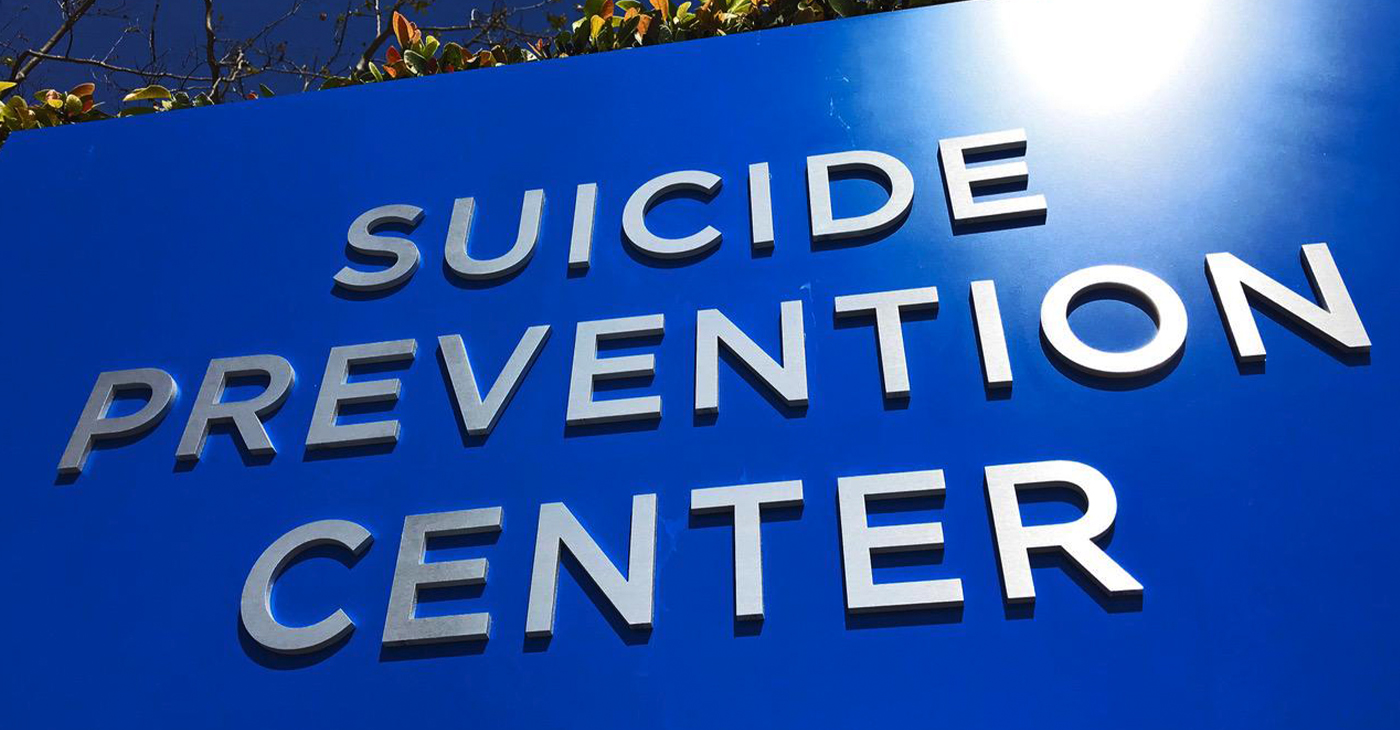
The conclusion of Suicide Prevention Week on Sept.16 served as a reminder, according to wellness advocates, of the ongoing mental health crisis faced by Black Californians. Between 2010 and 2019, Black Californians experienced a 31.1% increase in suicide deaths, according to the California Mental Health Services Oversight and Accountability Commission.

By Aldon Thomas Stiles
California Black Media
The conclusion of Suicide Prevention Week on Sept.16 served as a reminder, according to wellness advocates, of the ongoing mental health crisis faced by Black Californians.
Between 2010 and 2019, Black Californians experienced a 31.1% increase in suicide deaths, according to the California Mental Health Services Oversight and Accountability Commission.
The Center for Disease Control and Prevention (CDC) reported that between 2019 and 2020, non-Hispanic white people experienced a decrease in suicide rates by 4.5% while the rate for non-Hispanic Black people increased by 4%.
For Black men, the numbers are more dire. Over the last two decades, the suicide rate for Black men has increased by nearly 60%, according to the American Academy of Child and Adolescent Psychiatry.
Many of these suicides occur among people ages 10 to 24, prompting schools, colleges and universities to develop programs to reach out to young Black Californians dealing with mental health challenges.
The Claremont Colleges (TCC), a consortium of five private liberal arts colleges and two graduate schools located in Southern California, have implemented programs of their own.
“Across our campuses, we are continuously working to reduce or remove perceived barriers that may prevent people of color from getting services at a counseling center,” said TCC’s director of the Monsour Counseling and Psychological Services Center (MCAPS), Dr. Gary DeGroot.
DeGroot highlighted several internal obstacles, including a mistrust of treatment and therapy, a lack of confidence in the mental healthcare system’s ability to provide culturally competent care, and fear of stigma.
Dr. Adrienne Hilliard, senior staff psychologist at the Claremont Colleges, spoke about the stigma connected to treatment for mental health issues.
“I think as suicide and mental health stigma decreases, Black men are now more open to identify and report that they are in crisis and instead of silently suffering are now encouraged and willing to seek help,” said Hilliard.
She pointed to some external obstacles to seeking mental health treatment.
“Several institutional factors can contribute to the increase suicide rates for Black men: economic oppression, increased educational disparities, racism and racial trauma across all sectors, racial injustice witnessed with the recent increase in recorded murders of Black men by police and others, stigma surrounding manhood and mental illness,” said Hilliard.
Black Californians had the largest increase in firearm suicide rates since the start of the COVID-19 pandemic, according to a study by Injury Epidemiology.
However, TCC has seen an increase in the number of students participating in their mental health programs.
“More resources, specifically for Black folks are becoming readily available,” said Hilliard. “So, statistically there may be greater representation.”
Hilliard pointed to programs like Therapy for Black Men, Black Emotional and Mental Health Collective (BEAM), Black Mental Health Alliance, and The Boris Lawrence Henson Foundation.
DeGroot, who also works closely with the Office of Black Student Affairs (OBSA), stated that students respond positively to having access to Black therapists, connecting with Black organizations, and attending Black student events.
Hilliard spoke on the importance of a community-based approach to mental health care for Black students on their campuses.
“Although each campus has individual resources and services, we encourage a more community-oriented mindset when it comes to our students of color,” said Hilliard. “We understand that community is extremely important for Black students, so we maintain connections with faculty and staff across departments, such as counseling, student health, housing, etc., to ensure our students are supported on every front.




Activism
2025 in Review: Seven Questions for Black Women’s Think Tank Founder Kellie Todd Griffin
As the president and CEO of the California Black Women’s Collective Empowerment Institute, Griffin is on a mission to shift the narrative and outcomes for Black women and girls. She founded the nation’s first Black Women’s Think Tank, securing $5 million in state funding to fuel policy change.

By Edward Henderson
California Black Media
With more than 25 years of experience spanning public affairs, community engagement, strategy, marketing, and communications, Kellie Todd Griffin is recognized across California as a leader who mobilizes people and policy around issues that matter.
As the president and CEO of the California Black Women’s Collective Empowerment Institute, Griffin is on a mission to shift the narrative and outcomes for Black women and girls. She founded the nation’s first Black Women’s Think Tank, securing $5 million in state funding to fuel policy change.
Griffin spoke with California Black Media (CBM) about her successes and setbacks in 2025 and her hopes for 2026.
Looking back at 2025, what stands out to you as your most important achievement and why?
Our greatest achievement in this year is we got an opportunity to honor the work of 35 Black women throughout California who are trailblazing the way for the next generation of leaders.
How did your leadership, efforts and investments as president and CEO California Black Women’s Collective Empowerment Institute contribute to improving the lives of Black Californians?
We’re training the next leaders. We have been able to train 35 women over a two-year period, and we’re about to start a new cohort of another 30 women. We also have trained over 500 middle and high school girls in leadership, advocacy, and financial literacy.
What frustrated you the most over the last year?
Getting the question, “why.” Why advocate for Black women? Why invest in Black people, Black communities? It’s always constantly having to explain that, although we are aware that there are other populations that are in great need, the quality-of-life indices for Black Californians continue to decrease. Our life expectancies are decreasing. Our unhoused population is increasing. Our health outcomes remain the worst.
We’re not asking anyone to choose one group to prioritize. We are saying, though, in addition to your investments into our immigrant brothers and sisters – or our religious brothers and sisters – we are also asking you to uplift the needs of Black Californians. That way, all of us can move forward together.
What inspired you the most over the last year?
I’ve always been amazed by the joy of Black women in the midst of crisis.
That is really our secret sauce. We don’t let the current state of any issue take our joy from us. It may break us a little bit. We may get tired a little bit. But we find ways to express that – through the arts, through music, through poetry.
What is one lesson you learned in 2025 that will inform your decision-making next year?
Reset. It’s so important not to be sitting still. We have a new administration. We’re seeing data showing that Black women have the largest unemployment rate. We’ve lost so many jobs. We can have rest – we can be restful – but we have to continue the resistance.
In one word, what is the biggest challenge Black Californians faced in 2025?
Motivation.
I choose motivation because of the tiredness. What is going to motivate us to be involved in 2026?
What is the goal you want to achieve most in 2026?
I want to get Black Californians in spaces and places of power and influence – as well as opportunities to thrive economically, socially, and physically.
Activism
Oakland Post: Week of December 10 – 16, 2025
The printed Weekly Edition of the Oakland Post: Week of – December 10 – 16, 2025

To enlarge your view of this issue, use the slider, magnifying glass icon or full page icon in the lower right corner of the browser window.
Activism
Oakland Post: Week of November 26 – December 2, 2025
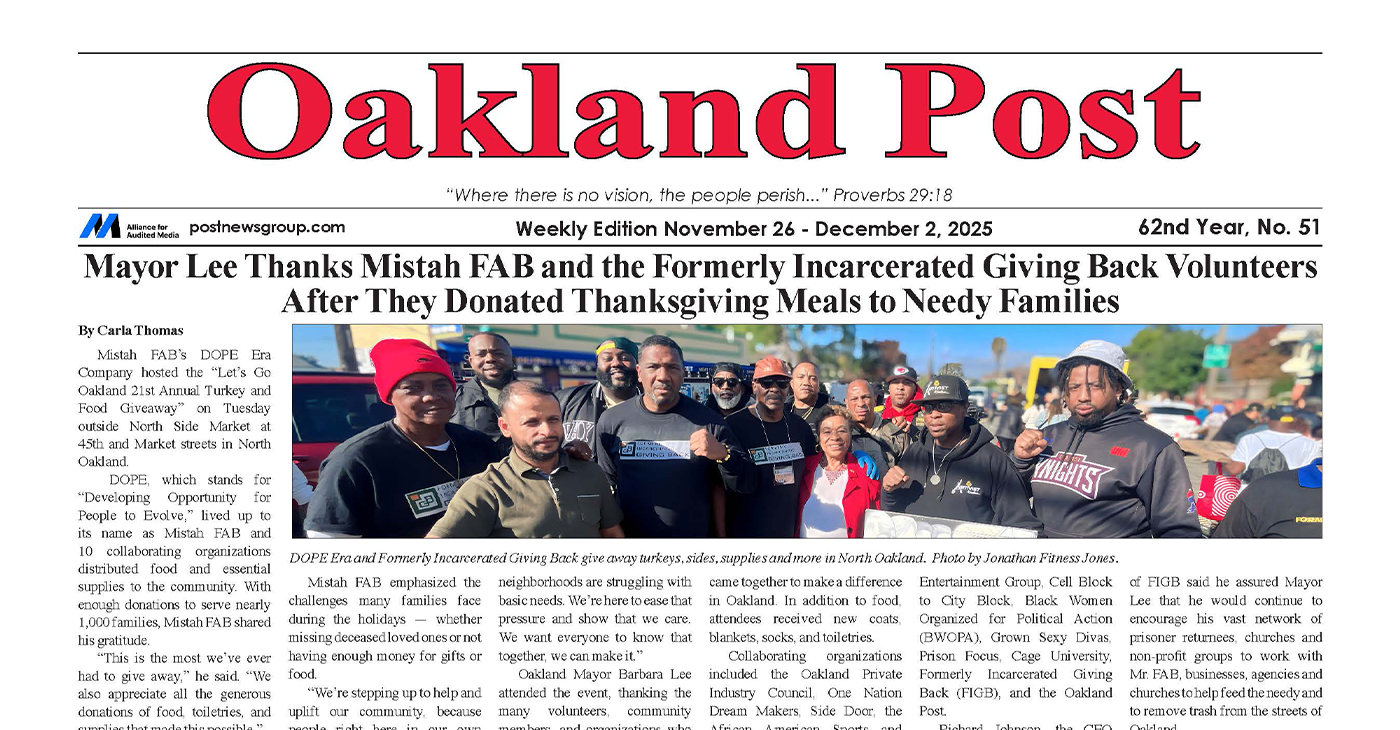
The printed Weekly Edition of the Oakland Post: Week of November 26 – December 2, 2025
To enlarge your view of this issue, use the slider, magnifying glass icon or full page icon in the lower right corner of the browser window.

WORK FROM HOME
Home-based business with potential monthly income of $10K+ per month. A proven training system and website provided to maximize business effectiveness. Perfect job to earn side and primary income. Contact Lynne for more details: Lynne4npusa@gmail.com 800-334-0540


Support Your Child’s Mental Health: Medi-Cal Covers Therapy, Medication, and More

Ann Lowe: The Quiet Genius of American Couture

2025 in Review: Seven Questions for Black Women’s Think Tank Founder Kellie Todd Griffin

BRIDGE Housing President and CEO Ken Lombard Scores Top Honors for Affordable Housing Leadership

Oakland School Board Grapples with Potential $100 Million Shortfall Next Year

COMMENTARY: If You Don’t Want Your ‘Black Card’ Revoked, Watch What You Bring to Holiday Dinners

Mayor Lee, City Leaders Announce $334 Million Bond Sale for Affordable Housing, Roads, Park Renovations, Libraries and Senior Centers

Fayeth Gardens Holds 3rd Annual Kwanzaa Celebration at Hayward City Hall on Dec. 28

Post Salon to Discuss Proposal to Bring Costco to Oakland Community meeting to be held at City Hall, Thursday, Dec. 18

Oakland Post: Week of December 10 – 16, 2025

Seth Curry Makes Impressive Debut with the Golden State Warriors

A Nation in Freefall While the Powerful Feast: Trump Calls Affordability a ‘Con Job’

The Numbers Behind the Myth of the Hundred Million Dollar Contract

FBI Report Warns of Fear, Paralysis, And Political Turmoil Under Director Kash Patel

ACA Deadline Nears as 20 million Brace for Higher Health Costs

Oakland Post: Week of October 29 – November 4, 2025

Oakland Post: Week of November 12 – 18, 2025

Oakland Post: Week of November 5 – 11, 2025

IN MEMORIAM: William ‘Bill’ Patterson, 94

How Charles R. Drew University Navigated More Than $20 Million in Fed Cuts – Still Prioritizing Students and Community Health

No Justice in the Justice System

Beyoncé and Jay-Z make rare public appearance with Lewis Hamilton at Las Vegas Grand Prix

Oakland Post: Week of November 19 – 25, 2025

Lewis Hamilton set to start LAST in Saturday Night’s Las Vegas Grand Prix

LIHEAP Funds Released After Weeks of Delay as States and the District Rush to Protect Households from the Cold
Seth Curry Makes Impressive Debut with the Golden State Warriors

Protecting Pedophiles: The GOP’s Warped Crusade Against Its Own Lies

The Perfumed Hand of Hypocrisy: Trump Hosted Former Terror Suspect While America Condemns a Muslim Mayor

Thanksgiving Celebrated Across the Tri-State

Trinidad and Tobago – Prime Minister Confirms U.S. Marines Working on Tobago Radar System

Hyundai Ioniq 5 Parking, Safety, and 360 View #shorts

2025 Ioniq 5 New Wiper & Powerful Performance! #shorts

Electric SUV Range: Is 259 Miles Enough? #shorts

EV Charging: How Fast Can You Charge an Electric Vehicle? #shorts

Biometric Cooling… Messaging Seats…Come on! 2025 Infiniti QX80 Autograph 4WD

Charged Up: Witness the Magic of a Fully Electric Car! #shorts

Range Rover Sport PHEV Included…: See What’s Inside This Luxury SUV! #shorts

Invisible Hood View: Perfect Parking with X-Ray Vision! #shorts

AI Is Reshaping Black Healthcare: Promise, Peril, and the Push for Improved Results in California

ESSAY: Technology and Medicine, a Primary Care Point of View

Sanctuary Cities

The RESISTANCE – FREEDOM NOW

STATE OF THE PEOPLE: Freddie

ECONOMIC BOYCOTT DAY!!!!!

I told You So
-
 Activism4 weeks ago
Oakland Post: Week of November 12 – 18, 2025
-
 Activism4 weeks ago
IN MEMORIAM: William ‘Bill’ Patterson, 94
-
 Activism4 weeks ago
How Charles R. Drew University Navigated More Than $20 Million in Fed Cuts – Still Prioritizing Students and Community Health
-
 Bay Area4 weeks ago
No Justice in the Justice System
-
 #NNPA BlackPress3 weeks ago
Beyoncé and Jay-Z make rare public appearance with Lewis Hamilton at Las Vegas Grand Prix
-
 Activism3 weeks ago
Oakland Post: Week of November 19 – 25, 2025
-
 #NNPA BlackPress3 weeks ago
Lewis Hamilton set to start LAST in Saturday Night’s Las Vegas Grand Prix
-
 #NNPA BlackPress2 weeks ago
LIHEAP Funds Released After Weeks of Delay as States and the District Rush to Protect Households from the Cold
