
Activism
Black Doctors March Shine Spotlight on Institutionalized Racism
The national kickoff for the not-for-profit organization Black Doc Village began with a breakfast at the Pasadena Hilton hosted by two Black Doc Village cofounders: nephrologist Vanessa Grubbs and educator and physician Aysha H. Khoury.

By Solomon O. Smith, California Black Media
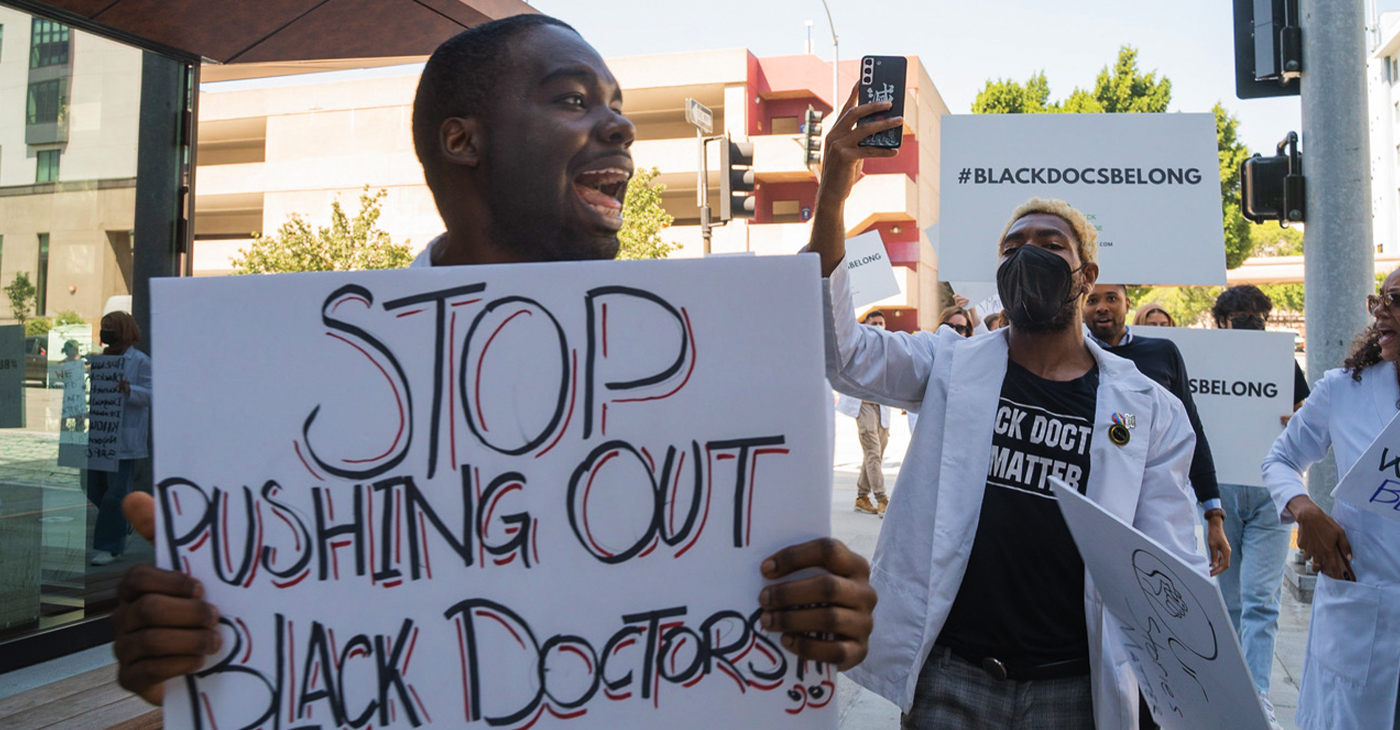
The #BlackDocsBelong campaign held a rally in Pasadena last Friday calling on Black medical doctors to join their movement dedicated to keeping and growing the ranks of Black physicians.
“We actively support and advocate for Black trainees and physicians facing workplace discrimination,” states the website of Black Doc Village, the group organizing the rally. “We aim to expand the Black physician workforce to improve health outcomes in the Black community.”
The national kickoff for the not-for-profit organization Black Doc Village began with a breakfast at the Pasadena Hilton hosted by two Black Doc Village cofounders: nephrologist Vanessa Grubbs and educator and physician Aysha H. Khoury.
About 100 young medical students and staff gathered to march to the Kaiser Permanente Bernard J. Tyson School of Medicine. A wide range of ethnicities came to provide support.
A student who chose to remain anonymous shared the contents of a message about the protest from the Kaiser School of Medicine:
“Students who choose to participate in the demonstration tomorrow will not be penalized or retaliated against for doing so,” reads an email by senior associate dean for student affairs Dr. Anne M. Eacker, “and absence from class or clinical sites tomorrow morning will be considered an excused absence.”
The Kaiser School of Medicine was named the 6th Most Diverse Medical School in the nation and ranked 2nd in California by U.S. News & World Report after the School of Medicine at the University of California Davis.
With handmade signs and white lab coats, the rally set off for a two-block march to the medical school. Walking in a single file line, the doctors raised their voices in a shouted call-and-response chant.
“Stop pushing,” they shouted followed by the comeback, “Black docs out.”
Black medical professionals from across the country came to support the Black Doc Village rally.
Dr. Robert Rock, who practices on the East Coast, says he was inspired to go into medicine by his grandmother and the strength she exhibited when she “refused to be disrespected” by medical professionals during her care. He witnessed a racist act aimed at a patient which he described as shocking.
“We were deterred from talking about it,” said Rock. “It was then that I lost my faith [in the system].”
Jessica Isom is a Boston-based psychiatrist and an advocate for equity and justice for BIPOC patients. She has been an outspoken resource and advisor in Diversity, Equity and Inclusion programs through her company Vision for Equality, which has worked with several major brands and medical institutions. She sees part of the issue as a flaw in the culture of medicine which makes changing it difficult.
Isom says resistance to change is “perpetuated through training” and that people may not be conscious that change is needed. She referred to an article written by Rhea W. Boyd, a pediatrician who has spoken before Congress about racism in the medical profession.
“People see it. The person who serves you your food looks like me. The person who provides you your medical care often does not, and that is an intentional process of segregation,” says Isom.
Doctors are not the only people who want more Black physicians and medical professionals in the industry. Robert Phillips was looking for a Black nephrologist, a doctor specializing in diseases and functions of the kidneys and found Dr. Grubbs. He felt ignored and unheard by white doctors.
Scores of studies show that health outcomes for African Americans have historically been among the lowest, according to various metrics. The Centers for Disease Control and Prevention (CDC) recently reported African Americans have the highest rate of infant mortality of any ethnic group. The number of Black doctors is also disproportionately low, at just 5 %, according to a 2019 survey by the Association of American Medical Colleges.
Some at the rally are in litigation against Kaiser, including Khoury. She is well-known for a viral thread on Twitter relating her story of how she was removed from Kaiser Medical School.
Kaiser has released a statement disputing Khoury’s claim.
“Regarding Dr. Aysha Khoury, one of the founders of the Black Doc Village organization, the school has been clear that Dr. Khoury was not placed on leave because she brought content related to anti-racism to the classroom or because she shared her experiences as a Black woman in medicine,” the Kaiser statement says.
Khoury and Grubbs say that issues with Kaiser are a small part of a bigger problem in the medical community and are hoping that their stories can be the jumping-off point for action.
“Kaiser is where we are today, but this is everywhere, not just there,” said Khoury. “This is why we need the whole village.”











Activism
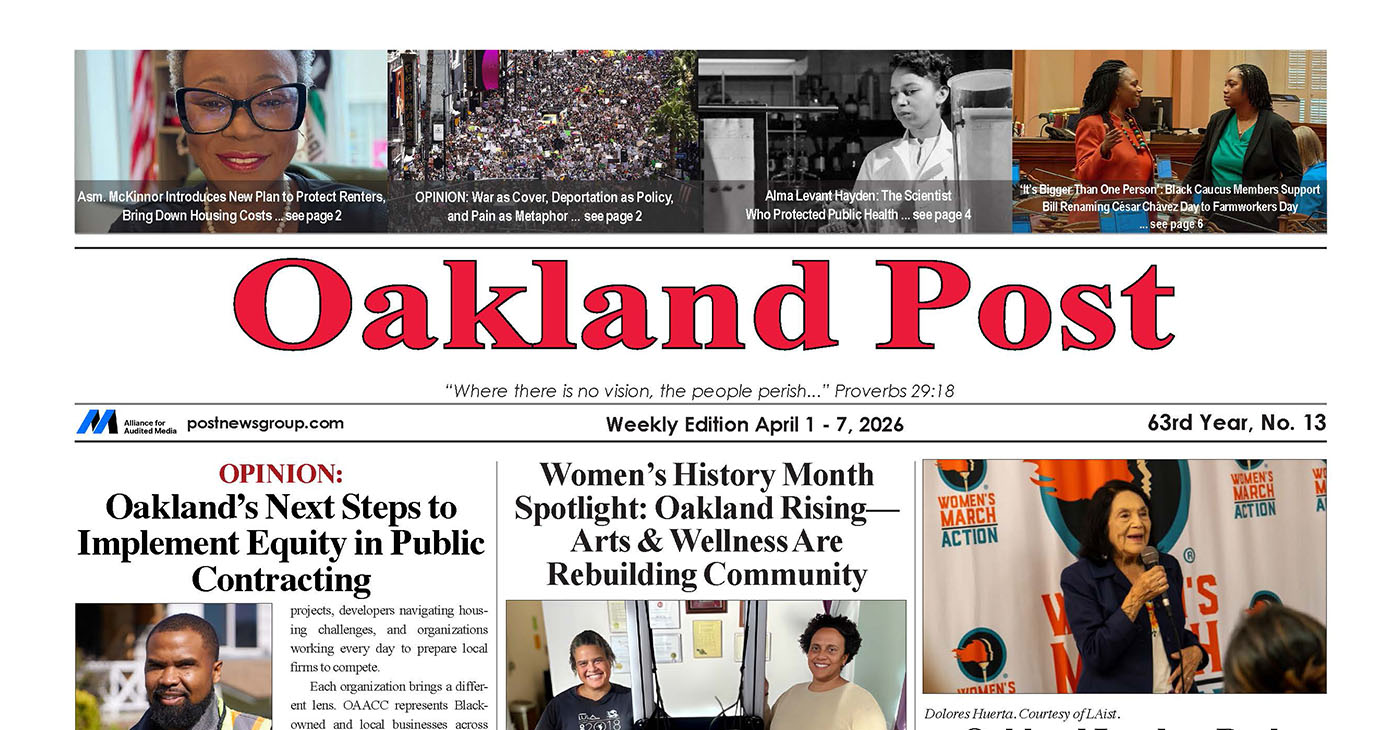
Oakland Post: Week of April 1 – 7, 2026
The printed Weekly Edition of the Oakland Post: Week of April 1 – 7, 2026
To enlarge your view of this issue, use the slider, magnifying glass icon or full page icon in the lower right corner of the browser window.
Activism
Oakland Post: Week of March 18 – 24, 2026
The printed Weekly Edition of the Oakland Post: Week of March 18 – 24, 2026

To enlarge your view of this issue, use the slider, magnifying glass icon or full page icon in the lower right corner of the browser window.
Activism
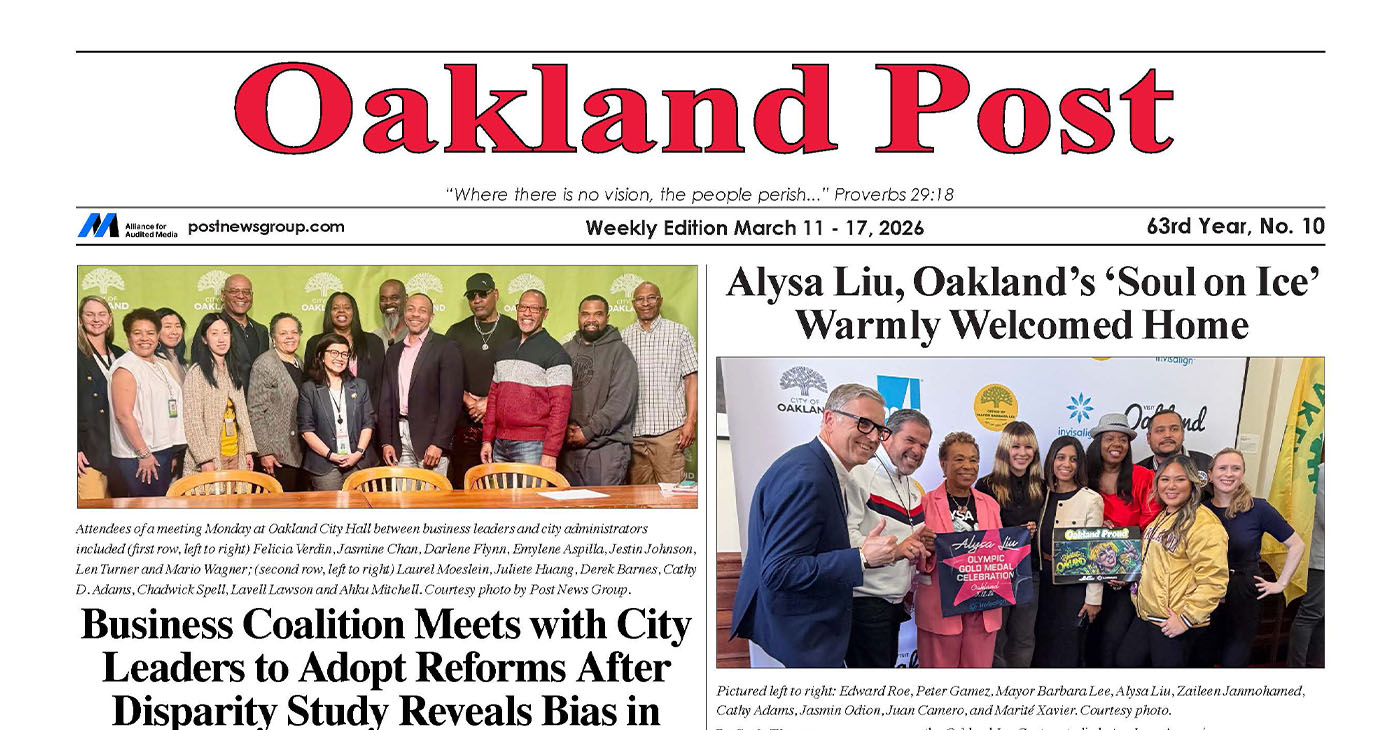
Oakland Post: Week of March 11 -17, 2026
The printed Weekly Edition of the Oakland Post: Week of March 11 – 17, 2026
To enlarge your view of this issue, use the slider, magnifying glass icon or full page icon in the lower right corner of the browser window.


WORK FROM HOME
Home-based business with potential monthly income of $10K+ per month. A proven training system and website provided to maximize business effectiveness. Perfect job to earn side and primary income. Contact Lynne for more details: Lynne4npusa@gmail.com 800-334-0540


Oakland Post: Week of April 1 – 7, 2026

Black Artists in America, Installation Three Wraps at the Dixon Gallery and Gardens

Grief, Advocacy, and Education: A Counselor Reflects on Black Maternal Health

Future of Florida’s Black History Museum in Limbo

New Research Shows the Many Benefits of Early Learning

South Hampton K-8 Students Among Top 10 Finalists for Samsung’s ‘Solve for Tomorrow’ Competition

Cuba: No Negotiation with US on the President or Political System

Brooklyn Academy of Music Names Jamaican-Born Tamara McCaw as President

Trinidad & Tobego – U.S. Launches WhatsApp Channel for American Citizens in the Country

Oakland Post: Week of March 18 – 24, 2026

AI Innovation vs. Ethics and Environmental Impact

AI, Web3, and Digital Reparations

What If You Owned Your AI Agent?

Season 7, Episode 3 – January Reporter’s Roundtable 📱

Season 7, Episode 3 – January Reporter’s Roundtable

Reflecting on Black History Milestones in Birmingham AL

Oakland Post: Week of February 25 – March 3, 2026

PRESS ROOM: NBA Hall of Fame Nominee Terry Cummings Joins 100 Black Men of DeKalb County to Launch Victory & Values Initiative

Trump’s MAGA Allies are Creating Executive Order Plan to Steal the 2026 Midterms

Oakland Post: Week of March 4 – 10, 2026

Chase Oakland Community Center Hosts Alley-Oop Accelerator Building Community and Opportunity for Bay Area Entrepreneurs

U.S. manufacturing rebounds – how foundry services are adapting to rising demand

Poll Shows Support for Policies That Help Families Afford Child Care

OP-ED: One Hundred Years of Black Workers Telling the Truth

Advancements in solar technology that are changing the way we power the world

Oakland Post: Week of March 11 -17, 2026

Woman’s Search for Family’s Roots Leads to Ancestor John T. Ward – A Successful Entrepreneur and Conductor on the Underground Railroad

COMMENTARY: Women of Color Shape Our Past and Future

PRESS ROOM: Civil Rights TV Launches in Selma as the World’s First 24/7 Civil Rights Television Network
Oakland Post: Week of March 18 – 24, 2026

Hyundai Ioniq 5 Parking, Safety, and 360 View #shorts

2025 Ioniq 5 New Wiper & Powerful Performance! #shorts

Electric SUV Range: Is 259 Miles Enough? #shorts

EV Charging: How Fast Can You Charge an Electric Vehicle? #shorts

Biometric Cooling… Messaging Seats…Come on! 2025 Infiniti QX80 Autograph 4WD

Charged Up: Witness the Magic of a Fully Electric Car! #shorts

Range Rover Sport PHEV Included…: See What’s Inside This Luxury SUV! #shorts

Invisible Hood View: Perfect Parking with X-Ray Vision! #shorts

AI Is Reshaping Black Healthcare: Promise, Peril, and the Push for Improved Results in California

ESSAY: Technology and Medicine, a Primary Care Point of View

Sanctuary Cities

The RESISTANCE – FREEDOM NOW

STATE OF THE PEOPLE: Freddie

ECONOMIC BOYCOTT DAY!!!!!

I told You So
-
 Activism3 weeks ago
Oakland Post: Week of March 11 -17, 2026
-
 #NNPA BlackPress4 weeks ago
Woman’s Search for Family’s Roots Leads to Ancestor John T. Ward – A Successful Entrepreneur and Conductor on the Underground Railroad
-
 #NNPA BlackPress4 weeks ago
COMMENTARY: Women of Color Shape Our Past and Future
-
 Activism2 weeks ago
Oakland Post: Week of March 18 – 24, 2026
-

 Advice3 weeks ago
Financial Wellness and Mental Health: Managing Money Stress in College
-

 #NNPA BlackPress4 weeks ago
Advocates Raise Alarm Over ICE Operation, MOU and Detention Risks in Baltimore County
-

 #NNPA BlackPress4 weeks ago
Pete Buttigieg to Join Mayor Randall Woodfin for Community Town Hall in Birmingham
-
 #NNPA BlackPress2 weeks ago
Brooklyn Academy of Music Names Jamaican-Born Tamara McCaw as President
