
California Black Media
Bullying in California: In Some School Districts, Black Students are Targeted by Their Latino Peers
On Feb. 16, 2022, a Black student in the Santa Barbara Unified School District was assaulted by Latino students. His attackers called him the N-word and kneeled on his neck while repeatedly chanting the name “George Floyd.” A district-wide acknowledgment of the hate crime was sent six days later. Despite the psychological trauma this student experienced, the school did little to provide him with mental health support.


By Edward Henderson
California Black Media
On Feb. 16, 2022, a Black student in the Santa Barbara Unified School District was assaulted by Latino students. His attackers called him the N-word and kneeled on his neck while repeatedly chanting the name “George Floyd.” A district-wide acknowledgment of the hate crime was sent six days later.
Despite the psychological trauma this student experienced, the school did little to provide him with mental health support.
Connie Alexander-Boaitey, the president of the Santa Barbara branch of the NAACP, says African Americans are often minimized in her city due to being the smallest demographic group.
Alexander-Boaitey spoke during an Oct. 27 news briefing hosted by Ethnic Media Services on school bullying.
She was joined by Becky L. Monroe, the deputy director of strategic initiatives and external affairs at the California Civil Rights Department; Dashka Slater, an award-winning journalist and author who has written books about child bullying victims; and Mina Fedor, a young Asian American activist who founded the organization AAPI Youth Rising.
Alexander-Boaitey said the hate crimes and incidents affecting children are all connected to “generational pain” for Black Americans. Primarily, there is “a pervasive calling of the N-word by young Latino students,” she said. “It’s every day. It’s weekly.”
She said that a Black family in Santa Barbara now walks their child to school to protect her from bullying classmates, and another has pulled their daughter out of the school system completely, opting for homeschooling.
The Santa Barbara Unified School District commissioned a survey titled “2023 Anti-Blackness and Racial Climate Assessment and Analysis” that proposed a set of recommendations for addressing the problem.
The hate incidents targeting African American children are increasing across California, according to the NAACP. These incidents, often involving physical violence and verbal abuse, are more frequent as Black families relocate to predominantly Latino neighborhoods.
In Santa Barbara, African Americans make up only 2% of the population but account for the most victims of bullying and hate crimes in the area. At 47.5%, Latinos make up the majority of Santa Barbara’s population followed by white people at 43.5%. According to the local NAACP branch, most of the perpetrators of the bullying and hate crimes are Latino children.
Alexander-Boaitey says she believes the hate incidents are rooted in historic racism and connected to a general desire to make Black people invisible — expressed through one racially oppressed group pushing out another in an attempt to get closer to whiteness.
According to Dashka Slater, 3 in 4 Americans of ages 15 to 25 have run into extremist content online. One in four students between the ages of 12 and 18 have seen hateful graffiti in their schools. About 1.3 million students were bullied because of some aspect of their identity during the 2018-2019 school year, and half of those children were targeted because of their race.
“Some forms of bullying are, in fact, acts of hate,” said Monroe. “Some acts of hate are crimes, while others are violations of other civil rights laws. Some may be lawful but incredibly harmful, nonetheless. We must recognize the civil rights issues at the heart of this discussion around bullying.”
Monroe also spoke about the state law requiring schools to provide all students with a safe environment free of harassment.
“Schools have a legal obligation to ensure that students are not denied opportunities, treated differently, discriminated against, or harassed because of their race, color, national origin, gender, gender identity, sexual orientation, religion, or disability,” she said.
Studies have shown that students who perpetuate racially motivated bullying don’t necessarily ascribe to racist ideologies but are simply influenced by outside sources or mirroring behavior from their parents or guardians at home.
Alexander-Boaitey says Black and Latino leaders and residents from the area have not formally met yet to resolve tensions brewing between their communities.
“I know this is where the struggle really is,” she added. “We have to actually sit down and have our own conversations. Has it happened? No, it has not happened … What supports it not happening is the erasure culture that says, no, we don’t really need to talk about that, oh, it was just a single incident.”
The state of California provides resources for victims of hate crimes or incidents. Victims or witnesses can report a hate crime or incident https://stophate.calcivilrights.ca.gov/s/
They can also call 833-8-NO-HATE; (833) 866-4283 Monday-Friday from 9 a.m.-6 p.m. or call 211.
This California Black Media report was supported in whole or in part by funding provided by the State of California, administered by the California State Library.













Activism
Oakland Post: Week of April 1 – 7, 2026
The printed Weekly Edition of the Oakland Post: Week of April 1 – 7, 2026
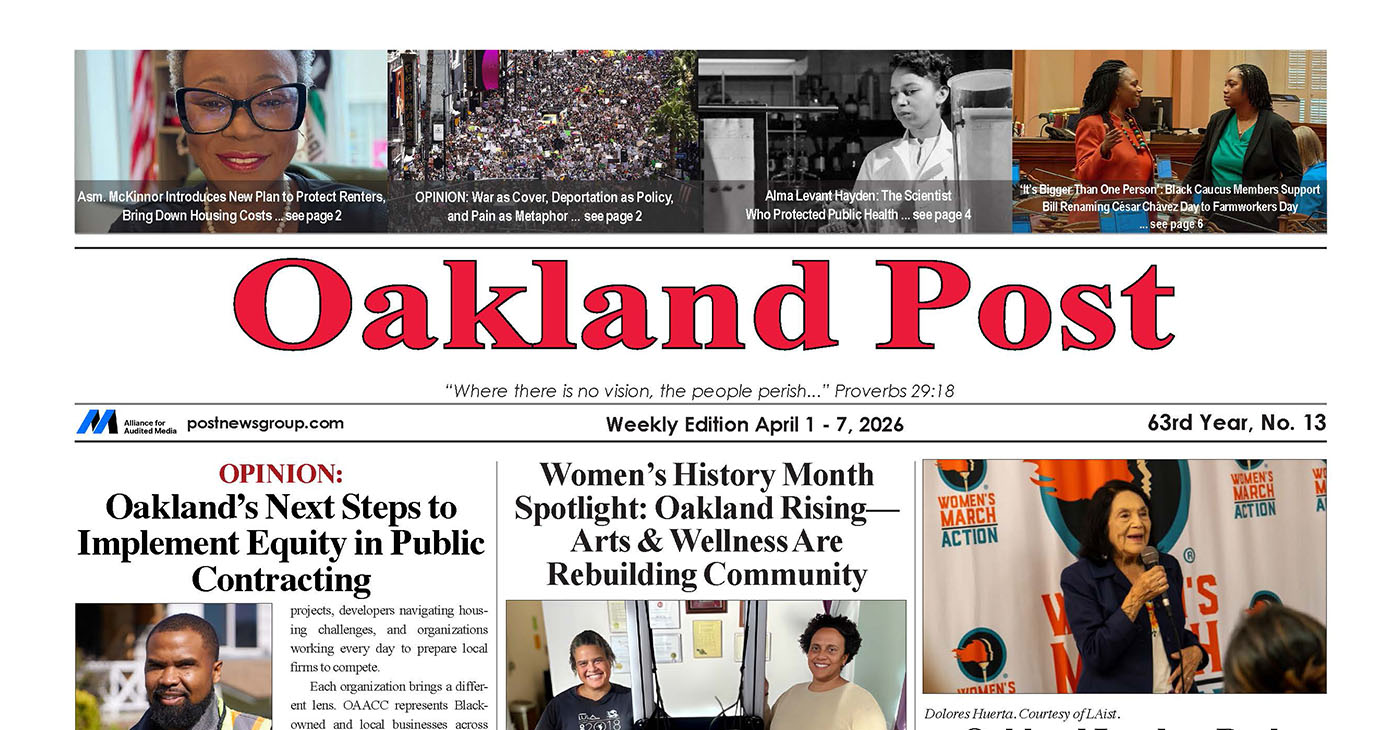
To enlarge your view of this issue, use the slider, magnifying glass icon or full page icon in the lower right corner of the browser window.
Activism
Oakland Post: Week of March 18 – 24, 2026
The printed Weekly Edition of the Oakland Post: Week of March 18 – 24, 2026

To enlarge your view of this issue, use the slider, magnifying glass icon or full page icon in the lower right corner of the browser window.
Activism
Oakland Post: Week of March 11 -17, 2026
The printed Weekly Edition of the Oakland Post: Week of March 11 – 17, 2026
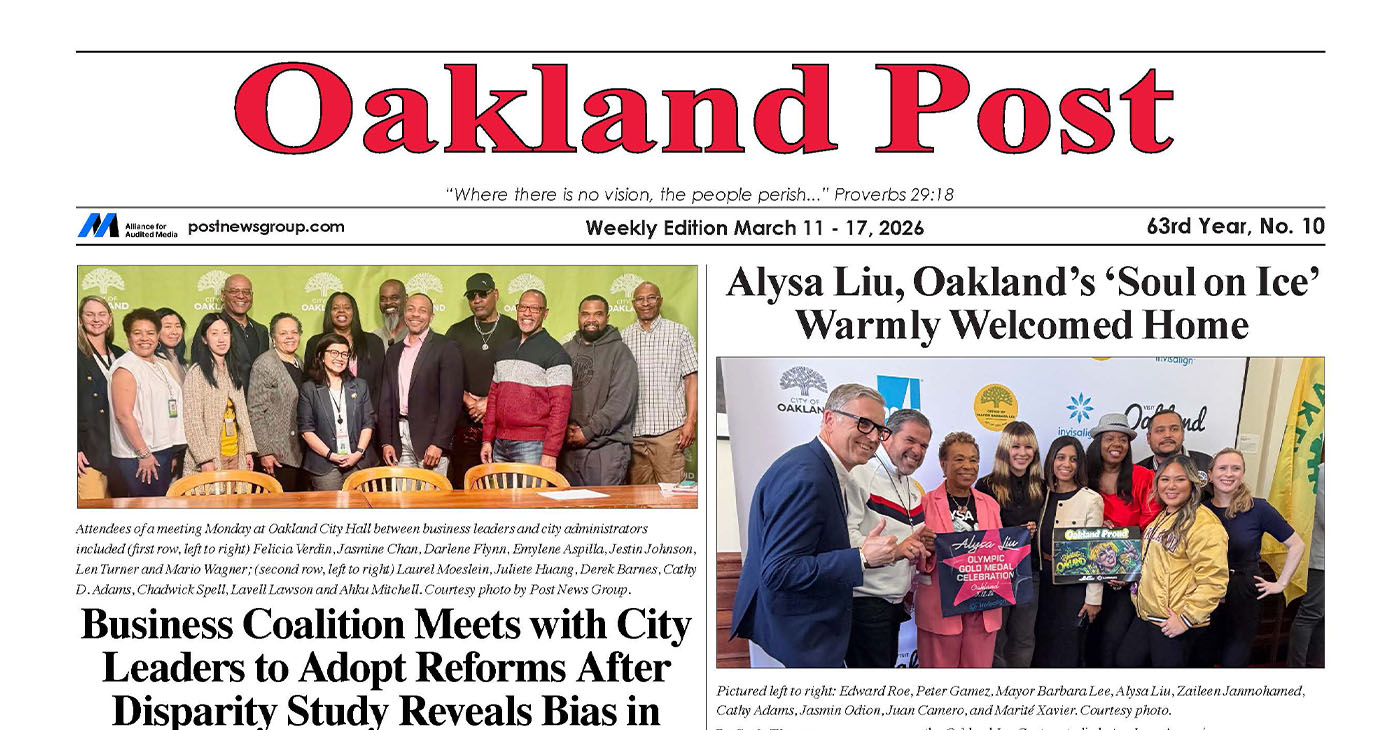
To enlarge your view of this issue, use the slider, magnifying glass icon or full page icon in the lower right corner of the browser window.

WORK FROM HOME
Home-based business with potential monthly income of $10K+ per month. A proven training system and website provided to maximize business effectiveness. Perfect job to earn side and primary income. Contact Lynne for more details: Lynne4npusa@gmail.com 800-334-0540


Oakland Post: Week of April 1 – 7, 2026

Black Artists in America, Installation Three Wraps at the Dixon Gallery and Gardens

Grief, Advocacy, and Education: A Counselor Reflects on Black Maternal Health

Future of Florida’s Black History Museum in Limbo

New Research Shows the Many Benefits of Early Learning

South Hampton K-8 Students Among Top 10 Finalists for Samsung’s ‘Solve for Tomorrow’ Competition

Cuba: No Negotiation with US on the President or Political System

Brooklyn Academy of Music Names Jamaican-Born Tamara McCaw as President

Trinidad & Tobego – U.S. Launches WhatsApp Channel for American Citizens in the Country

Oakland Post: Week of March 18 – 24, 2026

AI Innovation vs. Ethics and Environmental Impact

AI, Web3, and Digital Reparations

What If You Owned Your AI Agent?

Season 7, Episode 3 – January Reporter’s Roundtable 📱

Season 7, Episode 3 – January Reporter’s Roundtable

Reflecting on Black History Milestones in Birmingham AL

Oakland Post: Week of February 25 – March 3, 2026

PRESS ROOM: NBA Hall of Fame Nominee Terry Cummings Joins 100 Black Men of DeKalb County to Launch Victory & Values Initiative

Oakland Post: Week of March 4 – 10, 2026

Trump’s MAGA Allies are Creating Executive Order Plan to Steal the 2026 Midterms

U.S. manufacturing rebounds – how foundry services are adapting to rising demand

Poll Shows Support for Policies That Help Families Afford Child Care

OP-ED: One Hundred Years of Black Workers Telling the Truth

Oakland Post: Week of March 11 -17, 2026

Advancements in solar technology that are changing the way we power the world
Oakland Post: Week of March 18 – 24, 2026

Woman’s Search for Family’s Roots Leads to Ancestor John T. Ward – A Successful Entrepreneur and Conductor on the Underground Railroad

COMMENTARY: Women of Color Shape Our Past and Future

PRESS ROOM: Civil Rights TV Launches in Selma as the World’s First 24/7 Civil Rights Television Network

Financial Wellness and Mental Health: Managing Money Stress in College

Hyundai Ioniq 5 Parking, Safety, and 360 View #shorts

2025 Ioniq 5 New Wiper & Powerful Performance! #shorts

Electric SUV Range: Is 259 Miles Enough? #shorts

EV Charging: How Fast Can You Charge an Electric Vehicle? #shorts

Biometric Cooling… Messaging Seats…Come on! 2025 Infiniti QX80 Autograph 4WD

Charged Up: Witness the Magic of a Fully Electric Car! #shorts

Range Rover Sport PHEV Included…: See What’s Inside This Luxury SUV! #shorts

Invisible Hood View: Perfect Parking with X-Ray Vision! #shorts

AI Is Reshaping Black Healthcare: Promise, Peril, and the Push for Improved Results in California

ESSAY: Technology and Medicine, a Primary Care Point of View

Sanctuary Cities

The RESISTANCE – FREEDOM NOW

STATE OF THE PEOPLE: Freddie

ECONOMIC BOYCOTT DAY!!!!!

I told You So

-
 Activism3 weeks ago
Oakland Post: Week of March 11 -17, 2026
-
 Activism2 weeks ago
Oakland Post: Week of March 18 – 24, 2026
-
 #NNPA BlackPress4 weeks ago
Woman’s Search for Family’s Roots Leads to Ancestor John T. Ward – A Successful Entrepreneur and Conductor on the Underground Railroad
-
 #NNPA BlackPress4 weeks ago
COMMENTARY: Women of Color Shape Our Past and Future
-
 Advice3 weeks ago
Financial Wellness and Mental Health: Managing Money Stress in College
-

 #NNPA BlackPress4 weeks ago
Advocates Raise Alarm Over ICE Operation, MOU and Detention Risks in Baltimore County
-

 #NNPA BlackPress4 weeks ago
Pete Buttigieg to Join Mayor Randall Woodfin for Community Town Hall in Birmingham
-
 #NNPA BlackPress2 weeks ago
Brooklyn Academy of Music Names Jamaican-Born Tamara McCaw as President
