
Politics
Court Ruling Spurs Backers’ Hopes for Redistricting Changes


New interns run with a decision across the plaza of the Supreme Court in Washington, Monday June 29, 2015. On Monday, the court upheld Arizona congressional districts drawn by an independent commission and rejected a constitutional challenge from Republican lawmakers and upheld the use of a controversial drug in lethal injection executions Monday, as two dissenting justices said for the first time that they think it’s “highly likely” that the death penalty itself is unconstitutional. (AP Photo/Jacquelyn Martin)
ALAN FRAM, Associated Press
WASHINGTON (AP) — Groups hoping to squeeze partisan politics out of how states shape congressional districts are hailing a Supreme Court decision that lets independent commissions, not legislatures, draw those lines.
But Republicans say Monday’s 5-4 decision upholding Arizona’s independent redistricting commission will have little nationwide impact. And history shows that past efforts to persuade voters to change how states shape districts have had mixed results.
Proponents of shifting redistricting from state legislatures to independent bodies say they’ll rely in part on the same technique Arizona used: Initiatives, which let voters put questions on the ballot, usually after gathering signatures on petitions.
“The current system allows politicians to choose their voters, rather than allowing voters to choose their elected officials,” said Lloyd Leonard, advocacy director for the League of Women Voters, which filed a brief backing the commission.
From 1904 to 2001, there were 39 statewide ballot initiatives on how legislative boundaries are configured, and the voters have approved only 15, according data from the Initiative and Referendum Institute at the University of Southern California law school. Most addressed state legislative lines.
That underscores the difficulty of approving those changes and how infrequently such questions come before voters. Twenty-four states allow ballot initiatives, according to the institute.
While that opens the door for many states to consider redistricting commissions, “That door wasn’t exactly swinging wildly before this case came up,” said Thomas Mann, a congressional scholar at the liberal-leaning Brookings Institution who submitted a brief supporting commissions.
On Tuesday, the Supreme Court agreed to hear a new case in coming months on whether the drawing of state legislative lines by Arizona’s redistricting commission was constitutional.
With the GOP’s current House majority aided by its domination of congressional line-drawing in many states, some Republicans conceded that reducing that power could hurt them but would be hard for opponents to achieve.
“It’s a sweeping decision that lays the groundwork, but the work still has to be done” by advocates of independent commissions, said GOP strategist Sean Noble. “And whether they have the time, money or will has yet to be determined.”
Others doubted that commissions would actually remove partisanship from the once-a-decade process of shaping congressional districts.
The commissions “could be used to shield or really cover what is actually the same partisan politics,” said Michael T. Morley, attorney for the conservative Coolidge-Reagan Foundation, which wrote a brief opposing the Arizona commission.
Kathay Feng, national redistricting director for the liberal Common Cause, said efforts to use initiatives to alter how district boundaries are drawn are under way in Illinois, Michigan and Ohio. In three other states, supporters are working through the legislature: Indiana, Maryland and North Carolina, she said.
House Speaker John Boehner, R-Ohio, “believes redistricting decisions are best made by the people’s representatives in state legislatures — not by some unelected, unaccountable board of bureaucrats,” said Boehner press secretary Olivia Hnat.
House Minority Leader Nancy Pelosi, D-Calif., backed the court decision and said Congress should set standards so state redistricting commissions “reflect the diversity of their states and communities.”
In Monday’s ruling, the justices rejected a challenge by Arizona’s Republican-led legislature to the state’s independent commission, which voters established by ballot initiative in 2000.
The legislators argued that the Constitution reserves the power to draw district lines to state legislatures, not a commission created by initiative. That argument was rejected by the court’s four liberal justices plus Anthony Kennedy, a frequent swing voter.
“The invention of the initiative was in full harmony with the Constitution’s conception of the people as the font of governmental power,” Justice Ruth Bader Ginsburg wrote.
Led by Chief Justice John Roberts, the dissenters said the majority relied on “disconnected observations about direct democracy, a contorted interpretation of an irrelevant statute and naked appeals to public policy.”
The decision left the status quo intact for Arizona and 12 other states that have commissions with varying roles in drawing congressional lines.
Overall, Republicans have a 246-188 House majority, plus a vacancy in one GOP-leaning district.
Analysts attribute part of that advantage to Democrats’ concentration in dense urban areas. But it also reflects district lines Republicans drew after making major gains in 2010 state elections. In 2012, GOP House candidates got 1.4 million fewer votes than Democrats but won a 33-seat majority.
The GOP controls the governorship and legislature of 24 states, including Nebraska’s officially nonpartisan legislature. Seven states are run by Democrats and 19 are split, according to the National Conference of State Legislatures.
Copyright 2015 The Associated Press. All rights reserved. This material may not be published, broadcast, rewritten or redistributed.










Business
OP-ED: Proposition 44 Would Put a Price on Trust
The danger in Proposition 44 is not only its 90 percent figure. It is that the meaning of “qualifying” spending will be worked out later. A clinic preparing a budget today may not know whether a navigator, health educator, transportation program, outreach worker, technology upgrade, or other patient-support service will be counted the way it expects. Yet the financial consequence of getting it wrong could be immediate.



Business
OP-ED: Proposition 40: It’s Time to Play Chess, Not Checkers
Proposition 40 would impose a one-time 5 percent tax on the wealth of Californians with more than $1 billion in assets. Most of that money would go toward health care, with the remainder supporting food assistance and education-related programs.

Activism
Oakland Post: Week of September 30 – October 6, 2026
The printed Weekly Edition of the Oakland Post: Week of September 30 – October 6, 2026
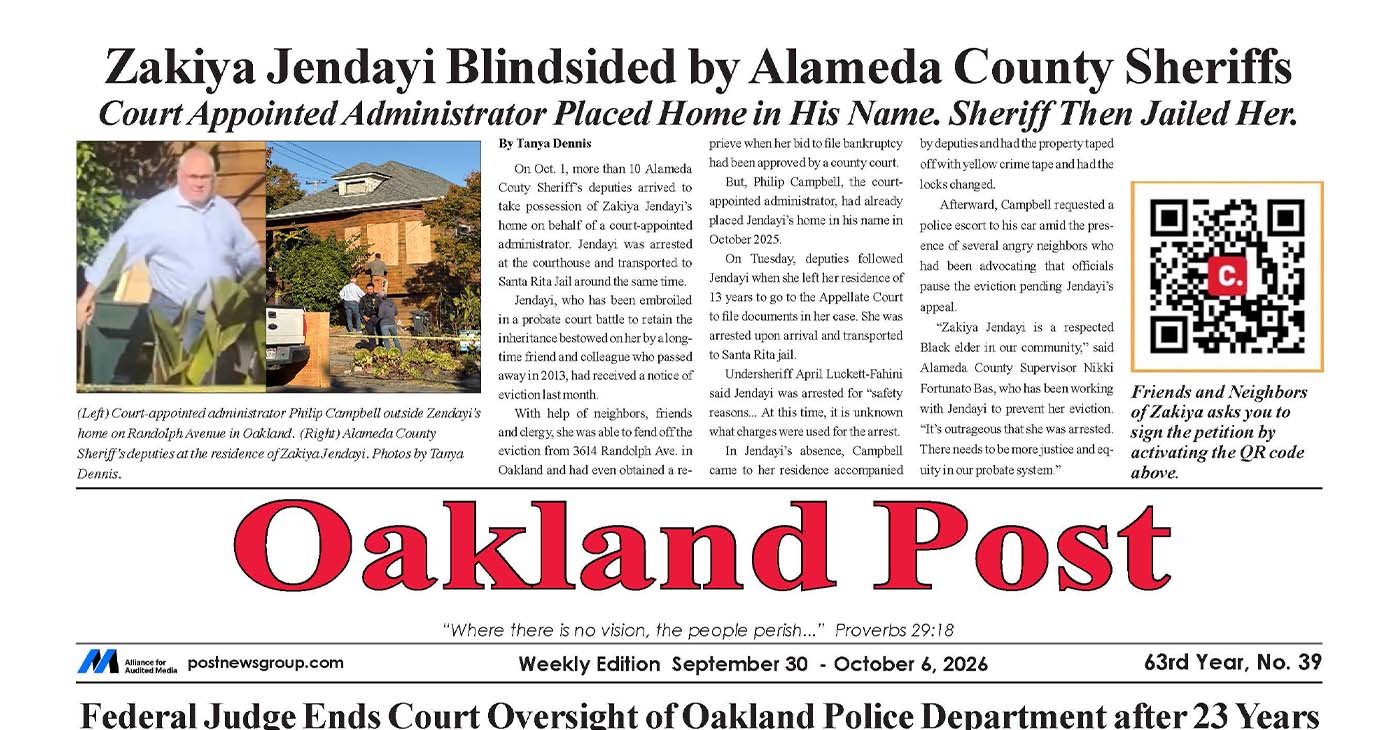
To enlarge your view of this issue, use the slider, magnifying glass icon or full page icon in the lower right corner of the browser window.


OP-ED: Proposition 44 Would Put a Price on Trust

OP-ED: Proposition 40: It’s Time to Play Chess, Not Checkers

Listening as a Lifeline: A Doula’s Witness to Black Maternal Health

New Protections for Ticket Buyers: Gov. Newsom Signs Assemblymember Isaac Bryan’s Bill

‘We Don’t Talk Trash — We Pick Up Trash!’

Zakiya Jendayi Arrested, Locked Out of Home by Sheriff’s Deputies

Oakland Post: Week of September 30 – October 6, 2026

Asm. Corey Jackson Announces Launch of 24-Hour Childcare in His District

IN MEMORIAM: The Rev. Leon “Sonny” Clark, Longtime Orange County Pastor and Community Leader, Dies at 72

Poll: Becerra Widens His Lead Over Hilton; Californians Split on Wealth Tax

From Historic Memories to New Possibilities: Oakland Celebrates Coliseum 60

County Office of Education Says OUSD Finances Are Getting Healthier, Materially Stronger

LIVE FREE Sunday Dinner Brings Faith, Fellowship and Civic Conversation to Oakland

Remembering Chauncey Bailey as Student Journalists Face Threats to Truth-Telling

BLACspace Cooperative Invites Bay Area to Experience Oakland’s Black Cultural Ecosystem Through a BLAC Map Tour + Party

Standoff for Justice: Our Homes Are Worth Fighting For

Oakland Post: Week of August 26 – September 1, 2026

Frontier Airlines’ Return to Oakland Airport Brings Flights, Jobs and Opportunity

Gubernatorial Candidate Steve Hilton Blasts California New Tire Rules; Newsom Hits Back

Jackie Wright Champions Bay Area Stories, Filmmakers and Cultural Institutions

Chef Sharon Lee Blends Culinary Excellence, Education and Empowerment

Misnamed ‘Parent’ PAC Seeks to Influence Oakland School Board Elections

Oakland Coliseum Project Opens Door for Small Businesses to Build Bigger

Gov. Newsom’s Latest Appointees Include Sacramento Advocate for Formerly Incarcerated Students; State’s New Tech Chief

Big City Mayors Ask for “Yes” Vote on Housing Bond Measure; Conservatives Say “No”

Longtime BWOPA Member Brendalyn Goodall Appointed to California Workforce Development Board

Oakland Post: Week of September 2 – 8, 2026

Gov. Newsom Signs Law Shielding Immigration Aid Workers From Doxing Threats

Secretary of State Shirley N. Weber Urges Californians to Vote Early as Voter ID Battle Intensifies

Oakland Post: Week of September 9 – 15, 2026

The Conversation With Al McFarlane 6/23/26

Media Monday 6/22/26

LIVE! ASK ALMA! — TUES. 6.23.26 7PM EST

Car Buying Secrets: 4 Hidden Checks Before You Sign!

Is This 550 HP Charger Worth YOUR Money? AutoNetwork Review

Celebrating Juneteenth – Frederick Douglass on education and resistance

LIVE! — ASK ALMA! — TUES. 6.19.26 7PM EST

Hyundai Ioniq 5 Parking, Safety, and 360 View #shorts

2025 Ioniq 5 New Wiper & Powerful Performance! #shorts

Electric SUV Range: Is 259 Miles Enough? #shorts

EV Charging: How Fast Can You Charge an Electric Vehicle? #shorts

Biometric Cooling… Messaging Seats…Come on! 2025 Infiniti QX80 Autograph 4WD

Charged Up: Witness the Magic of a Fully Electric Car! #shorts

Range Rover Sport PHEV Included…: See What’s Inside This Luxury SUV! #shorts

Invisible Hood View: Perfect Parking with X-Ray Vision! #shorts
-
 Community4 weeks ago
Misnamed ‘Parent’ PAC Seeks to Influence Oakland School Board Elections
-
 Activism4 weeks ago
Oakland Post: Week of September 9 – 15, 2026
-

 Community4 weeks ago
Richmond Tiny House Village Farm & Garden Set to Open Gates on Sept. 26
-

 Black History4 weeks ago
Latest Massacre in Haiti Reveals Cruelty U.S. Deportations
-

 Black History4 weeks ago
OPINION: Nolan Wells’ Death One of Several Signifying Racial Terror Lives on in U.S. South
-

 Business3 weeks ago
Mayor Lee Announces $1 Million Kaiser Permanente Grant for Pilot Program to Address Homelessness, Clean Up Public Spaces throughout Oakland
-

 Community4 weeks ago
Democratic Clubs Interview Candidates for Oakland School Board
-
 Economy2 weeks ago
Poll: Becerra Widens His Lead Over Hilton; Californians Split on Wealth Tax
