
Featured
Ending the HIV Epidemic in the African American Community


By Barbara Lee
Today, we celebrate National Black HIV/AIDS Awareness Day and reflect on the tremendous strides we have made in the fight against HIV since the epidemic first began. We are making progress towards an AIDS-free generation, but our work is far from over. To achieve this goal, we need to do more to address the unequal burden of this epidemic on the African American community.
Despite increased awareness campaigns and prevention efforts, African Americans are overrepresented in new transmissions.
According to the Center for Disease Control, black, gay, and bisexual men account for the highest number of new HIV diagnoses. Black gay men are at the highest risk of any population – research indicates that one in two will be diagnosed with HIV during their lifetime.
Black women are also disproportionately affected by HIV. The HIV diagnosis rate remains at a staggering 16 times that of white women, and five times the rate of Latinas. And the sad reality is that African Americans living with HIV not only have to bear the weight of HIV/AIDS stigma, but also racism.
Rather than treat these sobering statistics as a foregone conclusion, we should see them as a call to action. If we work together, we can change these numbers – and save lives.
If we are serious about ending the epidemic, we must work from a culturally sensitive framework to reduce disparities in access to education, testing and treatment.
We must honestly acknowledge the impacts of institutional and structural racism in healthcare, which is a major barrier to care in the African American community.
We must openly discuss the persistent impacts of societal and cultural stigma around HIV and AIDS. In order to provide quality preventative care, we need to change the outdated culture of fear and discrimination around the virus.
We need to ensure that students – in all classrooms – are taught comprehensive sex education, so that young people can take charge of their health from day one.
We must ensure resources are allocated to the communities with the highest need.
And, finally, we must recognize the inherent dignity of every human being. That includes the right of all people – regardless of race, zip code, or income – to have quality health care at an affordable price.
As advocates, we must leave no stone unturned and also recognize that our efforts must not end at our borders.
That is why I have worked with my colleagues on both sides of the aisle, including President George W. Bush, to craft the President’s Emergency Plan for AIDS Relief (PEPFAR) which has saved millions of lives around the world.
We have blazed a trail forward, but President Trump is trying to roll back this progress.
Instead of advancing the National HIV/AIDS Strategy, President Trump has dismissed the President’s Advisory Council on HIV/AIIDS (PACHA) and failed to appoint a new director for the Office on National AIDS Policy. These actions have crippled our response to the crisis and sent a worrying signal to experts, activists and patients.
Coupled with the Trump Budget, which proposed one billion dollars in cuts to HIV funding, many are rightly questioning whether the Trump Administration is trying to undermine decades of bipartisan efforts to end the HIV/AIDS epidemic.
As co-founder and co-chair of the bipartisan Congressional HIV/AIDS Caucus, I recently wrote to President Trump urging him to continue our longstanding commitment against the epidemic – but my letter has been met with silence.
We cannot allow inaction and stonewalling from this administration undermine the progress we have made over the past two decades. People are living long, happy lives with HIV – but they deserve a commitment from their government to end this epidemic.
I will continue to hold this administration accountable. I will not allow us to return to the days when the AIDS epidemic was willfully ignored by our government. And I will not be silent as people of color – and especially African Americans – bear the brunt of this public health crisis.
We can make an AIDS-free generation a reality, but we cannot leave anyone behind in the process.





Activism
Oakland Post: Week of December 24 – 30, 2025
The printed Weekly Edition of the Oakland Post: Week of – December 24 – 30, 2025

To enlarge your view of this issue, use the slider, magnifying glass icon or full page icon in the lower right corner of the browser window.
Alameda County
Bling It On: Holiday Lights Brighten Dark Nights All Around the Bay
On the block where I grew up in the 1960s, it was an unwritten agreement among the owners of those row homes to put up holiday lights: around the front window and door, along the porch banister, etc. Some put the Christmas tree in the window, and you could see it through the open slats of the blinds.
By Wanda Ravernell
I have always liked Christmas lights.
From my desk at my front window, I feel a quiet joy when the lights on the house across the street come on just as night falls.
On the block where I grew up in the 1960s, it was an unwritten agreement among the owners of those row homes to put up holiday lights: around the front window and door, along the porch banister, etc. Some put the Christmas tree in the window, and you could see it through the open slats of the blinds.
My father, the renegade of the block, made no effort with lights, so my mother hung a wreath with two bells in the window. Just enough to let you know someone was at home.
Two doors down was a different story. Mr. King, the overachiever of the block, went all out for Christmas: The tree in the window, the lights along the roof and a Santa on his sleigh on the porch roof.
There are a few ‘Mr. Kings’ in my neighborhood.
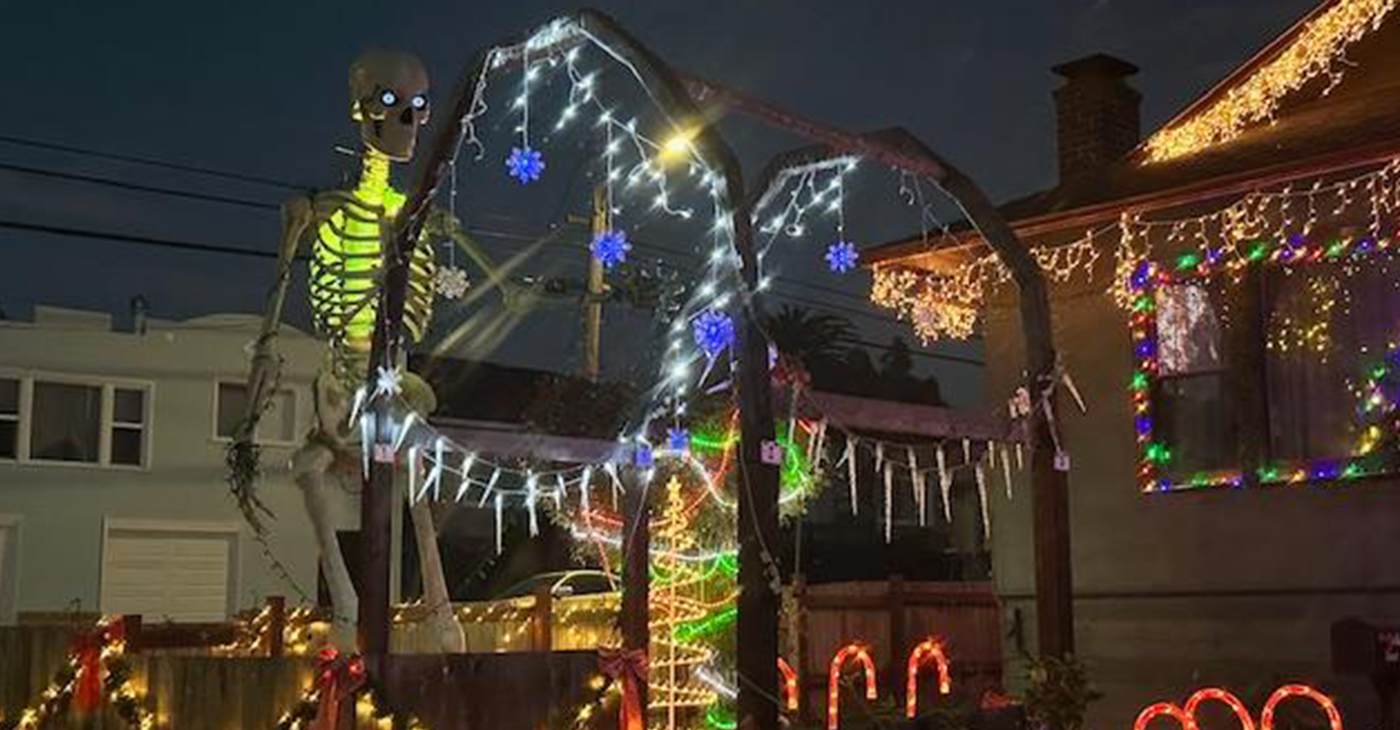
In particular is the gentleman down the street. For Halloween, they erected a 10-foot skeleton in the yard, placed ‘shrunken heads’ on fence poles, pumpkins on steps and swooping bat wings from the porch roof. They have not held back for Christmas.
The skeleton stayed up this year, this time swathed in lights, as is every other inch of the house front. It is a light show that rivals the one in the old Wanamaker’s department store in Philadelphia.
I would hate to see their light bill…
As the shortest day of the year approaches, make Mr. King’s spirit happy and get out and see the lights in your own neighborhood, shopping plazas and merchant areas.
Here are some places recommended by 510 Families and Johnny FunCheap.
Oakland
Oakland’s Temple Hill Holiday Lights and Gardens is the place to go for a drive-by or a leisurely stroll for a religious holiday experience. Wear a jacket, because it’s chilly outside the Church of Jesus Christ of Latter-day Saints, at 4220 Lincoln Ave., particularly after dark. The gardens are open all day from 9 a.m. to 9 p.m. with the lights on from dusk until closing.
Alameda
Just across the High Street Bridge from Oakland, you’ll find Christmas Tree Lane in Alameda.
On Thompson Avenue between High Street and Fernside drive, displays range from classic trees and blow-ups to a comedic response to the film “The Nightmare Before Christmas.” Lights turn on at dusk and can be seen through the first week in January.
Berkeley
The Fourth Street business district from University Avenue to Virginia Street in Berkeley comes alive with lights beginning at 5 p.m. through Jan. 1, 2026.
There’s also a display at one house at 928 Arlington St., and, for children, the Tilden Park Carousel Winter Wonderland runs through Jan. 4, 2026. Closed Christmas Day. For more information and tickets, call (510) 559-1004.
Richmond
The Sundar Shadi Holiday Display, featuring a recreation of the town of Bethlehem with life-size figures, is open through Dec. 26 at 7501 Moeser Lane in El Cerrito.
Marin County
In Marin, the go-to spot for ‘oohs and ahhs’ is the Holiday Light Spectacular from 4-9 p.m. through Jan. 4, 2026, at Marin Center Fairgrounds at 10 Ave of the Flags in San Rafael through Jan. 4. Displays dazzle, with lighted walkways and activities almost daily. For more info, go to: www.marincounty.gov/departments/cultural-services/department-sponsored-events/holiday-light-spectacular
The arches at Marin County Civic Center at 3501 Civic Center Dr. will also be illuminated nightly.
San Francisco
Look for light installations in Golden Gate Park, chocolate and cheer at Ghirardelli Square, and downtown, the ice rink in Union Square and the holiday tree in Civic Center Plaza are enchanting spots day and night. For neighborhoods, you can’t beat the streets in Noe Valley, Pacific Heights, and Bernal Heights. For glee and over-the-top glitz there’s the Castro, particularly at 68 Castro Street.
Livermore
The winner of the 2024 Great Light Flight award, Deacon Dave has set up his display with a group of creative volunteers at 352 Hillcrest Avenue since 1982. See it through Jan. 1, 2026. For more info, go to https://www.casadelpomba.com
Fremont
Crippsmas Place is a community of over 90 decorated homes with candy canes passed out nightly through Dec. 31. A tradition since 1967, the event features visits by Mr. and Mrs. Claus on Dec. 18 and Dec. 23 and entertainment by the Tri-M Honor Society at 6 p.m. on Dec. 22. Chrippsmas Place is located on: Cripps Place, Asquith Place, Nicolet Court, Wellington Place, Perkins Street, and the stretch of Nicolet Avenue between Gibraltar Drive and Perkins Street.
Alameda County
Oakland Council Expands Citywide Security Cameras Despite Major Opposition
In a 7-1 vote in favor of the contract, with only District 3 Councilmember Carroll Fife voting no, the Council agreed to maintain its existing network of 291 cameras and add 40 new “pan-tilt-zoom cameras.”

By Post Staff
The Oakland City Council this week approved a $2.25 million contract with Flock Safety for a mass surveillance network of hundreds of security cameras to track vehicles in the city.
In a 7-1 vote in favor of the contract, with only District 3 Councilmember Carroll Fife voting no, the Council agreed to maintain its existing network of 291 cameras and add 40 new “pan-tilt-zoom cameras.”
In recent weeks hundreds of local residents have spoken against the camera system, raising concerns that data will be shared with immigration authorities and other federal agencies at a time when mass surveillance is growing across the country with little regard for individual rights.
The Flock network, supported by the Oakland Police Department, has the backing of residents and councilmembers who see it as an important tool to protect public safety.
“This system makes the Department more efficient as it allows for information related to disruptive/violent criminal activities to be captured … and allows for precise and focused enforcement,” OPD wrote in its proposal to City Council.
According to OPD, police made 232 arrests using data from Flock cameras between July 2024 and November of this year.
Based on the data, police say they recovered 68 guns, and utilizing the countywide system, they have found 1,100 stolen vehicles.
However, Flock’s cameras cast a wide net. The company’s cameras in Oakland last month captured license plate numbers and other information from about 1.4 million vehicles.
Speaking at Tuesday’s Council meeting, Fife was critical of her colleagues for signing a contract with a company that has been in the national spotlight for sharing data with federal agencies.
Flock’s cameras – which are automated license plate readers – have been used in tracking people who have had abortions, monitoring protesters, and aiding in deportation roundups.
“I don’t know how we get up and have several press conferences talking about how we are supportive of a sanctuary city status but then use a vendor that has been shown to have a direct relationship with (the U.S.) Border Control,” she said. “It doesn’t make sense to me.”
Several councilmembers who voted in favor of the contract said they supported the deal as long as some safeguards were written into the Council’s resolution.
“We’re not aiming for perfection,” said District 1 Councilmember Zac Unger. “This is not Orwellian facial recognition technology — that’s prohibited in Oakland. The road forward here is to add as many amendments as we can.”
Amendments passed by the Council prohibit OPD from sharing camera data with any other agencies for the purpose of “criminalizing reproductive or gender affirming healthcare” or for federal immigration enforcement. California state law also prohibits the sharing of license plate reader data with the federal government, and because Oakland’s sanctuary city status, OPD is not allowed to cooperate with immigration authorities.
A former member of Oakland’s Privacy Advisory Commission has sued OPD, alleging that it has violated its own rules around data sharing.
So far, OPD has shared Flock data with 50 other law enforcement agencies.


WORK FROM HOME
Home-based business with potential monthly income of $10K+ per month. A proven training system and website provided to maximize business effectiveness. Perfect job to earn side and primary income. Contact Lynne for more details: Lynne4npusa@gmail.com 800-334-0540


Oakland Post: Week of December 24 – 30, 2025

Bling It On: Holiday Lights Brighten Dark Nights All Around the Bay

Oakland Council Expands Citywide Security Cameras Despite Major Opposition

Lu Lu’s House is Not Just Toying Around with the Community

Desmond Gumbs — Visionary Founder, Mentor, and Builder of Opportunity

Families Across the U.S. Are Facing an ‘Affordability Crisis,’ Says United Way Bay Area

Black Arts Movement Business District Named New Cultural District in California
Oakland Post: Week of December 17 – 23, 2025

Support Your Child’s Mental Health: Medi-Cal Covers Therapy, Medication, and More

Ann Lowe: The Quiet Genius of American Couture

2025 in Review: Seven Questions for Black Women’s Think Tank Founder Kellie Todd Griffin

BRIDGE Housing President and CEO Ken Lombard Scores Top Honors for Affordable Housing Leadership

Oakland School Board Grapples with Potential $100 Million Shortfall Next Year

COMMENTARY: If You Don’t Want Your ‘Black Card’ Revoked, Watch What You Bring to Holiday Dinners

Mayor Lee, City Leaders Announce $334 Million Bond Sale for Affordable Housing, Roads, Park Renovations, Libraries and Senior Centers

Oakland Post: Week of November 12 – 18, 2025

IN MEMORIAM: William ‘Bill’ Patterson, 94

How Charles R. Drew University Navigated More Than $20 Million in Fed Cuts – Still Prioritizing Students and Community Health

No Justice in the Justice System

Oakland Post: Week of November 19 – 25, 2025

LIHEAP Funds Released After Weeks of Delay as States and the District Rush to Protect Households from the Cold

Oakland Post: Week of November 26 – December 2, 2025

Seth Curry Makes Impressive Debut with the Golden State Warriors

Seven Steps to Help Your Child Build Meaningful Connections

Beyoncé and Jay-Z make rare public appearance with Lewis Hamilton at Las Vegas Grand Prix

Seven Steps to Help Your Child Build Meaningful Connections

Lewis Hamilton set to start LAST in Saturday Night’s Las Vegas Grand Prix

The Perfumed Hand of Hypocrisy: Trump Hosted Former Terror Suspect While America Condemns a Muslim Mayor

Trinidad and Tobago – Prime Minister Confirms U.S. Marines Working on Tobago Radar System

Thanksgiving Celebrated Across the Tri-State

Hyundai Ioniq 5 Parking, Safety, and 360 View #shorts

2025 Ioniq 5 New Wiper & Powerful Performance! #shorts

Electric SUV Range: Is 259 Miles Enough? #shorts

EV Charging: How Fast Can You Charge an Electric Vehicle? #shorts

Biometric Cooling… Messaging Seats…Come on! 2025 Infiniti QX80 Autograph 4WD

Charged Up: Witness the Magic of a Fully Electric Car! #shorts

Range Rover Sport PHEV Included…: See What’s Inside This Luxury SUV! #shorts

Invisible Hood View: Perfect Parking with X-Ray Vision! #shorts

AI Is Reshaping Black Healthcare: Promise, Peril, and the Push for Improved Results in California

ESSAY: Technology and Medicine, a Primary Care Point of View

Sanctuary Cities

The RESISTANCE – FREEDOM NOW

STATE OF THE PEOPLE: Freddie

ECONOMIC BOYCOTT DAY!!!!!

I told You So
-
 #NNPA BlackPress4 weeks ago
LIHEAP Funds Released After Weeks of Delay as States and the District Rush to Protect Households from the Cold
-
 Alameda County4 weeks ago
Seth Curry Makes Impressive Debut with the Golden State Warriors
-
 #NNPA BlackPress4 weeks ago
Seven Steps to Help Your Child Build Meaningful Connections
-
 #NNPA BlackPress4 weeks ago
Seven Steps to Help Your Child Build Meaningful Connections
-
 #NNPA BlackPress4 weeks ago
Trinidad and Tobago – Prime Minister Confirms U.S. Marines Working on Tobago Radar System
-
 #NNPA BlackPress4 weeks ago
Thanksgiving Celebrated Across the Tri-State
-

 #NNPA BlackPress4 weeks ago
Teens Reject Today’s News as Trump Intensifies His Assault on the Press
-

 #NNPA BlackPress4 weeks ago
Breaking the Silence: Black Veterans Speak Out on PTSD and the Path to Recovery
