
Activism
Ending Months of Public Speculation, Barbara Lee Launches Campaign for Mayor of Oakland
In an exclusive interview Wednesday afternoon at the offices of the Oakland Post, Lee spoke about how she came to the decision to run for mayor in the April 15 special election. She also discussed some of her priorities, including defense of human rights of immigrants.


By Ken Epstein
Part 1
“I’ve never shied away from a challenge – I’m always ready to fight for Oakland,” said outgoing Congresswoman Barbara Lee, kicking off her campaign this week to become the next mayor of Oakland, speaking with characteristic optimism.
In an exclusive interview Wednesday afternoon at the offices of the Oakland Post, Lee spoke about how she came to the decision to run for mayor in the April 15 special election. She also discussed some of her priorities, including defense of human rights of immigrants.
“As mayor, I’ll address our homelessness crisis, prioritize comprehensive public safety and mental health services, and lead with fiscal responsibility to deliver the core City services residents and business owners deserve,” she said in her campaign announcement.
In reaching her decision to run, Lee said, “The process was actually doing a deep dive (talking) with many different people, organizations, constituencies here in Oakland, with the business community, with labor, with activists, with nonprofits, with ordinary folks who are just trying to survive on a daily basis.
“It has been and will continue to be a good process primarily of listening and listening for the common threads, because I believe that this city – and I love this city – has had such a great history of working together and being unified, even though we disagree on a lot, but in challenging times, we come together,” she said.
“I (will) be a mayor who is hands-on and helping find solutions. We can’t make big promises, naturally, but I certainly can say we’re all going to try and move forward together.”
Looking at public safety concerns, she said, “People want to feel safe in their neighborhoods and wherever they are, but they also want to see that we’re preventing violence. We (need) a comprehensive strategy.
“I think the city is moving toward and has a good integration” with Ceasefire, a violence reduction program in Oakland, she continued. “We have to bring Ceasefire to scale, (and) also look at the underlying reasons and the root causes of crime. I think we can put together an overall agenda and try to get the resources for a comprehensive public safety strategy, which incorporates crime prevention, violence prevention, addressing the underlying causes.
“We also must make sure we have a police force that does their job, and (we can help) free them up from some of the burdens that they have right now so they can do their job to make sure that they keep communities safe.”
Finding federal resources and funding for the city may be difficult in the current climate, Lee said. “I’m going to talk to foundations, the business community, investors, we need to make sure that we create an environment for investments to come into Oakland.”
“That means, addressing all the cost-of-living issues, the public safety issues, all the issues that we have to address for investments, but also talking to foundations and talking to the private sector.
“Right now, public-private partnerships are going to be key,” she continued. “You hear people talk about it, but not really know what it means. Well, it means that if I win, I’m going to go directly to the source in terms of the foundations.
“In terms of the private sector, (I’ll) talk to them about the beauty of Oakland, its challenges, (and) how, with minimal investment, they can help us move forward. I think that’s the job. It’s going to be a heavy lift, but ‘going to do that.
While public education may be under threat currently, she said she will look at local initiatives, including the effort to bring a Historically Black College and University (HBCU) to Oakland.
“Right now, there is no HBCU West of the Mississippi,” except for a medical school in Los Angeles, she said. “This is an important initiative, absolutely important,” Lee said, explaining that while in Congress she served on the Appropriations Committee funding HBCUs.
Lee has a long history as a public servant. She was a U.S. representative from Oakland and the East Bay for 26 years, from 1998 to 2025. During that time, she chaired the Congressional Black Caucus and was co-chair of the Congressional Progressive Caucus.
Before entering Congress, she was a member of the California State Assembly for three terms, elected in 1990. She was elected to the California State Senate in 1996, resigning her position in 1998 after winning a special election for the House of Representatives.
In the State Legislature, Lee was the first African-American woman to represent Northern California. She authored 67 bills in the Legislature that were signed into law by the Republican governor, including the California Schools Hate Crimes Prevention Act and the California Violence Against Women Act.
She worked to defeat California’s three-strikes law and was an early champion of LGBTQ+ rights. She also was a member of the California Commission on the Status of Women and founded the California Commission on the Status of African American Males.




Activism
Oakland Post: Week of April 1 – 7, 2026
The printed Weekly Edition of the Oakland Post: Week of April 1 – 7, 2026

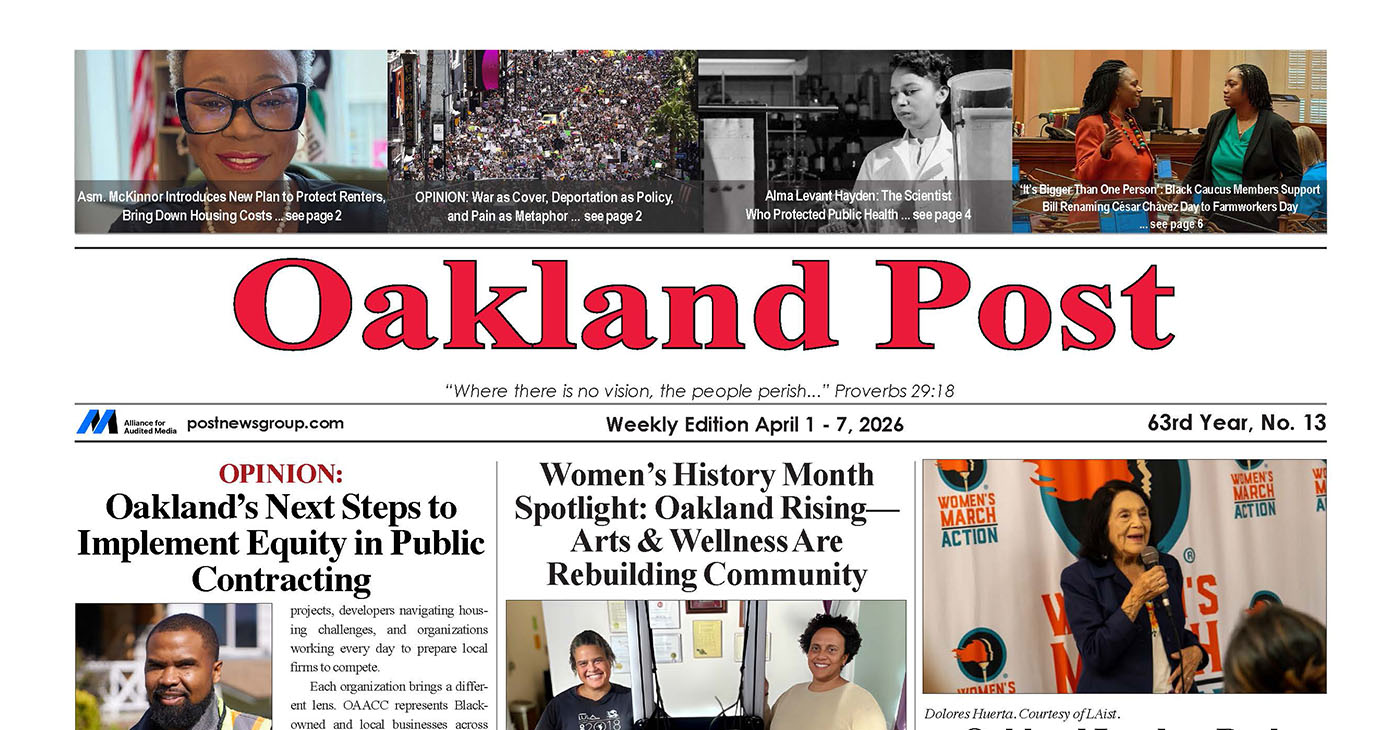
To enlarge your view of this issue, use the slider, magnifying glass icon or full page icon in the lower right corner of the browser window.

Activism
Oakland Post: Week of March 18 – 24, 2026
The printed Weekly Edition of the Oakland Post: Week of March 18 – 24, 2026
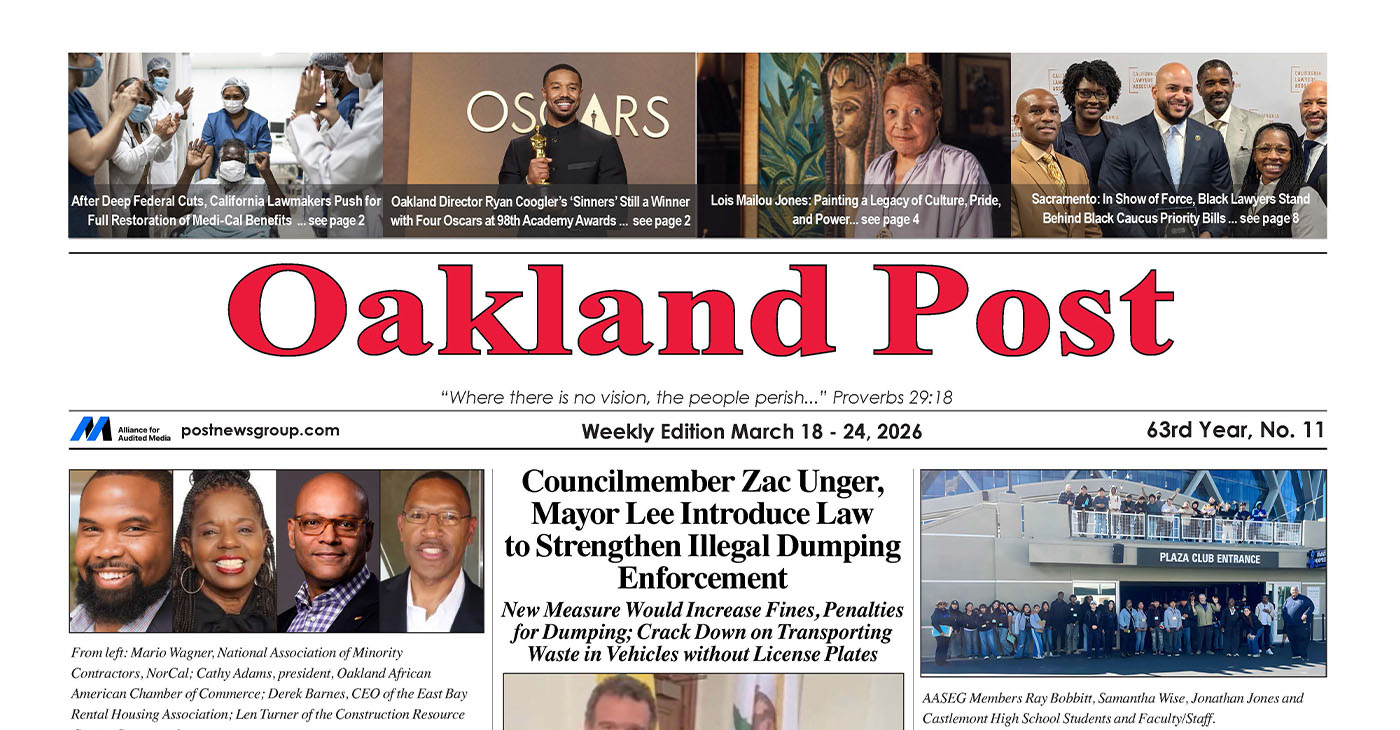
To enlarge your view of this issue, use the slider, magnifying glass icon or full page icon in the lower right corner of the browser window.
Activism
Oakland Post: Week of March 11 -17, 2026
The printed Weekly Edition of the Oakland Post: Week of March 11 – 17, 2026
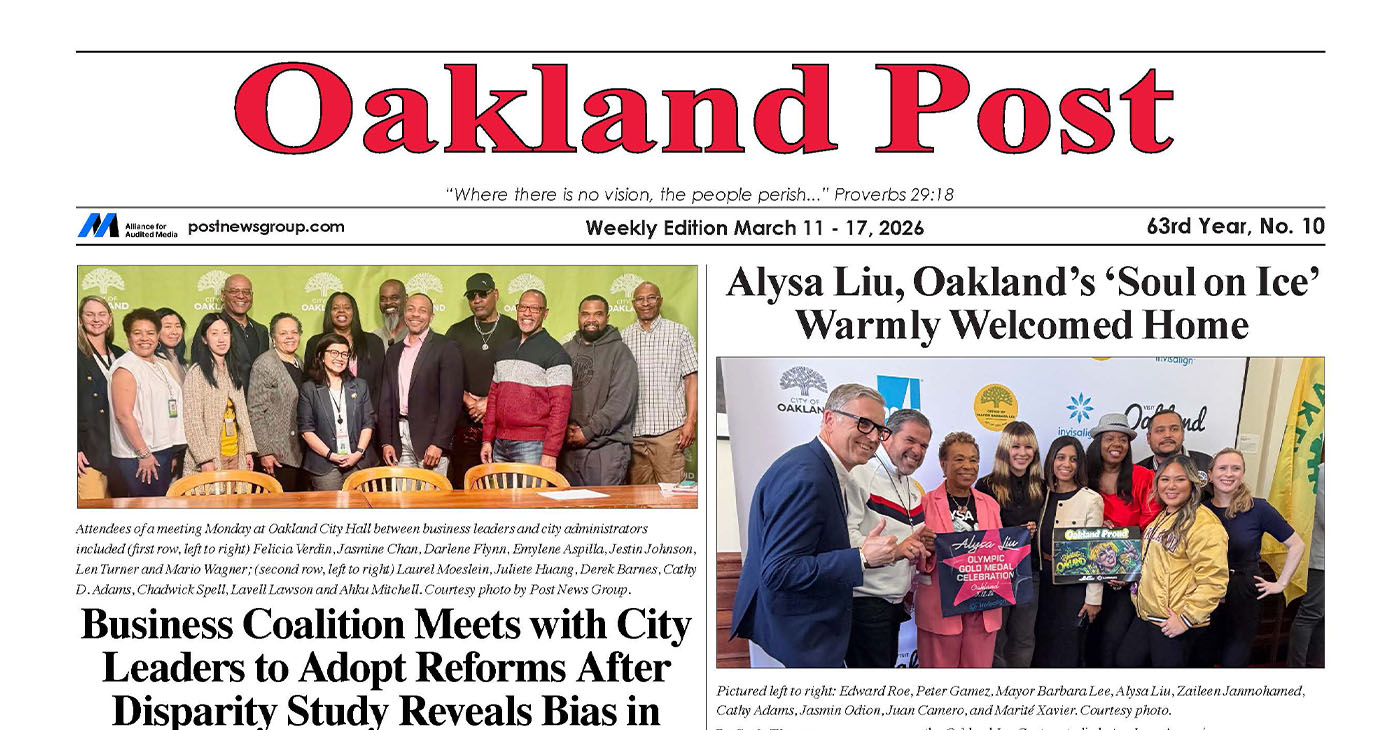
To enlarge your view of this issue, use the slider, magnifying glass icon or full page icon in the lower right corner of the browser window.


WORK FROM HOME
Home-based business with potential monthly income of $10K+ per month. A proven training system and website provided to maximize business effectiveness. Perfect job to earn side and primary income. Contact Lynne for more details: Lynne4npusa@gmail.com 800-334-0540


Oakland Post: Week of April 1 – 7, 2026

Black Artists in America, Installation Three Wraps at the Dixon Gallery and Gardens

Grief, Advocacy, and Education: A Counselor Reflects on Black Maternal Health

Future of Florida’s Black History Museum in Limbo

New Research Shows the Many Benefits of Early Learning

South Hampton K-8 Students Among Top 10 Finalists for Samsung’s ‘Solve for Tomorrow’ Competition

Cuba: No Negotiation with US on the President or Political System

Brooklyn Academy of Music Names Jamaican-Born Tamara McCaw as President

Trinidad & Tobego – U.S. Launches WhatsApp Channel for American Citizens in the Country

Oakland Post: Week of March 18 – 24, 2026

AI Innovation vs. Ethics and Environmental Impact

AI, Web3, and Digital Reparations

What If You Owned Your AI Agent?

Season 7, Episode 3 – January Reporter’s Roundtable 📱

Season 7, Episode 3 – January Reporter’s Roundtable

Reflecting on Black History Milestones in Birmingham AL

Oakland Post: Week of February 25 – March 3, 2026

PRESS ROOM: NBA Hall of Fame Nominee Terry Cummings Joins 100 Black Men of DeKalb County to Launch Victory & Values Initiative

Oakland Post: Week of March 4 – 10, 2026

Trump’s MAGA Allies are Creating Executive Order Plan to Steal the 2026 Midterms

U.S. manufacturing rebounds – how foundry services are adapting to rising demand

Poll Shows Support for Policies That Help Families Afford Child Care

OP-ED: One Hundred Years of Black Workers Telling the Truth

Oakland Post: Week of March 11 -17, 2026

Advancements in solar technology that are changing the way we power the world
Oakland Post: Week of March 18 – 24, 2026

Woman’s Search for Family’s Roots Leads to Ancestor John T. Ward – A Successful Entrepreneur and Conductor on the Underground Railroad

COMMENTARY: Women of Color Shape Our Past and Future

PRESS ROOM: Civil Rights TV Launches in Selma as the World’s First 24/7 Civil Rights Television Network

Financial Wellness and Mental Health: Managing Money Stress in College

Hyundai Ioniq 5 Parking, Safety, and 360 View #shorts

2025 Ioniq 5 New Wiper & Powerful Performance! #shorts

Electric SUV Range: Is 259 Miles Enough? #shorts

EV Charging: How Fast Can You Charge an Electric Vehicle? #shorts

Biometric Cooling… Messaging Seats…Come on! 2025 Infiniti QX80 Autograph 4WD

Charged Up: Witness the Magic of a Fully Electric Car! #shorts

Range Rover Sport PHEV Included…: See What’s Inside This Luxury SUV! #shorts

Invisible Hood View: Perfect Parking with X-Ray Vision! #shorts

AI Is Reshaping Black Healthcare: Promise, Peril, and the Push for Improved Results in California

ESSAY: Technology and Medicine, a Primary Care Point of View

Sanctuary Cities

The RESISTANCE – FREEDOM NOW

STATE OF THE PEOPLE: Freddie

ECONOMIC BOYCOTT DAY!!!!!

I told You So
-
 Activism3 weeks ago
Oakland Post: Week of March 11 -17, 2026
-
 Activism2 weeks ago
Oakland Post: Week of March 18 – 24, 2026
-
 #NNPA BlackPress4 weeks ago
Woman’s Search for Family’s Roots Leads to Ancestor John T. Ward – A Successful Entrepreneur and Conductor on the Underground Railroad
-
 #NNPA BlackPress4 weeks ago
COMMENTARY: Women of Color Shape Our Past and Future
-
 Advice3 weeks ago
Financial Wellness and Mental Health: Managing Money Stress in College
-

 #NNPA BlackPress4 weeks ago
Advocates Raise Alarm Over ICE Operation, MOU and Detention Risks in Baltimore County
-

 #NNPA BlackPress4 weeks ago
Pete Buttigieg to Join Mayor Randall Woodfin for Community Town Hall in Birmingham
-
 #NNPA BlackPress2 weeks ago
Brooklyn Academy of Music Names Jamaican-Born Tamara McCaw as President
