
Community
How Mobihealth Drives a Telemedicine Revolution in Africa
As a child growing up in northern Nigeria, Dr. Funmi Adewara experienced a severe hand injury that required multiple surgeries and frequent hospital visits. These visits exposed her to the harsh realities of the country’s healthcare system. “I remember sitting in overcrowded waiting rooms, watching doctors stretched thin, unable to meet the needs of so many patients,” Adewara recalls. This formative experience ignited her passion for transforming healthcare in Africa.


By Ifeanyi Abraham
CNN
As a child growing up in northern Nigeria, Dr. Funmi Adewara experienced a severe hand injury that required multiple surgeries and frequent hospital visits.
These visits exposed her to the harsh realities of the country’s healthcare system. “I remember sitting in overcrowded waiting rooms, watching doctors stretched thin, unable to meet the needs of so many patients,” Adewara recalls.
This formative experience ignited her passion for transforming healthcare in Africa.
Growing up with a mother who worked as a nurse, Adewara’s understanding of healthcare challenges deepened through her mother’s stories.
“I knew early on that healthcare wasn’t a privilege — it was a necessity, and I wanted to be part of changing the system,” she explains.
After training as a physician, Adewara worked for 15 years in the United Kingdom’s National Health Service before founding the telemedicine platform Mobihealth in 2017.
Since its launch, Mobihealth has impacted thousands of lives, connecting patients with doctors and healthcare professionals across Nigeria and beyond.
The platform has 20 integrated telehealth clinics that offer remote consultations, diagnostics, and access to specialist care via digital health tools. Located primarily in Nigeria, these clinics are accessible to patients through various subscription plans and are often financed through partnerships with global donor organizations and private donors.
In addition to the clinics, Mobihealth has partnerships with over 200 hospitals, labs, and pharmacies, Adewara says.
The company has earned global recognition, including a $1 million grant from the U.S. Trade and Development Agency in 2022. Adewara was also one of the World Bank’s seven 2020 Sustainable Development Goals & Her award winners, selected from over 2,400 entries worldwide.
Connecting Rural Patients
Across sub-Saharan Africa, millions struggle to access basic healthcare. According to the World Health Organization, the region bears 25% of the global disease burden but has only 3% of the world’s healthcare workers.
“In rural Africa, a trip to the nearest hospital can mean the difference between life and death,” says Adewara.
Mobihealth’s latest initiative offers healthcare for $1 a month for rural and underserved populations. It allows Africans in the diaspora — and global supporters — to sponsor essential services like doctor consultations, diagnostic tests, and access to telemedicine clinics.
The scheme is not solely based on donations; individuals can also subscribe to the service for themselves.
“Healthcare systems across Africa are under immense pressure,” Adewara explains. “Our initiative is a direct response, using technology to connect rural patients with doctors thousands of miles away.”
For Adewara, Mobihealth’s telemedicine platform is not a temporary fix; it represents the future of healthcare in Africa.
“This is about creating a resilient, sustainable and inclusive system, where people, no matter where they are, can access the care they need,” she says.
“Telemedicine brings doctors to people, wherever they may be. By integrating AI and remote monitoring, we are improving the speed and accuracy of care, saving lives in the process,” she adds.
A number of African companies provide telemedicine services, but researchers have pointed out that there are obstacles that could hinder the growth of telemedicine in the continent.
Rural areas can have an unreliable electricity supply and poor internet connectivity, and there is often a lack of government policies and funding around virtual healthcare.
“A Healthcare System for the Future”
Adewara envisions scaling her company’s model to reach millions more across Africa, particularly in countries like Ghana, Kenya, and Ivory Coast.
“Our work is just beginning,” she says. “We are building a healthcare system for the future — one that is resilient, inclusive and capable of meeting Africa’s growing population’s needs.”
However, partnerships are crucial to achieving this vision. “We can’t do this alone. Our collaborations with the African diaspora, hospitals, governments, and international organizations allow us to reach more people and ensure that healthcare is affordable, efficient and accessible,” Adewara adds.







Activism
Mayor Barbara Lee Proclaims April 9 as ‘100 Black Men of the Bay Area Day’
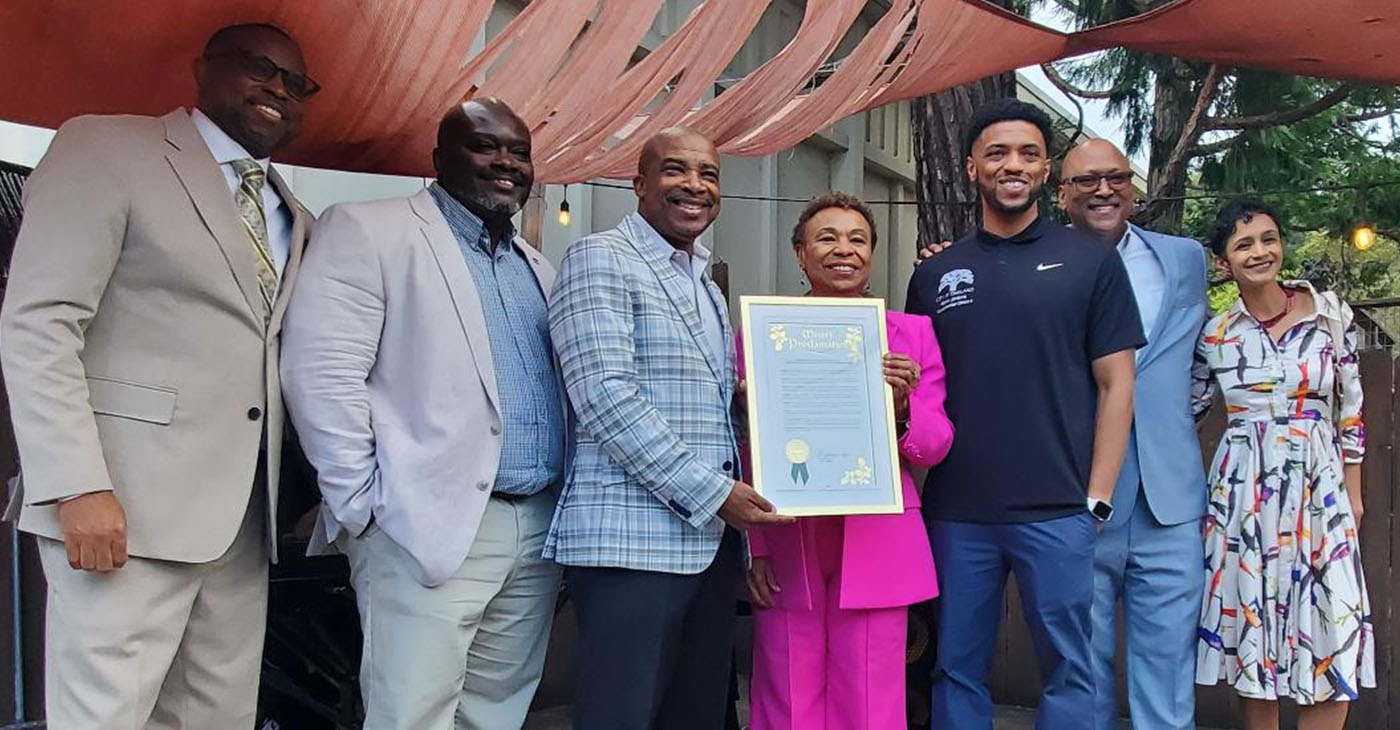
“Today, the 100th day of the year, I proclaim 100 Black Men Day,” said Mayor Barbara Lee standing with newly appointed Oakland Port Commissioner Derek Mohammad, a 100 Black Men member. “Whereas the 100 Black Men of the Bay Area has demonstrated decades of unwavering commitment to uplifting youth and strengthening families and advancing opportunity and access in Oakland and the greater Bay Area with their signature programs…the chapter has impacted thousands of young people and contributed thousands of hours of community service…”
By Carla Thomas
When Oakland Mayor Barbara Lee announced that she would proclaim Thursday, April 9, as “100 Black Men of the Bay Area Day,” the organization’s board chairman and owner of D. Monaghan’s on the Hill, Danny Lee Williams knew he wanted to mark the historic moment with fanfare his community could share.
Standing at the podium on the patio of his restaurant in the Oakland Hills, he welcomed about 150 members of the organization and the broader community who gathered to celebrate.
“This is a special day, and we are in the midst of our Economic Empowerment week,” he said. Williams also welcomed four vendors to sell their gifts and accessories during the event free of charge.
“Today, the 100th day of the year, I proclaim 100 Black Men Day,” said Mayor Barbara Lee standing with newly appointed Oakland Port Commissioner Derek Mohammad, a 100 Black Men member. “Whereas the 100 Black Men of the Bay Area has demonstrated decades of unwavering commitment to uplifting youth and strengthening families and advancing opportunity and access in Oakland and the greater Bay Area with their signature programs…the chapter has impacted thousands of young people and contributed thousands of hours of community service…”

Lee shared how as a single parent of two boys, she was grateful to have the organization’s support in mentoring her sons.
“Today, my adult son is a member in Illinois, and I thank the organization for supporting so many Black boys.”
The idea for the proclamation originated with Oakland City Councilmember Kevin Jenkins, who praised the organization for its leadership and contributions to Oakland and the greater Bay Area.
“This work that we do would not be possible without partnerships with organizations like the 100 Black Men,” said Jenkins. “We’re saving lives, restoring communities, and giving people hope and opportunities.”
“This is Oakland,” said Mayor Lee. “This is what we’re about. It’s about new ideas, thinking outside the box and being who we are. It’s about bringing joy. This is our holiday.”
The mayor also thanked the organization for volunteering during Oakland Cleanup days.
Councilmember Janani Ramachandran added that while many complain about problems in the city, “the 100” put in the work.
“It’s hard to be in the community and do the work, but that is exactly what the 100 Black Men does,” she said.
The organization’s economic chair and associate director of Diversity Equity and Inclusion at the University of California Berkeley’s Business School, Marco T. Lindsey, shared his enthusiasm for change.
“Today is the culmination of our work and something special is happening in our organization and our city,” he said. “We have a special opportunity to show up for our community now in ways that we haven’t had in the past. We have a mayor that supports us and it’s important that each and every one of us do our part. We all need our fingerprints on whatever we want to see in our city.”
Lindsey also expressed that if underserved youth and their parents had access to the resources needed for success, “Our youth wouldn’t be breaking windows and joining gangs if they had a pathway to earn $75k to $100k a year.”
The 100 Black Men were hosts of an Economic Empowerment Forum at McClymonds High School on April 11 educating students on entrepreneurship and financial literacy. On Sat., April 18, they will hold their fifth annual Career Expo at Contra Costa College 2600 Mission Bell Drive (G225) in San Pablo from 8 a.m. to 3 p.m. The 100 Black Men chapter of the Bay Area was established in 1988, one of the earliest in the nation.
For more information visit 100blackmenba.org
Alameda County
Stanford Health Care Collaborates with Alameda Health System Affiliate, Expanding Access to Care in East Bay
Introduced at a community event hosted at St. Rose Hospital in Hayward, an AHS affiliate, the partnership will enhance care for nearly 400,000 residents and solidify St. Rose’s position as a cornerstone of health and healing in the East Bay.
By Carla Thomas
On April 9, Alameda Health System (AHS) and Stanford Health Care announced a new collaboration to expand access to specialized medical services across central and southern Alameda County.
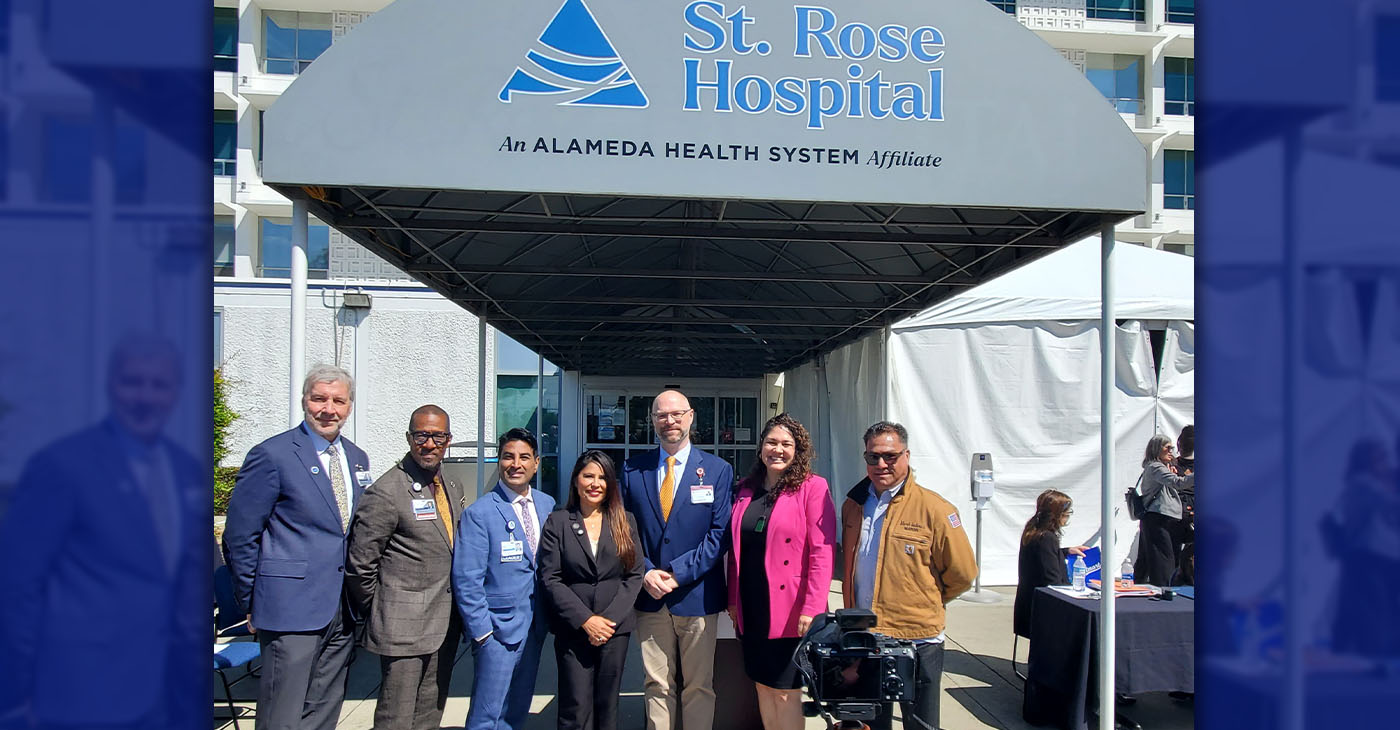
Introduced at a community event hosted at St. Rose Hospital in Hayward, an AHS affiliate, the partnership will enhance care for nearly 400,000 residents and solidify St. Rose’s position as a cornerstone of health and healing in the East Bay.
The initiative marks a milestone for the region, uniting two leading institutions in a shared mission to deliver high-quality, patient-centered care closer to home. Through this collaboration, AHS and Stanford Health Care will expand rehabilitative and behavioral health services, increase use of St. Rose’s operating rooms for advanced procedures, and enhance inpatient medical-surgical units managed by Stanford Health Care physicians.
The partnership will also support the AHS/St. Rose Foundation to advance local health programs that directly benefit East Bay residents.
Alameda County Supervisor Elisa Márquez praised the collaboration’s impact on local stability.
“This hospital was on the brink of closing, and saving it became my top priority,” Márquez said. “With continued collaboration, we’ll not only strengthen St. Rose but restore vital services like labor and delivery so babies can be born in Hayward again.
“When Stanford Health Care in Santa Clara stepped up, it was a pivotal moment,” she said. Keeping St. Rose open protects the entire regional health care ecosystem.”
James Jackson, chief executive officer of Alameda Health System, highlighted how the effort builds on recent progress at St. Rose.
“In just two years, AHS has made St. Rose financially stable and thriving,” Jackson said. “We want to make sure patients no longer need to drive miles down the highway to get care.
“Our mission; caring, healing, teaching, and serving all, remains at the heart of this collaboration. While HR1 presents real challenges for health care funding nationwide, it also offers an opportunity to reimagine how we deliver care. I’m confident that, through innovation and partnership, we’ll emerge stronger than before.”
For Rick Shumway, executive vice president and chief operating officer of Stanford Health Care, the alignment between the two organizations is crucial.
“This partnership reflects exactly who we are and who we aspire to be,” he said. “Working alongside AHS and St. Rose allows us to better understand community needs and respond meaningfully. Partnerships like this will carry us forward. We’re stronger together.”
AHS Chief Operating Officer Mark Fratzke echoed the same sentiment.
“I’m excited that the communities of Hayward and S. Alameda have access to care like this, he said. “Never underestimate the power of collaborations and partnerships.”
For nearly six decades, St. Rose Hospital has served Alameda County as a community-based safety-net hospital. One of Hayward’s largest employers, it provides more than 800 jobs and 300 skilled physicians and is designated by Alameda County as a ST-Elevation Myocardial Infarction STEMI Receiving Center for heart attack care.
Activism
Building Bridges of Support: How AAPI Equity Alliance Is Strengthening California’s Anti-Hate Network
In May 2022, Patricia Roque said she and her parents were attacked after a late-night stop at a fast-food drive-thru in Southern California. After hitting their car, the other driver pulled alongside them and mocked them using a racist Asian accent. Then, he threatened to kill them. The situation escalated when the man returned while the family was waiting for police and assaulted Roque’s father, fracturing his rib and choking her mother before bystanders intervened.

By Edward Henderson
When Aurelle Garner stepped out of her car one summer evening and saw a group of youths marching down her street, her stomach dropped.
What had begun as slurs hurled at her and her transgender children at a local park had escalated to violent pounding on their front door. Garner said that, before that incident, local law enforcement had repeatedly minimized her reports of harassment.
It was not until she contacted the Legal Department at The LGBTQ Center Long Beach that her family finally found help.
“I don’t know where we’d be if it weren’t for their help,” Garner, who lives in Southern California, said. “They didn’t just give legal advice. They helped us navigate a system that had otherwise dismissed us.”
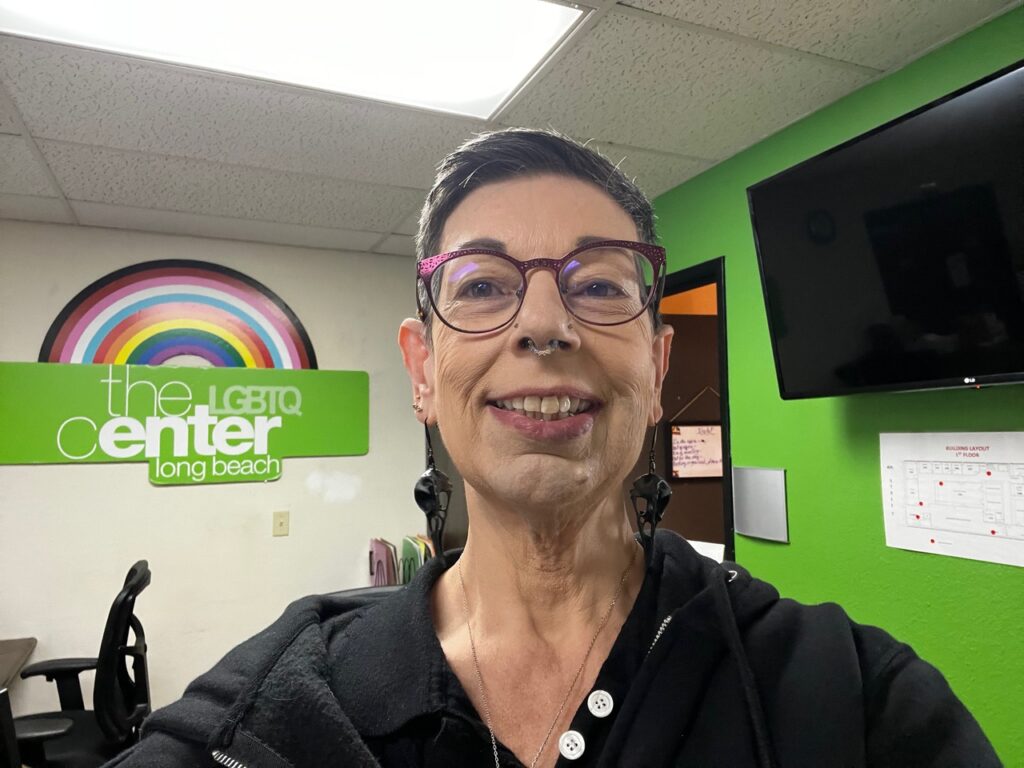
Aurelle Garner, who received services from The LGBTQ Center Long Beach (Sponsored by AAPI Equity Alliance) to aid her transgender children. (Courtesy of AAPI Equity Alliance)
That support exists because The LGBTQ Center Long Beach does not work in isolation.
The Center partners with the AAPI Equity Alliance under California’s Stop the Hate program, a statewide coalition aimed at preventing hate and supporting survivors.
As the Los Angeles County Regional Lead, AAPI Equity Alliance works with the Center and dozens of other community-based organizations to connect people to legal aid, mental health services, and support. The programs also work in tandem with CA vs Hate, the state’s anti-hate hotline and virtual reporting system that connects people across California with organizations like the LGBTQ Center Long Beach – that provide support services
Garner’s experience illustrates the kind of harm that often falls outside the narrow legal definition of a hate crime but still leaves families traumatized and unsafe. It also shows how AAPI Equity Alliance’s leadership in the Stop the Hate ecosystem translates state funding and policy into real, on-the-ground support.

Patricia Roque (Courtesy of AAPI Equity Alliance)
In May 2022, Patricia Roque said she and her parents were attacked after a late-night stop at a fast-food drive-thru in Southern California. After hitting their car, the other driver pulled alongside them and mocked them using a racist Asian accent. Then, he threatened to kill them. The situation escalated when the man returned while the family was waiting for police and assaulted Roque’s father, fracturing his rib and choking her mother before bystanders intervened.
“The police arrived long after it was over,” Roque told California Black Media (CBM). “By then, the damage was already done.”
The following day, Roque’s family was connected to the Filipino Migrant Center (FMC), a community-based organization that has received Stop the Hate funding and works within the broader AAPI Equity Alliance network. FMC provided immediate support — helping the family navigate legal options, organizing emergency financial assistance to cover medical bills and missed work, and offering emotional and community care while the criminal case unfolded.
“But the process is long and complicated. When you need help right away, that delay is a huge barrier. FMC was there immediately,”Rogue said.
The criminal case did not result in the accountability the family hoped for. But Roque said the support she received transformed her relationship to her community and to advocacy.
“Before this, I wasn’t involved in organizing at all,” she said. “Through this process, I realized my voice mattered. FMC helped turn something traumatic into a way to support others and push for change.”
Stories like Garner’s and Roque’s are part of a much larger reckoning that began at the onset of the COVID-19 pandemic, when Asian Americans and Pacific Islanders across the country experienced a surge in harassment, discrimination, and violence fueled by racist rhetoric.
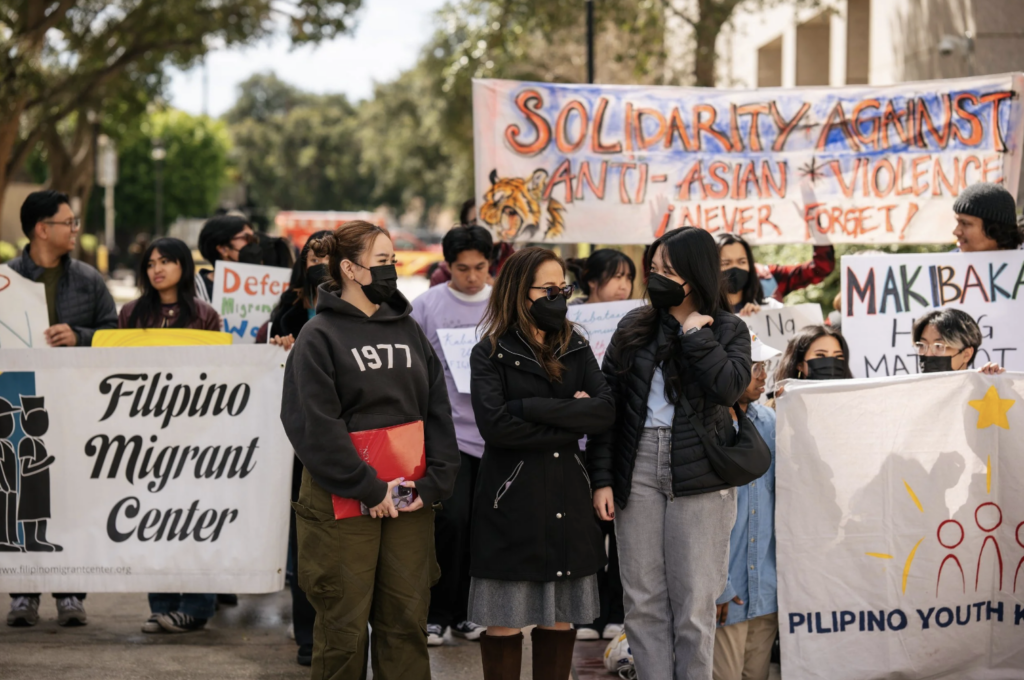
Filipino Migrant Center stands in solidarity against Anti-Asian Violence (Courtesy of AAPI Equity Alliance)
In response, AAPI Equity Alliance partnered with San Francisco’s Chinese for Affirmative Action and the Asian American Studies Department at San Francisco State University to launch Stop AAPI Hate in March 2020. Since then, the project has collected more than 9,000 reports nationwide documenting incidents ranging from verbal harassment and workplace discrimination to physical assault and child bullying.
“People tend to think about hate only when it turns violent,” said Kiran Bhalla of AAPI Equity Alliance. “But there are everyday acts of discrimination that people endure constantly. Without some kind of recourse, that harm just keeps going.”
The data helped spur unprecedented action in California. In 2021, the State Legislature passed the $165.5 million Asian Pacific Islander Equity Budget, signed by Gov. Gavin Newsom. Of that total, $110 million was dedicated to victim services, education, and outreach. In August 2023, California invested an additional $40 million to expand California’s Stop the Hate program to serve a broader range of communities affected by hate and discrimination.
Today, the program supports roughly 100 nonprofit organizations statewide. As Los Angeles County Regional Lead, AAPI Equity Alliance coordinates grantees, facilitates cross-community collaboration, and helps ensure services reach those most impacted.
A recently released survey estimated that approximately 3.1 million Californians directly experienced hate, with Native Hawaiian or Pacific Islanders, Black or African Americans, and other communities of color, including Asian Americans, among those most likely to experience hate.
Black Californians, however, remain the most targeted group when it comes to reported hate crimes.
Nearly 48% of Asian American and Pacific Islander adults in California reported experiencing a hate incident in 2024, according to Stop AAPI Hate research. Most incidents were not criminal, leaving survivors with little recourse through the legal system.
That gap is precisely where AAPI Equity Alliance and its partners focus their work. The Stop the Hate framework prioritizes non-carceral responses, recognizing that policing alone often fails survivors and can further harm Black, brown, and immigrant communities.
Instead, the work centers on data and research, policy advocacy, community care, and public education. Through school-based programs, legal advocacy, emergency assistance, and survivor-centered services, the network aims to interrupt cycles of harm before they escalate.
For survivors like Garner and Roque, that support has made the difference between enduring trauma in silence and finding a path toward healing and collective power.
“When people experience hate, there’s often a profound sense of isolation,” Bhalla said. “This work helps people get back to school, back to work, back to their lives. It reminds them they’re not alone.”
Get Support After Hate:
California vs Hate is a non-emergency, multilingual hotline and online portal offering confidential support for hate crimes and incidents. Victims and witnesses can get help anonymously by calling 833-8-NO-HATE (833-866-4283), Monday to Friday, 9 a.m.–6 p.m. PT, or online at any time. Anonymous. Confidential. No Police. No ICE.This story was produced in partnership with CA vs Hate. Join them for the first-ever CA Civil Rights Summit on May 11, 2026. More information at www.cavshate.org/summit.

WORK FROM HOME
Home-based business with potential monthly income of $10K+ per month. A proven training system and website provided to maximize business effectiveness. Perfect job to earn side and primary income. Contact Lynne for more details: Lynne4npusa@gmail.com 800-334-0540


Mayor Barbara Lee Proclaims April 9 as ‘100 Black Men of the Bay Area Day’

Stanford Health Care Collaborates with Alameda Health System Affiliate, Expanding Access to Care in East Bay

Building Bridges of Support: How AAPI Equity Alliance Is Strengthening California’s Anti-Hate Network

Oakland Post: Week of April 15 – 21, 2026

The hidden risks of poor water management in residential properties

Black Micro-Schools Deserve Recognition: NABML Creates National Standards and Resources

IN MEMORIAM: Rest in Power — Minnesota Loses a True Warrior in Yusef Mgeni

Revolve Fund to Provide $20,000 to Support Food Access Efforts in Alabama Black Belt

Mamdani Plans City Grocery Store in East Harlem

Cuban President Vows to Defend the Country Against US Invasion

What to do when inheriting a house that is paid off

Oakland Post: Week of April 8 – 14, 2026

Do DUI checkpoints reduce impaired driving? What local data shows

Black Press Celebrates Ties to Black Church in Annual Sunday Service

Black Women in Rural Areas Grapple with Stark Decline in Obstetric Care

Oakland Post: Week of March 18 – 24, 2026

Oakland Post: Week of March 4 – 10, 2026

Oakland Post: Week of March 11 -17, 2026

Financial Wellness and Mental Health: Managing Money Stress in College

New Research Shows the Many Benefits of Early Learning

Grief, Advocacy, and Education: A Counselor Reflects on Black Maternal Health

Brooklyn Academy of Music Names Jamaican-Born Tamara McCaw as President

Trinidad & Tobego – U.S. Launches WhatsApp Channel for American Citizens in the Country

Black Artists in America, Installation Three Wraps at the Dixon Gallery and Gardens

Future of Florida’s Black History Museum in Limbo

Women & Wealth: Tips for Navigating Your Lifelong Financial Journey

Cuba: No Negotiation with US on the President or Political System

Woman’s Search for Family’s Roots Leads to Ancestor John T. Ward – A Successful Entrepreneur and Conductor on the Underground Railroad

South Hampton K-8 Students Among Top 10 Finalists for Samsung’s ‘Solve for Tomorrow’ Competition

COMMENTARY: Women of Color Shape Our Past and Future

Hyundai Ioniq 5 Parking, Safety, and 360 View #shorts

2025 Ioniq 5 New Wiper & Powerful Performance! #shorts

Electric SUV Range: Is 259 Miles Enough? #shorts

EV Charging: How Fast Can You Charge an Electric Vehicle? #shorts

Biometric Cooling… Messaging Seats…Come on! 2025 Infiniti QX80 Autograph 4WD

Charged Up: Witness the Magic of a Fully Electric Car! #shorts

Range Rover Sport PHEV Included…: See What’s Inside This Luxury SUV! #shorts

Invisible Hood View: Perfect Parking with X-Ray Vision! #shorts

AI Is Reshaping Black Healthcare: Promise, Peril, and the Push for Improved Results in California

ESSAY: Technology and Medicine, a Primary Care Point of View

Sanctuary Cities

The RESISTANCE – FREEDOM NOW

STATE OF THE PEOPLE: Freddie

ECONOMIC BOYCOTT DAY!!!!!

I told You So
-
 Activism4 weeks ago
Oakland Post: Week of March 18 – 24, 2026
-
 #NNPA BlackPress4 weeks ago
New Research Shows the Many Benefits of Early Learning
-
 #NNPA BlackPress4 weeks ago
Grief, Advocacy, and Education: A Counselor Reflects on Black Maternal Health
-
 #NNPA BlackPress4 weeks ago
Brooklyn Academy of Music Names Jamaican-Born Tamara McCaw as President
-
 #NNPA BlackPress4 weeks ago
Trinidad & Tobego – U.S. Launches WhatsApp Channel for American Citizens in the Country
-
 #NNPA BlackPress4 weeks ago
Black Artists in America, Installation Three Wraps at the Dixon Gallery and Gardens
-
 #NNPA BlackPress4 weeks ago
Future of Florida’s Black History Museum in Limbo
-
 #NNPA BlackPress4 weeks ago
Cuba: No Negotiation with US on the President or Political System
