
Activism
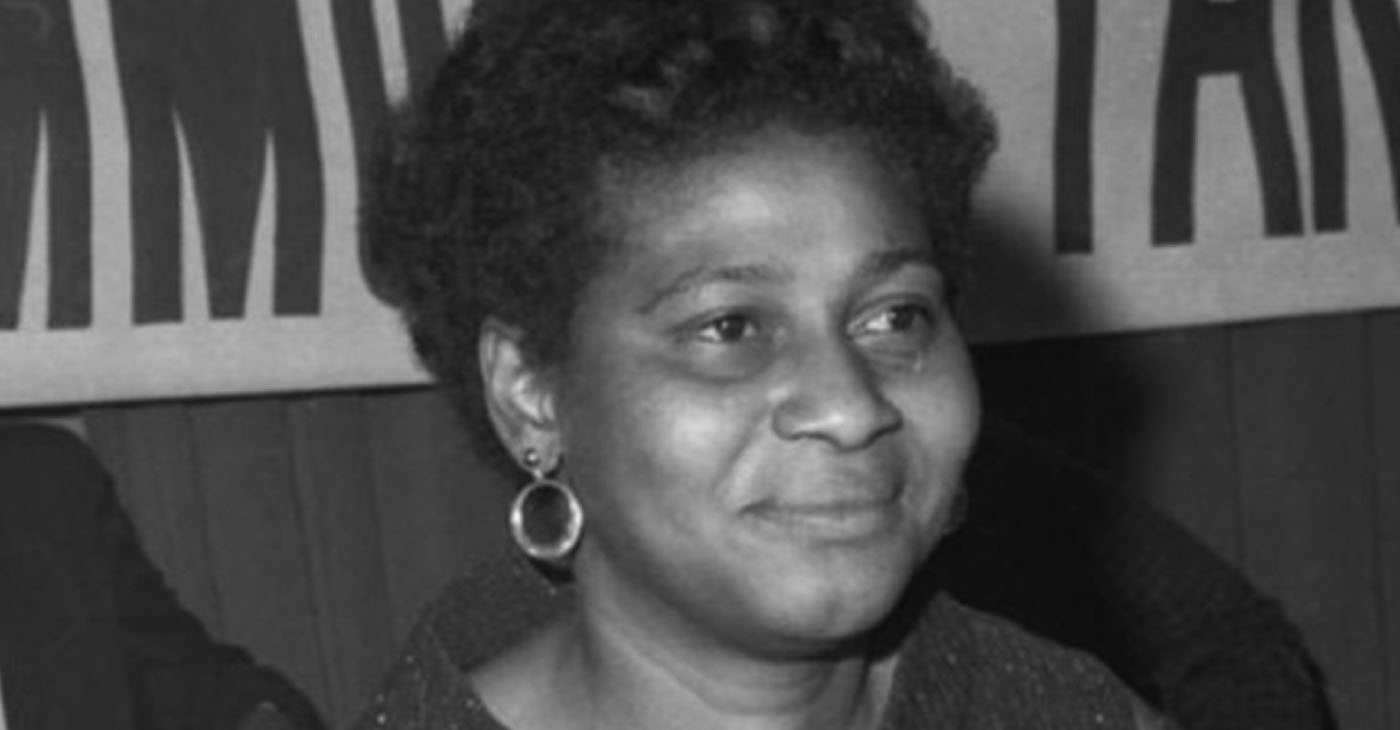
IN MEMORIAM: Charlene Mitchell, Civil Rights Activist and 1st Black Woman to Run for President, Dies at 92
In her 1968 run for president, Mitchell’s slogan was “Black and White Unite to Fight Racism, Poverty, and War!” She and her running mate made it to the ballot in only four states and won just over 1,000 votes, the New York Times reports, but her candidacy put a new face on the Communist Party, which was struggling under the weight of repression from the federal government.

By Brandon Patterson
Civil rights activist Charlene Mitchell, a long-time Communist Party leader and freedom fighter, passed away in Manhattan, New York, on Dec. 14, 2022. She was 92.
As the Communist Party’s nominee in 1968, Mitchell was the first Black woman to run for president, ahead of Shirley Chisolm who became the first Black woman to seek the nomination for a major party —the Democratic Party — in 1972.
Mitchell was also known for her leadership in the campaign to free Angela Davis when Davis was arrested in 1969.
Born in Cincinnati, Ohio, in 1930, Mitchell moved to Chicago with her family at age 9, where they settled down in the Cabrini Green housing project, then a mix-raced housing complex and “a center of left-wing politics,” according to the New York Times.
Her father worked as a Pullman porter and was active in the labor movement, so she was exposed to the Black civil rights struggle from a young age. At 13, Mitchell joined the local youth branch of the Communist Party, helping to lead a student protest against segregated seating at a local theater.
In the 1960s, she moved to Los Angeles, where she founded an all-Black chapter of the Communist Party. Mitchell stressed the need for solidarity with oppressed people around the world, and traveled the world meeting with leftists in Europe, South America, and South Africa, the Grio reported. Notably, she was among the first Americans to speak out against the incarceration of Nelson Mandela and anti-apartheid struggle in South Africa.
“Having known Charlene Mitchell through political victories and defeats, through personal tragedies and triumphs, I can say with confidence that she is the person to whom I am most grateful for showing me a life path,” activist Angela Davis, a professor at UC Santa Cruz, told the New York Times. Davis continued: “I don’t think I have ever known someone as consistent in her values, as collective in her outlook on life, as firm in her trajectory as a freedom fighter.”
In her 1968 run for president, Mitchell’s slogan was “Black and White Unite to Fight Racism, Poverty, and War!” She and her running mate made it to the ballot in only four states and won just over 1,000 votes, the New York Times reports, but her candidacy put a new face on the Communist Party, which was struggling under the weight of repression from the federal government.
Mitchell would eventually split from the Communist Party in the 1980s but would support several other anti-racist political organizations, including the Committees of Correspondence for Democracy and Socialism and the National Alliance Against Racial and Political Repression.
“Black Lives Matter and modern Black feminism stand on the shoulders of Charlene Mitchell,” Erik S. McDuffie, a professor of African American studies at the University of Illinois, told the New York Times.









Activism
Oakland Post: Week of March 18 – 24, 2026
The printed Weekly Edition of the Oakland Post: Week of March 18 – 24, 2026

To enlarge your view of this issue, use the slider, magnifying glass icon or full page icon in the lower right corner of the browser window.
Activism
Oakland Post: Week of March 11 -17, 2026
The printed Weekly Edition of the Oakland Post: Week of March 11 – 17, 2026
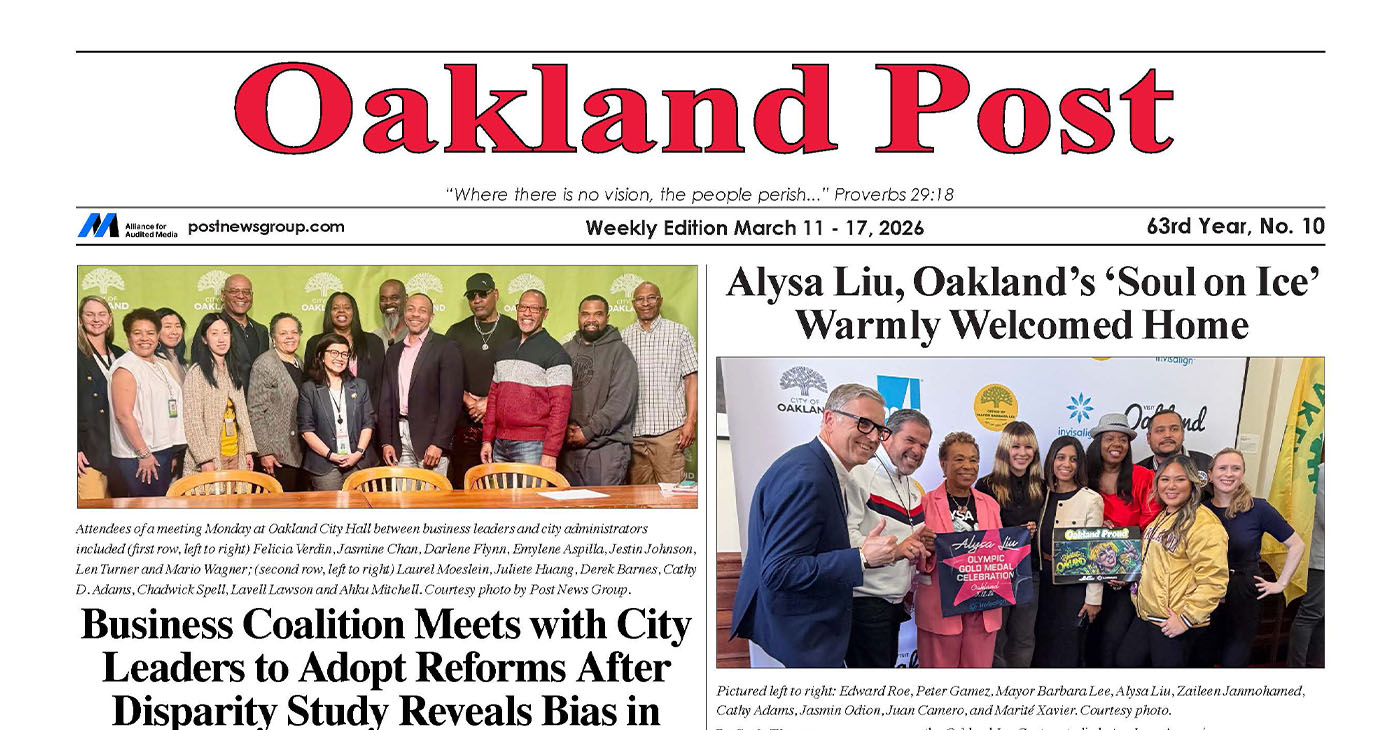
To enlarge your view of this issue, use the slider, magnifying glass icon or full page icon in the lower right corner of the browser window.
Activism
Oakland Post: Week of March 4 – 10, 2026
The printed Weekly Edition of the Oakland Post: Week of March 4 – 10, 2026

To enlarge your view of this issue, use the slider, magnifying glass icon or full page icon in the lower right corner of the browser window.


WORK FROM HOME
Home-based business with potential monthly income of $10K+ per month. A proven training system and website provided to maximize business effectiveness. Perfect job to earn side and primary income. Contact Lynne for more details: Lynne4npusa@gmail.com 800-334-0540


Black Artists in America, Installation Three Wraps at the Dixon Gallery and Gardens

Grief, Advocacy, and Education: A Counselor Reflects on Black Maternal Health

Future of Florida’s Black History Museum in Limbo

New Research Shows the Many Benefits of Early Learning

South Hampton K-8 Students Among Top 10 Finalists for Samsung’s ‘Solve for Tomorrow’ Competition

Cuba: No Negotiation with US on the President or Political System

Brooklyn Academy of Music Names Jamaican-Born Tamara McCaw as President

Trinidad & Tobego – U.S. Launches WhatsApp Channel for American Citizens in the Country

Oakland Post: Week of March 18 – 24, 2026

AI Innovation vs. Ethics and Environmental Impact

AI, Web3, and Digital Reparations

What If You Owned Your AI Agent?

Season 7, Episode 3 – January Reporter’s Roundtable 📱

Season 7, Episode 3 – January Reporter’s Roundtable

AI, Media, and Power | Part 2, Real-World Impacts and Tradeoffs

Oakland Post: Week of February 11 – 17, 2026

Reflecting on Black History Milestones in Birmingham AL

CITY OF SAN LEANDRO STATE OF CALIFORNIA PUBLIC WORKS DEPARTMENT ENGINEERING DIVISION NOTICE TO BIDDERS FOR ANNUAL STREET OVERLAY/REHABILITATION 2019-21 – PHASE III

Oakland Post: Week of February 18 – 24, 2026

PRESS ROOM: NBA Hall of Fame Nominee Terry Cummings Joins 100 Black Men of DeKalb County to Launch Victory & Values Initiative

Oakland Post: Week of February 25 – March 3, 2026

Trump’s MAGA Allies are Creating Executive Order Plan to Steal the 2026 Midterms

U.S. manufacturing rebounds – how foundry services are adapting to rising demand

OP-ED: One Hundred Years of Black Workers Telling the Truth

Chase Oakland Community Center Hosts Alley-Oop Accelerator Building Community and Opportunity for Bay Area Entrepreneurs

Advancements in solar technology that are changing the way we power the world

Poll Shows Support for Policies That Help Families Afford Child Care

Oakland Post: Week of March 4 – 10, 2026

PRESS ROOM: Civil Rights TV Launches in Selma as the World’s First 24/7 Civil Rights Television Network

Woman’s Search for Family’s Roots Leads to Ancestor John T. Ward – A Successful Entrepreneur and Conductor on the Underground Railroad

Hyundai Ioniq 5 Parking, Safety, and 360 View #shorts

2025 Ioniq 5 New Wiper & Powerful Performance! #shorts

Electric SUV Range: Is 259 Miles Enough? #shorts

EV Charging: How Fast Can You Charge an Electric Vehicle? #shorts

Biometric Cooling… Messaging Seats…Come on! 2025 Infiniti QX80 Autograph 4WD

Charged Up: Witness the Magic of a Fully Electric Car! #shorts

Range Rover Sport PHEV Included…: See What’s Inside This Luxury SUV! #shorts

Invisible Hood View: Perfect Parking with X-Ray Vision! #shorts

AI Is Reshaping Black Healthcare: Promise, Peril, and the Push for Improved Results in California

ESSAY: Technology and Medicine, a Primary Care Point of View

Sanctuary Cities

The RESISTANCE – FREEDOM NOW

STATE OF THE PEOPLE: Freddie

ECONOMIC BOYCOTT DAY!!!!!

I told You So
-
 Activism4 weeks ago
Oakland Post: Week of March 4 – 10, 2026
-
 #NNPA BlackPress3 weeks ago
Woman’s Search for Family’s Roots Leads to Ancestor John T. Ward – A Successful Entrepreneur and Conductor on the Underground Railroad
-

 #NNPA BlackPress4 weeks ago
OP-ED: NNPA Launches 2026 “Leadership Matters” Video Series
-

 #NNPA BlackPress3 weeks ago
Advocates Raise Alarm Over ICE Operation, MOU and Detention Risks in Baltimore County
-

 #NNPA BlackPress3 weeks ago
COMMENTARY: Women of Color Shape Our Past and Future
-

 #NNPA BlackPress3 weeks ago
Pete Buttigieg to Join Mayor Randall Woodfin for Community Town Hall in Birmingham
-

 Activism2 weeks ago
Oakland Post: Week of March 11 -17, 2026
-

 #NNPA BlackPress4 weeks ago
PRESS ROOM: PMG and Cranbrook Horizons-Upward Bound Launch Journey Fellowship Cohort 2
