
Activism
IN MEMORIAM: Jimmy Carter, 39th President and Global Humanitarian, Dies at 100
Despite serving just one term, Carter’s presidency is remembered by historians as one of the most consequential. He brokered the Camp David Accords between Egypt and Israel in 1978, a milestone in Middle East peace efforts. Carter prioritized human rights in U.S. foreign policy, advanced environmental conservation, and created the Departments of Energy and Education.

By Stacy M. Brown, NNPA Newswire
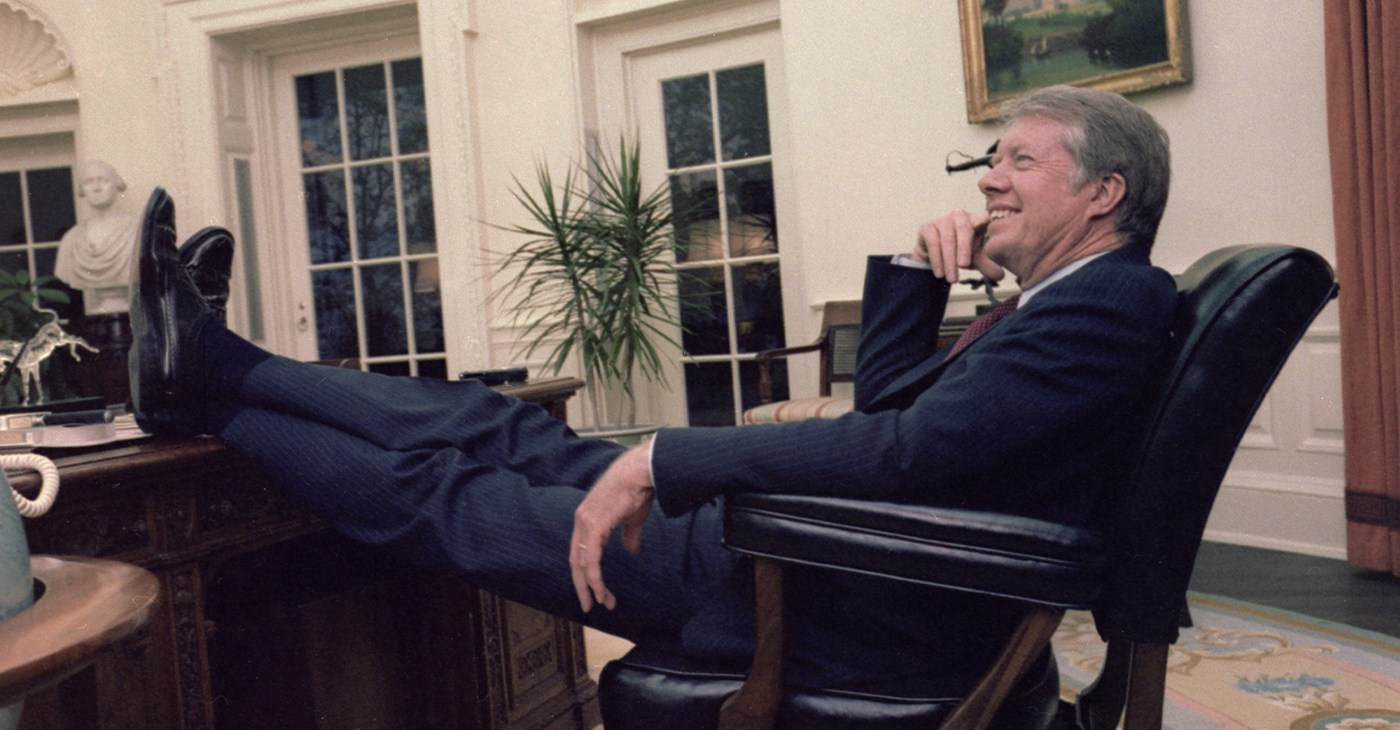
James “Jimmy” Carter, the peanut farmer from Plains, Georgia, who became the 39th president of the United States and later redefined the role of an ex-president through decades of humanitarian work, died Sunday at his home. He was 100.
His son, James E. Carter III, known as ‘Chip,’ confirmed the death but provided no immediate cause. Carter had been in hospice care since February 2023 after battling an aggressive form of melanoma that spread to his brain and liver.
Carter’s wife, Rosalynn, with whom he shared 77 years of marriage—the longest of any presidential couple—died on Nov. 19, 2023, at 96. The couple’s final years were marked by their enduring love, and Carter’s last public appearance was at Rosalynn’s funeral, where he sat in the front row in a wheelchair.
Carter’s official state funeral will take place on Jan. 9 in Washington, D.C., and President Joe Biden, who will deliver the eulogy, declared the date a National Day of Mourning.
“America and the world lost an extraordinary leader, statesman and humanitarian,” President Joe Biden said in a statement issued by the White House on Sunday. “Over six decades, we had the honor of calling Jimmy Carter a dear friend.
“… With his compassion and moral clarity, he worked to eradicate disease, forge peace, advance civil rights and human rights, promote free and fair elections, house the homeless, and always advocate for the least among us. He saved, lifted, and changed the lives of people all across the globe. … To the entire Carter family, we send our gratitude for sharing them with America and the world,” Biden continued.
Carter’s legacy will also be celebrated in Atlanta before the national events and will be followed by a private interment in Carter’s hometown of Plains, Georgia, according to The Carter Center, though final arrangements are still underway.
Vice President Kamala Harris’ issued an official statement as well: President Jimmy Carter was guided by a deep and abiding faith — in God, in America, and in humanity.
Jimmy Carter’s life is a testament to the power of service — as a Lieutenant in the United States Navy, the 76th Governor of Georgia, and the 39th President of the United States. He reminded our nation and the world that there is strength in decency and compassion.
. “His life and legacy continue to inspire me — and will inspire generations to come.”
Many of California’s state and local elected officials also remembered Carter.
On X, formerly known as Twitter, California Senator Alex Padilla said “Jimmy Carter was a clean energy champion, a staunch defender of democracy, and a fundamentally decent person. His lifelong commitment to service led us through turbulent moments, and he leaves behind a shining example of how to better treat one another.”
U.S. Speaker of the House Emeritus Nancy Pelosi said “As President, his work to restore integrity to the political arena during a difficult chapter in our history was a testament to his firm faith in the sanctity of the public good, which he always placed above his own. After leaving the White House, he carried on his service – leading perhaps the most impactful post-presidency in history.
Fox News reported that San Francisco Mayor London Breed said that the city was lowering the American flag to half-staff at City Hall for the next 30 days following Carter’s death. “We join the nation in mourning his loss and celebrating the enduring legacy of a truly remarkable leader,” she said. She also praised his work aimed at “building a more just and compassionate future.”
“Jimmy Carter was a beacon of justice and sevice – from desegregating schools to championing civil rights and building homes with Habitat for Humanity,” said Lateefah Simon, newly elected representative of the Bay Area’s 12th Congressional district. “He lived his faith and fought for dignity every day. May his memory be a blessing. Rest in power.”
Former Berkeley mayor and newly elected State Senator Jesse Arreguín said that “Jimmy Carter was a shining example of what it means to be a public servant,” and encouraged others to “build upon his legacy of advancing human rights, social justice, and peace.”
California Controller Malia Cohen told the San Francisco Chronicle “Carter’s commitment to humanitarian issues and social justice inspired her ‘to value kindness and empathy in my own life.’
“‘His legacy encourages me to strive for a more just and compassionate world, reminding me that service to others is one of the highest callings we can pursue,” Cohen said in a statement.
Governor Gavin Newsom’s statement said in part: “President Carter was a man of rare character – whose beliefs ran true and ran deep, whose moral compass never wavered. He saw the common humanity in all of us, building bridges between people of different faiths and factions abroad while working to meet the needs of those at home. Despite daunting challenges and trying times, his bright energy and spirit never faltered.”
Born in Plains on Oct. 1, 1924, Carter grew up on a farm, served in the U.S. Navy, and rose to prominence as Georgia’s governor from 1971 to 1975. He was elected president in 1976, becoming the first man from the Deep South since 1837. The victory made Carter the only Democrat to hold the office between Lyndon B. Johnson and Bill Clinton.
Carter’s presidency, defined by ambitious domestic and foreign policy initiatives, faced formidable challenges. During Carter’s presidency, America struggled with ‘stagflation,’ an energy crisis, and international turmoil.
The 1979 Iranian hostage crisis and the failed rescue mission that followed, combined with economic woes and a Soviet invasion of Afghanistan, led to his overwhelming defeat in the 1980 election by Ronald Reagan.
Despite serving just one term, Carter’s presidency is remembered by historians as one of the most consequential. He brokered the Camp David Accords between Egypt and Israel in 1978, a milestone in Middle East peace efforts. Carter prioritized human rights in U.S. foreign policy, advanced environmental conservation, and created the Departments of Energy and Education.
His vision for alternative energy led to installing solar panels on the White House, which he called “a small part of one of the greatest and most exciting adventures ever undertaken by the American people.”
In his biography “His Very Best: Jimmy Carter, a Life,” Jonathan Alter described Carter as “perhaps the most misunderstood president in American history.” In contrast, Kai Bird’s “The Outlier: The Unfinished Presidency of Jimmy Carter” highlighted his moral conviction in tackling issues others avoided, even at political cost.
After leaving the White House, Carter devoted himself to humanitarian work, transforming the role of former presidents. Through the Carter Center, founded with Rosalynn in 1982, he worked to promote democracy, monitor elections, and combat diseases like Guinea worm. The Center has monitored 115 elections in 40 countries and played a key role in nearly eradicating Guinea worm disease.
Carter and Rosalynn’s decades-long partnership with Habitat for Humanity further exemplified their commitment to service. Wearing tool belts and working alongside volunteers, they helped build or renovate more than 4,000 homes in 14 countries.
In 2002, Carter received the Nobel Peace Prize for his “decades of untiring effort to find peaceful solutions to international conflicts, to advance democracy and human rights, and to promote economic and social development.” Gunnar Berge, a Nobel committee member, called Carter “the best ex-president the country ever had.”
Carter’s post-presidency also saw moments of controversy. His 2006 book “Palestine: Peace Not Apartheid” drew criticism for its comparison of Israeli policies to South African apartheid. Yet, even in contentious circumstances, his tireless advocacy for peace earned him widespread respect.
“During his presidency, Jimmy Carter advocated to have Medicare cover all Americans. After his presidency, he continued humanitarian works that everyone, regardless of political affiliation, should respect,” said former Congresswoman Nina Turner.
Carter maintained a modest lifestyle, choosing not to capitalize on his presidency. He and Rosalynn lived in the same Plains home they built in 1961, and Carter often said he wanted their gravesite in Plains to benefit the local economy through tourism.
In their later years, the Carters celebrated milestones with family and friends, including their 75th wedding anniversary in 2021. Guests included civil rights leader Andrew Young, country music stars Garth Brooks and Trisha Yearwood, and former President Bill Clinton.
Carter is survived by his four children, numerous grandchildren and great-grandchildren, and a legacy of public service that transformed lives around the globe. He will be buried next to Rosalynn under a willow tree near a pond he helped dig in Plains, where his journey began and ends.
The San Francisco Chronicle, Los Angeles Times, New York Post, X, CNN, The Mercury News, and NBC News contributed to this report.






Activism
Oakland Post: Week of March 18 – 24, 2026
The printed Weekly Edition of the Oakland Post: Week of March 18 – 24, 2026
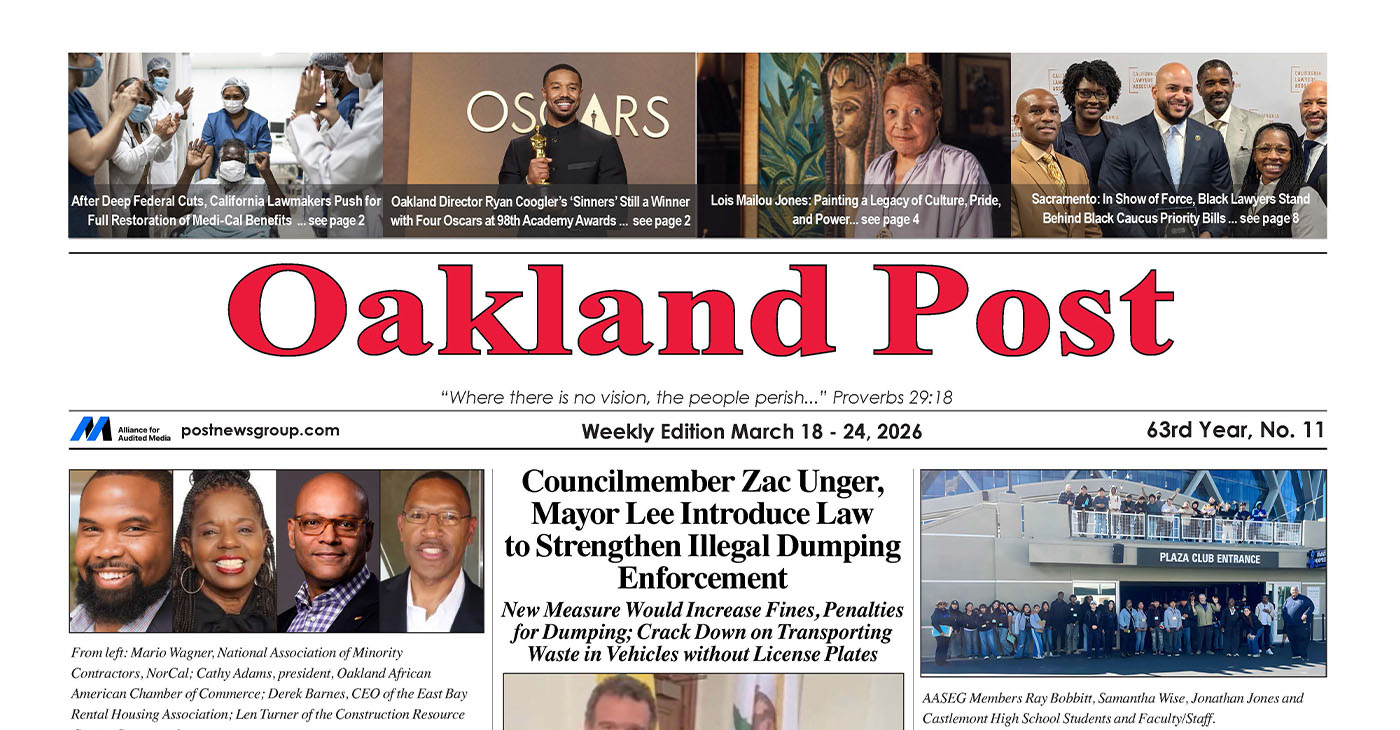
To enlarge your view of this issue, use the slider, magnifying glass icon or full page icon in the lower right corner of the browser window.
Activism
Oakland Post: Week of March 11 -17, 2026
The printed Weekly Edition of the Oakland Post: Week of March 11 – 17, 2026
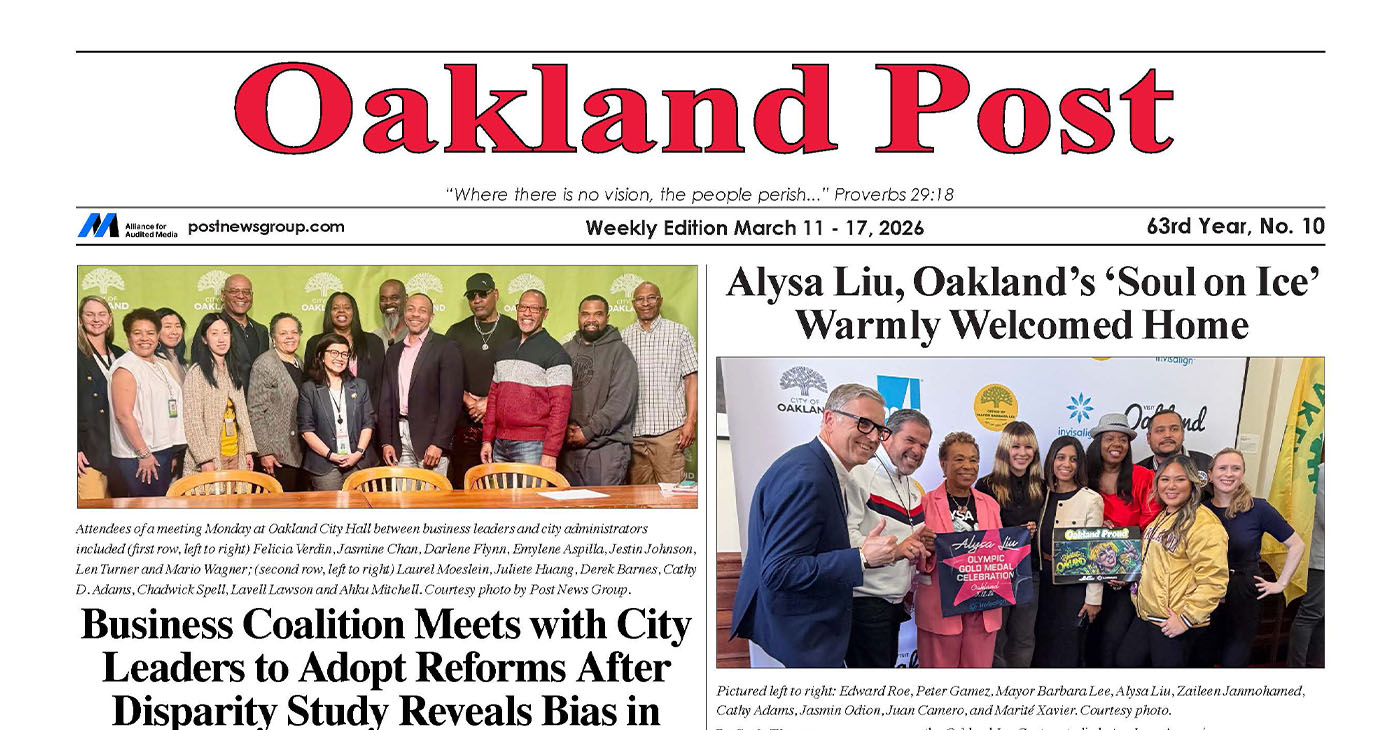
To enlarge your view of this issue, use the slider, magnifying glass icon or full page icon in the lower right corner of the browser window.
Activism
Oakland Post: Week of March 4 – 10, 2026
The printed Weekly Edition of the Oakland Post: Week of March 4 – 10, 2026

To enlarge your view of this issue, use the slider, magnifying glass icon or full page icon in the lower right corner of the browser window.


WORK FROM HOME
Home-based business with potential monthly income of $10K+ per month. A proven training system and website provided to maximize business effectiveness. Perfect job to earn side and primary income. Contact Lynne for more details: Lynne4npusa@gmail.com 800-334-0540


Black Artists in America, Installation Three Wraps at the Dixon Gallery and Gardens

Grief, Advocacy, and Education: A Counselor Reflects on Black Maternal Health

Future of Florida’s Black History Museum in Limbo

New Research Shows the Many Benefits of Early Learning

South Hampton K-8 Students Among Top 10 Finalists for Samsung’s ‘Solve for Tomorrow’ Competition

Cuba: No Negotiation with US on the President or Political System

Brooklyn Academy of Music Names Jamaican-Born Tamara McCaw as President

Trinidad & Tobego – U.S. Launches WhatsApp Channel for American Citizens in the Country

Oakland Post: Week of March 18 – 24, 2026

AI Innovation vs. Ethics and Environmental Impact

AI, Web3, and Digital Reparations

What If You Owned Your AI Agent?

Season 7, Episode 3 – January Reporter’s Roundtable 📱

Season 7, Episode 3 – January Reporter’s Roundtable

AI, Media, and Power | Part 2, Real-World Impacts and Tradeoffs

Oakland Post: Week of February 11 – 17, 2026

Reflecting on Black History Milestones in Birmingham AL

CITY OF SAN LEANDRO STATE OF CALIFORNIA PUBLIC WORKS DEPARTMENT ENGINEERING DIVISION NOTICE TO BIDDERS FOR ANNUAL STREET OVERLAY/REHABILITATION 2019-21 – PHASE III

Oakland Post: Week of February 18 – 24, 2026

PRESS ROOM: NBA Hall of Fame Nominee Terry Cummings Joins 100 Black Men of DeKalb County to Launch Victory & Values Initiative

Oakland Post: Week of February 25 – March 3, 2026

Trump’s MAGA Allies are Creating Executive Order Plan to Steal the 2026 Midterms

U.S. manufacturing rebounds – how foundry services are adapting to rising demand

OP-ED: One Hundred Years of Black Workers Telling the Truth

Chase Oakland Community Center Hosts Alley-Oop Accelerator Building Community and Opportunity for Bay Area Entrepreneurs

Poll Shows Support for Policies That Help Families Afford Child Care

Oakland Post: Week of March 4 – 10, 2026

Advancements in solar technology that are changing the way we power the world

PRESS ROOM: Civil Rights TV Launches in Selma as the World’s First 24/7 Civil Rights Television Network

Woman’s Search for Family’s Roots Leads to Ancestor John T. Ward – A Successful Entrepreneur and Conductor on the Underground Railroad

Hyundai Ioniq 5 Parking, Safety, and 360 View #shorts

2025 Ioniq 5 New Wiper & Powerful Performance! #shorts

Electric SUV Range: Is 259 Miles Enough? #shorts

EV Charging: How Fast Can You Charge an Electric Vehicle? #shorts

Biometric Cooling… Messaging Seats…Come on! 2025 Infiniti QX80 Autograph 4WD

Charged Up: Witness the Magic of a Fully Electric Car! #shorts

Range Rover Sport PHEV Included…: See What’s Inside This Luxury SUV! #shorts

Invisible Hood View: Perfect Parking with X-Ray Vision! #shorts

AI Is Reshaping Black Healthcare: Promise, Peril, and the Push for Improved Results in California

ESSAY: Technology and Medicine, a Primary Care Point of View

Sanctuary Cities

The RESISTANCE – FREEDOM NOW

STATE OF THE PEOPLE: Freddie

ECONOMIC BOYCOTT DAY!!!!!

I told You So
-
 Activism4 weeks ago
Oakland Post: Week of March 4 – 10, 2026
-
 #NNPA BlackPress3 weeks ago
Woman’s Search for Family’s Roots Leads to Ancestor John T. Ward – A Successful Entrepreneur and Conductor on the Underground Railroad
-

 #NNPA BlackPress4 weeks ago
OP-ED: NNPA Launches 2026 “Leadership Matters” Video Series
-

 #NNPA BlackPress3 weeks ago
Advocates Raise Alarm Over ICE Operation, MOU and Detention Risks in Baltimore County
-

 #NNPA BlackPress3 weeks ago
COMMENTARY: Women of Color Shape Our Past and Future
-

 #NNPA BlackPress3 weeks ago
Pete Buttigieg to Join Mayor Randall Woodfin for Community Town Hall in Birmingham
-
 Activism2 weeks ago
Oakland Post: Week of March 11 -17, 2026
-

 #NNPA BlackPress4 weeks ago
PRESS ROOM: PMG and Cranbrook Horizons-Upward Bound Launch Journey Fellowship Cohort 2
