
Art
‘JQA’ Sheds New Light on Life of John Quincy Adams
WASHINGTON INFORMER — The world premiere of “JQA,” a fictitious tale written and directed by Aaron Posner about the life of the eighth secretary of state and the sixth president of the U.S., John Quincy Adams, presents a challenging perspective on American history that continues to affect the nation some 150 years after his death.

By D. Kevin McNeir
The world premiere of “JQA,” a fictitious tale written and directed by Aaron Posner about the life of the eighth secretary of state and the sixth president of the U.S., John Quincy Adams, presents a challenging perspective on American history that continues to affect the nation some 150 years after his death.
The play continues at the Arena Stage through April 14 and while Posner succeeds in his goal to help us “look at today through the lens of yesterday,” one has to wonder why he felt compelled to tackle the life of a privileged son of a former president whose intellectual prowess failed him in his role as a father, husband and as a leader who could have done so much more to promote and secure the abolition of slavery.
History may have little positive to say about Adams (1767-1848) but Posner’s energetic dialogue, presented with great aplomb by a talented, four-member cast, maintains the action from start to finish, the result being a production well worth the price of admission.
In addition, Posner, following a casting decision recently-employed within today’s theatrical world, allows each of the four actors, Jacqueline Correa, Eric Hissom, Phyllis Kay and Joshua David Robinson, to portray Adams, race and gender notwithstanding — later changing their roles in the portrayal of historical figures of great significance each of whom lived during his lifetime including his wife, Louisa, Henry Clay, Andrew Jackson and Frederick Douglass.

Native Washingtonian Joshua David Robinson, stellar in his roles as Jackson and the heralded abolitionist Douglass, said his desire to become an actor developed during his youth due to tremendous experiences, opportunities and resources provided by the District and his encouraging family.
“DC is a rich environment and a fertile ground for creativity and debate that has long allowed its youth to take advantage of its resources — from summer camp at the Smithsonian to seeing actors on stage presenting the classics of Shakespeare to musicals like ‘Phantom of the Opera’ which blew my mind when I first saw it as a child at the Kennedy Center,” he said. “Those experiences opened my eyes and my mind in ways that I’m still discovering today.”
“The theater is a place for community — a gathering point where people go to voluntarily have a shared and often emotional experience with strangers. I’ve found this fact to be truly awesome. If actors do their job effectively, the community leaves the theater differently from the way they entered. In ‘JQA,’ the cast is given the opportunity to step into the soul of a white man who profoundly affected this country which each of us call home.”
“I learned a great deal about Adams while preparing for the show. JQA was a fascinating guy and a member of a political dynasty in an era where votes for office were more often argued for than bought. What struck me most about him though was his spirit. He was a man of unimpeachable, unyielding and unforgiving integrity — a quality that allowed him to achieve great heights but also doomed him to a life of little happiness.”
“By changing roles as a cast member, I discovered once again that representation is powerful — in this play it helps claim our shared history. I believe audiences will leave the theatre with a sense that everyone can make a difference in this country and the world and that significance isn’t reserved for only a select few. It’s for all of us.”
Robinson, now living in Brooklyn, said he could have never anticipated being cast as Andrew Jackson, but loved the chance.
“It may not be my dream role, that is, if such a role has even been written — one that I may have to write myself one day — but it was a real pleasure and joy,” he said. “Who would have thought that I’d have the opportunity to explore someone who’s vastly different from me? It was really exciting.”
As for youth who hope to cut their teeth one day as professional thespians, Robinson, who completed studies at NYU in the MFA graduate program, says one has to “love being an actor.”
“There’s no formula for success,” he said. “The truth is you have to understand that being an actor has no guarantees. I have found it to be exhilarating and challenging. But I really can’t express in words how much being an actor means to me, particularly as it has given me the chance to serve as a vehicle for social change. But it’s a sacrifice, not only for the actor but for those who love and care about you. That’s why I am deliberate in the projects I choose. I want to always honor the sacrifices my loved ones and I have made that allowed me to perfect my craft and to pursue my dreams.”
“JQA” continues through April 14 at Arena Stage in Southwest. For tickets, call 202-488-3300 or go to www.arenastage.org.
This article originally appeared in the Washington Informer.











Activism
‘I Was There Too’ Reveals the Hopes, Dangers of Growing Up in The Black Panther Party
On July 20, at the Oakland Museum of California’s Spotlight Sundays, Gabriel, the daughter of a Black Panther Party couple, Emory Douglas, minister of culture, and artist-educator, Gayle Asalu Dickson, gave a raw personal view of being raised in the middle of the Black Power Movement.
By Carla Thomas
Chronicles of the Black Panther Party are often shared from the perspectives of Huey Newton, Bobby Seale, Angela Davis, or Kathleen Cleaver. However, the view from a Panther’s child was unique on stage as Meres-Sia Gabriel performed, “I Was There Too.”
On July 20, at the Oakland Museum of California’s Spotlight Sundays, Gabriel, the daughter of a Black Panther Party couple, Emory Douglas, minister of culture, and artist-educator, Gayle Asalu Dickson, gave a raw personal view of being raised in the middle of the Black Power Movement.
Gabriel took the audience on her tumultuous journey of revolution as a child caught between her mother’s anger and her father’s silence as the Party and Movement were undermined by its enemies like the COINTELPRO and the CIA.
Gabriel remembers her mom receiving threats as the Party unraveled and the more lighthearted moments as a student at the Black Panther Party’s Community School.
The school was a sanctuary where she could see Black power and excellence in action.
It was there that she and other children were served at the complimentary breakfast program and had a front row seat to the organization’s social and racial justice mission, and self-determination, along with the 10-point platform where the party fought for equality and demanded its right to protect its community from police brutality.
On her journey of self-development, Gabriel recounted her college life adventures and transformation while immersed in French culture. While watching television in France, she discovered that her father had become a powerful post-revolution celebrity, sharing how high school and college-age youth led a movement that inspired the world.
Through family photographs, historical images projected on screen, personal narratives, and poetry, Gabriel presented accounts worth contemplating about the sacrifices made by Black Panther Party members. Her performance was backed by a jazz trio with musical director Dr. Yafeu Tyhimba on bass, Sam Gonzalez on drums, and pianist Sam Reid.

At the Oakland Museum of California, Amy Tharpe, Ayanna Reed, artist Meres-Sia Gabriel and Kenan Jones at the meet-and-greet after the “I Was There Too” multimedia production. Photo by Carla Thomas.
Gabriel’s poetry is featured in the “Black Power” installation at the Oakland Museum of California, and her father’s book, “Black Panther: The Revolutionary Art of Emory Douglas,” features her foreword. She accompanied her father on tour exhibiting his artwork from the Panther Party’s publication as Minister of Culture.
Gabriel considers her work as a writer and performer a pathway toward self-reflection and personal healing. While creating “I Was There Too,” she worked for a year with the production’s director, Ajuana Black.
“As director, I had the opportunity to witness, to create, to hold space with tenderness and trust,” said Black. “Her performance touched my soul in a way that left me breathless.”
With over two decades of musical theater experience, Black has starred in productions such as “Dreamgirls” as Lorrell and “Ain’t Misbehavin’s” Charlene. She also performs as the lead vocalist with top-tier cover bands in the Bay Area.
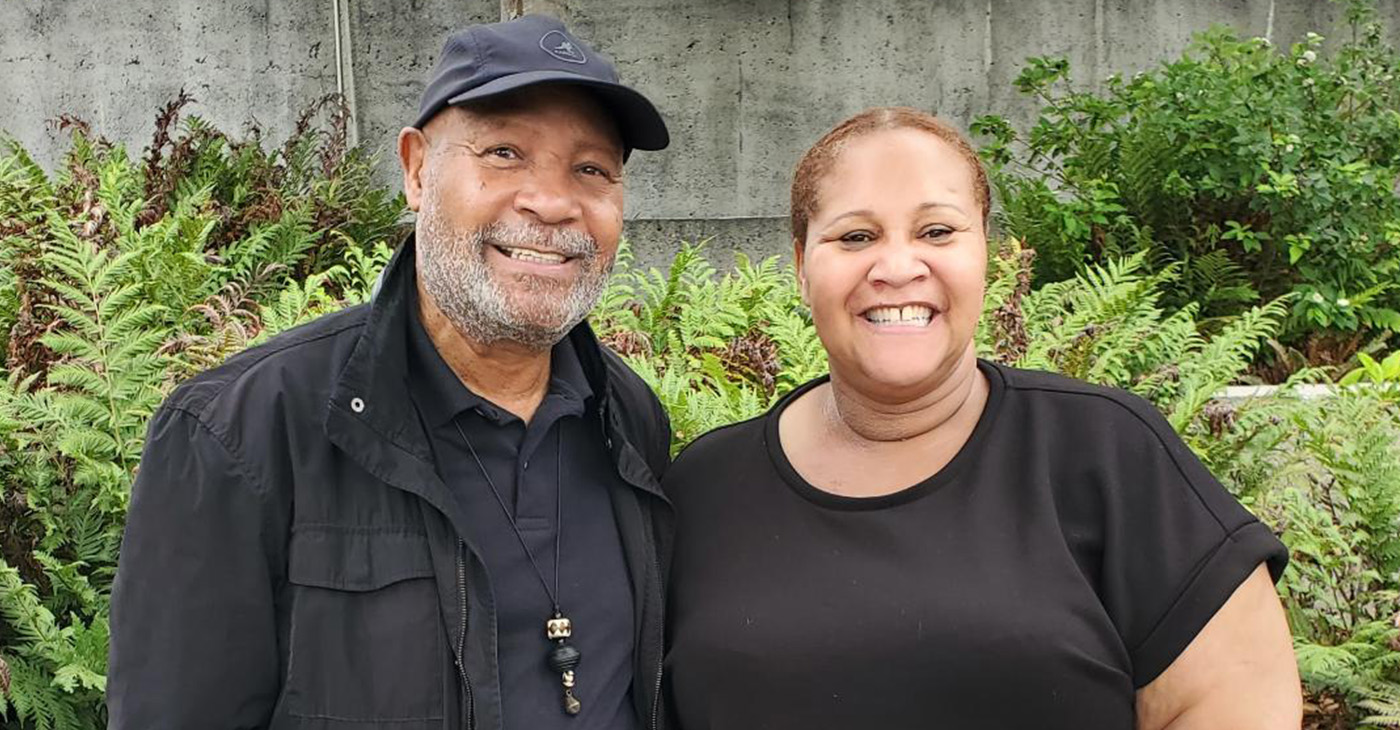
During the post-performance meet-and-greet in the (OMCA) Oakland Museum of California garden, Gabriel’s father posed for photos with family and friends.
“I am proud of her and her ability to share her truth,” he said. “She has a gift and she’s sharing it with the world.”
Shona Pratt, the daughter of the late BPP member Geronimo Pratt, also attended to support Gabriel. Pratt and Gabriel, known as Panther Cubs (children of the Black Panther Party), shared their experience on a panel in Richmond last year.
“Meres-Sia did a great job today,” said Pratt. “It was very powerful.”
Meres-Sia Gabriel was born and raised in Oakland, California. A graduate of Howard University in Washington, D.C., and Middlebury College School in France, Gabriel serves as a French instructor and writing coach.
Activism
The Past and Future of Hip Hop Blend in Festival at S.F.’s Midway
“The Music and AI: Ethics at the Crossroads” panel featured X.Eyee, CEO of Malo Santo and senior advisor for UC Berkeley’s AI Policy, Sean Kantrowitz, director of media and content @Will.I.A.’s FYI, Adisa Banjoko of 64 Blocks and Bishop Chronicles podcast, and Julie Wenah, chairwoman of the Digital Civil Rights Coalition.
By Carla Thomas
“Cultural Renaissance,” the first-ever SF Hip-Hop conference, occurred at The Midway at 900 Marin St. in San Francisco on July 18 and 19. Held across three stages, the event featured outdoor and indoor performance spaces, and a powerful lineup of hip-hop icons and rising artists.
Entertainment included Tha Dogg Pound, celebrating their 30th anniversary, Souls of Mischief, and Digable Planets. “Our organization was founded to preserve and celebrate the rich legacy of Hip-Hop culture while bringing the community together,” said SF Hip-Hop Founder Kamel Jacot-Bell.
“It’s important for us to bring together artists, innovators, and thought leaders to discuss how hip-hop culture can lead the next wave of technological and creative transformation,” said Good Trouble Ventures CEO Monica Pool-Knox with her co-founders, AJ Thomas and Kat Steinmetz.
From art activations to cultural conversations, the two-day event blended the intersections of AI and music. Panels included “Creative Alchemy – The Rise of the One-Day Record Label,” featuring producer OmMas Keith, composer-producer Rob Lewis, AI architect-comedian Willonious Hatcher, and moderator-event sponsor, AJ Thomas.
“The Legends of Hip-Hop and the New Tech Frontier” panel discussion featured hip-hop icon Rakim, radio personality Sway, chief revenue officer of @gamma, Reza Hariri, and music producer Divine. Rakim shared insights on culture, creativity, and his A.I. start-up NOTES.
“AI is only as good as the person using it,” said Rakim. “It cannot take the place of people.”
Rakim also shared how fellow artist Willonious helped him get comfortable with AI and its power. Rakim says he then shared his newfound tool of creativity with business partner Divine.
The panel, moderated by the Bay Area’s hip-hop expert Davey D, allowed Divine to speak about the music and the community built by hip-hop.
“Davey D mentored me at a time when I had no hope,” said Divine. “Without his support, I would not be here on a panel with Rakim and Willonious.”
Hatcher shared how his AI-produced BBL Drizzy video garnered millions of views and led to him becoming one of Time magazine’s 100 most influential AI creators.
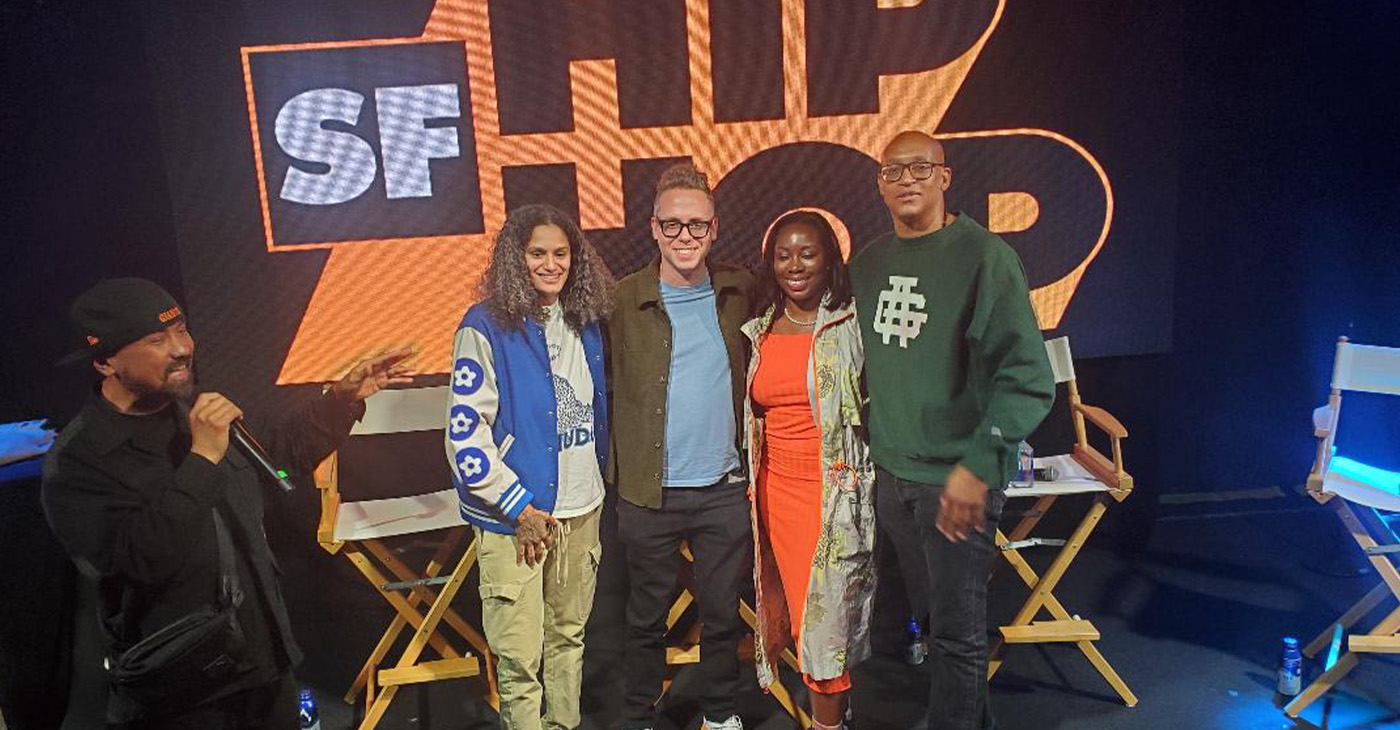
“The Music and AI: Ethics at the Crossroads” panel featured X.Eyee, CEO of Malo Santo and senior advisor for UC Berkeley’s AI Policy, Sean Kantrowitz, director of media and content @Will.I.A.’s FYI, Adisa Banjoko of 64 Blocks and Bishop Chronicles podcast, and Julie Wenah, chairwoman of the Digital Civil Rights Coalition.
“Diverse teams solve important questions such as: ‘How do we make sure we bring diverse people to the table, with diverse backgrounds and diverse lived experiences, and work together to create a more culturally sound product,’” said Wenah.
Self-taught developer, X.Eyee said, “You have to learn the way you learn so you can teach yourself anything. Future jobs will not be one roadmap to one individual skill; you will be the orchestrator of teams comprised of real and synthetic humans to execute a task.”
Activist Jamal Ibn Mumia, the son of political prisoner Mumia Abu Jamal, greeted Black Panther Party illustrator Emory Douglas, who was honored for his participation in the Black Power Movement. Douglas was presented with a statue of a black fist symbolizing the era.
“It’s an honor to be here and accept this high honor on behalf of the Black Panther Party,” said Douglas, holding the Black Power sculpture. “It’s an art (my illustrations) that’s been talked about. It’s not a ‘me’ art, but a ‘we’ art. It’s a reflection of the context of what was taking place at the time that inspired people.
“To be inspired by is to be in spirit with, to be in spirit with is to be inspired by, and to see young people continue on in the spirit of being inspired by is a very constructive and powerful statement in the way they communicate,” Douglas said.
His work embodied the soul of the Black Panther Party, and as its minister of culture and revolutionary artist, he definitely keeps the Panther Party soul alive, and his work is everywhere.
“Brother Emory Douglas is an icon in the community,” said JR Valrey of the Block Report.
“Fifty years later, he’s still standing,” said Ibn Mumia, raising his fist in the traditional Black Power salute.
“Emory is a living legend and so deserving of this award,” Valrey said. “We have to honor our elders.”
Activism
Mayor Lee’s Economic Development Summit at Oakstop Furthers Creative Strategies for Oakland’s Future
Oakstop’s workforce development initiative, “The Oakstop Effect: WFD,” focuses on providing pathways to employment and advancement for Black adults aged 18–64. Through culturally relevant, mission-driven training facilitated by Black professionals with relatable backgrounds, the program creates supportive environments for skill-building, wealth creation, and worker empowerment.

By Carla Thomas
On Monday, Aug. 4, Oakland Mayor Barbara Lee convened the Mayor’s Economic Development Working Group at Oakstop, drawing leaders from business, workforce development, arts and culture, education, small business, and community organizations.
This initiative builds on the administration’s deep-rooted community engagement efforts, expanding on the dozens of roundtables and listening sessions conducted during Lee’s first 76 days in office.
The collaborative session aimed to shape an economic strategy rooted in equity, creativity, and community using the mayor’s five-point economic plan, including empowering small businesses, strengthening the local workforce, revitalizing Oakland’s cultural and social landscape, attracting and retaining strategic sectors, and ensuring economic opportunity for all communities.
During breakout sessions, participants shared recommendations across five focus areas: economic policy, small business support, workforce development, narrative change, and integration of arts and culture.
More than 100 participants at the meeting, which included former Alameda County Supervisor Keith Carson, Black Cultural Zone CEO Carolyn Johnson, East Oakland Youth Development Center CEO Selena Wilson, African American Sports and Entertainment Group founder, Ray Bobbitt, Executive Director of the Oakland School for the Arts Mike Oz, Visit Oakland Executive Director Peter Gamez and activist-artist Kev Choice.
“Our economic development working group aims to spark collaboration, uplift existing successes, and identify what’s needed to keep The Town open for business — vibrant, safe, and rooted in equity,” said Lee remarked at the gathering.
Oakstop founder and CEO Trevor Parham stated that the summit felt like an open community forum. “It’s critical to have as many perspectives as possible to drive solutions so we can cover not only our concerns, but fulfill our economic mission,” said Parham.
Parham says the community should expect summits and collaborations more often at Oakstop. “I’m excited about the prospects and the outcomes from bringing people from different industry sectors as well as different levels.”
Oakstop’s workforce development initiative, “The Oakstop Effect: WFD,” focuses on providing pathways to employment and advancement for Black adults aged 18–64. Through culturally relevant, mission-driven training facilitated by Black professionals with relatable backgrounds, the program creates supportive environments for skill-building, wealth creation, and worker empowerment.
“Our goal is to foster worker power for local workers, to build wealth, while building skills and redefining the workplace,” said Parham.
The program is powered through partnerships with organizations such as Philanthropic Ventures Foundation and Community Vision. Beyond workforce development, Oakstop offers co-working spaces, event venues, art galleries, and mental health and wellness programs — reinforcing its mission of community empowerment and economic mobility.
With a strategic equity framework, cultural and economic integration, and a continuous pipeline of sustainable talent, Lee plans to revitalize the Oakland economy by creating policies and opportunities that stabilize the city.


WORK FROM HOME
Home-based business with potential monthly income of $10K+ per month. A proven training system and website provided to maximize business effectiveness. Perfect job to earn side and primary income. Contact Lynne for more details: Lynne4npusa@gmail.com 800-334-0540


Oakland Post: Week of December 31, 2025 – January 6, 2026

Big God Ministry Gives Away Toys in Marin City

First 5 Alameda County Distributes Over $8 Million in First Wave of Critical Relief Funds for Historically Underpaid Caregivers

2025 in Review: Seven Questions for Assemblymember Lori Wilson — Advocate for Equity, the Environment, and More

2025 in Review: Seven Questions for Assemblymember Tina McKinnor, Champion of Reparations, Housing and Workers’ Rights

2025 in Review: Seven Questions for Sen. Laura Richardson, Who Made Legislative History This Year

2025 in Review: Seven Questions for Sen. Lola Smallwood-Cuevas – an Advocate for Jobs and Justice

Alfred Cralle: Inventor of the Ice Cream Scoop

BOOK REVIEW: Let Me Be Real With You

Oakland Post: Week of December 24 – 30, 2025

Bling It On: Holiday Lights Brighten Dark Nights All Around the Bay

Oakland Council Expands Citywide Security Cameras Despite Major Opposition

Lu Lu’s House is Not Just Toying Around with the Community

Desmond Gumbs — Visionary Founder, Mentor, and Builder of Opportunity

Families Across the U.S. Are Facing an ‘Affordability Crisis,’ Says United Way Bay Area

Oakland Post: Week of November 19 – 25, 2025

Oakland Post: Week of November 26 – December 2, 2025

Seth Curry Makes Impressive Debut with the Golden State Warriors

LIHEAP Funds Released After Weeks of Delay as States and the District Rush to Protect Households from the Cold

Seven Steps to Help Your Child Build Meaningful Connections

Beyoncé and Jay-Z make rare public appearance with Lewis Hamilton at Las Vegas Grand Prix

Seven Steps to Help Your Child Build Meaningful Connections

Lewis Hamilton set to start LAST in Saturday Night’s Las Vegas Grand Prix

Post Salon to Discuss Proposal to Bring Costco to Oakland Community meeting to be held at City Hall, Thursday, Dec. 18

Trinidad and Tobago – Prime Minister Confirms U.S. Marines Working on Tobago Radar System

FBI Report Warns of Fear, Paralysis, And Political Turmoil Under Director Kash Patel

Teens Reject Today’s News as Trump Intensifies His Assault on the Press

Mayor Lee, City Leaders Announce $334 Million Bond Sale for Affordable Housing, Roads, Park Renovations, Libraries and Senior Centers

Thanksgiving Celebrated Across the Tri-State

Oakland Post: Week of December 10 – 16, 2025

Hyundai Ioniq 5 Parking, Safety, and 360 View #shorts

2025 Ioniq 5 New Wiper & Powerful Performance! #shorts

Electric SUV Range: Is 259 Miles Enough? #shorts

EV Charging: How Fast Can You Charge an Electric Vehicle? #shorts

Biometric Cooling… Messaging Seats…Come on! 2025 Infiniti QX80 Autograph 4WD

Charged Up: Witness the Magic of a Fully Electric Car! #shorts

Range Rover Sport PHEV Included…: See What’s Inside This Luxury SUV! #shorts

Invisible Hood View: Perfect Parking with X-Ray Vision! #shorts

AI Is Reshaping Black Healthcare: Promise, Peril, and the Push for Improved Results in California

ESSAY: Technology and Medicine, a Primary Care Point of View

Sanctuary Cities

The RESISTANCE – FREEDOM NOW

STATE OF THE PEOPLE: Freddie

ECONOMIC BOYCOTT DAY!!!!!

I told You So
-
 Bay Area3 weeks ago
Post Salon to Discuss Proposal to Bring Costco to Oakland Community meeting to be held at City Hall, Thursday, Dec. 18
-
 Activism3 weeks ago
Mayor Lee, City Leaders Announce $334 Million Bond Sale for Affordable Housing, Roads, Park Renovations, Libraries and Senior Centers
-
 Activism3 weeks ago
Oakland Post: Week of December 10 – 16, 2025
-
 Activism3 weeks ago
Oakland School Board Grapples with Potential $100 Million Shortfall Next Year
-

 Arts and Culture3 weeks ago
Fayeth Gardens Holds 3rd Annual Kwanzaa Celebration at Hayward City Hall on Dec. 28
-

 Activism3 weeks ago
2025 in Review: Seven Questions for Black Women’s Think Tank Founder Kellie Todd Griffin
-

 Advice3 weeks ago
COMMENTARY: If You Don’t Want Your ‘Black Card’ Revoked, Watch What You Bring to Holiday Dinners
-

 Activism3 weeks ago
Ann Lowe: The Quiet Genius of American Couture
