
Activism
Local Black Leaders Break Silence on “Politicization” of Oakland NAACP Branch
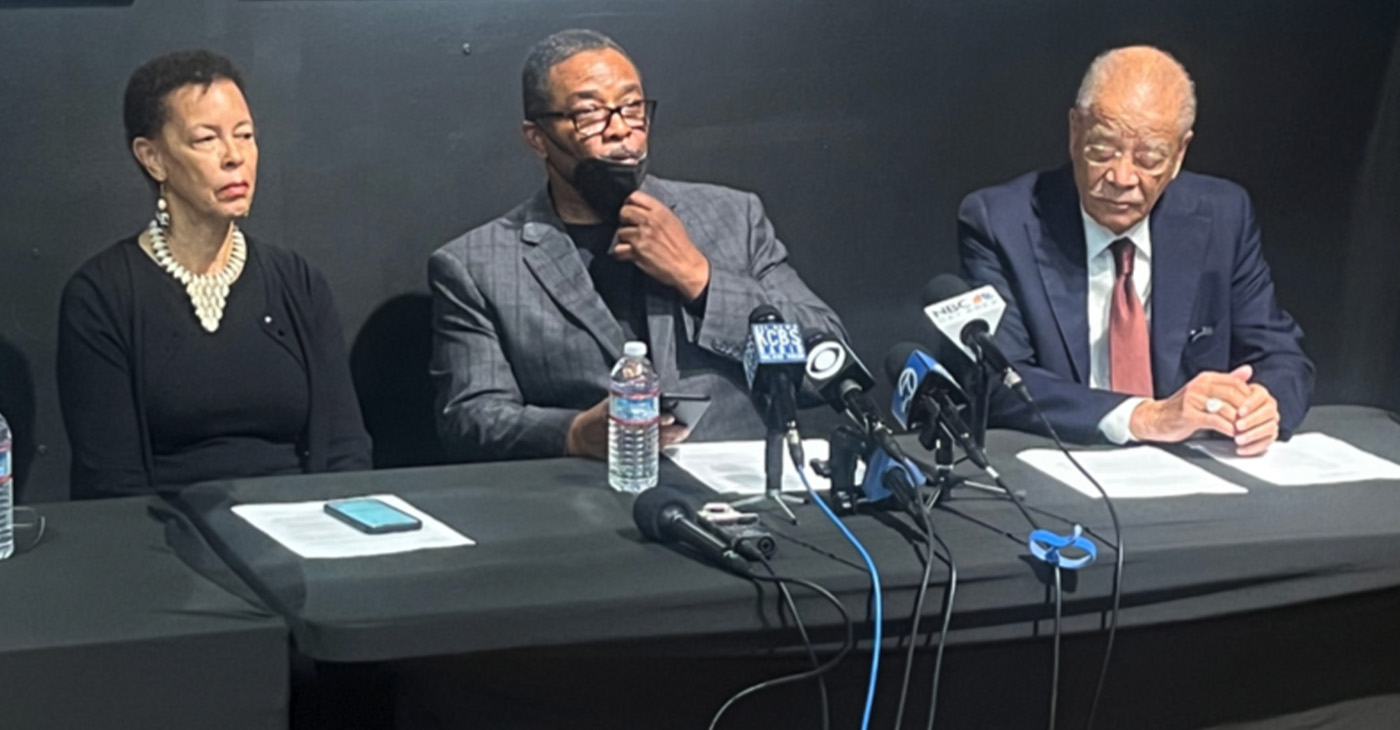
Several lifelong NAACP members, including Black Business Round Table host Doug Blacksher and civil rights attorney Walter Riley, held a press conference this week criticizing the conduct of the Oakland NAACP chapter for its attacks on criminal justice reform and on reformer Black DA Pamela Price, the repetition of false narratives about crime and criminal justice, and the use of historic fear-mongering that props up the system of mass incarceration.

By Ken Epstein
Several lifelong NAACP members, including Black Business Round Table host Doug Blacksher and civil rights attorney Walter Riley, held a press conference this week criticizing the conduct of the Oakland NAACP chapter for its attacks on criminal justice reform and on reformer Black DA Pamela Price, the repetition of false narratives about crime and criminal justice, and the use of historic fear-mongering that props up the system of mass incarceration.
The speakers also said the Oakland NAACP has acted in alliance with Republican anti-Black and anti-democratic forces and served as a vehicle for the self-interest actions of failed candidates in opposition to the national NAACP’s promulgated policy and positions.
Oakland “NAACP leadership is reverting to lies, fear-mongering, and the ‘tough-on-crime’ rhetoric that has targeted African Americans throughout our entire history in this country, evoking stereotypical narratives of Black criminality that maintains the United States incarcerating more Black people than there were enslaved Africans,” said Blacksher, in a media release.
“We call upon the national NAACP to reign in the Oakland Chapter and demand that Branch 1051 align itself with the mandate of the national NAACP such as addressing policies that unfairly target or penalize Black people in the criminal justice system,” Blacksher said.
Speakers at the press conference, held Tuesday at the Dr. Huey P. Newton Center for Research & Action at 1427 Broadway in Oakland were: Blacksher and Riley, as well as Chaney Turner, Oakland-born entrepreneur and organizer; Desmond Jeffries, Oakland activist; and Cathy Leonard, longtime police accountability activist.
“Interestingly, when previous district attorneys were overcharging African Americans with excessive sentences and previous councils presided over unprecedented Black displacement and homelessness, the (Oakland) NAACP was silent. Now, they are taking positions and aligning themselves with those who wish a return to the unjust status quo,” said Leonard, an Oakland native.
Riley said the Oakland NAACP chapter is working against policies and positions that the national NAACP supports. “We seek to be in alignment with the national NAACP on topics of education, public safety, housing and economic justice, but our chapter constantly contradicts this aspiration,” he said.
In a letter to national NAACP President Derrick Johnson, the press conference organizers accused current Oakland NAACP leaders of advocating conservative positions that align with the Republican Party, such as “singular support of charter school (Board of Education) candidates, efforts to recall the first Black female District Attorney in our county’s history, support (for) legislation that defunds public education in favor of tax breaks for the powerful real estate lobby over renters, and taking payouts from big tobacco and big pharmaceutical corporations.”
Letter signers included press conference speakers Blacksher, Riley, and Leonard, as well as Millie Cleveland, retired SEIU 1021 Field Representative; Ben “Coach” Tapscott, public education advocate; and Sheryl Walton, community activist and Oakland native.
The letter signers said that as NAACP members, they support formal positions taken by the East Bay Stonewall Democratic Club and the Alameda County Democratic Party denouncing the hateful accusations and homophobic statements made by Oakland NAACP leader Seneca Scott.
According to the letter, Oakland NAACP leaders are utilizing Republican talking points to attack “women of color who are currently serving in Oakland, creating stark divisions in the public discourse,” and seeking to “agitate people around a divisive, yet organizable conservative agenda.”
The letter said local NAACP leaders are seeking to misdirect people on the sources of crime and disorder in Oakland, instead blaming ‘wokeness,’ progressive policies, ‘liberal Democrats,’ and debunked claims that ‘defund the police’ are the sources of everything wrong in the city.”
Proposals for reform of the Oakland chapter include:
- “Cease the spread of false information. Factcheck first.”
- Remove any member, officer, or former elected official …who seeks to weaponize Oakland NAACP for personal gain.
- Disentangle the Oakland NAACP from the political agenda of the Alameda County Republican Party.
- “Reject all connections with Sam Singer,” a corporate public relations operative.
- “Provide transparency on all financial contributions.”








Activism
Oakland Post: Week of March 18 – 24, 2026
The printed Weekly Edition of the Oakland Post: Week of March 18 – 24, 2026

To enlarge your view of this issue, use the slider, magnifying glass icon or full page icon in the lower right corner of the browser window.
Activism
Oakland Post: Week of March 11 -17, 2026
The printed Weekly Edition of the Oakland Post: Week of March 11 – 17, 2026
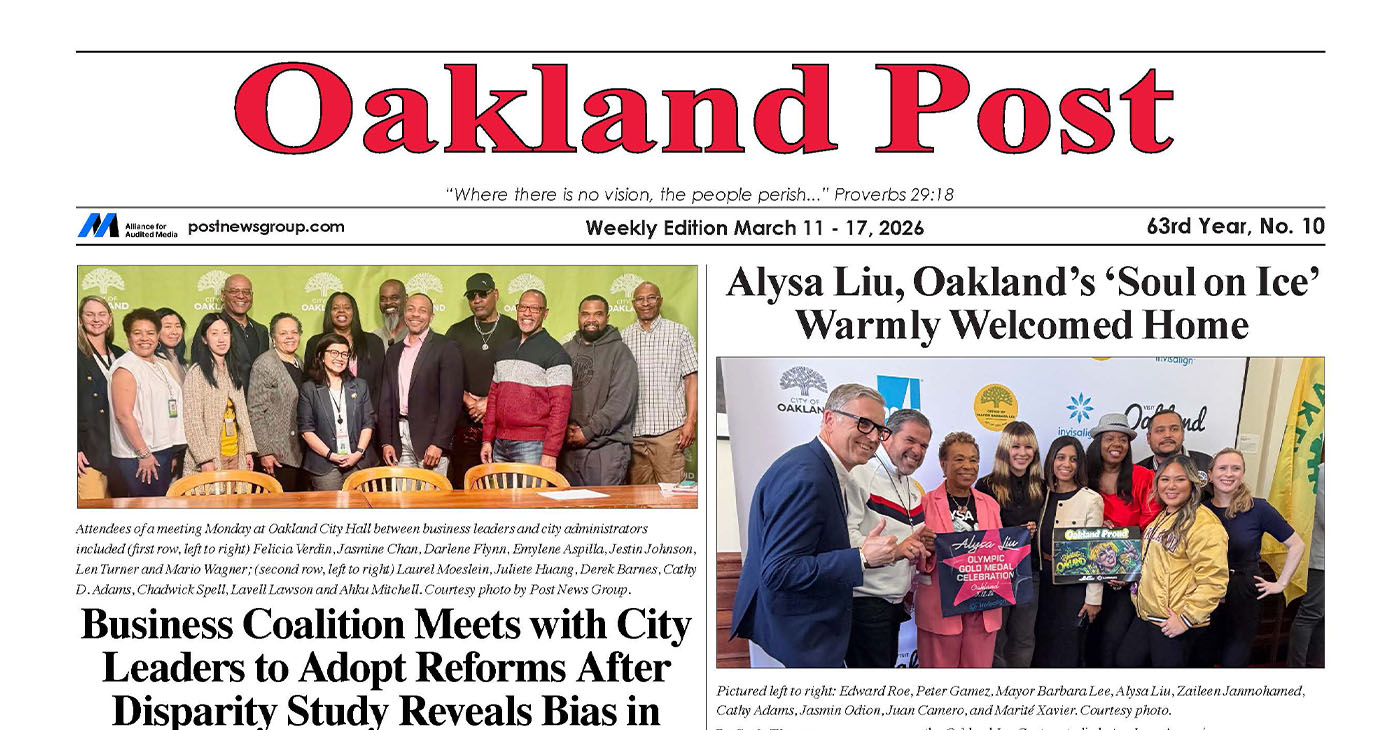
To enlarge your view of this issue, use the slider, magnifying glass icon or full page icon in the lower right corner of the browser window.
Activism
Oakland Post: Week of March 4 – 10, 2026
The printed Weekly Edition of the Oakland Post: Week of March 4 – 10, 2026

To enlarge your view of this issue, use the slider, magnifying glass icon or full page icon in the lower right corner of the browser window.


WORK FROM HOME
Home-based business with potential monthly income of $10K+ per month. A proven training system and website provided to maximize business effectiveness. Perfect job to earn side and primary income. Contact Lynne for more details: Lynne4npusa@gmail.com 800-334-0540


Black Artists in America, Installation Three Wraps at the Dixon Gallery and Gardens

Grief, Advocacy, and Education: A Counselor Reflects on Black Maternal Health

Future of Florida’s Black History Museum in Limbo

New Research Shows the Many Benefits of Early Learning

South Hampton K-8 Students Among Top 10 Finalists for Samsung’s ‘Solve for Tomorrow’ Competition

Cuba: No Negotiation with US on the President or Political System

Brooklyn Academy of Music Names Jamaican-Born Tamara McCaw as President

Trinidad & Tobego – U.S. Launches WhatsApp Channel for American Citizens in the Country

Oakland Post: Week of March 18 – 24, 2026

AI Innovation vs. Ethics and Environmental Impact

AI, Web3, and Digital Reparations

What If You Owned Your AI Agent?

Season 7, Episode 3 – January Reporter’s Roundtable 📱

Season 7, Episode 3 – January Reporter’s Roundtable

AI, Media, and Power | Part 2, Real-World Impacts and Tradeoffs

Reflecting on Black History Milestones in Birmingham AL

CITY OF SAN LEANDRO STATE OF CALIFORNIA PUBLIC WORKS DEPARTMENT ENGINEERING DIVISION NOTICE TO BIDDERS FOR ANNUAL STREET OVERLAY/REHABILITATION 2019-21 – PHASE III

Oakland Post: Week of February 18 – 24, 2026

Oakland Post: Week of February 25 – March 3, 2026

PRESS ROOM: NBA Hall of Fame Nominee Terry Cummings Joins 100 Black Men of DeKalb County to Launch Victory & Values Initiative

Trump’s MAGA Allies are Creating Executive Order Plan to Steal the 2026 Midterms

Oakland Post: Week of March 4 – 10, 2026

Chase Oakland Community Center Hosts Alley-Oop Accelerator Building Community and Opportunity for Bay Area Entrepreneurs

U.S. manufacturing rebounds – how foundry services are adapting to rising demand

Poll Shows Support for Policies That Help Families Afford Child Care

OP-ED: One Hundred Years of Black Workers Telling the Truth

Advancements in solar technology that are changing the way we power the world

Woman’s Search for Family’s Roots Leads to Ancestor John T. Ward – A Successful Entrepreneur and Conductor on the Underground Railroad

PRESS ROOM: Civil Rights TV Launches in Selma as the World’s First 24/7 Civil Rights Television Network

Oakland Post: Week of March 11 -17, 2026

Hyundai Ioniq 5 Parking, Safety, and 360 View #shorts

2025 Ioniq 5 New Wiper & Powerful Performance! #shorts

Electric SUV Range: Is 259 Miles Enough? #shorts

EV Charging: How Fast Can You Charge an Electric Vehicle? #shorts

Biometric Cooling… Messaging Seats…Come on! 2025 Infiniti QX80 Autograph 4WD

Charged Up: Witness the Magic of a Fully Electric Car! #shorts

Range Rover Sport PHEV Included…: See What’s Inside This Luxury SUV! #shorts

Invisible Hood View: Perfect Parking with X-Ray Vision! #shorts

AI Is Reshaping Black Healthcare: Promise, Peril, and the Push for Improved Results in California

ESSAY: Technology and Medicine, a Primary Care Point of View

Sanctuary Cities

The RESISTANCE – FREEDOM NOW

STATE OF THE PEOPLE: Freddie

ECONOMIC BOYCOTT DAY!!!!!

I told You So
-
 Activism4 weeks ago
Oakland Post: Week of March 4 – 10, 2026
-
 #NNPA BlackPress4 weeks ago
Woman’s Search for Family’s Roots Leads to Ancestor John T. Ward – A Successful Entrepreneur and Conductor on the Underground Railroad
-
 Activism3 weeks ago
Oakland Post: Week of March 11 -17, 2026
-

 #NNPA BlackPress4 weeks ago
COMMENTARY: Women of Color Shape Our Past and Future
-

 #NNPA BlackPress4 weeks ago
OP-ED: NNPA Launches 2026 “Leadership Matters” Video Series
-

 #NNPA BlackPress4 weeks ago
Advocates Raise Alarm Over ICE Operation, MOU and Detention Risks in Baltimore County
-

 #NNPA BlackPress4 weeks ago
Pete Buttigieg to Join Mayor Randall Woodfin for Community Town Hall in Birmingham
-

 Advice3 weeks ago
Financial Wellness and Mental Health: Managing Money Stress in College
