
#NNPA BlackPress
Miami Grand Prix 2023
NNPA NEWSWIRE — The only Black man to have raced in Formula 1, British driver Lewis Hamilton, 38, has won more and been the fastest qualifier more times than any other driver, triggering racist social-media diatribes from motorsports fans used to their Nomex-clad heroes being White-only.
The post Miami Grand Prix 2023 first appeared on BlackPressUSA.


MIAMI GARDENS, FL – Chattering happily, rocking garb worn to ward off an unrelenting South Florida sun, scores of Black faithful exuberantly trudge toward their place of Sunday worship – Hard Rock Stadium, home of the NFL’s Miami Dolphins.
The 20 helmeted deities to be exalted this afternoon probably couldn’t toss a perfect spiral if their lives depended on it, and their average weight is a dinky 148 pounds. But they drive the hell out of nimble, 1,000-horsepower winged cars better than anyone on the planet, and are led by a Black high priest whose seven world championships and 103 career victories make him the hands-down G.O.A.T.
Welcome to the Formula 1 Crypto.Com Miami Grand Prix 2023, the fifth round of a traveling circus that will hit 24 global racing venues this year and is viewed as the pinnacle of motorsport. Formula 1’s irrepressible Black king, British driver Lewis Hamilton, 38, has drawn the sport’s ire for speaking truth to power, to include kneeling atop racetracks while clad in a Black Lives Matter T-shirt, to protest the police executions of George Floyd and Breonna Taylor.
The only Black man to have raced in Formula 1, Hamilton has won more and been the fastest qualifier more times than any other driver, triggering racist social-media diatribes from motorsports fans used to their Nomex-clad heroes being White-only.
The only Formula 1 icon with 103 wins and 103 pole positions, Hamilton was victimized by an inexplicable, last-second rules change during the last lap of the last race of 2021, which was held in Abu Dhabi. As a result, Hamilton, who entered Formula 1 in 2007 and currently drives for the Mercedes-AMG Petronas team, was controversially deprived of a chance to win a record-setting eighth world championship.
His otherworldly talent, off-track fashionista flair, and even his affluence (Forbes says Hamilton raked in $55 million in 2022, excluding endorsements), spurred a noticeable Black presence among the more than 270,000 fans who attended three days of Miami Grand Prix festivities May 5, 6 and 7. Easily half of the melanated faces in the crowd were crowned by baseball caps emblazoned with Mercedes’ distinctive tri-star logo.
Without Hamilton in the field, it’s doubtful there would have been pre-race pageantry featuring Venus and Serena Williams standing near the start/finish line of a twisty, makeshift 3.36-mile asphalt track winding around Hard Rock Stadium. The Williams sisters smiled appreciatively as showman LL Cool J bombastically introduced each of the contest’s 20 drivers, while will.i.am theatrically led a string orchestra providing background music.
The Miami Grand Prix is more than a contest where cars routinely hit 210 mph while traversing a 19-turn course lined by unforgiving concrete barriers. It’s part sporting event, part over-the-top party leavened with plenty of palm trees, more celebs than you can shake a stick at, blaring reggaeton and sumptuous food and drink prepared by worldclass chefs and mixologists.
Moko, a colorfully dressed native of Senegal who’s traveling to each of Formula 1’s 24 races in 2023, wouldn’t have it any other way.
“I look at Formula 1 like art, in a way,” says Moko, who idolizes Juan Manuel Fangio, a charismatic Argentinian driver who seized the world championship in 1951, 1954, 1955, 1956 and 1957, before Moko was born. “I like the duality between the machine and the human being.
“It’s hard to explain, but I’m going to give it to you the African way — it’s like you’re dancing with the woman you love, and if you don’t dance right, the woman can kill you,” Moko laughs. “And the woman is the car!”
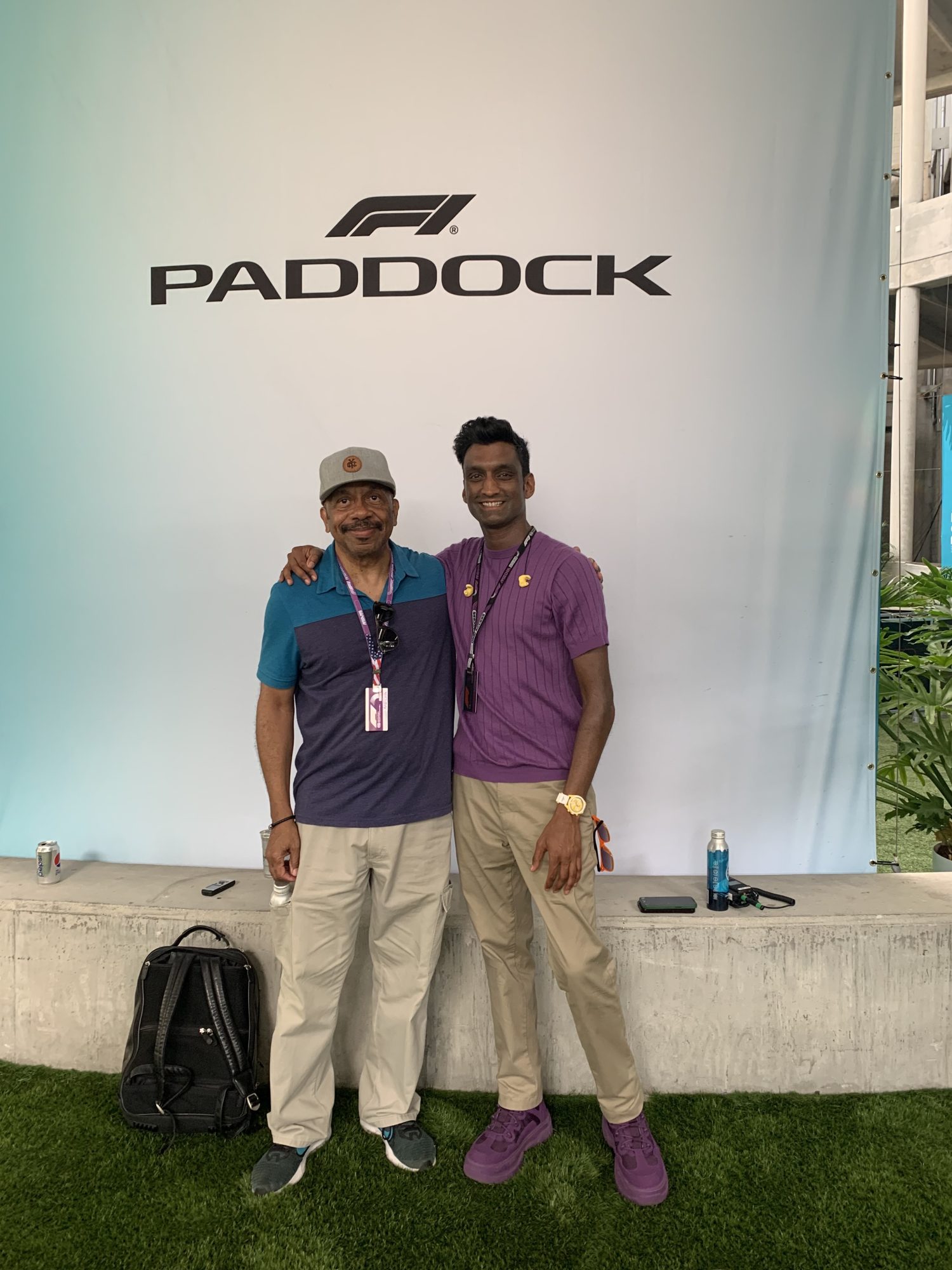
As for the financial impact of the Miami Grand Prix, where $100 earns you the privilege of strolling around the sprawling Miami International Autodrome campus for a single day, without getting a place to sit, Moko shrugs. “If you love something and you can afford it, why not?”
Unlike Moko, saxophone player Bismarck Morgan traveled only 60 miles from West Palm Beach. “I think there’s a great atmosphere here, and I think it’s important for people to come and make a decision for themselves,” Morgan says. “You get in and it’s a very wonderful and beautiful atmosphere. It’s easy to sit on the outside of something and have an opinion of it, but when you get there, it’s actually a beautiful place.
“There are plenty of people from around the world here, people of color from India, Dubai. It’s a beautiful thing, and I love the sound of race cars, I love the revving of the engines. It gets your blood flowing.”
Lewis Hamilton, who drives a W14 Mercedes-AMG road rocket propelled by a 1.6-liter, V6 engine and an electric motor hooked to a rechargeable battery, has noticed a change in the hue of Grand Prix crowds since he joined the Grand Prix circuit 16 years ago.
“For the first five or ten years or so, I didn’t see many people of color in the grandstands,” says Hamilton, whose Mercedes-AMG Petronas team has an annual budget exceeding $300 million. “There were very few people of color. It was not as diverse as I might have hoped.”
However, Hamilton is now “seeing a crowd that’s more diverse. That’s amazing to me to not be the only one there, which is nice to see. And it’s just great to be seeing that we’re tapping into those different cultures, those different communities, who perhaps once didn’t think (Formula 1 racing) was for them. “Because they didn’t see someone that looked like them in the sport, maybe.”
Just as Tiger Woods’ soul-crushing dominance drew more Black fans to golf tournaments, Lewis Hamilton’s championship-winning campaigns in 2008, 2014, 2015, 2017, 2018, 2019 and 2020 have lured new eyeballs to Formula 1.
So has the Netflix series “Formula 1: Drive to Survive,” which New England Patriots safety Adrian Phillips and his wife, pediatrician Camille Phillips, credit with attracting them to Miami Gardens to see Hamilton drive.
The couple watched Hamilton hustle his underperforming W14 Mercedes from 13th on the grid to a 6th-–place finish. Hamilton says that despite having subpar equipment this year, and finishing the Miami Grand Prix fourth in the driver standings with 56 points, compared with 119 for first-place Dutchman Max Verstappen, Hamilton will be back in 2024 and beyond.
Adrian and Camille Phillips say you can count them in, too.
The post Miami Grand Prix 2023 first appeared on BlackPressUSA.





#NNPA BlackPress
COMMENTARY: Women of Color Shape Our Past and Future
MINNESOTA SPOKESMAN RECORDER — Every March, Women’s History Month invites us to pause and honor the women whose courage, intellect, and leadership have shaped our world. This year, that invitation feels especially urgent. We are living in a time when history is being rewritten, when DEI is being recast as a threat, and when the stories we choose to uplift matter more than ever. The stories of women of color must be centered, celebrated, and carried forward with intention.

Women of Color Leadership Shapes the Legacy of Women’s History Month
By Dr. Sharon M. Holder | Minnesota Spokesman Recorder
Women’s History Month offers an opportunity to recognize the enduring impact of women of color leadership across history and in the present day. From Harriet Tubman and Shirley Chisholm to today’s leaders in science, politics and culture, women of color continue to shape movements, institutions and communities through courage, collaboration and vision.
Every March, Women’s History Month invites us to pause and honor the women whose courage, intellect, and leadership have shaped our world. This year, that invitation feels especially urgent. We are living in a time when history is being rewritten, when DEI is being recast as a threat, and when the stories we choose to uplift matter more than ever. The stories of women of color must be centered, celebrated, and carried forward with intention.
For centuries, women of color have been architects of progress, even when history tried to confine them to the margins. They have led movements, built institutions, transformed culture, and expanded the boundaries of justice, leadership, and community. Their contributions are not postscripts; they are landmarks. Yet too often, their brilliance has been acknowledged only in hindsight. Women’s History Month offers a chance to correct that imbalance, not only by remembering the past, but by recognizing their leadership unfolding before us.
This legacy lives in Harriet Tubman, whose courage and strategic brilliance transformed the Underground Railroad into one of the boldest freedom operations in American history. In Barbara Jordan, whose moral clarity reshaped the nation’s understanding of justice and constitutional responsibility. In Madam C. J. Walker, expanding both the beauty industry and the economic horizons of Black women. It dances in Josephine Baker, who challenged racism and resisted fascism. In Ida B. Wells and Dolores Huerta, who wielded truth and determination in pursuit of justice. In Chien-Shiung Wu, whose experiments altered science, and Shirley Chisholm, whose political courage expanded the very definition of leadership. These women did more than break barriers; they built new worlds.
A powerful throughline in the leadership of women of color is how they lead: collaboratively, creatively, relationally, and with deep responsibility to community. Their leadership is grounded not in hierarchy but in connection, in the belief that progress is something we build together.
We see this in Kamala Harris, whose presence expands the boundaries of possibility; in Ketanji Brown Jackson; in Oprah Winfrey; and in Toni Morrison, who insisted that the interior lives of Black women are essential to the human story. It resonates in Simone Biles and Serena Williams, redefining strength through excellence and self-belief.
Today, women of color continue to drive breakthroughs in medicine, technology, the arts, politics, and environmental justice. Their leadership appears not only in boardrooms or public office, but in mentorship, advocacy, and the daily navigation of systems never designed for them. The spirit shines in Mae Jemison and Ellen Ochoa; in Michelle Obama; and in the brilliance of Katherine Johnson, Dorothy Vaughan, Mary Jackson, and Christine Darden, whose work helped launch a nation into space.
Celebration is important, but it is not enough. Honoring women of color requires intentional action rooted in equity. It means creating environments where their voices are valued, challenging the biases that shape who is recognized, and ensuring progress is shared.
As we celebrate Women’s History Month, let us honor women of color not as symbols, but as leaders whose work continues to guide us. When we uplift women of color, we honor history and shape the future.
Dr. Sharon M. Holder lives in South Carolina. She holds a PhD/MPhil in Gerontology from the Center for Research on Aging at the University of Southampton, UK; a Master of Science in Gerontology from the Institute of Gerontology at King’s College London, UK; and a Master of Social Work from the Graduate College of Social Work at the University of Houston, Texas.
Dr. Holder discovered her love of poetry at the University of Houston–Downtown, where she published in The Bayou Review and the Anthology of Poetry. Today, she writes poetry as a practice of gratitude alongside her academic research.
#NNPA BlackPress
Woman’s Search for Family’s Roots Leads to Ancestor John T. Ward – A Successful Entrepreneur and Conductor on the Underground Railroad
THE AFRO — For years, she wanted to know more about her ancestor John T. Ward, she said, and her curiosity eventually became an obsession, leading her to become the genealogist for her family. And so, for more than a decade, she set out to trace her family’s roots and discovered a story that would change her life and the way she viewed American history.
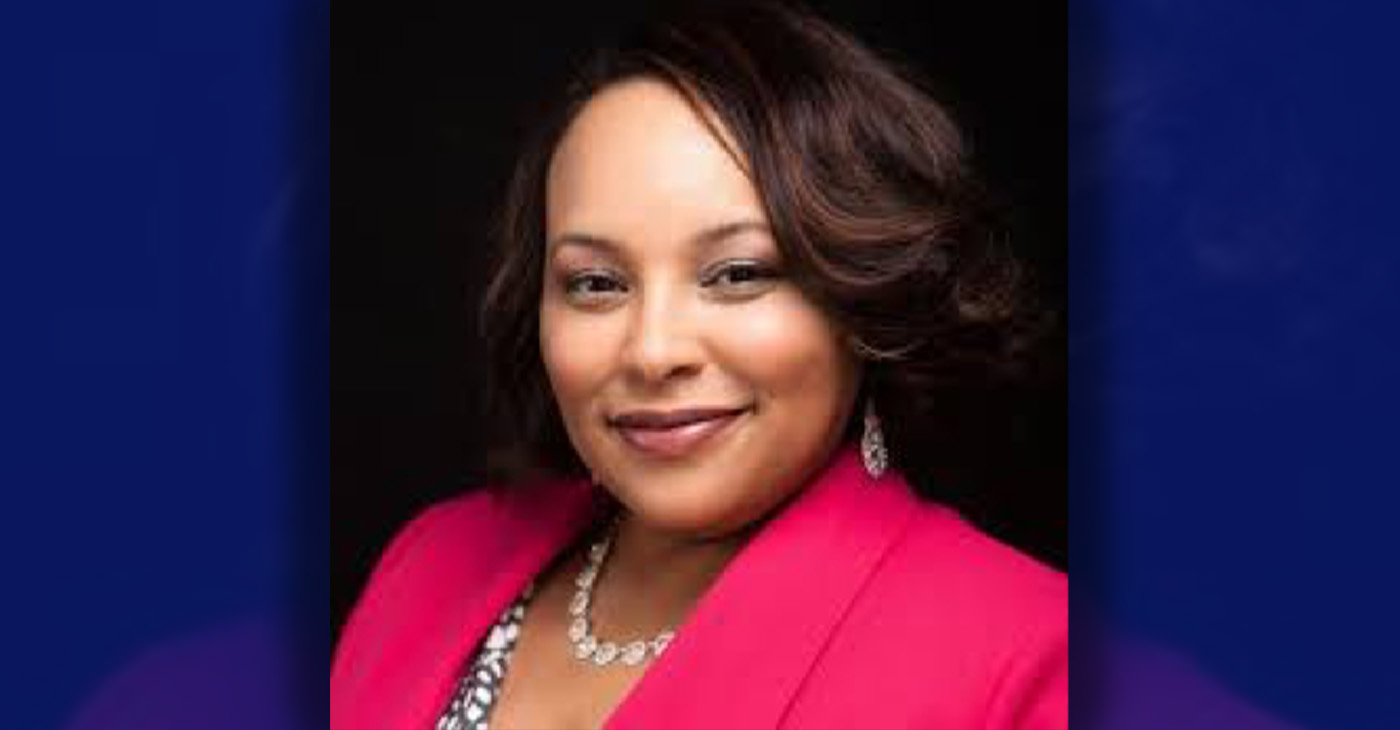
By D. Kevin McNeir | Special to The AFRO
Shanna Ward, the owner of a publishing company and insurance agency located in Columbus, Ohio, said the elders in her family often say she inherited her entrepreneurial spirit from one of their ancestors – a formerly enslaved child from Virginia whose freedom came through manumission in 1827.
For years, she wanted to know more about her ancestor John T. Ward, she said, and her curiosity eventually became an obsession, leading her to become the genealogist for her family. And so, for more than a decade, she set out to trace her family’s roots and discovered a story that would change her life and the way she viewed American history.
John T. Ward would help others secure their freedom and justice in his roles as a conductor on the Underground Railroad, an abolitionist, and political activist. But realizing that economic freedom was essential to his and his family’s survival, he and his son founded the Ward Transfer Line in 1881 (now E.E. Ward Moving) – one of America’s oldest Black-owned businesses. While it has transferred ownership, the business remains in operation today.
Shanna Ward recently published a book about her ancestor, “The Bequest of John T. Ward,” which she hopes can be added to other unheralded tales of Black resistance that occurred during America’s antebellum period.
“Originally, I just wanted to write a 100-page story when I first began digging and was encouraged after I found a copy of a will dated 1827 which included him and was a rare example of a mass manumission,” Shanna Ward said. “Three of the slaves, including John’s grandfather, were given about 294 acres of land in the will, but all the former slaves were supposed to remain on the plantation until their 21st birthday. Some refused to remain. That’s how our family got to Ohio.”
Ward said she learned that newly freed Blacks, including her ancestors in Ohio, had to fend for themselves and often did so with amazing results given the obstacles they faced.
“In those days there were no civil rights organizations, and in local communities, Blacks formed and supported Black-owned businesses, took their own census recordings, and became involved in local politics – all without White involvement,” she said.
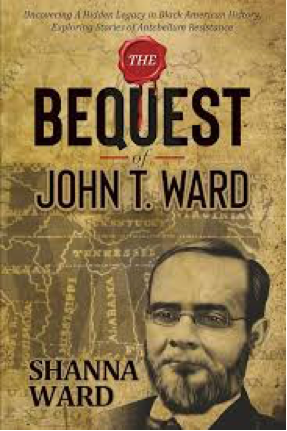
BOOK COVER: The cover of the book “The Bequest of John T. Ward,” written by Shanna Ward about her ancestor who, as a child, was granted his freedom in 1827 and went on to become a successful business owner in Ohio, a political activist, and a conductor on the historic Underground Railroad.
“There is part of Ohio where, during the days of slavery, if you successfully crossed the river you were free,” she said. “That was where Black life began – across the river in freedom. When we understand ourselves as more than property and uncover tales of survival which are the foundation of our legacy, then we can better understand who we are and what our ancestors endured. We are stronger than we are often led to believe.”
Efforts among African Americans to learn their family roots have increased over the past several decades, particularly given the success of the PBS documentary, “Finding Your Roots,” hosted and narrated by Harvard University professor Dr. Henry Louis Gates Jr.
On the show’s website, Gates said he developed the show in 2012 in efforts to continue his quest to “get into the DNA of American culture.”
In each episode, celebrities view ancestral histories and share their emotional experience with viewers. Gates attributes the success of the show to a significant surge in interest among Black Americans in tracing their family roots and a desire to reconnect with ancestral history that was severed by slavery.
JOHN T. WARD: John T. Ward, the historic patriarch in a family whose roots can be traced to the days of slavery in Virginia, is the subject of a new book written by a member of his proud family, Shanna Ward, called “The Bequest of John T. Ward.”
“Advancements in DNA testing have increased accessibility of records and led to a cultural push to reclaim identity beyond the ‘brick wall’ of 1870,” said Gates who noted that the 1870 U.S. Census represents the first time former slaves were listed by name and, unfortunately, serves as the point where records of their lives often stop and cannot be traced any earlier.
In a recent paper published in the journal “American Anthropologist,” University of Illinois Urbana-Champaign anthropology professor LaKisha David posits that by using genetic genealogy, African Americans now have the real possibility of restoring family narratives that were disrupted, severed and destroyed by institutional slavery.
“For African Americans who have grown up with a sense of ancestral loss and disconnection, this reclamation of family history is deeply humanizing and healing,” she writes. “It replaces the genealogical unknown with tangible knowledge of ancestral histories and kinship ties.
“Identifying African ancestors and living relatives is an act of restorative justice. It is ultimately about (re)claiming the humanity, dignity, and agency of enslaved Africans and their descendants, which is an essential component of repairing the harms of slavery.”
Ward said by uncovering her family’s truth, she has established a platform for education and empowerment for herself, her children, and today’s youth.
“I realized how important it is to pass down our own stories to the next generation,” Ward said. “There’s so much our children need to know about the Underground Railroad, the quilt codes created by Black women, and other examples of unrecorded heroics and bravery exhibited by Black men and women. Their collective efforts led to the end of Jim Crow laws and the securing of equal rights in the U.S. Constitution for African Americans. If you look hard enough, I believe everyone has someone like Harriet Tubman or Frederick Douglass in their family.”
#NNPA BlackPress
Advocates Raise Alarm Over ICE Operation, MOU and Detention Risks in Baltimore County
THE AFRO — “This is highly problematic given many of the charges that land people in county correctional facilities to begin with are for misdemeanors of which they may not even ultimately be proven guilty and convicted,” said Cathryn Ann Paul Jackson, public policy director for We Are CASA. “It results in a subversion of the local criminal justice system as a means to further racial profiling and do ICE’s dirty work.”

By Megan Sayles | AFRO Staff Writer
msayles@afro.com
As U.S. Immigration Customs and Enforcement (ICE) operations intensify nationwide, community organizations have become the eyes and ears of their neighborhoods—monitoring the agency’s presence and alerting residents to protect themselves and their neighbors.
In Baltimore County, nonprofits like We Are CASA have observed a spectrum of enforcement actions.
“We have seen a range of activity, including traffic stops and ICE showing up in neighborhoods or in seeming response to tips,” said Cathryn Ann Paul Jackson, public policy director for We Are CASA. “Beyond actual ICE activity in Baltimore County, we have seen many detentions of Baltimore County residents across the DMV, as community members tend to travel across counties and cities for work.”
We Are CASA, a national nonprofit headquartered in Maryland, is dedicated to empowering and improving the quality of life for working-class Black, Latino, Afro-descendent, Indigenous and immigrant communities. Jackson’s personal connection to this mission led her to the organization. A daughter of immigrants from Guyana and Trinidad, she said she grew up witnessing firsthand how immigration policy can define families’ safety, opportunity and sense of belonging.

She said the locations and times of ICE operations in Baltimore County have varied over time.
“We have consistently seen ICE arrest people at their check-in appointments, which were ironically created as an alternative to detention and are now being abused to trap people into custody,” said Jackson. “For a period of time, we were witnessing a significant amount of arrests along the Baltimore-Washington Parkway by U.S. Park Police, who were using a previously rarely enforced law against driving commercial vehicles on this road as a pretext to profile immigrant drivers, detain them and hand them over to ICE.”
Last fall, Baltimore County entered into a Memorandum of Understanding (MOU) with ICE, removing the locality from the Department of Justice’s (DOJ) sanctuary jurisdictions list and formalizing a policy for notifying ICE before the release of inmates with federal immigration detainers or judge-signed warrants.
The agreement codified an existing practice within the Baltimore County Department of Corrections. The MOU is not a 287(g) agreement, which is a partnership between local law enforcement and ICE to delegate immigration enforcement authority to police officers. Those agreements were banned by the state of Maryland on Feb. 17.
However, Jackson criticized the policy memorialized in the MOU, saying that although it is carefully drafted to avoid legal violations, it effectively allows detention centers to hold people past their court-ordered release so that ICE can take them into custody.
“This is highly problematic given many of the charges that land people in county correctional facilities to begin with are for misdemeanors of which they may not even ultimately be proven guilty and convicted,” said Jackson. “It results in a subversion of the local criminal justice system as a means to further racial profiling and do ICE’s dirty work.”
Baltimore County has said it entered into the MOU in an effort to preserve its access to federal funding. The locality explained its reasoning on a FAQ page about its removal from the DOJ’s sanctuary jurisdictions list.
“Inclusion on DOJ’s list could risk significant federal funding, on which the county and constituents depend,” the entry read. “Signing the MOU ensures that the county avoids risks to federal funding that is used to provide needed services.”
Baltimore County’s removal is not unique, as neither Maryland nor any of its counties appear on the DOJ’s list. Still, community members worry that the county’s MOU with ICE could lead to wrongful detentions and the misidentification of residents.
Immigration detainers are not always confirmation of a person’s immigration status—or lack thereof. They are requests by ICE that can be issued without a judicial determination and do not, on their own, establish a person’s legal status.
“We’re very concerned about errors occurring here in the county because of the amped up nature of this mass deportation push,” said Patterson. “This is a replacement theory-driven immigration policy. That means that at the same time we are importing White South African Afrikaaners—who at one time essentially colonized South Africa and oppressed Black South Africans—we are fast deporting people of color. All of us who are the minority can be mistaken for ‘unlawful immigrants.’”
The recent escalation in Minneapolis has heightened Patterson’s concern. He said the city has effectively been made a battleground.
Patterson said the Baltimore County NAACP wants the public to recognize that ICE operates as a militarized organization, unlike local police. He urged people to consider avoiding areas where ICE is active whenever possible and to exercise caution if they encounter agents. If approached, Patterson stressed that people verify warrants are properly signed and directed at them, assert their right to remain silent and contact an attorney before answering questions or consenting to searches.
He also encouraged residents to notify the Baltimore County NAACP of any encounters with ICE.
“We don’t want to wait for Minnesota in Maryland before speaking out about this,” said Patterson. “We want to equip our people to protect themselves behaviorally, consciously and conscientiously because these things are coming to pass. The imprint is among us and we need, therefore, to be aware.”


WORK FROM HOME
Home-based business with potential monthly income of $10K+ per month. A proven training system and website provided to maximize business effectiveness. Perfect job to earn side and primary income. Contact Lynne for more details: Lynne4npusa@gmail.com 800-334-0540


COMMENTARY: Women of Color Shape Our Past and Future

Woman’s Search for Family’s Roots Leads to Ancestor John T. Ward – A Successful Entrepreneur and Conductor on the Underground Railroad

Advocates Raise Alarm Over ICE Operation, MOU and Detention Risks in Baltimore County

Pete Buttigieg to Join Mayor Randall Woodfin for Community Town Hall in Birmingham

WATCH: Week One – NNPA’s “Leadership Matters” Video Series

Oakland Post: Week of March 4 – 10, 2026

OP-ED: NNPA Launches 2026 “Leadership Matters” Video Series

PRESS ROOM: PMG and Cranbrook Horizons-Upward Bound Launch Journey Fellowship Cohort 2

Los Angeles Summit Brings Together Leaders to Tackle Poverty and Affordability

Civil Rights TV Launches 24/7 Network Focused on Black History, Education and Equity

REVIEW: The Ultimate Hot Girl Summer Getaway: Sunseeker Resort Florida

COMMENTARY: How You Stop a Prescription Medicine is as Important as How You Start

PRESS ROOM: From Congress to Corporate America: NNPA Spotlights Visionaries in New Video Series

Poll Shows Support for Policies That Help Families Afford Child Care

Oakland Post: Week of February 25 – March 3, 2026

Oakland Post: Week of January 28, 2025 – February 3, 2026

Life Expectancy in Marin City, a Black Community, Is 15-17 Years Less than the Rest of Marin County

California Launches Study on Mileage Tax to Potentially Replace Gas Tax as Republicans Push Back

Community Celebrates Turner Group Construction Company as Collins Drive Becomes Turner Group Drive

Book Review: Books on Black History and Black Life for Kids

Discrimination in City Contracts

COMMENTARY: The Biases We Don’t See — Preventing AI-Driven Inequality in Health Care

Post Newspaper Invites NNPA to Join Nationwide Probate Reform Initiative

Black History Events in the East Bay

Medi-Cal Cares for You and Your Baby Every Step of the Way

Art of the African Diaspora Celebrates Legacy and Community at Richmond Art Center

COMMENTARY: The National Protest Must Be Accompanied with Our Votes

New Bill, the RIDER Safety Act, Would Support Transit Ambassadors and Safety on Public Transit

Oakland Post: Week of February 4 – 10, 2026

After Don Lemon’s Arrest, Black Officials Raise Concerns About Independent Black Media

Hyundai Ioniq 5 Parking, Safety, and 360 View #shorts

2025 Ioniq 5 New Wiper & Powerful Performance! #shorts

Electric SUV Range: Is 259 Miles Enough? #shorts

EV Charging: How Fast Can You Charge an Electric Vehicle? #shorts

Biometric Cooling… Messaging Seats…Come on! 2025 Infiniti QX80 Autograph 4WD

Charged Up: Witness the Magic of a Fully Electric Car! #shorts

Range Rover Sport PHEV Included…: See What’s Inside This Luxury SUV! #shorts

Invisible Hood View: Perfect Parking with X-Ray Vision! #shorts

AI Is Reshaping Black Healthcare: Promise, Peril, and the Push for Improved Results in California

ESSAY: Technology and Medicine, a Primary Care Point of View

Sanctuary Cities

The RESISTANCE – FREEDOM NOW

STATE OF THE PEOPLE: Freddie

ECONOMIC BOYCOTT DAY!!!!!

I told You So
-

 Activism4 weeks ago
Oakland Post: Week of February 11 – 17, 2026
-

 #NNPA BlackPress3 weeks ago
Reflecting on Black History Milestones in Birmingham AL
-

 Bay Area4 weeks ago
CITY OF SAN LEANDRO STATE OF CALIFORNIA PUBLIC WORKS DEPARTMENT ENGINEERING DIVISION NOTICE TO BIDDERS FOR ANNUAL STREET OVERLAY/REHABILITATION 2019-21 – PHASE III
-
 #NNPA BlackPress3 weeks ago
PRESS ROOM: NBA Hall of Fame Nominee Terry Cummings Joins 100 Black Men of DeKalb County to Launch Victory & Values Initiative
-

 #NNPA BlackPress3 weeks ago
U.S. manufacturing rebounds – how foundry services are adapting to rising demand
-
 Activism4 weeks ago
Oakland Post: Week of February 18 – 24, 2026
-

 #NNPA BlackPress3 weeks ago
OP-ED: One Hundred Years of Black Workers Telling the Truth
-

 #NNPA BlackPress3 weeks ago
Advancements in solar technology that are changing the way we power the world
