
Alameda County
Mid-Year Data Shows Crime Is Declining in Oakland Across All Fronts
Lee, now less than three months in office, said her administration has been working on a comprehensive approach to combating crime in the city. By expanding the Department of Violence Prevention, adding resources for sideshow prevention, and removing abandoned vehicles from the streets, Lee expects crime to decline.


By Magaly Muñoz
Crimes in Oakland are trending down in the first half of the year across nearly all indexes aside from arson, according to new mid-year data from the Oakland Police Department (OPD).
“These results show that we’re on the right track, but our work is far from done,” Oakland Mayor Barbara Lee said at a press conference on Thursday afternoon.
Lee, now less than three months in office, said her administration has been working on a comprehensive approach to combating crime in the city. By expanding the Department of Violence Prevention, adding resources for sideshow prevention, and removing abandoned vehicles from the streets, Lee expects crime to decline.
According to OPD data, total crime has gone down 28% since 2024, with the most significant drops in robbery, burglary, and theft crimes.
Last year’s statistics also revealed that robbery is down 41%, while robbery involving a firearm is down 48%, the largest decline in all indexes. Carjacking and motor vehicle theft also saw the next largest drops at 46% and 45% respectively, from 2024.
Despite lower crime rates, arson is up nine percent from last year, though no explanation as to the increase.
Oakland Police Chief Floyd Mitchell also addressed the drop in property crimes and the validity in the data, which have previously been called into question because of delays in reporting.
“We know that not everyone reports property crimes. When crimes go unreported, it limits our ability to investigate and identify emerging crime trends,” Mitchell said.
The police department is also increasing its 911 answering speed, up to 73%, but is still below the 90% standard for state requirements.
Mitchell said that people have been telling him that they are starting to feel safer in the community, noticing the drops in crime for themselves, further supporting the data.
Assistant Chief Anthony Tedesko said the department has also ramped up sideshow and dangerous driving enforcement.
Tedesko said 100 vehicles have been towed for dangerous driving, and four arrests have been made for a series of crimes involving vehicles used to smash into businesses in the area.
Lee and Mitchell largely attribute the drops in violent crimes to the reemergence of the Ceasefire program, which targets and prevents community gun violence in Oakland.
Ceasefire had been used for many years in Oakland before it took a backseat in 2019, and quickly after, there was a large increase in crimes throughout the city during the pandemic.
“The fact that we walked away from the strategy in 2019, I don’t think it is a coincidence that crime was going up and did not start to turn down like it was in many other places. So the reimplementation of the strategy in early 2024 is a really important data point for us to note,” Dr. Holly Joshi, chief of the Department of Violence Prevention, said.






Activism
At the event, 16 entities signed the EIP pledge, vowing to take steps to increase public contracting opportunities in their spheres for small and historically underutilized businesses. The pledge signees included Hub International, the Port of San Francisco, the San Francisco Public Utilities Commission, California High-Speed Rail Authority, the Port of Oakland, Robert Graham of Webcor Builders, Holder Construction, the Weitz Company, Sky Blue Builders, Hornblower, Swinerton, Luster National, Talson Solutions, Center for Community Wealth Building, and the Construction Contractors Alliance.

By Calvin Naito, Special to The Post
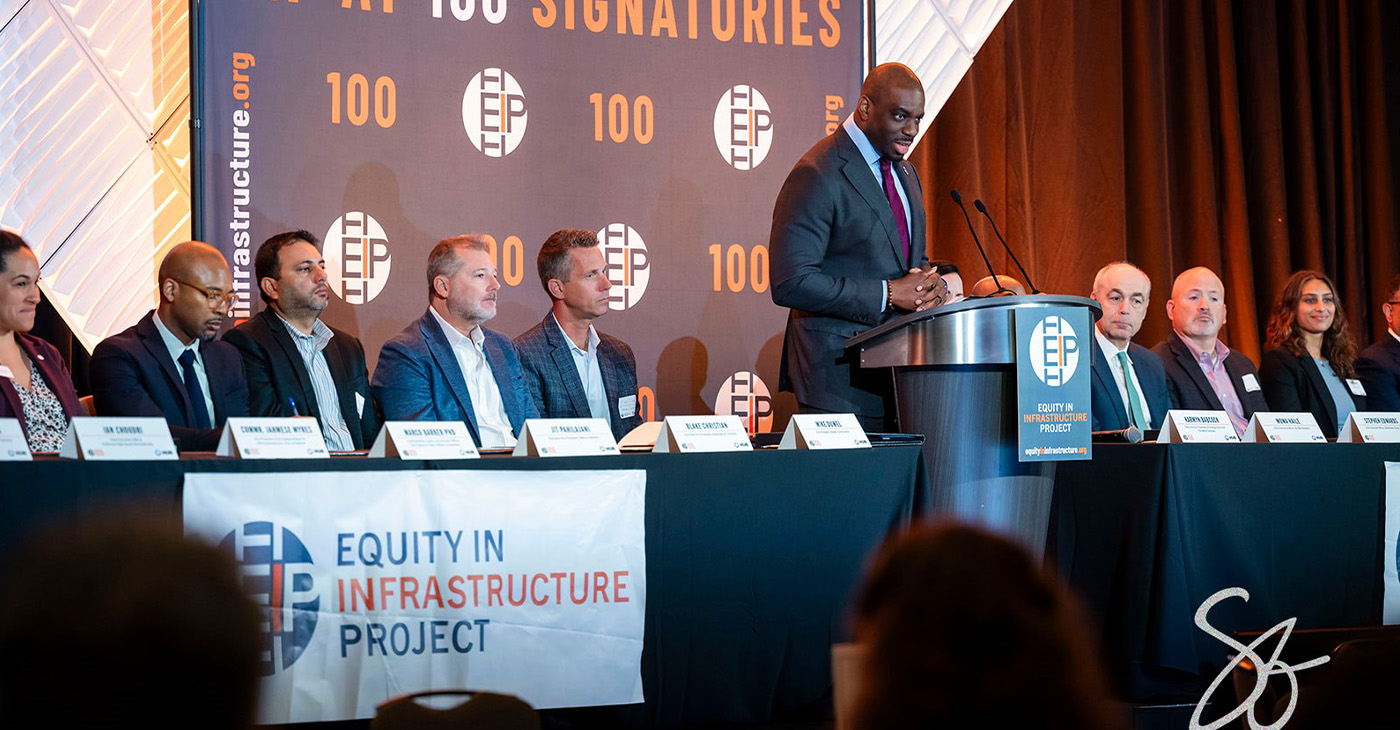
On June 4, a national nonprofit named the Equity in Infrastructure Project (EIP) – which aims to increase public construction contracting opportunities for small and historically underutilized businesses – held a day-long event in downtown San Francisco to rally supporters and build momentum to its cause.
It was attended by more than 100 individuals from public agencies, private firms, and other organizations committed to increasing contracting opportunities with governmental agencies, thereby creating more competition and lowering public costs.
The EIP event was held the Hyatt Regency San Francisco in conjunction with BuildIT, which aims to increase contracting opportunities for LGBT-owned businesses.
At the event, 16 entities signed the EIP pledge, vowing to take steps to increase public contracting opportunities in their spheres for small and historically underutilized businesses.
The pledge signees included Hub International, the Port of San Francisco, the San Francisco Public Utilities Commission, California High-Speed Rail Authority, the Port of Oakland, Robert Graham of Webcor Builders, Holder Construction, the Weitz Company, Sky Blue Builders, Hornblower, Swinerton, Luster National, Talson Solutions, Center for Community Wealth Building, and the Construction Contractors Alliance.
Following the workshop, BuildIT hosted a VIP evening reception honoring EIP, whose principals – Phil Washington, John Procari, and Rick Jacobs – accepted the award.

The event also set in motion the coalition’s efforts to implement recommendations from EIP’s “Procurement for Prosperity: A Playbook.”
The Playbook is a practical guide for public agency leaders and procurement and contracting practitioners to grow the capacity of small and first-time contractors, strengthen competition, and deliver better value for taxpayers.
Toks Omishakin, Secretary of the California State Transportation Agency (CalSTA), a long-time EIP supporter, also told attendees, “This is about commitment. This has been a life’s work. This is a tailwind moment.”
The event’s presenting sponsor was Hub International, one of the largest insurance brokerages in the nation, which was joined by partners Travelers Insurance and the State Compensation Insurance Fund.
After the pledge-signing ceremony, attendees participated in a workshop in which they examined the policies, practices, and programs needed to meet EIP goals, learned from practitioners, and identified next steps toward utilizing the Playbook.
Ingrid Meriwether, formerly of Merriwether & Williams Insurance Services (MWIS) and current president of Hub International’s Aligned Risk Management, MWIS, described the hard-fought lessons she and her MWIS team have learned over the last three decades administering contractor development programs (CDPs) for the City and County of San Francisco, Alameda County, City of Los Angeles, LA Metro, and other municipalities.
The CDPs help small and local construction firms win public infrastructure contracts with these government agencies. The program provides bonding assistance, contract financing, technical support, training, and other services to underrepresented businesses funded by public agencies who seek greater contracting participation with these firms.
Merriwether said programs like these “break down systemic barriers, create greater fairness, and save taxpayers money by enabling more competition. The contractor development programs have, cumulatively, over two decades, helped contractors access over $1 billion in bonding, supporting over $380 million in awarded contracts, and maintaining a loss ratio 250 times lower than the industry average – while saving participating municipalities more than $27 million in contracting costs as a result of enabling more competition.”
Rick Jacobs, EIP co-founder and co-chair urged attendees make plans to meet again in the near future “to continue building on this work, share progress on organizational commitments, and discuss how we can collectively advance the goals of the EIP pledge.”
For more information on the EIP and to access a copy of the Playbook, go online to https://equityininfrastructure.org/
Calvin Naito is communications manager for Equity in Infrastructure Project.

Alameda County
Ferry Fares to Increase July 1 as Ridership Hits Record Highs
The Oakland and Alameda routes will increase from $4.90 to $5.10, the South San Francisco route will go up from $7.40 to $7.60, and the Vallejo route will increase from $9.90 to $10.

By Mike Aldax, The Richmond Standard
Starting July 1, the standard adult fare for the San Francisco Bay Ferry route between Richmond and San Francisco will increase to $5.20, up from the current $4.90.
Discounted fares for eligible passengers, including youth, seniors, people with disabilities, and Clipper START users, will rise to $2.60 from the current $2.40. Children under 5 will continue to ride for free.
The Oakland and Alameda routes will increase from $4.90 to $5.10, the South San Francisco route will go up from $7.40 to $7.60, and the Vallejo route will increase from $9.90 to $10.
The adjustments are part of a systemwide fare update approved by the agency’s Board of Directors, which is moving away from a flat 3% annual increase to route-specific pricing for the 2027 and 2028 fiscal years.
This fare update arrives as San Francisco Bay Ferry celebrates a historic May, transporting 301,270 passengers. The record-breaking figure represents an 8% increase over May 2025 and marks the third consecutive month of record-setting ridership.
Furthermore, it is the sixth month in a row that passenger numbers have exceeded pre-pandemic levels. Weekend travel has been a primary driver of this growth, with average weekend ridership seeing a 56% increase compared to pre-pandemic trends.
The agency states that the fare adjustments are necessary to ensure the long-term fiscal sustainability of public ferry services. By shifting to route-specific adjustments, the agency aims to offset rising operating costs while maintaining the high levels of service frequency and reliability.
Activism
NCBW-OBAC Champions Black Women Entrepreneurs at Business en Blaque Expo
Aspiring entrepreneurs, small business owners, and financial professionals gathered for a day of education, networking, and community engagement. Participants attended workshops and panel discussions covering Business Literacy 101, wealth-building strategies, and entrepreneurship fundamentals.

By Carla Thomas
The National Coalition of 100 Black Women, Inc., Oakland Bay Area Chapter (NCBW-OBAC) strengthened its commitment to economic empowerment through its 2026 Sisternomics initiative, offering free financial literacy and entrepreneurship resources aimed at advancing financial independence among Black women.
As part of the initiative, the “Business en Blaque” Entrepreneurship Workshop and Small Business Expo was held Saturday, May 23, at the Executive Inn & Suites in Oakland.
Aligned with the national theme “Resilient. Resourceful. Ready.,” the event highlighted NCBW-OBAC’s ongoing efforts to close economic gaps and expand opportunities for Black women.
Aspiring entrepreneurs, small business owners, and financial professionals gathered for a day of education, networking, and community engagement. Participants attended workshops and panel discussions covering Business Literacy 101, wealth-building strategies, and entrepreneurship fundamentals.
One featured session, moderated by Jennifer Hammock, included panelists Eva Allen of Full Belly Bakery, Samantha Wise of Tip Top Shape, Ashley Harvey of Phoenix AI, and Michelle McQueen, owner of Town Fare and Lucy Blue. Panelists shared candid insights on their business journeys, including both successes and challenges.
McQueen and Blue emphasized the importance of maintaining clear financial records. “It’s important to know where you stand financially so you can make adjustments when necessary,” she said.
Ashley Harvey of Phoenix AI encouraged entrepreneurs to leverage AI tools such as ChatGPT and Claude to streamline operations and save time. She also stressed the importance of consistency in marketing. “Just put it out there. We’ve got to get over ourselves,” she said, noting that pre-scheduling social media posts can improve efficiency.
Wise echoed that sentiment, highlighting the value of consistent engagement. “I post two to three times a day because people want to be engaged, and your post doesn’t have to be perfect,” she said. She also shared that her faith continues to guide her work and purpose.
Allen spoke to the role of passion and community in entrepreneurship. “Baking is my passion, and it’s great to build community,” she said.
In addition to educational sessions, the Small Business Expo showcased local Black-owned businesses, creating a platform for visibility and support. The event fostered meaningful connections among attendees, speakers, and vendors.
Anita Russell of Working Solutions provided guidance on accessing capital, encouraging entrepreneurs to be prepared and intentional. “Do your homework, know your ‘why,’ and do not marginalize each other,” she said.

WORK FROM HOME
Home-based business with potential monthly income of $10K+ per month. A proven training system and website provided to maximize business effectiveness. Perfect job to earn side and primary income. Contact Lynne for more details: Lynne4npusa@gmail.com 800-334-0540



Oakland Museum Presents Landmark Retrospective Celebrating Beloved Bay Area Artist Mildred Howard

Ferry Fares to Increase July 1 as Ridership Hits Record Highs

Stop the Hate Symposium Brings Oakland Together Through Dialogue, Partnership, and Community Healing

Six Months in, Probate Reform Coalition Marks Progress in Protecting Elders From Financial Abuse

A Long Time Coming: School District Kicks Off Massive $97 Million Renovation of West Oakland’s McClymonds High School

IN MEMORIAM: Oakland Dance Legend Reginald Ray-Savage, 67

UC Berkeley Named Top Public University in the U.S. and No. 7 in the World by ‘U.S. News’

NCBW-OBAC Champions Black Women Entrepreneurs at Business en Blaque Expo

Lock In Car Price: Avoid Dealer Payment Traps!

Sell Your Car: Get Offers BEFORE Visiting Dealerships!

The Conversation With Al McFarlane 6/23/26

Media Monday 6/22/26

LIVE! ASK ALMA! — TUES. 6.23.26 7PM EST

Car Buying Secrets: 4 Hidden Checks Before You Sign!

After 10-Year Wait, Fillmore Heritage Center Reopens in San Francisco

Oakland Post: Week of June 3 – 9, 2026

Oakland Post: Week of May 20 – 26, 2026

Oakland Post: Week of May 27 – June 2, 2026

COMMENTARY: Black Music is the Sound of Black Freedom: Let Us Reclaim Both This Juneteenth

5 Cleveland Police Officers Injured, Gunfire Erupts During East Side Pursuit

2026 World Cup is Here and Atlanta is Ready For It

Oakland Director Boots Dazzles Once Again in ‘I Love Boosters’

Oakland Post: Week of June 10 – 16, 2026

Venus Williams Calls a Sabalenka Exit a Tragedy

COMMENTARY: Using Art, Healing, And Community to Transform Mental Health Dialogue

Sale of Coliseum to African American Developers Moves Toward Completion

Study: Waiting Lists for Child Care Assistance Nearly Doubled

Oakland Post: Week of June 17 – 23, 2026
The Conversation With Al McFarlane 6/23/26
Media Monday 6/22/26
LIVE! ASK ALMA! — TUES. 6.23.26 7PM EST
Car Buying Secrets: 4 Hidden Checks Before You Sign!

Is This 550 HP Charger Worth YOUR Money? AutoNetwork Review

Celebrating Juneteenth – Frederick Douglass on education and resistance

LIVE! — ASK ALMA! — TUES. 6.19.26 7PM EST

Hyundai Ioniq 5 Parking, Safety, and 360 View #shorts

2025 Ioniq 5 New Wiper & Powerful Performance! #shorts

Electric SUV Range: Is 259 Miles Enough? #shorts

EV Charging: How Fast Can You Charge an Electric Vehicle? #shorts

Biometric Cooling… Messaging Seats…Come on! 2025 Infiniti QX80 Autograph 4WD

Charged Up: Witness the Magic of a Fully Electric Car! #shorts

Range Rover Sport PHEV Included…: See What’s Inside This Luxury SUV! #shorts

Invisible Hood View: Perfect Parking with X-Ray Vision! #shorts
-
 Art3 weeks ago
After 10-Year Wait, Fillmore Heritage Center Reopens in San Francisco
-
 Activism4 weeks ago
Oakland Post: Week of June 3 – 9, 2026
-
 Arts and Culture4 weeks ago
COMMENTARY: Black Music is the Sound of Black Freedom: Let Us Reclaim Both This Juneteenth
-
 #NNPA BlackPress4 weeks ago
5 Cleveland Police Officers Injured, Gunfire Erupts During East Side Pursuit
-
 #NNPA BlackPress4 weeks ago
2026 World Cup is Here and Atlanta is Ready For It
-
 Art3 weeks ago
Oakland Director Boots Dazzles Once Again in ‘I Love Boosters’
-
 Activism3 weeks ago
Oakland Post: Week of June 10 – 16, 2026
-
 #NNPA BlackPress4 weeks ago
Venus Williams Calls a Sabalenka Exit a Tragedy
