
Activism
Oakland Deputy Mayor Kimberly Mayfield Meets Legislators in France
Dr. Kimberly Mayfield, deputy mayor of the City of Oakland, met with elected officials in France, including two members of the French National Assembly, and visited several educational programs, where she spoke with educators and students. Dr. Mayfield was able to visit France after a visit to London with the Hidden Genius Project and Oakland Natives Give Back to participate in Black History Month, which takes place in October in England. No public money was spent.


By Ken Epstein
Dr. Kimberly Mayfield, deputy mayor of the City of Oakland, last week met with elected officials in France, including two members of the French National Assembly, and visited several educational programs, where she spoke with educators and students.
She met with Danièle Obono and Nadège Abomangoli, both members of the French Parliament, where they discussed many issues, including policymaking, racism, and immigration.
Dr. Mayfield was able to visit France after a visit to London with the Hidden Genius Project and Oakland Natives Give Back to participate in Black History Month, which takes place in October in England. No public money was spent.
Obono, has represented the 17th constituency of Paris in the National Assembly since 2017. A member of La France Insoumise (FI), she was reelected in the first round of the 2022 legislative election.
Abomangoli, also a member of La France Insoumise, was elected to Parliament for Seine-Saint-Denis’s 10th constituency in the 2022 French legislative election. She was born in Brazzaville, Republic of the Congo.
The two leaders had lots of questions about current conditions in the U.S., Dr. Mayfield told the Oakland Post. “They wanted to know what it means for Oakland to be a sanctuary city, what my thoughts were on the upcoming presidential elections, and what I thought the prospects were for Biden and Trump,” she said.
They also wanted to find out about Black fraternities and sororities in the U.S., and what people did to mobilize the vote, so that voter suppression would not be able to determine the outcome of elections.
They pointed out that, as in the U.S., people in France are dealing with police brutality, and the handful of Black members of Parliament sometimes face hostility when they speak out.
With an extensive background as an education professor and administrator, as well as a public-school teacher, Mayfield said she was excited to have the opportunity to visit a primary and a middle school and had a wide-ranging conversation with young people at Réseau Etudiant, an after-school study program.
She also met with residents and elected officials from Gennevilliers, a small port city close to Paris, which is similar to Oakland in demographics and politics.
Zahir Meliani, a resident of Gennevilliers, made arrangements for Mayfield’s meetings at the Parliament and her visit to his city.
She was welcomed by Mayor Patrice Leclerc and one of his deputies, Celine Lanoiselée, and they toured areas of the town. They discussed some differences in city governance structures between France and the U.S. and explored the potential for exchange visits between young people in the two countries.
“I am excited to work on improving our cities and contributing to peace in the world by using the potential for online and in-person visits to learn from each other,” said Mayfield.









Activism
Oakland Post: Week of April 1 – 7, 2026
The printed Weekly Edition of the Oakland Post: Week of April 1 – 7, 2026
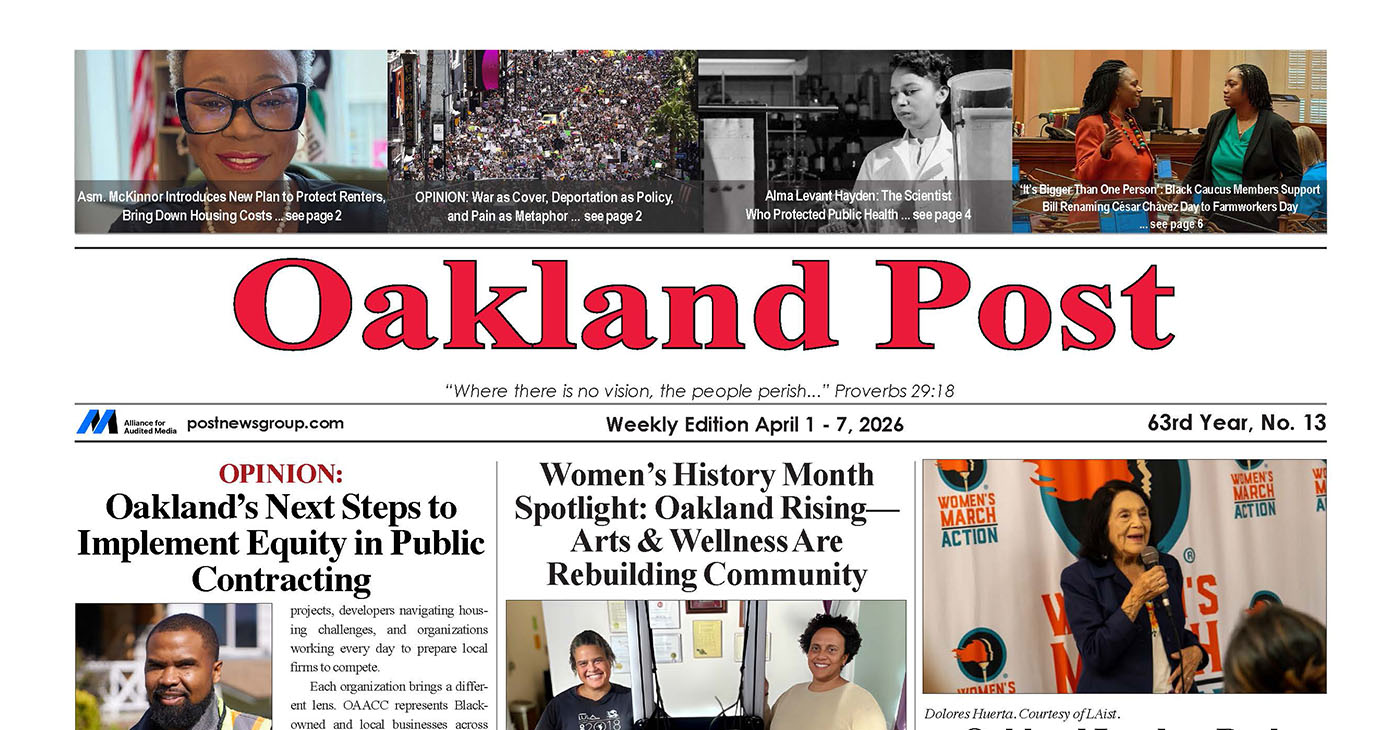
To enlarge your view of this issue, use the slider, magnifying glass icon or full page icon in the lower right corner of the browser window.
Activism
Oakland Post: Week of March 18 – 24, 2026
The printed Weekly Edition of the Oakland Post: Week of March 18 – 24, 2026

To enlarge your view of this issue, use the slider, magnifying glass icon or full page icon in the lower right corner of the browser window.
Activism
Oakland Post: Week of March 11 -17, 2026
The printed Weekly Edition of the Oakland Post: Week of March 11 – 17, 2026
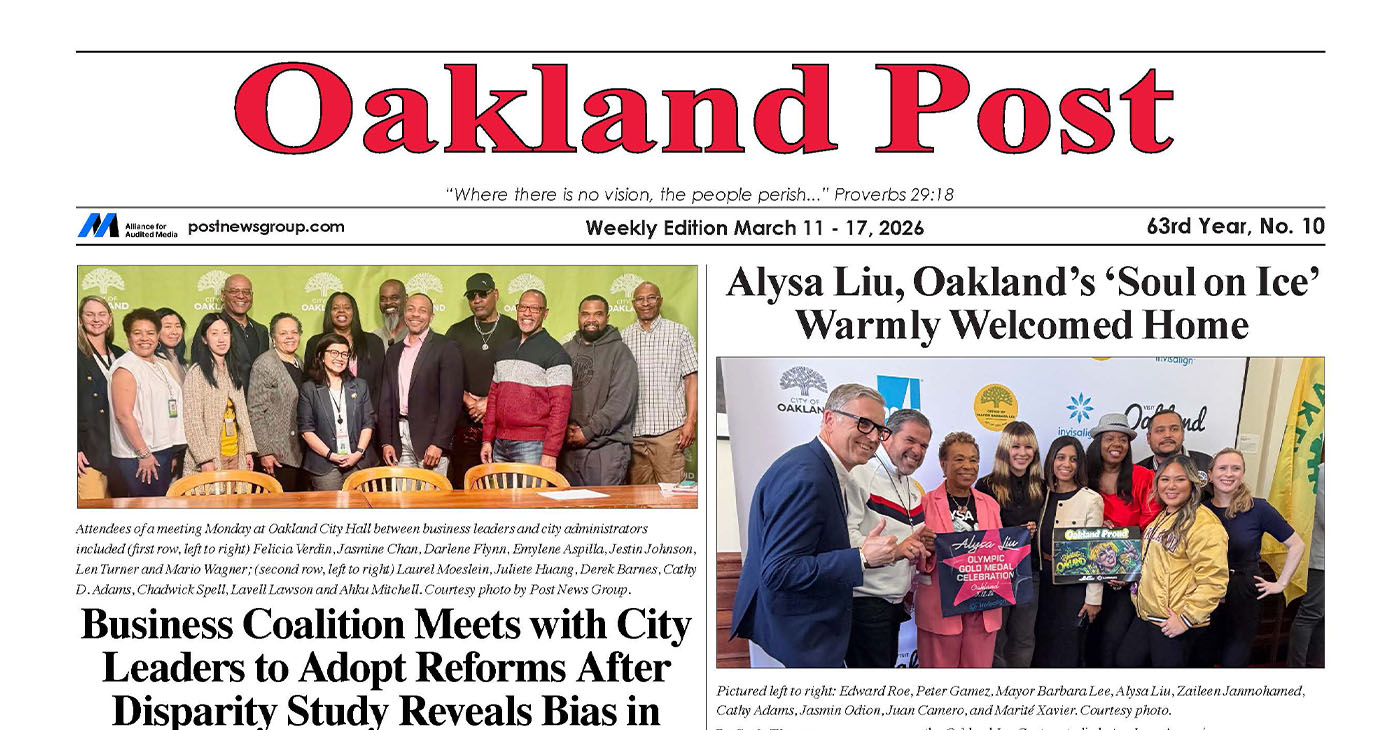
To enlarge your view of this issue, use the slider, magnifying glass icon or full page icon in the lower right corner of the browser window.


WORK FROM HOME
Home-based business with potential monthly income of $10K+ per month. A proven training system and website provided to maximize business effectiveness. Perfect job to earn side and primary income. Contact Lynne for more details: Lynne4npusa@gmail.com 800-334-0540


Oakland Post: Week of April 1 – 7, 2026

Black Artists in America, Installation Three Wraps at the Dixon Gallery and Gardens

Grief, Advocacy, and Education: A Counselor Reflects on Black Maternal Health

Future of Florida’s Black History Museum in Limbo

New Research Shows the Many Benefits of Early Learning

South Hampton K-8 Students Among Top 10 Finalists for Samsung’s ‘Solve for Tomorrow’ Competition

Cuba: No Negotiation with US on the President or Political System

Brooklyn Academy of Music Names Jamaican-Born Tamara McCaw as President

Trinidad & Tobego – U.S. Launches WhatsApp Channel for American Citizens in the Country

Oakland Post: Week of March 18 – 24, 2026

AI Innovation vs. Ethics and Environmental Impact

AI, Web3, and Digital Reparations

What If You Owned Your AI Agent?

Season 7, Episode 3 – January Reporter’s Roundtable 📱

Season 7, Episode 3 – January Reporter’s Roundtable

Reflecting on Black History Milestones in Birmingham AL

Oakland Post: Week of February 25 – March 3, 2026

PRESS ROOM: NBA Hall of Fame Nominee Terry Cummings Joins 100 Black Men of DeKalb County to Launch Victory & Values Initiative

Oakland Post: Week of March 4 – 10, 2026

Trump’s MAGA Allies are Creating Executive Order Plan to Steal the 2026 Midterms

U.S. manufacturing rebounds – how foundry services are adapting to rising demand

Poll Shows Support for Policies That Help Families Afford Child Care

OP-ED: One Hundred Years of Black Workers Telling the Truth

Oakland Post: Week of March 11 -17, 2026

Advancements in solar technology that are changing the way we power the world
Oakland Post: Week of March 18 – 24, 2026

Woman’s Search for Family’s Roots Leads to Ancestor John T. Ward – A Successful Entrepreneur and Conductor on the Underground Railroad

COMMENTARY: Women of Color Shape Our Past and Future

PRESS ROOM: Civil Rights TV Launches in Selma as the World’s First 24/7 Civil Rights Television Network

Financial Wellness and Mental Health: Managing Money Stress in College

Hyundai Ioniq 5 Parking, Safety, and 360 View #shorts

2025 Ioniq 5 New Wiper & Powerful Performance! #shorts

Electric SUV Range: Is 259 Miles Enough? #shorts

EV Charging: How Fast Can You Charge an Electric Vehicle? #shorts

Biometric Cooling… Messaging Seats…Come on! 2025 Infiniti QX80 Autograph 4WD

Charged Up: Witness the Magic of a Fully Electric Car! #shorts

Range Rover Sport PHEV Included…: See What’s Inside This Luxury SUV! #shorts

Invisible Hood View: Perfect Parking with X-Ray Vision! #shorts

AI Is Reshaping Black Healthcare: Promise, Peril, and the Push for Improved Results in California

ESSAY: Technology and Medicine, a Primary Care Point of View

Sanctuary Cities

The RESISTANCE – FREEDOM NOW

STATE OF THE PEOPLE: Freddie

ECONOMIC BOYCOTT DAY!!!!!

I told You So
-
 Activism3 weeks ago
Oakland Post: Week of March 11 -17, 2026
-
 Activism2 weeks ago
Oakland Post: Week of March 18 – 24, 2026
-
 #NNPA BlackPress4 weeks ago
Woman’s Search for Family’s Roots Leads to Ancestor John T. Ward – A Successful Entrepreneur and Conductor on the Underground Railroad
-
 #NNPA BlackPress4 weeks ago
COMMENTARY: Women of Color Shape Our Past and Future
-
 Advice3 weeks ago
Financial Wellness and Mental Health: Managing Money Stress in College
-

 #NNPA BlackPress4 weeks ago
Advocates Raise Alarm Over ICE Operation, MOU and Detention Risks in Baltimore County
-

 #NNPA BlackPress4 weeks ago
Pete Buttigieg to Join Mayor Randall Woodfin for Community Town Hall in Birmingham
-
 #NNPA BlackPress2 weeks ago
Brooklyn Academy of Music Names Jamaican-Born Tamara McCaw as President
