
Bay Area
Oakland Organizations Champion Financial Literacy Empowering Residents with Vital Resources
Rising numbers of unbanked or underbanked individuals, largely due to unmet minimum balance requirements, have become a growing concern. However, organizations across Oakland are stepping up, waging a war against the financial illiteracy that’s plaguing some residents. Up to 4% of Alameda County’s residents lack access to basic banking services, with Black and Hispanic communities making up the majority of that unbanked or underbanked population.


By Magaly Muñoz
Rising numbers of unbanked or underbanked individuals, largely due to unmet minimum balance requirements, have become a growing concern. However, organizations across Oakland are stepping up, waging a war against the financial illiteracy that’s plaguing some residents.
Up to 4% of Alameda County’s residents lack access to basic banking services, with Black and Hispanic communities making up the majority of that unbanked or underbanked population. The term ‘unbanked’ describes people without a checking or savings account, while ‘underbanked’ describes people who have checking or savings accounts but often rely on alternative financial solutions like money orders and payday loans rather than conventional loans and credit cards.
Recently, the downtown Oakland Wells Fargo branch redesigned their bank to include a Hope Inside center in partnership with Operation HOPE, an organization centered around expanding economic opportunities for underserved communities.
The center features free access to financial coaches who work with individuals to gain financial assistance and guidance, such as helping improve credit scores.
Dr. Joaquin Wallace is one of the financial coaches at the Oakland branch who meets one-on-one with clients to provide credit money management solutions and develop strategic plans to assist them with reaching their financial goals.
He’s created a seven-step blueprint for attaining generational wealth. This includes acknowledging that your background and culture have significant influence on how you view finances, focusing on reprogramming financial trauma and gaining financial edification through literacy programs.

He shared that it can be difficult for some to accept their financial struggles because their environment might not allow for these immediate understandings because for many, money is not openly discussed in their communities.
“Money is a topic that is not communicated about — it’s taboo. And so first, you have to at least feel comfortable enough to have this conversation,” Wallace said.
Despite the initial roadblocks, the branch is seeing success with the program. Fifty-seven percent of the clients at the Hope Inside center have increased their credit score by an average of 19 points; 47% of the clients increased their savings by a median of $141; and 50% of clients have successfully reduced their debt by a median of $364.
Sonya Verdine, an Oakland resident of four years, is one of the success stories that Oakland Wells Fargo has helped since their soft launch in 2022.
Verdine’s life has been a rollercoaster of challenges including homelessness, mental health struggles and health scares that ultimately pushed her to improve her life, starting with attempting to correct the financial choices she’d made up to that point.
She was introduced to Wallace’s seven-step generational wealth method which provided her with a roadmap to get her on the right track to financial stability. Since visiting the Hope Inside center, Verdine has seen her credit score go up 200 points and she’s saving almost 10% of her income every month with a goal to someday buy her own home.
“You can take this program, you can start from literally nothing, and the program can help you build because they offer a variety of other services,” Verdine said. “It will be time well spent to participate in this program.”
Another organization that has long taken the reins to combat financial illiteracy and break the cycle of poverty is United Way Bay Area (UWBA), a program that assists families in the region to find financial stability.
Nicole Harden, Vice President of Economic Success at UWBA, says that their Sparkpoint program, which features centers scattered across the Bay Area that help low to middle income families establish financial goals, has grown tremendously since its inception in 2009. Anyone can come into one of their 23 centers to consult with a financial coach to receive guidance on how to increase their income, boost their credit, augment their savings, or reduce their debt.
She shared that it’s important for people to not feel embarrassed when talking about their financial struggles. Organizations like UWBA exist to help provide resources that they know are often inaccessible to underserved communities.
Harden explained that their centers not only cater to low-income families but see a significant number of women of color seeking assistance. As a result, they’ve taken the steps to ensure their programs are culturally competent to make conversations easier and more comfortable.
“We operate from the assumption that folks are creative, resourceful and whole. People have been making it all along, people aren’t broken. There’s systems that are broken, but this is an opportunity to work within the systems and help folks figure out how to navigate that,” she said.





Activism
Oakland Post: Week of August 12 – 18, 2026
The printed Weekly Edition of the Oakland Post: Week of August 12 – 18, 2026


To enlarge your view of this issue, use the slider, magnifying glass icon or full page icon in the lower right corner of the browser window.

Activism
Oakland Post: Week of August 5 – 11, 2026
The printed Weekly Edition of the Oakland Post: Week of August 5 – 11, 2026
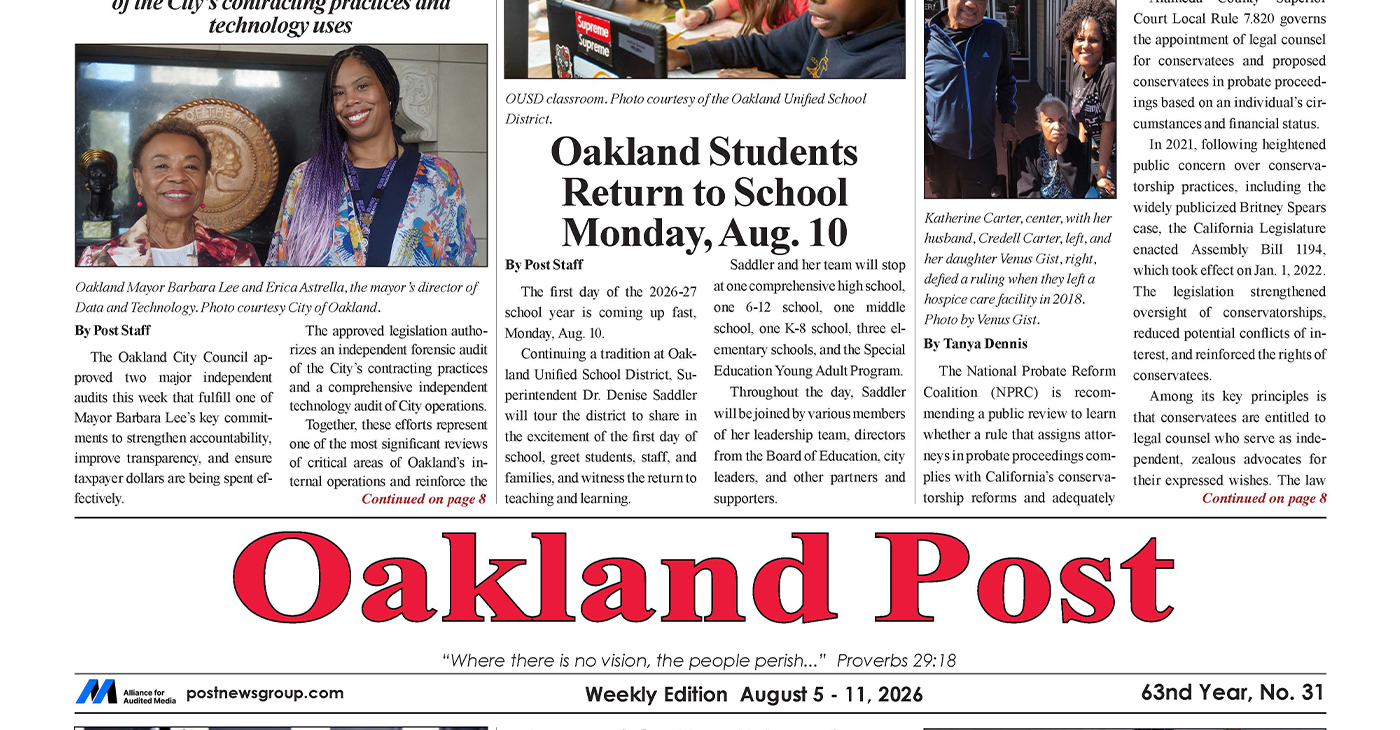
To enlarge your view of this issue, use the slider, magnifying glass icon or full page icon in the lower right corner of the browser window.
Activism
Oakland Post: Week of July 29 – August 4, 2026
The printed Weekly Edition of the Oakland Post: Week of July 29 – August 4, 2026

To enlarge your view of this issue, use the slider, magnifying glass icon or full page icon in the lower right corner of the browser window.

WORK FROM HOME
Home-based business with potential monthly income of $10K+ per month. A proven training system and website provided to maximize business effectiveness. Perfect job to earn side and primary income. Contact Lynne for more details: Lynne4npusa@gmail.com 800-334-0540


OPINION: 57,000 Empty Apartments and Not a Word of Apology – City Limits

Oakland Protesters Rally to Defend Haitian Immigrants and TPS

First 5 Alameda County Celebrates First Year of Measure C’s Implementation

From Palestine to Oakland: Seeds for Liberation Examines Shared Struggles for Freedom

NABJ Convention Brings Black Journalists, Civic Leaders Together in Atlanta

At Sacramento Summit, Becerra Discusses Policy; Uses “Family” Metaphor to Frame Case for National Political Unity

$5 Billion Coliseum Vision Puts Oakland Jobs, Businesses at Center

Gov. Newsom Nominates 3 Black Women Judges to Serve on State Courts of Appeal

Oakland Observes Black August with Block Parties, Film Showings, Workshops

NPRC Elder Justice Symposium Invites Community to Join Effort to Protect Alameda County Elders
Episode 4: Grow Stronger After 50
Episode 4: Grow Stronger After 50

Four Candidates, Including Incumbent Barbara Lee, Qualify for Oakland Mayor’s Race

Oakland Observes Black August with Block Parties, Film Showings, Workshops

Oakland Post: Week of August 12 – 18, 2026

Department of Homeland Security Demands California Secretary of State Shirley N. Weber Scrub Voter Rolls

New Judge Could Decide if Karmelo Anthony Gets a New Trial

Oakland Children’s Hospital Workers and Patients Rally for Pediatric Medical Care

“The Power to See Threats Sooner”: Gov. Newsom, Safety Officials Showcase California’s Investments in Hi-Tech Wildfire Prevention

Alpha Kappa Alpha Sorority, Inc. Celebrates New North Atlantic Regional Director

Surveillance Pricing Fight: State Senate Debates Bill Banning Retailers from Using AI to Set Prices Based on a Buyer’s Profile

Mount Zion MBC, Church of Jesus Christ of Latter-day Saints Partner to Bring 29,000 Meals to Alameda County

California Sen. Padilla Joins Colleagues to Introduce Bill Imposing Term Limits on Supreme Court Justices

Less Affluent School Districts, Including Sacramento City, Face Threat of State Takeover

Car Wash Workers Cope with Lingering Impacts of ICE Raids

Starting This Summer, California Car Buyers Can Get an Instant $3500 Off the Cost of Electric Vehicles

COMMENTARY: You Are Already Paying for the AI Boom

California Bill Would Let Abuse Victims Use Trauma as Legal Defense for Violent Crime

Fed Court to Decide Landmark First Amendment Case

Gov. Gavin Newsom Signs Law Streamlining Affordable Housing Rules

The Conversation With Al McFarlane 6/23/26

Media Monday 6/22/26

LIVE! ASK ALMA! — TUES. 6.23.26 7PM EST

Car Buying Secrets: 4 Hidden Checks Before You Sign!

Is This 550 HP Charger Worth YOUR Money? AutoNetwork Review

Celebrating Juneteenth – Frederick Douglass on education and resistance

LIVE! — ASK ALMA! — TUES. 6.19.26 7PM EST

Hyundai Ioniq 5 Parking, Safety, and 360 View #shorts

2025 Ioniq 5 New Wiper & Powerful Performance! #shorts

Electric SUV Range: Is 259 Miles Enough? #shorts

EV Charging: How Fast Can You Charge an Electric Vehicle? #shorts

Biometric Cooling… Messaging Seats…Come on! 2025 Infiniti QX80 Autograph 4WD

Charged Up: Witness the Magic of a Fully Electric Car! #shorts

Range Rover Sport PHEV Included…: See What’s Inside This Luxury SUV! #shorts

Invisible Hood View: Perfect Parking with X-Ray Vision! #shorts
-
 Featured2 weeks ago
Department of Homeland Security Demands California Secretary of State Shirley N. Weber Scrub Voter Rolls
-
 #NNPA BlackPress3 weeks ago
New Judge Could Decide if Karmelo Anthony Gets a New Trial
-
 Environment2 weeks ago
“The Power to See Threats Sooner”: Gov. Newsom, Safety Officials Showcase California’s Investments in Hi-Tech Wildfire Prevention
-
 Business4 weeks ago
Oakland Children’s Hospital Workers and Patients Rally for Pediatric Medical Care
-
 Black History3 weeks ago
Alpha Kappa Alpha Sorority, Inc. Celebrates New North Atlantic Regional Director
-
 Business4 weeks ago
Surveillance Pricing Fight: State Senate Debates Bill Banning Retailers from Using AI to Set Prices Based on a Buyer’s Profile
-
 Business4 weeks ago
Mount Zion MBC, Church of Jesus Christ of Latter-day Saints Partner to Bring 29,000 Meals to Alameda County
-
 Featured2 weeks ago
California Sen. Padilla Joins Colleagues to Introduce Bill Imposing Term Limits on Supreme Court Justices
