
Community
OP-ED: A Proactive Solution for Baltimore: Investing in our City’s Youth
THE AFRO — Like every major American city, the City of Baltimore has significant challenges. We continue to combat the issue of aging and vacant homes, a crumbling water infrastructure, and high rates of violent crime. Yet, there are a number of things that our city does well – and it is vital that we continue to build upon our strengths at the same time that we confront and resolve our difficulties.

Like every major American city, the City of Baltimore has significant challenges. We continue to combat the issue of aging and vacant homes, a crumbling water infrastructure, and high rates of violent crime. Yet, there are a number of things that our city does well – and it is vital that we continue to build upon our strengths at the same time that we confront and resolve our difficulties.
The YouthWorks Program, under the leadership of one of our city’s most effective agency heads, Jason Perkins Cohen, is a foremost example of what we’re doing well. Just this past year, the Mayor’s Office of Employment Development put 8,654 young people (ages 14-21) to work. The problem is that we had approximately 11,370 young people submit paperwork on time and over 17,000 fill out applications overall.
I have a deep respect for the 11,000+ young people who were already thinking about summer employment in the month of March. That level of responsibility is exactly what we need to be encouraging in the workforce. However, it’s a disappointing reality that 2,716 of these young people who met every deadline and did what they were supposed to do were unable to secure employment. We as leaders have to do more to address this issue.
Not only are programs like YouthWorks an opportunity to gain experience in the workplace setting, it also provides a safe environment during the deadliest months of the year: July and August. These are 2,700 young people that are now dealing with idle time while they could be under supervision doing something productive and earning an economic opportunity.
I applaud the State of Maryland for appropriating over $3 million towards this initiative. And when Baltimore reconciled with the tragic death of Freddy Gray, the Governor appropriated more than 4 million dollars towards YouthWorks – and philanthropic organizations stepped up to ensure that every child who wanted an opportunity would receive one that summer. That same year, the Administrator of the Maryland Transportation Administration (MTA) gave every young person a bus pass to ensure that transportation was not a barrier to going to work that summer. Unfortunately that was only a one-year fix, and the money was reduced back to the $3 million appropriation the following year and the free bus passes were also discontinued.
For this reason I have sponsored Senate Bill 229 which requests the State of Maryland to appropriate 6 million dollars to youth works for fiscal years 2021, 2022, 2023. This bill would also require the City of Baltimore to match the state’s appropriation by 75 percent. It also specifies that the State of Maryland provide ten thousand bus passes for the program. This bill was unanimously sponsored and passed by the Baltimore City Senate Delegation: myself and Senators Carter, Ferguson, Hayes, Nathan-Pulliam, and Washington.
No longer can we do a one-year fix, and simultaneously expect things to change in the long-term. In investing into our youth, we have an opportunity to be proactive and make an investment that will pay dividends in the future. At a time when Baltimore is at one of its lowest points, it is critical that we have bold leadership that recognizes the inherent problem in spending more than 25 percent of our city’s budget on public safety but not being able to guarantee that every young person that fills out an application on time will have a job during the summer.
Our young people are a great and relentless generation, but they are also counting on those before them to lead and provide opportunity to ensure that they have a higher chance at achieving the American dream. Help us advocate for our youth by pushing for the passage of Senate Bill 229 this legislative session.
Cory McCray is a member of the Maryland State Senate, representing the 45th District, which encompasses Northeast and East Baltimore City.
This article originally appeared in The Afro.










Activism
Oakland Post: Week of December 24 – 30, 2025
The printed Weekly Edition of the Oakland Post: Week of – December 24 – 30, 2025

To enlarge your view of this issue, use the slider, magnifying glass icon or full page icon in the lower right corner of the browser window.
Alameda County
Bling It On: Holiday Lights Brighten Dark Nights All Around the Bay
On the block where I grew up in the 1960s, it was an unwritten agreement among the owners of those row homes to put up holiday lights: around the front window and door, along the porch banister, etc. Some put the Christmas tree in the window, and you could see it through the open slats of the blinds.
By Wanda Ravernell
I have always liked Christmas lights.
From my desk at my front window, I feel a quiet joy when the lights on the house across the street come on just as night falls.
On the block where I grew up in the 1960s, it was an unwritten agreement among the owners of those row homes to put up holiday lights: around the front window and door, along the porch banister, etc. Some put the Christmas tree in the window, and you could see it through the open slats of the blinds.
My father, the renegade of the block, made no effort with lights, so my mother hung a wreath with two bells in the window. Just enough to let you know someone was at home.
Two doors down was a different story. Mr. King, the overachiever of the block, went all out for Christmas: The tree in the window, the lights along the roof and a Santa on his sleigh on the porch roof.
There are a few ‘Mr. Kings’ in my neighborhood.
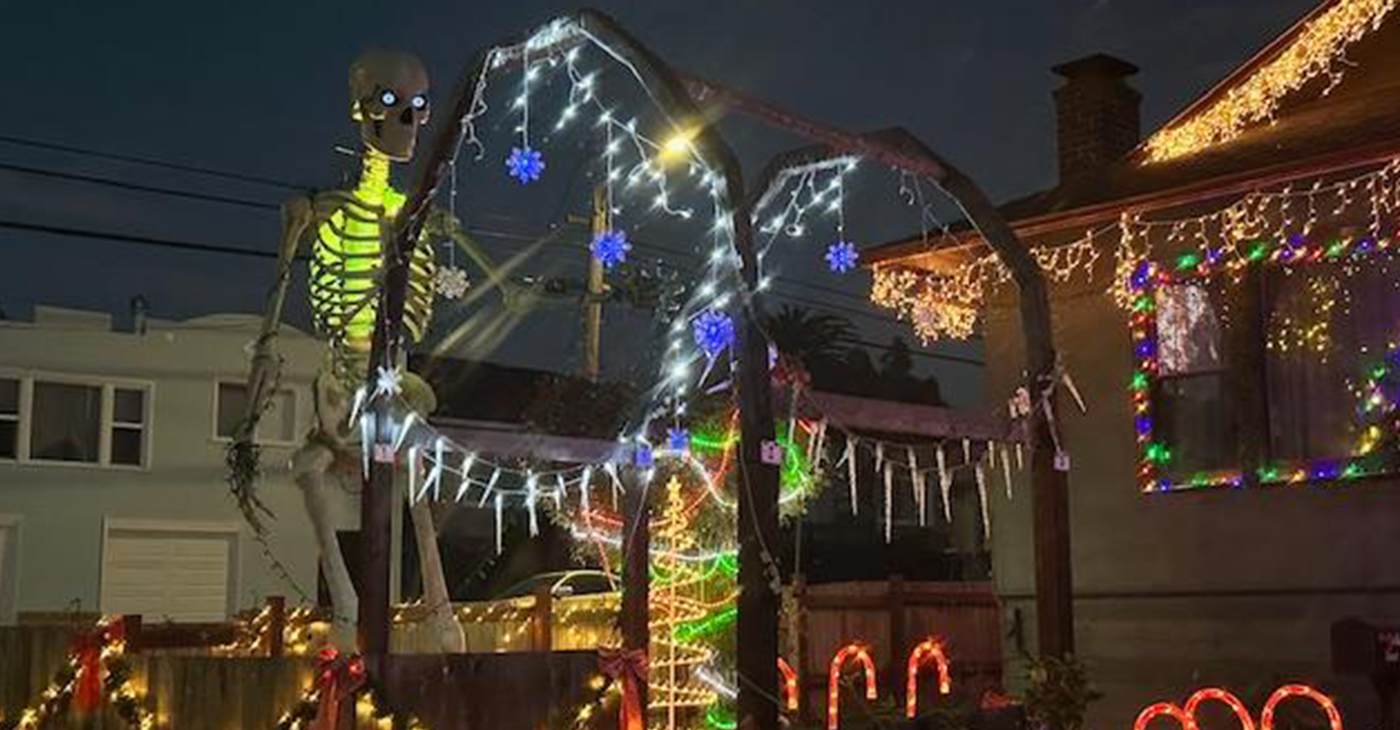
In particular is the gentleman down the street. For Halloween, they erected a 10-foot skeleton in the yard, placed ‘shrunken heads’ on fence poles, pumpkins on steps and swooping bat wings from the porch roof. They have not held back for Christmas.

The skeleton stayed up this year, this time swathed in lights, as is every other inch of the house front. It is a light show that rivals the one in the old Wanamaker’s department store in Philadelphia.
I would hate to see their light bill…
As the shortest day of the year approaches, make Mr. King’s spirit happy and get out and see the lights in your own neighborhood, shopping plazas and merchant areas.
Here are some places recommended by 510 Families and Johnny FunCheap.
Oakland
Oakland’s Temple Hill Holiday Lights and Gardens is the place to go for a drive-by or a leisurely stroll for a religious holiday experience. Wear a jacket, because it’s chilly outside the Church of Jesus Christ of Latter-day Saints, at 4220 Lincoln Ave., particularly after dark. The gardens are open all day from 9 a.m. to 9 p.m. with the lights on from dusk until closing.
Alameda
Just across the High Street Bridge from Oakland, you’ll find Christmas Tree Lane in Alameda.
On Thompson Avenue between High Street and Fernside drive, displays range from classic trees and blow-ups to a comedic response to the film “The Nightmare Before Christmas.” Lights turn on at dusk and can be seen through the first week in January.
Berkeley
The Fourth Street business district from University Avenue to Virginia Street in Berkeley comes alive with lights beginning at 5 p.m. through Jan. 1, 2026.
There’s also a display at one house at 928 Arlington St., and, for children, the Tilden Park Carousel Winter Wonderland runs through Jan. 4, 2026. Closed Christmas Day. For more information and tickets, call (510) 559-1004.
Richmond
The Sundar Shadi Holiday Display, featuring a recreation of the town of Bethlehem with life-size figures, is open through Dec. 26 at 7501 Moeser Lane in El Cerrito.
Marin County
In Marin, the go-to spot for ‘oohs and ahhs’ is the Holiday Light Spectacular from 4-9 p.m. through Jan. 4, 2026, at Marin Center Fairgrounds at 10 Ave of the Flags in San Rafael through Jan. 4. Displays dazzle, with lighted walkways and activities almost daily. For more info, go to: www.marincounty.gov/departments/cultural-services/department-sponsored-events/holiday-light-spectacular
The arches at Marin County Civic Center at 3501 Civic Center Dr. will also be illuminated nightly.
San Francisco
Look for light installations in Golden Gate Park, chocolate and cheer at Ghirardelli Square, and downtown, the ice rink in Union Square and the holiday tree in Civic Center Plaza are enchanting spots day and night. For neighborhoods, you can’t beat the streets in Noe Valley, Pacific Heights, and Bernal Heights. For glee and over-the-top glitz there’s the Castro, particularly at 68 Castro Street.
Livermore
The winner of the 2024 Great Light Flight award, Deacon Dave has set up his display with a group of creative volunteers at 352 Hillcrest Avenue since 1982. See it through Jan. 1, 2026. For more info, go to https://www.casadelpomba.com
Fremont
Crippsmas Place is a community of over 90 decorated homes with candy canes passed out nightly through Dec. 31. A tradition since 1967, the event features visits by Mr. and Mrs. Claus on Dec. 18 and Dec. 23 and entertainment by the Tri-M Honor Society at 6 p.m. on Dec. 22. Chrippsmas Place is located on: Cripps Place, Asquith Place, Nicolet Court, Wellington Place, Perkins Street, and the stretch of Nicolet Avenue between Gibraltar Drive and Perkins Street.
Activism
Lu Lu’s House is Not Just Toying Around with the Community
Wilson and Lambert will be partnering with Mayor Barbara Lee on a toy giveaway on Dec. 20. Young people, like Dremont Wilkes, age 15, will help give away toys and encourage young people to stay in school and out of trouble. Wilkes wants to go to college and become a specialist in financial aid. Sports agent Aaron Goodwin has committed to giving all eight young people from Lu Lu’s House a fully paid free ride to college, provided they keep a 3.0 grade point average and continue the program. Lu Lu’s House is not toying around.

Special to the Post
Lu Lu’s House is a 501c3 organization based in Oakland, founded by Mr. Zirl Wilson and Mr. Tracy Lambert, both previously incarcerated. After their release from jail, they wanted to change things for the better in the community — and wow, have they done that!
The duo developed housing for previously incarcerated people, calling it “Lu Lu’s House,” after Wilson’s wonderful wife. At a time when many young people were robbing, looting, and involved in shootings, Wilson and Lambert took it upon themselves to risk their lives to engage young gang members and teach them about nonviolence, safety, cleanliness, business, education, and the importance of health and longevity.
Lambert sold hats and T-shirts at the Eastmont Mall and was visited by his friend Wilson. At the mall, they witnessed gangs of young people running into the stores, stealing whatever they could get their hands on and then rushing out. Wilson tried to stop them after numerous robberies and finally called the police, who Wilson said, “did not respond.” Having been incarcerated previously, they realized that if the young people were allowed to continue to rob the stores, they could receive multiple criminal counts, which would take their case from misdemeanors to felonies, resulting in incarceration.


Lu Lu’s House traveled to Los Angeles and obtained more than 500 toys
for a Dec. 20 giveaway in partnership with Oakland Mayor Barbara
Lee. Courtesy Oakland Private Industry,
Wilson took it upon himself to follow the young people home and when he arrived at their subsidized homes, he realized the importance of trying to save the young people from violence, drug addiction, lack of self-worth, and incarceration — as well as their families from losing subsidized housing. Lambert and Wilson explained to the young men and women, ages 13-17, that there were positive options which might allow them to make money legally and stay out of jail. Wilson and Lambert decided to teach them how to wash cars and they opened a car wash in East Oakland. Oakland’s Initiative, “Keep the town clean,” involved the young people from Lu Lu’s House participating in more than eight cleanup sessions throughout Oakland. To assist with their infrastructure, Lu Lu’s House has partnered with Oakland’s Private Industry Council.
For the Christmas season, Lu Lu’s House and reformed young people (who were previously robbed) will continue to give back.
Lu Lu’s House traveled to Los Angeles and obtained more than 500 toys.
Wilson and Lambert will be partnering with Mayor Barbara Lee on a toy giveaway on Dec. 20. Young people, like Dremont Wilkes, age 15, will help give away toys and encourage young people to stay in school and out of trouble. Wilkes wants to go to college and become a specialist in financial aid. Sports agent Aaron Goodwin has committed to giving all eight young people from Lu Lu’s House a fully paid free ride to college, provided they keep a 3.0 grade point average and continue the program. Lu Lu’s House is not toying around.

WORK FROM HOME
Home-based business with potential monthly income of $10K+ per month. A proven training system and website provided to maximize business effectiveness. Perfect job to earn side and primary income. Contact Lynne for more details: Lynne4npusa@gmail.com 800-334-0540


Oakland Post: Week of December 24 – 30, 2025

Bling It On: Holiday Lights Brighten Dark Nights All Around the Bay

Oakland Council Expands Citywide Security Cameras Despite Major Opposition

Lu Lu’s House is Not Just Toying Around with the Community

Desmond Gumbs — Visionary Founder, Mentor, and Builder of Opportunity

Families Across the U.S. Are Facing an ‘Affordability Crisis,’ Says United Way Bay Area

Black Arts Movement Business District Named New Cultural District in California
Oakland Post: Week of December 17 – 23, 2025

Support Your Child’s Mental Health: Medi-Cal Covers Therapy, Medication, and More

Ann Lowe: The Quiet Genius of American Couture

2025 in Review: Seven Questions for Black Women’s Think Tank Founder Kellie Todd Griffin

BRIDGE Housing President and CEO Ken Lombard Scores Top Honors for Affordable Housing Leadership

Oakland School Board Grapples with Potential $100 Million Shortfall Next Year

COMMENTARY: If You Don’t Want Your ‘Black Card’ Revoked, Watch What You Bring to Holiday Dinners

Mayor Lee, City Leaders Announce $334 Million Bond Sale for Affordable Housing, Roads, Park Renovations, Libraries and Senior Centers

Oakland Post: Week of November 12 – 18, 2025

IN MEMORIAM: William ‘Bill’ Patterson, 94

How Charles R. Drew University Navigated More Than $20 Million in Fed Cuts – Still Prioritizing Students and Community Health

No Justice in the Justice System

Oakland Post: Week of November 19 – 25, 2025

LIHEAP Funds Released After Weeks of Delay as States and the District Rush to Protect Households from the Cold

Seth Curry Makes Impressive Debut with the Golden State Warriors

Oakland Post: Week of November 26 – December 2, 2025

Seven Steps to Help Your Child Build Meaningful Connections

Beyoncé and Jay-Z make rare public appearance with Lewis Hamilton at Las Vegas Grand Prix

Seven Steps to Help Your Child Build Meaningful Connections

Lewis Hamilton set to start LAST in Saturday Night’s Las Vegas Grand Prix

Trinidad and Tobago – Prime Minister Confirms U.S. Marines Working on Tobago Radar System

The Perfumed Hand of Hypocrisy: Trump Hosted Former Terror Suspect While America Condemns a Muslim Mayor

Thanksgiving Celebrated Across the Tri-State

Hyundai Ioniq 5 Parking, Safety, and 360 View #shorts

2025 Ioniq 5 New Wiper & Powerful Performance! #shorts

Electric SUV Range: Is 259 Miles Enough? #shorts

EV Charging: How Fast Can You Charge an Electric Vehicle? #shorts

Biometric Cooling… Messaging Seats…Come on! 2025 Infiniti QX80 Autograph 4WD

Charged Up: Witness the Magic of a Fully Electric Car! #shorts

Range Rover Sport PHEV Included…: See What’s Inside This Luxury SUV! #shorts

Invisible Hood View: Perfect Parking with X-Ray Vision! #shorts

AI Is Reshaping Black Healthcare: Promise, Peril, and the Push for Improved Results in California

ESSAY: Technology and Medicine, a Primary Care Point of View

Sanctuary Cities

The RESISTANCE – FREEDOM NOW

STATE OF THE PEOPLE: Freddie

ECONOMIC BOYCOTT DAY!!!!!

I told You So
-
 #NNPA BlackPress4 weeks ago
LIHEAP Funds Released After Weeks of Delay as States and the District Rush to Protect Households from the Cold
-
 Alameda County4 weeks ago
Seth Curry Makes Impressive Debut with the Golden State Warriors
-
 #NNPA BlackPress4 weeks ago
Seven Steps to Help Your Child Build Meaningful Connections
-
 #NNPA BlackPress4 weeks ago
Seven Steps to Help Your Child Build Meaningful Connections
-
 #NNPA BlackPress4 weeks ago
Trinidad and Tobago – Prime Minister Confirms U.S. Marines Working on Tobago Radar System
-
 #NNPA BlackPress4 weeks ago
Thanksgiving Celebrated Across the Tri-State
-

 #NNPA BlackPress4 weeks ago
Teens Reject Today’s News as Trump Intensifies His Assault on the Press
-

 #NNPA BlackPress4 weeks ago
Breaking the Silence: Black Veterans Speak Out on PTSD and the Path to Recovery
