
Bay Area
San Francisco Named Host City for 2023 Asia-Pacific Economic Cooperation Leaders’ Summit
Asian Americans account for about a third of San Francisco’s total population, and San Francisco has Sister City relationships with cities throughout the region, including Osaka, Seoul, Ho Chi Minh, Manila, Sydney, and Shanghai. San Francisco’s Chinatown is the first in North America and one of the largest Chinese communities outside of Asia. Additionally, the city currently hosts over 75 consulates, representing the government interests of virtually all major countries around the world. Additionally, many trade commissions have established offices in and around the city.

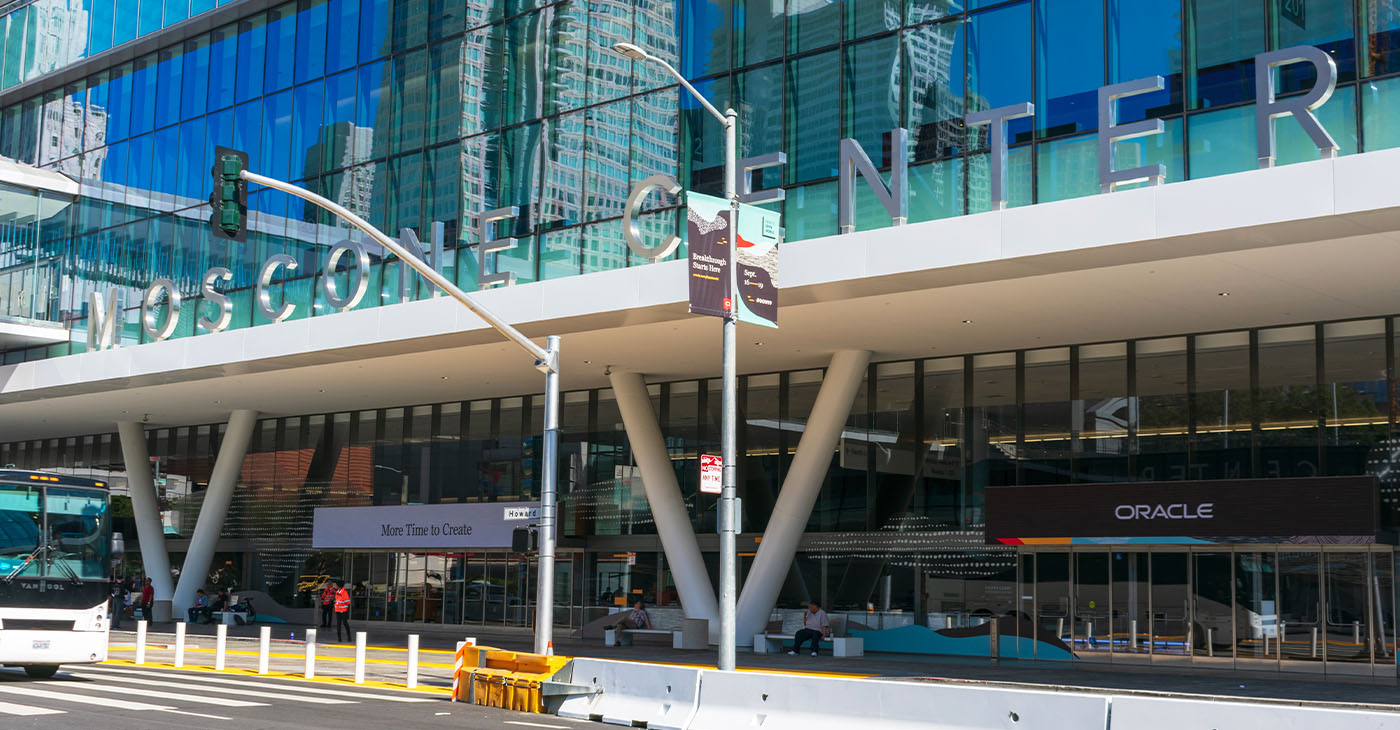
The summit will be held at Moscone Center and is expected to draw thousands of attendees from around the world with an estimated $36.5 million in total economic impact
By S.F. Mayor’s Office
Mayor London N. Breed celebrated news that San Francisco has been named the host city for the 30th Asia-Pacific Economic Cooperation Leaders’ Summit, or APEC, in November of next year.
The announcement was made on Nov. 18 at APEC where Vice President Kamala Harris is attending the Summit in Bangkok, Thailand. San Francisco will welcome President Biden, various chiefs of states, heads of government, and other officials from around the world.
In a letter sent to U.S. Secretary of State Antony Blinken in August, Breed made the request for the City and County of San Francisco to host the 2023 APEC Leaders’ Summit. U.S. Speaker of the House Nancy Pelosi and Senators Dianne Feinstein and Alex Padilla also submitted letters in support of the City winning the bid to host the five-day event.
Breed highlighted San Francisco’s extensive economic, cultural and academic connections to the Asia-Pacific Region, including the City’s recognition as the gateway to the Asia Pacific, which has positioned San Francisco as the primary destination for foreign direct investment from Asia.
Established in 1989, APEC is an intergovernmental forum for 21-member economies in the Pacific Rim that promotes free trade throughout the Asia-Pacific region. The countries that will be represented in next year’s APEC Leaders’ Summit include the United States, Canada, China, the Philippines, Japan, Singapore and Thailand.
“We are honored to be named as next year’s host and ready to welcome leaders from around the world to our beautiful city,” said Breed. “I want to thank President Biden and Vice President Harris for selecting San Francisco to host next year, as well as Speaker Pelosi and Senators Feinstein and Padilla for their unwavering support in this process.”
“San Francisco has the infrastructure already in place to accommodate an event on the scale and scope of the APEC Leaders’ Summit,” said Breed. “Our economic recovery is ongoing, but our footprint is strong with over 34,000 hotel rooms, a newly renovated Moscone Center, iconic sites and cultural experiences, and a world-class culinary scene. This is an exciting opportunity for our City, its residents, workers, and visitors.”
“San Francisco has long been recognized as a gateway to the Asia-Pacific — and thanks to President Biden and Vice President Harris, we are proud to host the Leaders’ Meeting of the 2023 APEC Summit,” Speaker Nancy Pelosi said. “With San Francisco’s deep economic, cultural and academic connections to the region, I was proud to join the chorus in advocating for our city as the perfect host for this critical gathering of Asia-Pacific leaders.”
Each year, the San Francisco Customs District logs $100 billion from two-way shipping with APEC members. Northern California firms sell an estimated $60 billion of goods and services to APEC buyers. The region continues to be a source and destination for massive investment flows.
“I’m thrilled that San Francisco was selected to host APEC next November. As one of the most significant cultural, commercial, and financial hubs in the United States, San Francisco is a great choice for a gathering of economic leaders from throughout the Asia-Pacific region,” stated Dominic Ng, chairman and CEO of East West Bank and President Biden’s appointee as 2023 Chair of the APEC Business Advisory Council (ABAC) stated. “As ABAC Chair, I look forward to working closely with the Biden Administration, the State of California, and the City of San Francisco on a successful APEC in 2023.”
“As the nation’s shining gateway to the Asia-Pacific region, San Francisco and the Bay Area are the ideal choice to host this important leadership summit,” said Jim Wunderman, Bay Area Council President and CEO. “This selection represents a ringing endorsement of San Francisco as a place of unmatched global connections, dynamic economic activity and rich cultural vibrancy. I want to applaud San Francisco Mayor London Breed and her entire Administration for their great work in securing the APEC Summit.”
Asian Americans account for about a third of San Francisco’s total population, and San Francisco has Sister City relationships with cities throughout the region, including Osaka, Seoul, Ho Chi Minh, Manila, Sydney, and Shanghai. San Francisco’s Chinatown is the first in North America and one of the largest Chinese communities outside of Asia. Additionally, the city currently hosts over 75 consulates, representing the government interests of virtually all major countries around the world. Additionally, many trade commissions have established offices in and around the city.
San Francisco is a major destination for business and tourism and leads the world in technology innovation. The city has a long history as a top destination for travel, conferences and seminars. In October, Salesforce brought Dreamforce back to San Francisco in person, attracting more than 40,000 people. The APEC Leaders’ Summit is estimated to generate nearly $37 million in economic benefit to San Francisco.
“This is a big win for San Francisco,” said Joe D’Alessandro, president & CEO of the San Francisco Travel Association. “APEC will bring global attention to the city, as well as thousands of international visitors that will help support our economic recovery and the hundreds of small businesses that depend on visitor dollars.”
This month Travel and Leisure magazine featured San Francisco as one of the 50 best places to travel in 2023 and the Wall Street Journal named San Francisco International Airport (SFO) the best large airport of 2022 thanks in part to the upgrade of its Harvey Milk Terminal 1, reliable flights and top-notch amenities. Virtually every major APEC city has direct or one-stop flights to SFO.
The San Francisco Bay Area has hosted major events in the past including the United Conference of Mayors in 2015, Superbowl 50 in 2016, and the Global Climate Action Summit in 2019. The last time the U.S. hosted APEC was in 2011. Additional details about the 2023 APEC Leaders’ Summit are forthcoming and will be released at a later date.







Activism
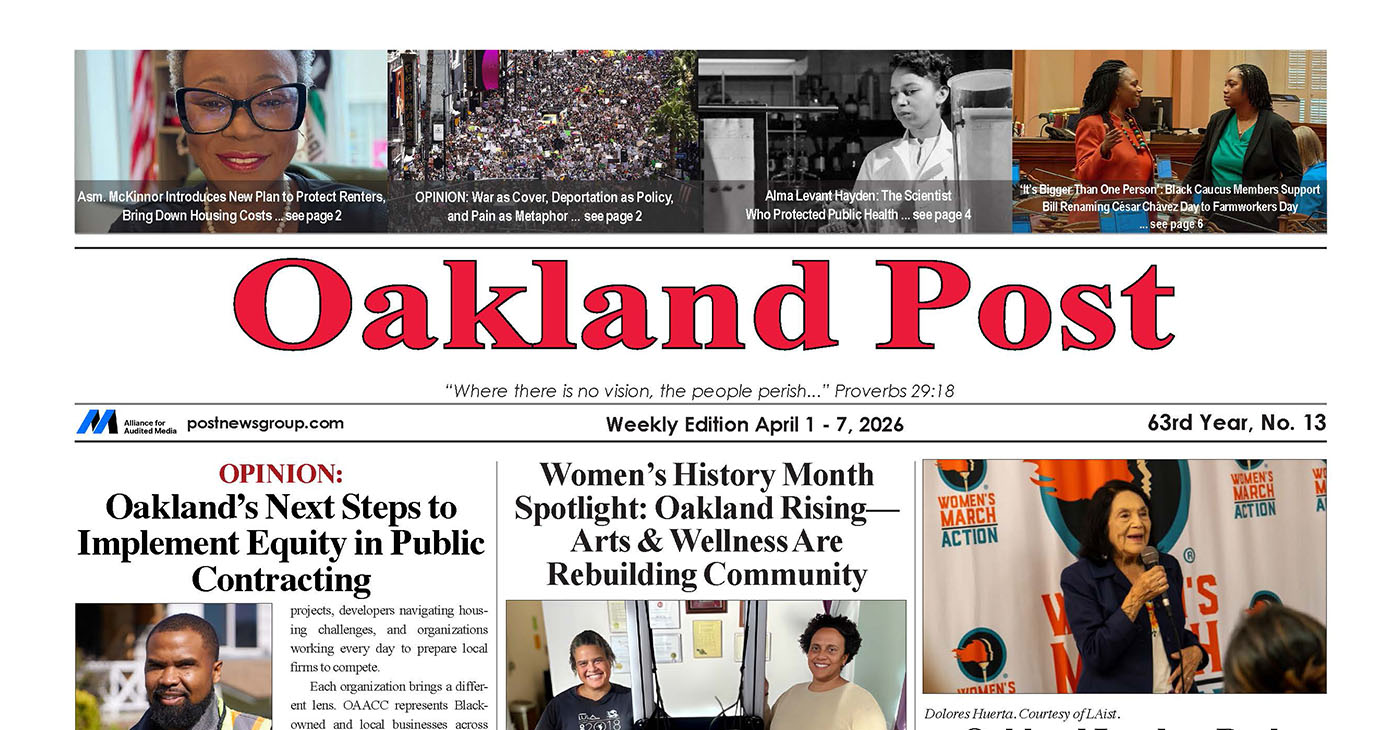
Oakland Post: Week of April 1 – 7, 2026
The printed Weekly Edition of the Oakland Post: Week of April 1 – 7, 2026
To enlarge your view of this issue, use the slider, magnifying glass icon or full page icon in the lower right corner of the browser window.
Activism
Oakland Post: Week of March 18 – 24, 2026
The printed Weekly Edition of the Oakland Post: Week of March 18 – 24, 2026

To enlarge your view of this issue, use the slider, magnifying glass icon or full page icon in the lower right corner of the browser window.
Activism
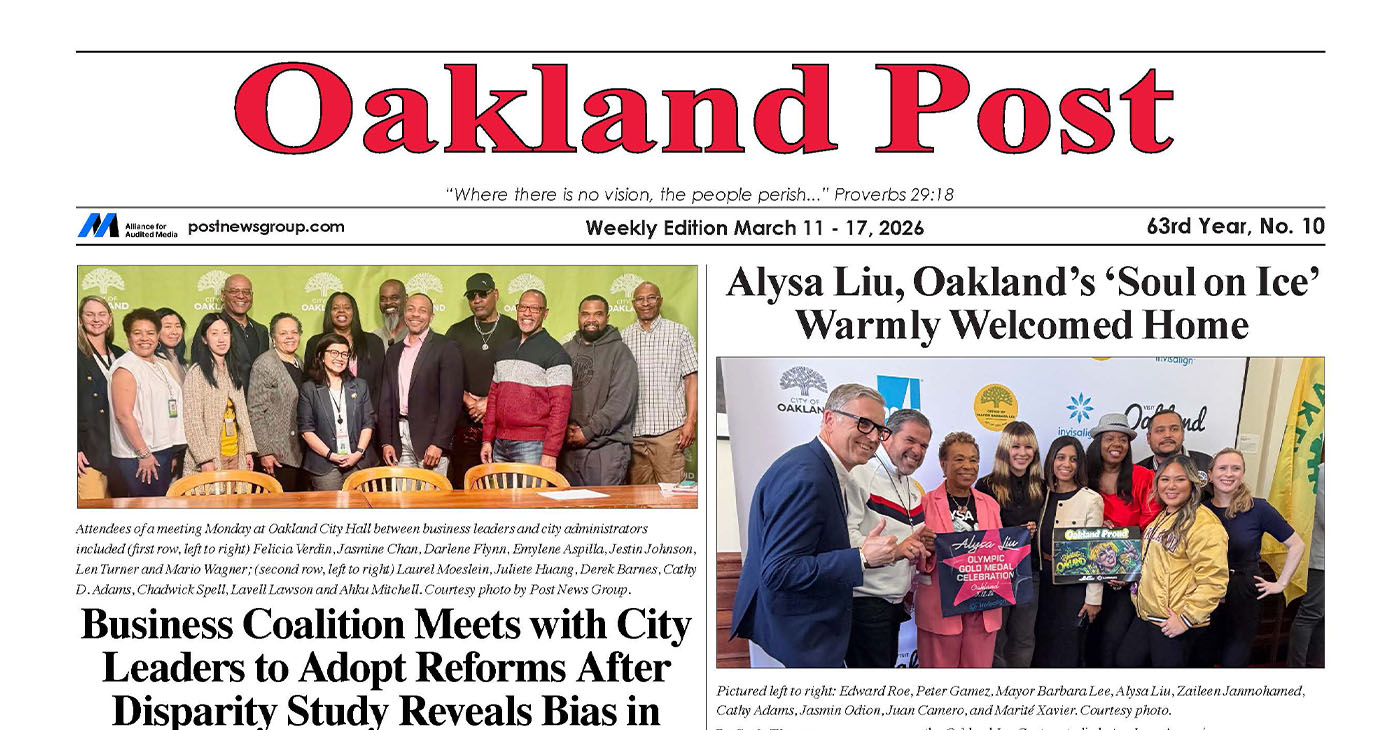
Oakland Post: Week of March 11 -17, 2026
The printed Weekly Edition of the Oakland Post: Week of March 11 – 17, 2026
To enlarge your view of this issue, use the slider, magnifying glass icon or full page icon in the lower right corner of the browser window.

WORK FROM HOME
Home-based business with potential monthly income of $10K+ per month. A proven training system and website provided to maximize business effectiveness. Perfect job to earn side and primary income. Contact Lynne for more details: Lynne4npusa@gmail.com 800-334-0540


Oakland Post: Week of April 1 – 7, 2026

Black Artists in America, Installation Three Wraps at the Dixon Gallery and Gardens

Grief, Advocacy, and Education: A Counselor Reflects on Black Maternal Health

Future of Florida’s Black History Museum in Limbo

New Research Shows the Many Benefits of Early Learning

South Hampton K-8 Students Among Top 10 Finalists for Samsung’s ‘Solve for Tomorrow’ Competition

Cuba: No Negotiation with US on the President or Political System

Brooklyn Academy of Music Names Jamaican-Born Tamara McCaw as President

Trinidad & Tobego – U.S. Launches WhatsApp Channel for American Citizens in the Country

Oakland Post: Week of March 18 – 24, 2026

AI Innovation vs. Ethics and Environmental Impact

AI, Web3, and Digital Reparations

What If You Owned Your AI Agent?

Season 7, Episode 3 – January Reporter’s Roundtable 📱

Season 7, Episode 3 – January Reporter’s Roundtable

Reflecting on Black History Milestones in Birmingham AL

CITY OF SAN LEANDRO STATE OF CALIFORNIA PUBLIC WORKS DEPARTMENT ENGINEERING DIVISION NOTICE TO BIDDERS FOR ANNUAL STREET OVERLAY/REHABILITATION 2019-21 – PHASE III

Oakland Post: Week of February 18 – 24, 2026

Oakland Post: Week of February 25 – March 3, 2026

PRESS ROOM: NBA Hall of Fame Nominee Terry Cummings Joins 100 Black Men of DeKalb County to Launch Victory & Values Initiative

Trump’s MAGA Allies are Creating Executive Order Plan to Steal the 2026 Midterms

Oakland Post: Week of March 4 – 10, 2026

Chase Oakland Community Center Hosts Alley-Oop Accelerator Building Community and Opportunity for Bay Area Entrepreneurs

U.S. manufacturing rebounds – how foundry services are adapting to rising demand

Poll Shows Support for Policies That Help Families Afford Child Care

OP-ED: One Hundred Years of Black Workers Telling the Truth

Advancements in solar technology that are changing the way we power the world

Oakland Post: Week of March 11 -17, 2026

Woman’s Search for Family’s Roots Leads to Ancestor John T. Ward – A Successful Entrepreneur and Conductor on the Underground Railroad

COMMENTARY: Women of Color Shape Our Past and Future

Hyundai Ioniq 5 Parking, Safety, and 360 View #shorts

2025 Ioniq 5 New Wiper & Powerful Performance! #shorts

Electric SUV Range: Is 259 Miles Enough? #shorts

EV Charging: How Fast Can You Charge an Electric Vehicle? #shorts

Biometric Cooling… Messaging Seats…Come on! 2025 Infiniti QX80 Autograph 4WD

Charged Up: Witness the Magic of a Fully Electric Car! #shorts

Range Rover Sport PHEV Included…: See What’s Inside This Luxury SUV! #shorts

Invisible Hood View: Perfect Parking with X-Ray Vision! #shorts

AI Is Reshaping Black Healthcare: Promise, Peril, and the Push for Improved Results in California

ESSAY: Technology and Medicine, a Primary Care Point of View

Sanctuary Cities

The RESISTANCE – FREEDOM NOW

STATE OF THE PEOPLE: Freddie

ECONOMIC BOYCOTT DAY!!!!!

I told You So
-
 Activism4 weeks ago
Oakland Post: Week of March 4 – 10, 2026
-
 #NNPA BlackPress4 weeks ago
Woman’s Search for Family’s Roots Leads to Ancestor John T. Ward – A Successful Entrepreneur and Conductor on the Underground Railroad
-
 Activism3 weeks ago
Oakland Post: Week of March 11 -17, 2026
-
 #NNPA BlackPress4 weeks ago
COMMENTARY: Women of Color Shape Our Past and Future
-

 #NNPA BlackPress4 weeks ago
Advocates Raise Alarm Over ICE Operation, MOU and Detention Risks in Baltimore County
-

 Advice3 weeks ago
Financial Wellness and Mental Health: Managing Money Stress in College
-
 Activism2 weeks ago
Oakland Post: Week of March 18 – 24, 2026
-

 #NNPA BlackPress4 weeks ago
Pete Buttigieg to Join Mayor Randall Woodfin for Community Town Hall in Birmingham
