Connect with us

Bay Area

Sarah Forbes Bonetta: Black and British

Published

on

The year was 1848. A Dahomeyan army of fearless Amazon warriors besieged Oke-Odan, a Nigerian village inhabited by the Egbado. Lives were lost; many were stolen to become slaves. Taken captive during the raid was 5-year-old Sarah Forbes Bonetta (1843–1880), born Aina. Her parents had been decapitated; her siblings slaughtered. Tribal marks on her face marked her status of princess, thus she was taken to the court of the Dahomeyan king, Ghezo, to become a human sacrifice.

Awaiting certain death, Aina was rescued by Captain Frederick Forbes of the Royal Navy. He convinced King Ghezo to give Aina to Queen Victoria, telling him that Queen Victoria would never kill a child and would certainly not respect him if he did so. About Aina, Forbes later wrote in his journal: “She would be a present from the king of the blacks to the queen of the whites.”

Forbes took Aina home to Gravesend, in northwest Kent, England. His wife then baptized Aina with the name Sarah Forbes Bonetta, for his ship, HMS Bonetta. Shortly thereafter, young Bonetta would meet Queen Victoria.

In 1850, Bonetta received an invitation to Windsor Castle, where she impressed the Queen Victoria and other royals. Despite her continuing to live with the Forbes, Bonetta had also become a part of the royal household and was a playmate to the royal prince and princess.

Young Bonetta quickly mastered music, art, and writing. Forbes later described her as a, “perfect genius with an amazing strength of mind and affection.” Queen Victoria, noting Bonetta’s penchant for learning and natural regal manner, raised as her goddaughter in the British middle class. She gave Bonetta an allowance for her welfare and allowed her to become a regular visitor to Windsor Castle.

No stranger to loneliness, Queen Victoria told Bonetta’s story: “Bonetta had been confined in a small space for weeks without human contact, and sometimes witnessed other people being dragged out of confinement to be sacrificed, knowing that it would be her turn one day too.”

She also wrote of her first meeting with Bonetta: “When we came home, found Albert still there, waiting for Captain Forbes and a poor little Negro girl, whom he brought back from the King of Dahomé, her Parents and all her relatives having been sacrificed. Captain Forbes saved her life by asking for her as a present . . . She is seven years old, sharp and intelligent, and speaks English. She was dressed as any other girl. When her bonnet was taken off, her little black woolly head and big earrings gave her the true negro type.”

In 1851, Bonetta developed a chronic cough from Great Britain’s climate and tuberculosis. She was then sent to school in Africa, returning to England in 1855. She later married Captain James Pinson Labulo Davies, a Victorian Lagos businessman.

Bonetta died of tuberculosis in 1880. Davies erected a monument in her memory at Ijon, in Western Lagos, where he had started a cocoa farm.
Tamara Shiloh

Tamara Shiloh


About Tamara Shiloh


Tamara Shiloh has published the first two books in her historical fiction chapter book series, Just Imagine…What If There Were No Black People in the World is about African American inventors, scientists and other notable Black people in history. The two books are Jaxon’s Magical Adventure with Black Inventors and Scientists and Jaxon and Kevin’s Black History Trip Downtown. Tamara Shiloh has also written a book a picture book for Scholastic, Cameron Teaches Black History, that will be available in June, 2022.

Tamara Shiloh’s other writing experiences include: writing the Black History column for the Post Newspaper in the Bay area, Creator and Instruction of the black History Class for Educators a professional development class for teachers and her non-profit offers a free Black History literacy/STEM/Podcast class for kids 3d – 8th grade which also includes the Let’s Go Learn Reading and Essence and tutorial program.   She is also the owner of the Multicultural Bookstore and Gifts, in Richmond, California,

Previously in her early life she was the /Editor-in-Chief of Desert Diamonds Magazine, highlighting the accomplishments of minority women in Nevada; assisting with the creation, design and writing of a Los Angeles-based, herbal magazine entitled Herbal Essence; editorial contribution to Homes of Color; Editor-in-Chief of Black Insight Magazine, the first digital, interactive magazine for African Americans; profile creations for sports figures on the now defunct PublicFigure.com; newsletters for various businesses and organizations; and her own Las Vegas community newsletter, Tween Time News, a monthly publication highlighting music entertainment in the various venues of Las Vegas.

She is a member of:

  • Society of Children’s Book Writers and Illustrators (SCBWI)

  • Richmond Chamber of Commerce

  • Point Richmond Business Association

  • National Association of Professional Women (NAPW)

  • Independent Book Publishers Association (IPBA)

  • California Writers Club-Berkeley & Marin

  • Richmond CA Kiwanis

  • Richmond CA Rotary

  • Bay Area Girls Club


Tamara Shiloh, a native of Northern California, has two adult children, one grandson and four great-grand sons. She resides in Point Richmond, CA with her husband, Ernest.

www.multiculturalbookstore.com

About Tamara Shiloh

Tamara Shiloh has published the first two books in her historical fiction chapter book series, Just Imagine…What If There Were No Black People in the World is about African American inventors, scientists and other notable Black people in history. The two books are Jaxon’s Magical Adventure with Black Inventors and Scientists and Jaxon and Kevin’s Black History Trip Downtown. Tamara Shiloh has also written a book a picture book for Scholastic, Cameron Teaches Black History, that will be available in June, 2022. Tamara Shiloh’s other writing experiences include: writing the Black History column for the Post Newspaper in the Bay area, Creator and Instruction of the black History Class for Educators a professional development class for teachers and her non-profit offers a free Black History literacy/STEM/Podcast class for kids 3d – 8th grade which also includes the Let’s Go Learn Reading and Essence and tutorial program.   She is also the owner of the Multicultural Bookstore and Gifts, in Richmond, California, Previously in her early life she was the /Editor-in-Chief of Desert Diamonds Magazine, highlighting the accomplishments of minority women in Nevada; assisting with the creation, design and writing of a Los Angeles-based, herbal magazine entitled Herbal Essence; editorial contribution to Homes of Color; Editor-in-Chief of Black Insight Magazine, the first digital, interactive magazine for African Americans; profile creations for sports figures on the now defunct PublicFigure.com; newsletters for various businesses and organizations; and her own Las Vegas community newsletter, Tween Time News, a monthly publication highlighting music entertainment in the various venues of Las Vegas. She is a member of:
  • Society of Children’s Book Writers and Illustrators (SCBWI)
  • Richmond Chamber of Commerce
  • Point Richmond Business Association
  • National Association of Professional Women (NAPW)
  • Independent Book Publishers Association (IPBA)
  • California Writers Club-Berkeley & Marin
  • Richmond CA Kiwanis
  • Richmond CA Rotary
  • Bay Area Girls Club
Tamara Shiloh, a native of Northern California, has two adult children, one grandson and four great-grand sons. She resides in Point Richmond, CA with her husband, Ernest. www.multiculturalbookstore.com

Activism

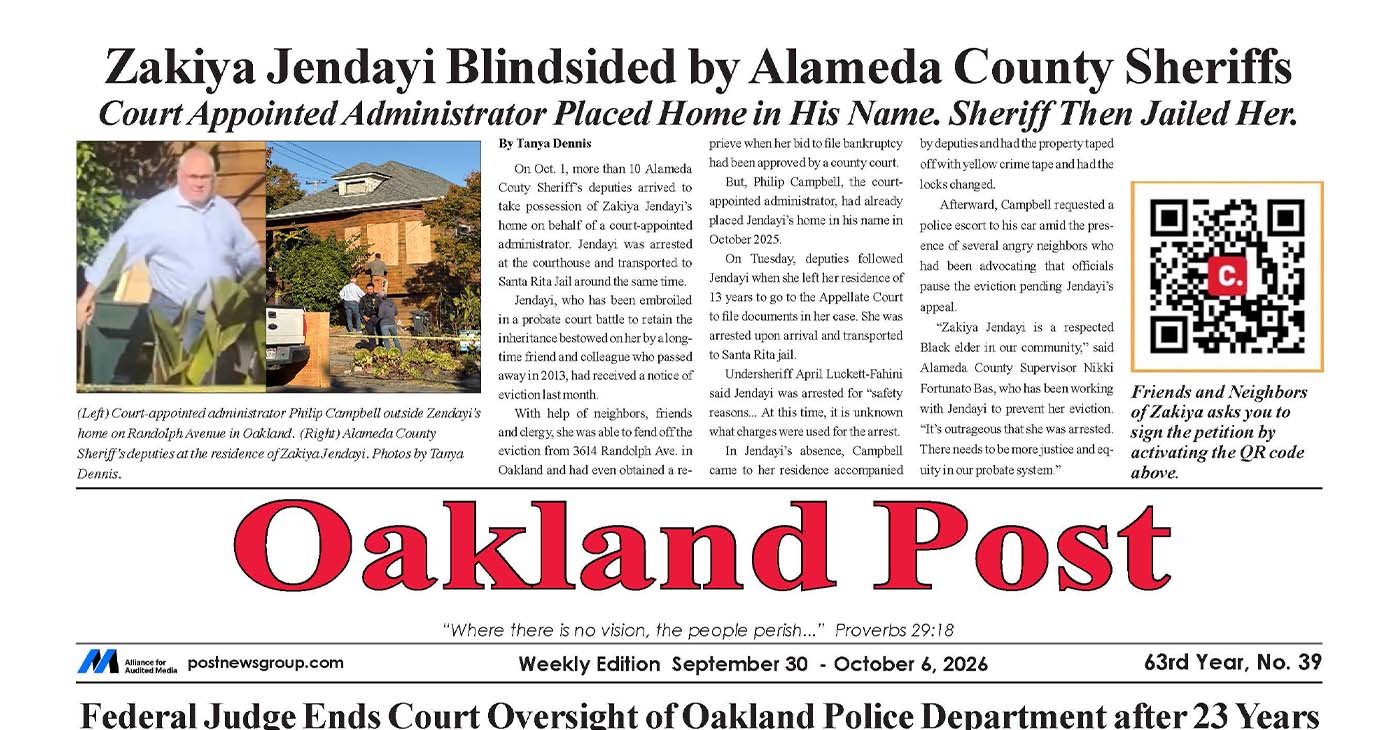
Oakland Post: Week of November 5 – 11, 2025

The printed Weekly Edition of the Oakland Post: Week of November 5 – 11, 2025

Published

on

To enlarge your view of this issue, use the slider, magnifying glass icon or full page icon in the lower right corner of the browser window.

Continue Reading

Activism

Oakland Post: Week of October 29 – November 4, 2025

The printed Weekly Edition of the Oakland Post: Week of October 29 – November 4, 2025

Published

on

To enlarge your view of this issue, use the slider, magnifying glass icon or full page icon in the lower right corner of the browser window.

Continue Reading

Activism

Past, Present, Possible! Oakland Residents Invited to Reimagine the 980 Freeway

Organizers ask attendees coming to 1233 Preservation Park Way to think of the event as a “time portal”—a walkable journey through the Past (harm and flourishing), Present (community conditions and resilience), and Future (collective visioning).

Published

on

Hundreds of residents in West Oakland were forced out by eminent domain before construction began on the 980 freeway in 1968. Courtesy photo.

By Randolph Belle
Special to The Post

Join EVOAK!, a nonprofit addressing the historical harm to West Oakland since construction of the 980 freeway began in 1968, will hold  a block party on Oct. 25 at Preservation Park for a day of imagination and community-building from 10 a.m. to 4 p.m.

Organizers ask attendees coming to 1233 Preservation Park Way to think of the event as a “time portal”—a walkable journey through the Past (harm and flourishing), Present (community conditions and resilience), and Future (collective visioning).

Activities include:

  • Interactive Visioning: Site mapping, 3-D/digital modeling, and design activities to reimagine housing, parks, culture, enterprise, and mobility.
  • Story & Memory: Oral history circles capturing life before the freeway, the rupture it caused, and visions for repair.
  • Data & Policy: Exhibits on health, environment, wealth impacts, and policy discussions.
  • Culture & Reflection: Films, installations, and performances honoring Oakland’s creativity and civic power.

The site of the party – Preservation Park – itself tells part of the story of the impact on the community. Its stately Victorians were uprooted and relocated to the site decades ago to make way for the I-980 freeway, which displaced hundreds of Black families and severed the heart of West Oakland. Now, in that same space, attendees will gather to reckon with past harms, honor the resilience that carried the community forward, and co-create an equitable and inclusive future.

A Legacy of Resistance

In 1979, Paul Cobb, publisher of the Post News Group and then a 36-year-old civil-rights organizer, defiantly planted himself in front of a bulldozer on Brush Street to prevent another historic Victorian home from being flattened for the long-delayed I-980 Freeway. Refusing to move, Cobb was arrested and hauled off in handcuffs—a moment that landed him on the front page of the Oakland Tribune.

Cobb and his family had a long history of fighting for their community, particularly around infrastructure projects in West Oakland. In 1954, his family was part of an NAACP lawsuit challenging the U.S. Post Office’s decision to place its main facility in the neighborhood, which wiped out an entire community of Black residents.

In 1964, they opposed the BART line down Seventh Street—the “Harlem of the West.” Later, Cobb was deeply involved in successfully rerouting the Cypress Freeway out of the neighborhood after the Loma Prieta earthquake.

The 980 Freeway, a 1.6-mile stretch, created an ominous barrier severing West Oakland from Downtown. Opposition stemmed from its very existence and the national practice of plowing freeways through Black communities with little input from residents and no regard for health, economic, or social impacts. By the time Cobb stood before the bulldozer, construction was inevitable, and his fight shifted toward jobs and economic opportunity.

Fast-forward 45 years: Cobb recalled the story at a convening of “Super OGs” organized to gather input from legacy residents on reimagining the corridor. He quickly retrieved his framed Tribune front page, adding a new dimension to the conversation about the dedication required to make change. Themes of harm repair and restoration surfaced again and again, grounded in memories of a thriving, cohesive Black neighborhood before the freeway.

The Lasting Scar

The 980 Freeway was touted as a road to prosperity—funneling economic opportunity into the City Center, igniting downtown commerce, and creating jobs. Instead, it cut a gash through the city, erasing 503 homes, four churches, 22 businesses, and hundreds of dreams. A promised second approach to the Bay Bridge never materialized.

Planning began in the late 1940s, bulldozers arrived in 1968, and after years of delays and opposition, the freeway opened in 1985. By then, Oakland’s economic engines had shifted, leaving behind a 600-foot-wide wound that resulted in fewer jobs, poorer health outcomes, and a divided neighborhood. The harm of displacement and loss of generational wealth was compounded through redlining, disinvestment, drugs, and the police state. Many residents fled to outlying cities, while those who stayed carried forward the spirit of perseverance.

The Big Picture

At stake now is up to 67 acres of new, buildable land in Downtown West Oakland. This time, we must not repeat the institutional wrongs of the past. Instead, we must be as deliberate in building a collective, equitable vision as planners once were in destroying communities.

EVOAK!’s strategy is rooted in four pillars: health, housing, economic development, and cultural preservation. These were the very foundations stripped away, and they are what  they aim to reclaim. West Oakland continues to suffer among the worst social determinants of health in the region, much of it linked to the three freeways cutting through the neighborhood.

The harms of urban planning also decimated cultural life, reinforced oppressive public safety policies, underfunded education, and fueled poverty and blight.

Healing the Wound

West Oakland was once the center of Black culture during the Great Migration—the birthplace of the Black Panther Party and home to the “School of Champions,” the mighty Warriors of McClymonds High. Drawing on that legacy, we must channel the community’s proud past into a bold, community-led future that restores connection, sparks innovation, and uplifts every resident.

Two years ago, Caltrans won a federal Reconnecting Communities grant to fund Vision 980, a community-driven study co-led by local partners. Phase 1 launched in Spring 2024 with surveys and outreach; Phase 2, a feasibility study, begins in 2026. Over 4,000 surveys have already been completed. This once-in-a-lifetime opportunity could transform the corridor into a blank slate—making way for accessible housing, open space, cultural facilities, and economic opportunity for West Oakland and the entire region.

Leading with Community

In parallel, EVOAK! is advancing a community-led process to complement Caltrans’ work. EVOAK! is developing a framework for community power-building, quantifying harm, exploring policy and legislative repair strategies, structuring community governance, and hosting arts activations to spark collective imagination. The goal: a spirit of co-creation and true collaboration.

What EVOAK! Learned So Far

Through surveys, interviews, and gatherings, residents have voiced their priorities: a healthy environment, stable housing, and opportunities to thrive. Elders with decades in the neighborhood shared stories of resilience, community bonds, and visions of what repair should look like.

They heard from folks like Ezra Payton, whose family home was destroyed at Eighth and Brush streets; Ernestine Nettles, still a pillar of civic life and activism; Tom Bowden, a blues man who performed on Seventh Street as a child 70 years ago; Queen Thurston, whose family moved to West Oakland in 1942; Leo Bazille who served on the Oakland City Council from 1983 to 1993; Herman Brown, still organizing in the community today; Greg Bridges, whose family’s home was picked up and moved in the construction process; Martha Carpenter Peterson, who has a vivid memory of better times in West Oakland; Sharon Graves, who experienced both the challenges and the triumphs of the neighborhood; Lionel Wilson, Jr., whose family were anchors of pre-freeway North Oakland; Dorothy Lazard, a resident of 13th Street in the ’60s and font of historical knowledge; Bishop Henry Williams, whose simple request is to “tell the truth,” James Moree, affectionately known as “Jimmy”; the Flippin twins, still anchored in the community; and Maxine Ussery, whose father was a business and land owner before redlining.

EVOAK! will continue to capture these stories and invites the public to share theirs as well.

Beyond the Block Party

The 980 Block Party is just the beginning. Beyond this one-day event, EVOAK! Is  building a long-term process to ensure West Oakland’s future is shaped by those who lived its past. To succeed, EVOAK! Is seeking partners across the community—residents, neighborhood associations, faith groups, and organizations—to help connect with legacy residents and host conversations.

980 Block Party Event Details
Saturday, Oct. 25
10 a.m. – 4 p.m.
Preservation Park, 1233 Preservation Park Way, Oakland, CA 94612
980BlockParty.org
info@evoak.org

Continue Reading

Subscribe to receive news and updates from the Oakland Post

* indicates required

CHECK OUT THE LATEST ISSUE OF THE OAKLAND POST

ADVERTISEMENT

WORK FROM HOME

Home-based business with potential monthly income of $10K+ per month. A proven training system and website provided to maximize business effectiveness. Perfect job to earn side and primary income. Contact Lynne for more details: Lynne4npusa@gmail.com 800-334-0540

Facebook

Trending

Copyright ©2021 Post News Group, Inc. All Rights Reserved.