
Health
Black Women Endure Menopause Longest


By Elaina Johnson
Special to the NNPA from Howard University News Service
WASHINGTON (NNPA) – Sarah Finney, 57, said she gets hot flashes throughout her body at least once an hour. She even wakes up in the night with so much perspiration that she looks like she just left working out at a gym, she said.
“Hot flashes are very annoying,” said Finney, a married mother of two who declined to use her real name. “A surge of heat goes through my body, sometimes accompanied by nausea. As the energy builds, I begin to sweat from my hair, neck, chest and underarms.”
Finney, a vegetarian, said she hoped eating healthy and her intense daily routines as a marathon runner would alleviate the symptoms, but no luck.
Finney, who lives in Alexandria, Va., is experiencing the results of menopause, a natural decline in reproductive hormones that affects millions of woman annually when they reach their 40s or 50s.
For women going through menopause, just one day of hot flashes can be too much. Imagine 14 years. A new study published in JAMA Internal Medicine, a medical journal of the American Medical Association, found that women could experience hot flashes for up to 14 years, and that African-American women like Finney typically experience the symptoms longer.

Finney has been going through it for 10 years.
The 17-year study of 1,449 women across the U.S. found that while on average, the women endured the symptoms for about seven and a half years, Black and Hispanic women experience hot flashes for significantly longer than White or Asian women. The median was 10 years for African Americans, nearly nine years for Hispanics, six and a half years for White women, about five and a half years for Chinese and nearly five years for Japanese.
“This is the only study that has looked at a very diverse population, ”said Dr. Ranit Mishori, associate professor of Family Medicine at the Georgetown University School of Medicine.
“No one knows for sure why African-American women are at risk for a longer duration of hot flashes. There could be a relationship between hormone levels, genetic differences, body mass index, the number of children you have or the age you began having children.”
Though the study’s results may not give the quick relief women hoped for, but it allows doctors and medical professional to give patients realistic expectations and find ways to help alleviate the hot flashes.
“This is not a fun thing for the doctor or the patient to realize,” Mishori said. “However, there are ways to manage the symptoms including hormone replacement therapy.”
Hormone replacement therapy is medication containing female hormones to replace the ones the woman’s body no longer makes after menopause.
This method can be a good choice for certain women, depending on their health risk, Mishori said. Women who consume estrogen pills are alleviated from hot flashes and other symptoms of menopause, she said.
The down side is that hormone therapy has been linked to increased risk of breast cancer, stroke and heart disease for some women.
Lifestyle changes, such as diet and exercise, may help some women, health officials said, and there are also non-hormonal medication and supplements that can help. These things may not shorten the duration of hot flashes, but it may lessen the affect and intensity of them.
If the symptoms are unbearable, health officials suggest you consult with your doctor.
Finney said she is resigned to the day-to-day struggle with the condition.
“Menopause is just something we have to deal with as women,” she said. “We all must continue to move forward. This is a part of life.”
###









Activism
Essay: Intentional Self Care and Community Connections Can Improve Our Wellbeing
At the deepest and also most expansive level of reality, we are all part of the same being, our bodies made from the minerals of the earth, our spirits infused by the spiritual breath that animates the universe. Willingness to move more deeply into fear and pain is the first step toward moving into a larger consciousness. Willingness to move beyond the delusion of our separateness can show us new ways of working and living together.

By Dr. Lorraine Bonner, Special to California Black Media Partners
I went to a medical school that was steeped in the principles of classical Western medicine. However, I also learned mindfulness meditation during that time, which opened me to the multifaceted relationship between illnesses and the interconnecting environmental, mental and emotional realities that can impact an individual’s health.
Therefore, when I began to practice medicine, I also pursued training in hypnosis, relaxation techniques, meditation, and guided imagery, to bring a mind-body focus to my work in medical care and prevention.
The people I saw in my practice had a mix of problems, including high blood pressure, diabetes, and a variety of pain issues. I taught almost everyone relaxation breathing and made some general relaxation tapes. To anyone willing, I offered guided imagery.
“My work embraced an approach to wellness I call “Liberatory Health” — one that not only addresses the treatment and management of disease symptoms but also seeks to dismantle the conditions that make people sick in the first place.”
From my perspective, illness is only the outermost manifestation of our efforts to cope, often fueled by addictions such as sugar, tobacco, or alcohol, shackled by an individualistic cult belief that we have only ourselves to blame for our suffering.
At the deepest and also most expansive level of reality, we are all part of the same being, our bodies made from the minerals of the earth, our spirits infused by the spiritual breath that animates the universe. Willingness to move more deeply into fear and pain is the first step toward moving into a larger consciousness. Willingness to move beyond the delusion of our separateness can show us new ways of working and living together.
To put these ideas into practical form, I would quote the immortal Mr. Rogers: “Find the helpers.” There are already people in every community working for liberation. Some of them are running for office, others are giving food to those who need it. Some are volunteering in schools, libraries or hospitals. Some are studying liberation movements, or are working in urban or community gardens, or learning to practice restorative and transformative justice, or creating liberation art, music, dance, theater or writing. Some are mentoring high schoolers or apprenticing young people in a trade. There are many places where compassionate humans are finding other humans and working together for a better world.
A more compassionate world is possible, one in which we will all enjoy better health. Creating it will make us healthier, too.
In community, we are strong. Recognizing denial and overcoming the fragmenting effects of spiritual disorder offer us a path to liberation and true health.
Good health and well-being are the collective rights of all people!
About the Author
Dr. Lorraine Bonner is a retired physician. She is also a sculptor who works in clay, exploring issues of trust, trustworthiness and exploitation, as well as visions of a better world.
Activism
Prescribing Prevention: Doctors Turn to Lifestyle, Herbs and Veggies to Protect Against Chronic Illness in Black Californians

By Charlene Muhammad, California Black Media
Leibo Glover received his diabetes diagnosis at the same time he found out he needed a below-the-knee amputation.
“Minor,” thought the 63-year-old.
Glover had been self-medicating a toe injury before seeing the doctor.
But while driving from South Los Angeles to Miami on a family trip, an infection set in.
“I had it but didn’t know,” said Glover. “I was just going to come back to California, but they told me if I had left, I would have come home as a corpse,” Glover told California Black Media (CBM).
A majority of the nearly 3.5 million Californians diagnosed with diabetes have preventable Type 2 diabetes, according to researchers at the UCLA Center for Health Policy Research.
In 2023, diabetes was diagnosed in 1 in 6 adults with the lowest incomes (16.7% at 0–99% of the federal poverty line), compared to 1 in 11 adults with the highest incomes (8.9% at 300% or more of the federal poverty line). Age is a factor, too: more than 1 in 5 older adults age 65 and over (22.3%) had diabetes, about twice the rate of adults age 18–64 (8.6%).
Another study by Health Economics and Evaluation Research (HEER) mapped patients with diabetes in California who had amputations. Researchers found that patients living in low-income ZIP codes were far more likely to have had lower-limb amputations than those in higher-income ZIP codes, essentially identifying amputation “hot spots.”
At the time of Glover’s 2018 diagnosis, he was experiencing housing instability and going through financial hardships. Now, he has more stable housing and he has improved his health through lifestyle changes like eating healthier and getting more sleep.
“If the equipment is right, I can stand on my leg for hours. I can actually run, jump, dance and all of that,” said Glover, who got his diabetes under control, in part, by avoiding carbohydrates and sugars.
As chronic illnesses continue to disproportionately impact Black Californians — often leading to preventable amputations and premature deaths — a growing number of doctors and advocates are expanding their care from just treatment to including prevention. From promoting diet and lifestyle changes to cultivating community farms focused on prevention and wellness like Dr. Bill Releford’s Bloom Ranch in Acton.
Releford, a podiatrist based in Los Angeles started the 250-acre Bloom Ranch in 2023 as part of his strategy for preventive care.
“This is my assignment,” said Releford.
“Bloom Ranch has been a perfect backdrop for me to be creative and to find avant-garde ways to make fresh fruits and vegetables more accessible to food deserts in Los Angeles County,” he stated.
California produces nearly half of the nation’s fruits and vegetables, yet more than 1 in 5 Californians — about 8.8 million people — currently struggle with food insecurity, according to the California Association of Food Banks.
“Studies have shown that 75% of amputations are preventable. And African Americans have the highest amputation rate in the nation,” Releford said.
As such, Releford continued, the mortality rate associated with high-level amputation is 50%, which means “if we had 10 people that all had high level amputations, five of those would be deceased in three years.”
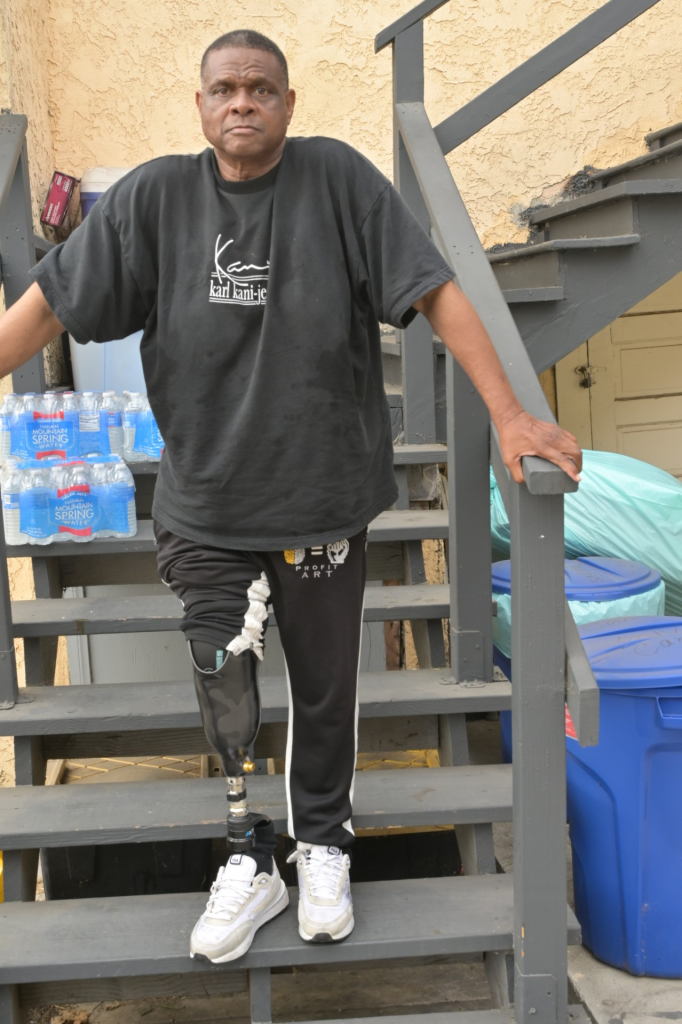
Monday, June 28, 2025. Leibo Glover at his home in Los Angeles, California. The security professional’s leg was amputated below the knee.
Releford’s ranch is the largest Black-owned farm in L.A. County. He plans to partner with UCLA and the Charles R. Drew University of Medicine and Science to develop prescriptive vegetable boxes.
“Certain vegetables and herbs can lower blood pressure naturally, like beets, turnips, dill, basil, garlic and others,” said Releford.
“Hopefully, this will inspire other farmers to take this model and replicate it across other urban areas,” Releford added.
“A lot of studies have shown that gardening has so many health benefits – being in the sun, Vitamin D,” said Releford. “The dirt has a lot of microbes that are good for your immune system. Studies have shown that people who work in the dirt have strong immune systems.”
Gardening can potentially decrease the risk of dementia, enhance cognition, reduce stress, and boost immunity, indicates research by Genoa Barrow of the University of Southern California Center for Health Journalism as part of the 2024 Ethnic Media Collaborative, Healing California.
During a recent picturesque day at Bloom Ranch, families, school children, farmers and members of The Ultimate Book Club 1998, founded by Alina Anderson, sampled and purchased fresh produce while taking photographs.
“This is huge. “All of us have families that could use this information,” said Anderson.
Doctors like Releford, who are committed to tackling the most chronic diseases impacting all their patients utilize peer-to-peer support programs with self-management training led by individuals living with chronic conditions to provide role models and support for patients, according to a recent study by the California Health Care Foundation.
“The unifying feature of these programs is that they seek to build on the strengths, knowledge, and experience that peers can offer,” the report states.
Liz Helms, CEO of the California Chronic Care Coalition, addressed state-backed prevention policy and initiatives.
“It’s in horrible shape. It needs to get so much better, especially in underserved areas, where the Black population has a whole set of different needs,” she said.
Helms, who started advocacy after being denied access to care in the early 1990s, applauded new developments in telehealth. The opportunity to choose between visiting a doctor’s office or placing a phone call makes a difference, especially if there are transportation or distance issues, or if one is too sick, she said.
Fear is one thing people, especially in the Black community, must overcome, emphasized Helms.
“I had to get over my fear of going to the doctor, of not speaking up,” continued Helms, urging patients to “understand the baseline” of their health.
“Don’t let anyone stigmatize you or tell you that you’re not good enough to get care or look down on you. Everyone has a right to good, quality, affordable, timely health care,” said Helms.
To engage Bloom Ranch for preventive care focused on wellbeing and healthy living, call (323) 388-4828 or sign up at Bloomranchofacton.com
Activism
A West Coast CDC? California Partners With Oregon, Washington and Hawaii to Form Regional Health Alliance
“President Trump’s mass firing of CDC doctors and scientists — and his blatant politicization of the agency — is a direct assault on the health and safety of the American people. California, Oregon, and Washington will not allow the people of our states to be put at risk,” said Governors Gavin Newsom, Tina Kotek, and Bob Ferguson in a joint statement.

By Bo Tefu, California Black Media
California, Oregon, and Washington have launched the West Coast Health Alliance, a regional initiative to provide unified, science-based guidance on immunizations and other public health policies. The alliance was created in response to federal actions that have undermined the independence of the Centers for Disease Control (CDC) and raised concerns about the politicization of science.
The alliance aims to ensure residents receive credible, evidence-based recommendations, free from political interference.
“President Trump’s mass firing of CDC doctors and scientists — and his blatant politicization of the agency — is a direct assault on the health and safety of the American people. California, Oregon, and Washington will not allow the people of our states to be put at risk,” said Governors Gavin Newsom, Tina Kotek, and Bob Ferguson in a joint statement.
State health leaders emphasized the importance of transparency and evidence-based communication.
California Department of Public Health Director Erica Pan said, “The dismantling of public health and dismissal of experienced and respected health leaders and advisors, along with the lack of using science, data, and evidence to improve our nation’s health are placing lives at risk.”
Oregon Health Authority Director Sejal Hathi backed the coalition saying, “Our communities deserve clear and transparent communication about vaccines — communication grounded in science, not ideology.” Washington State Secretary of Health Dennis Worsham noted, “Public health at its core is about prevention — preventing illness, preventing the spread of disease, and preventing early, avoidable deaths.”
Hawaii has joined the alliance, expanding the partnership to four states. “Hawaii is proud to stand with our West Coast partners to ensure public health decisions are grounded in science, not politics,” said Gov. Josh Green.
The alliance states will coordinate health guidelines using trusted national medical organizations, aligning immunization recommendations and public health strategies while respecting tribal sovereignty. Shared principles to strengthen public confidence in vaccines and other health measures will be finalized in the coming weeks.

WORK FROM HOME
Home-based business with potential monthly income of $10K+ per month. A proven training system and website provided to maximize business effectiveness. Perfect job to earn side and primary income. Contact Lynne for more details: Lynne4npusa@gmail.com 800-334-0540


Seth Curry Makes Impressive Debut with the Golden State Warriors

LIHEAP Funds Released After Weeks of Delay as States and the District Rush to Protect Households from the Cold

Seven Steps to Help Your Child Build Meaningful Connections

Seven Steps to Help Your Child Build Meaningful Connections

Teens Reject Today’s News as Trump Intensifies His Assault on the Press

Thanksgiving Celebrated Across the Tri-State

Breaking the Silence: Black Veterans Speak Out on PTSD and the Path to Recovery

Trinidad and Tobago – Prime Minister Confirms U.S. Marines Working on Tobago Radar System

‘Tis the Season: Festive Holiday Pop-ups Happening Around Atlanta

IN MEMORIAM: Mardelle Walker, 101

Oakland Post: Week of November 26 – December 2, 2025

‘Targeted’ Shooting of Two National Guardsmen Blocks From the White House

Meet Roxanne Brown, The First African American And The First Woman President Of The United Steelworkers

Tax Refunds Expected to Rise by About $1,000 Next Year

CFP Rankings: Top Five Remains Unchanged; Major Decision Looms for Lane Kiffin

A Call to Save Liberty Hall: Oakland’s Beacon of Black Heritage Faces an Uncertain Future

Port of Oakland September Cargo Volumes Dip Amid Shifting Trade Patterns

Oakland Post: Week of October 22 – 28, 2025

Prescribing Prevention: Doctors Turn to Lifestyle, Herbs and Veggies to Protect Against Chronic Illness in Black Californians

Oakland School Board Proposes Budget Solutions to Avoid State or County Takeover

Mayor Lee Responds to OPD Chief Floyd Mitchell’s Decision to Resign

Past, Present, Possible! Oakland Residents Invited to Reimagine the 980 Freeway

Oakland Post: Week of October 29 – November 4, 2025

Man Arrested for Making Death Threats Against Mayor Barbara Lee

Essay: Intentional Self Care and Community Connections Can Improve Our Wellbeing

Oakland Post: Week of November 12 – 18, 2025

Oakland Post: Week of November 5 – 11, 2025

IN MEMORIAM: William ‘Bill’ Patterson, 94

How Charles R. Drew University Navigated More Than $20 Million in Fed Cuts – Still Prioritizing Students and Community Health

MLK Way at 57th Street in Oakland Renamed Bobby Seale Way for Black Panther Co-Founder

Hyundai Ioniq 5 Parking, Safety, and 360 View #shorts

2025 Ioniq 5 New Wiper & Powerful Performance! #shorts

Electric SUV Range: Is 259 Miles Enough? #shorts

EV Charging: How Fast Can You Charge an Electric Vehicle? #shorts

Biometric Cooling… Messaging Seats…Come on! 2025 Infiniti QX80 Autograph 4WD

Charged Up: Witness the Magic of a Fully Electric Car! #shorts

Range Rover Sport PHEV Included…: See What’s Inside This Luxury SUV! #shorts

Invisible Hood View: Perfect Parking with X-Ray Vision! #shorts

AI Is Reshaping Black Healthcare: Promise, Peril, and the Push for Improved Results in California

ESSAY: Technology and Medicine, a Primary Care Point of View

Sanctuary Cities

The RESISTANCE – FREEDOM NOW

STATE OF THE PEOPLE: Freddie

ECONOMIC BOYCOTT DAY!!!!!

I told You So
-
 Activism3 weeks ago
Oakland Post: Week of November 12 – 18, 2025
-
 Activism3 weeks ago
IN MEMORIAM: William ‘Bill’ Patterson, 94
-
 Activism3 weeks ago
How Charles R. Drew University Navigated More Than $20 Million in Fed Cuts – Still Prioritizing Students and Community Health
-

 Bay Area3 weeks ago
No Justice in the Justice System
-

 #NNPA BlackPress3 weeks ago
Lewis Hamilton set to start LAST in Saturday Night’s Las Vegas Grand Prix
-

 #NNPA BlackPress2 weeks ago
Beyoncé and Jay-Z make rare public appearance with Lewis Hamilton at Las Vegas Grand Prix
-

 Activism2 weeks ago
Oakland Post: Week of November 19 – 25, 2025
-

 #NNPA BlackPress4 weeks ago
The Perfumed Hand of Hypocrisy: Trump Hosted Former Terror Suspect While America Condemns a Muslim Mayor
